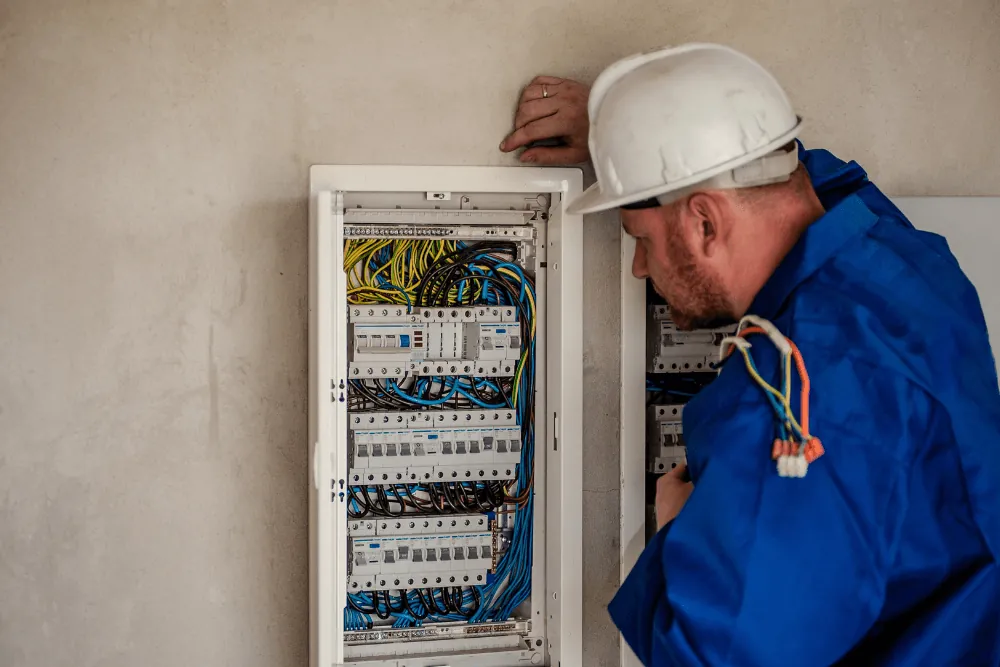
DB Box and Distribution Board Installation in Dubai: Electrical Panel, Breaker Box, Sub Panel, Isolator, Changeover Switch and Switchgear for Homes and Businesses
A distribution board is the part of a building where the supply is split into circuits, each with its own protection, so it decides how safely every socket, light, air conditioner and water heater behind it works. Distribution board installation, a new breaker box, a sub panel for an extension, an isolator or a changeover switch all come down to one question: does this board suit the load, the cables and the fault current at this point? We answer it with a load schedule and a test before we price, and we leave a labelled board and a record of the readings behind.
Circuit Dubai installs, replaces, upgrades and repairs DB boxes, electrical panels, sub panels and switchboards for villas, apartments, offices, shops and warehouses across Dubai. That covers a main electrical panel for a new build, a full or rusty fuse box that needs changing, a sub distribution board for an extension or a workshop, isolators and changeover switches for generators and air conditioners, and the testing and maintenance of larger switchgear. Searches that reach this page use American and British names such as breaker box, panel upgrade and consumer unit, so the terms section matches each name to its Dubai equivalent.
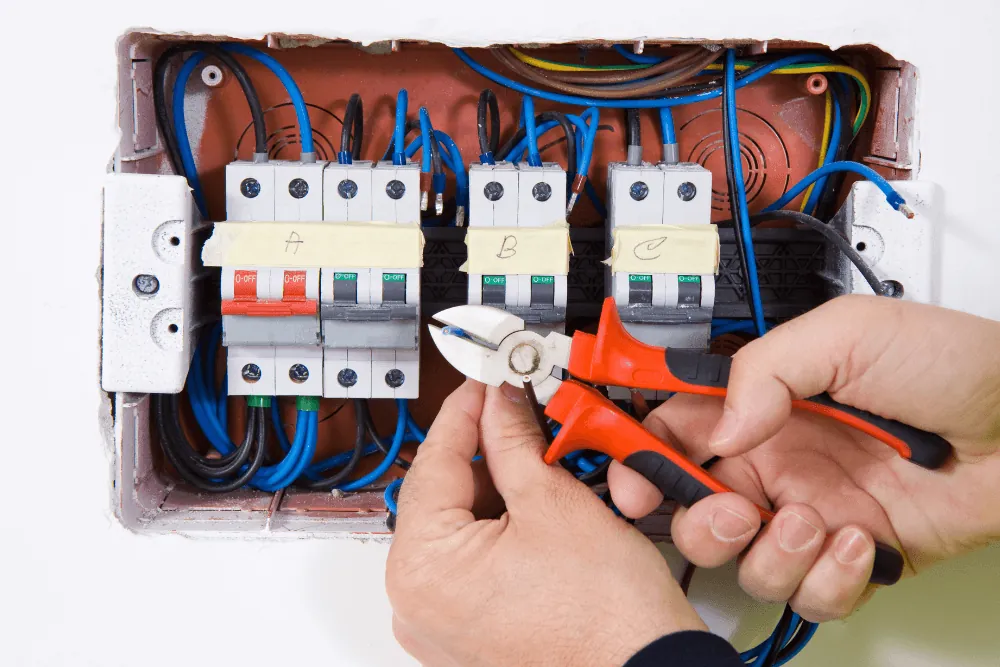
What DB box and distribution board work with us includes
A load check first, with the connected load, the spare ways and the incoming cable looked at before a board size is chosen.
Boards that suit Dubai rules, factory-built to IEC 61439 where DEWA's regulations call for it, with an incoming isolator, copper bars and no rewirable fuses.
New boards, replacements and upgrades, from a fuse box swap to a sub distribution board for an extension.
Isolators, changeover switches and generator, solar or inverter connections wired to the board with the interlocks the rules require.
Testing and labelling, with insulation, continuity and RCD tests, a circuit schedule in the door and a record of the readings.
Larger panels and switchgear, including busbar work, low-voltage panel service and thermal scanning, with medium and high-voltage switchgear handed to specialists.
The numbers at a glance
Typical answer for Dubai
Before you book DB box and distribution board work, open the board door and photograph it without removing anything: the whole board, the main breaker label and a close-up of any device that is hot, scorched or rusty. Count the circuits and note which ways are spare. Write down what you want to add, such as an air conditioner, an EV charger, solar or a workshop. Do not open the cover behind the devices, do not add a breaker to a full board and do not tape a lever on. If the board is hot, buzzing or smells of burning, switch off at the main if it is safe to reach and message us on WhatsApp.
Distribution board, breaker box, panel and switchgear terms: what people search for and what each means
The same grey box on the wall is called a DB box, a distribution board, an electrical panel, a breaker box, a fuse box, a consumer unit or a switchboard, depending on who is asking and where they learned the word. DEWA's regulations use three names: the MDB (main distribution board), the SMDB (sub main distribution board) and the DB (the final distribution board that feeds sockets and lights). The tables below match each search to the work behind it, so you can go straight to the part of this page that fits. Where a term is something we do not do, the table says so.
The board itself
| If you searched | What it means |
|---|---|
| Distribution board installation, db box wiring, wiring db board, house wiring db box, house wiring distribution board, switchboard installation | Fitting a new board and wiring every circuit into it, from the incoming cable to each outgoing breaker. The installation section covers the steps |
| Electrical panel, electric panel board, electrical panel box, main electrical panel | The American and trade names for the main board where the supply enters a building. In Dubai this is the MDB or the DB, depending on the size of the building |
| Electric fuse box, fuse box installation, changing a fuse board, fuse board change, replace a fuse in fuse box | An older board built around fuses. DEWA's regulations do not permit rewirable fuses in any wiring installation, so a fuse board is replaced with breakers and not rewired. The when to replace section sets out the signs |
| Fuse box repair, fuse box repair near me, fix fuse box | A fuse board that has failed, burned or lost its cover. We repair what is sound and replace what is not, and the testing section says how we decide |
| Fuse box outside house | The cabinet on an outside wall or at the boundary that holds the meter and the incoming supply. The supply authority's own equipment in it is not ours to open. The consumer's board and any outdoor distribution board are |
| Electric breaker box, breaker box installation, breaker box wiring, home breaker box wiring, breaker panel installation, installing new breaker box, installing a new breaker panel | American names for a board of circuit breakers. The work is the same as a DB installation, with Dubai's 230 V and 400 V supply |
| Replace breaker box, replacing a breaker panel, change electrical panel, replace electrical panel, install new electrical panel | Taking out an old board and fitting a new one, with every circuit moved across and tested |
| Upgrade electrical panel, panel upgrade, house electrical panel upgrade, electrical panel upgrade near me, electrical switchboard upgrade, switchboard upgrade | A new board with more ways, a bigger main or modern protection. The sizing section shows how we decide how much bigger |
| Wiring into breaker box, add circuit to breaker box | Adding one or more circuits to an existing board. The sub panels section explains when a spare way is enough and when it is not |
| Home switchboard wiring, house wiring switchboard, switchboard repair, switchboard maintenance, panel board work, panel board maintenance, electrical panel work | The same boards under the word switchboard or panel board, for repair, servicing and rewiring of a board |
| How to reset the breaker box | The reset routine for a tripped main or a tripped breaker. The when to replace section gives the safe steps, and our breaker tripping repair page covers a board that trips again |
Consumer unit searches
| If you searched | What it means |
|---|---|
| Consumer unit replacement, change consumer unit, wiring a new consumer unit | "Consumer unit" is the British name for a final distribution board in a home. The replacement work is the same: isolate, remove, fit the new board, move the circuits, test |
| Wiring a 2 way consumer unit | A very small board with two circuit breakers, such as a garage or outbuilding supply. It is wired like any board, with its own incoming isolator and earth bar |
| Wiring a 3 phase consumer unit | A three-phase final board. Wiring a 3 phase distribution board has its own steps, covered in the installation section |
| Terminating swa in consumer unit | Ending a steel wire armoured cable in a board: the gland, the armour earth connection and the cores. Our cable termination and jointing page covers the work in full |
| Connecting ev charger to consumer unit | A dedicated circuit and breaker for a charger. See our EV charger installation page, and the isolators and connections section below for what it needs at the board |
Amp sizes
| If you searched | What it means |
|---|---|
| 100 amp sub panel, 100 amp sub panel installation, 200 amp electrical panel, 200a electrical panel, electrical panel 200 amp | American panels are named by their main rating, such as 100 A or 200 A. In Dubai a board is sized from the load, the supply and the incoming cable, and DEWA's main distribution boards come in ratings from 200 A up. The sizing section explains |
Sub boards
| If you searched | What it means |
|---|---|
| Sub main distribution board, sub distribution board, sub distribution board wiring, main distribution board and sub distribution board | A board fed from the main board that serves one floor, one wing or one group of loads. The sub panels section covers the wiring |
| Electrical sub panel, electrical sub panel installation, install sub panel, adding electrical sub panel, subpanel electrical box, sub panel wiring, sub panel conduit, main panel to sub panel wiring | The American name for a sub board, such as a garage, annex or extension board, and the cable and conduit that feed it |
| Sub main distribution board components, pan assembly distribution board, electrical panel assembly | The parts a board is built from and the assembling of them in an enclosure. The types and parts section lists them |
Isolator, changeover and connection searches
| If you searched | What it means |
|---|---|
| Isolator installation, isolator switch installation, install isolator switch, isolator switch wiring, wiring an isolator, isolator wiring connection, how to wire a 2 pole isolator switch | A switch that cuts a circuit or a piece of equipment off from the supply so that it can be worked on. The isolators section explains how it differs from a breaker and how it is wired |
| AC isolator switch wiring, heat pump isolator switch, wiring ac unit to breaker box, ac breaker box wiring | The isolator next to an air conditioner or heat pump and the breaker that feeds it. See our AC electrical connection page for the unit itself |
| Bathroom fan isolator wiring, wiring a bathroom fan isolator switch, wiring a fan isolator, wiring a fan isolator switch, wiring bathroom extractor fan with isolator, extractor fan isolator, extractor fan isolator switch | A local switch that isolates a fan for servicing. See our exhaust fan installation page for the fan itself |
| Wiring a shower isolator switch, hot water heater breaker box, wiring hot water heater to breaker box, wiring water heater to breaker box | The breaker and isolator for an electric shower or water heater. See our water heater installation page |
| Main switch in house, three phase main switch connection | The switch at the head of the board that cuts the whole supply, and its connection on a three-phase supply |
| Changeover switch installation, changeover switch wiring, wiring changeover switch, electrical changeover switch connection, changeover breaker connection, automatic changeover switch installation | A switch that moves a load between two supplies, such as the grid and a generator, without ever joining them |
| Generator changeover switch installation, generator changeover switch wiring, connect generator to main panel, connecting a generator to a breaker box, wiring for generator in breaker box, ats panel installation | A generator connected to the board through a changeover switch or an automatic transfer switch (ATS). See our generator installation and servicing page |
| Connect inverter to db board, wiring inverter to db board, connect solar inverter to electrical panel, connecting solar inverter to breaker box, wiring solar inverter to breaker box, solar switchboard wiring | The breaker, isolator and protection that tie an inverter or a solar system into the board. See our solar panel installation, battery storage installation and UPS and inverter installation pages |
| Hot tub electrical panel | The supply and RCD protection for a hot tub or spa, which is a dedicated circuit at the board |
Switchgear, busbar and commercial searches
| If you searched | What it means |
|---|---|
| Switchgear installation, switchgear termination, draw out switchgear, lv panel installation | Low-voltage switchgear: the large panels and breakers that distribute power inside a building. The switchgear section covers what we fit |
| Switchgear maintenance, switchgear maintenance and testing, switchgear operation and maintenance, switchgear repair, electrical switchgear maintenance, lv panel maintenance, busbar maintenance, mcc panel maintenance | Servicing, testing and repairing low-voltage switchgear, busbars and motor control centres |
| 11kv switchgear maintenance, high voltage switchgear maintenance, hv switchgear maintenance, medium voltage switchgear maintenance, mv panel maintenance, gas insulated switchgear maintenance | Medium and high-voltage switchgear. This is specialist work for the utility or an authorised contractor, and we do not do it. The switchgear section says where the line falls |
| Busbar installation, zucchini busbar installation, replacing busbar electrical panel, adding bus bar to panel, grounding busbar installation | The copper bars inside a board, busbar trunking that carries power up a riser or along a plant room, and the earth bar. The types and parts section explains each |
| Mccb installation, mccb replacement | Fitting or replacing a moulded case circuit breaker, the larger breaker used for main and sub main circuits |
| Commercial breaker panel, commercial circuit breaker panel, commercial electrical panel, electrical panel commercial, electrical panel commercial building | The boards of an office, shop or warehouse. The commercial and switchgear sections cover them |
| Electrical distribution board maintenance, electrical panel board maintenance, electrical panel maintenance, electrical panel preventive maintenance, electrical panel service, electrical panel repair, electrical panel repair near me, repair electrical panel | Planned maintenance and repair of a board. The testing and maintenance section lists the tasks |
| Electrical panel contractor, contractor in electrical panel, electrical panel builders near me | A firm that builds, installs and services panels. We take homes and small commercial boards. A large factory-built switchboard is built by a panel maker and installed and tested by us or by a contractor |
Testing, drawings and cost searches
| If you searched | What it means |
|---|---|
| Electrical panel inspection, electrical panel testing, home inspection electrical panel, electrical panel safety tips | A check and test of the board for condition, heat, labelling and protection. The testing section covers it |
| Infrared camera for electrical panels, infrared testing electrical panels, infrared testing of electrical panels, thermal camera for electrical panels, thermal scanner for electrical panel, thermal scanning of electrical panels | Scanning a live board with a thermal camera to find hot joints. See our thermal imaging inspection page |
| Distribution board sketch, single line diagram, wiring diagram, load schedule, load calculation, panel layout | The drawings and sums behind a board. The design section covers each |
| Breaker box installation cost, consumer unit replacement cost, cost to replace electrical panel, cost to replace fuse box, new electrical panel cost, electrical panel installation cost, electrical switchgear cost estimate | What a board costs and what moves the price. The cost section answers it |
Searches this page does not cover
| If you searched | What it means |
|---|---|
| AC control panel wiring, air conditioner control panel wiring, electrical control panel wiring, control panel in electrical engineering, electrical control panel maintenance | A control panel is a box of relays, contactors and controls for a machine, such as a chiller, a pump or a fan. It is machine-specific wiring that follows the machine maker's diagram. We do the power supply to it and the protection at the board |
| Fire alarm control panel installation, fire alarm control panel wiring | The panel of a fire alarm system. See our fire alarm and smoke detector installation page |
| Home lighting control panel, smart home lighting control panel, smart lighting control panel, smart light control panel, smart home wall control panel, knx lighting control panel, lutron lighting control panel wiring | The controller of a lighting or home automation system. See our lighting design and control and smart home installation pages. The lighting circuits behind it are fed from the DB |
| Ceiling light panel replacement, led ceiling light panel replacement, led panel replacement | A flat LED light panel in a ceiling, which is a light fitting and not a distribution panel. See our downlight and spotlight installation page |
| Battery isolator install, battery isolator switch installation, battery isolator switch wiring, install battery isolator switch, dual battery isolator install, wiring battery isolator | A switch on a 12 V vehicle, boat or caravan battery. We do not fit these. A DC isolator on a home battery or solar system belongs to that system, and our battery storage installation page covers it |
| Ground loop isolator installation | A small audio part that stops hum in a sound system. See our home cinema and audio wiring page |
Planning a DB box or board change: what to check, what to read on the board and what to tell us
A board is chosen from what sits behind it, not from what is on the wall. The cables, the number of circuits, the loads you plan to add and the fault current at the point of supply set the size, and a few minutes with the door open gives most of that. This section lists what you can read safely, what to leave alone and what to send us so that the quote is for the right board.
Checks you can make safely
All of these are done with the door closed or opened by its own latch, and nothing touched behind the cover.
- 1Count the ways. Count the breakers and note which are spare. A board with no free way cannot take a new circuit, and a board with two or three spare ways may still be short if the new load is large.
- 2Read each breaker's label. Note the rating, such as 20 A, and what it feeds. A label that is blank, faded or wrong means the circuits have to be traced before anything is changed.
- 3Find the main. The largest breaker or switch, with a rating such as 63 A or 100 A. Photograph it.
- 4Find the leakage device. An RCCB or RCBO carries a mA rating such as 30 mA and a test button. Press the test button once and see that it trips.
- 5Look for signs of heat. A discoloured cover, a brown stain around a breaker, a smell of hot plastic or a buzz are all reasons to message us on WhatsApp before the next visit is booked.
- 6Note where the board is. DEWA's regulations do not allow a board in a bathroom, toilet, damp or wet area, bedroom, kitchen, storeroom, high-ambient or hazardous location, or under a staircase. If yours is in one of these, tell us.
- 7Check the door. A door that does not close, or a board with a missing blanking plate, leaves live parts open to a child's finger.
How to read the board's labels
| What is marked | What it tells you |
|---|---|
| Main breaker rating and poles | The most current the board is protected for, and whether it is single-phase (2-pole) or three-phase (4-pole) |
| Breaking capacity in kA, printed on each breaker | The largest fault current the breaker can interrupt. It has to be at least the fault current at the board |
| Maker's plate, rated current and the standard (IEC 61439) | Whether the board is a factory-built assembly with a stated rating, which DEWA's regulations call for in main, sub main and final boards |
| IP code on the enclosure, such as IP41 or IP54 | The protection against dust and water. Outdoors and in plant rooms the figure matters more than indoors |
| Circuit labels | What each way feeds. DEWA's regulations call for every breaker to be identified and labelled with its circuit |
| RCD rating, 30 mA or 100 mA | The leakage setting. DEWA's regulations call for 30 mA on socket circuits and 100 mA on other fixed equipment unless a different value is specified |
| A notice about testing the RCD | DEWA's regulations call for a quarterly test notice at or near the origin or the board |
What to leave alone
- The cover behind the devices. The incoming side of the main stays live when the main is off.
- The busbar and the incoming cables, which belong to the supply side of the board.
- The meter and DEWA's equipment, which are DEWA's property.
- Breakers swapped from another board. A breaker fits its own maker's board, and a mixed-make breaker is a fit and safety question that we answer on site.
- A taped lever, a larger breaker or a bridged fuse. These remove the protection that the board exists to give.
What to tell us
| Tell us | Why it matters |
|---|---|
| What you want to add | An air conditioner, a water heater, an EV charger, solar, a workshop or a kitchen each adds a known load, and the board and its main have to carry the sum |
| Single-phase or three-phase | Sets the poles, the main and the busbar. The main breaker label shows it: a 2-pole main is single-phase and a 4-pole main is three-phase |
| The main breaker label | The present rating, to compare with the load |
| Number of ways and spare ways | Whether a spare way is enough or a new board or a sub board is needed |
| What has happened | A trip, a smell, a buzz, a hot cover, a flicker or nothing at all |
| Where the board is and how it is fitted | Surface or recessed, indoor or outdoor, and whether the wall can take a larger board |
| Building type and who controls it | A tenant, a landlord, a building manager or a developer may each have to agree to a shutdown or a change |
| How long the power can be off | Sets whether the swap is done in one visit or planned in parts |
Photos that help
- The whole board with the door open.
- The main breaker and its label, close up.
- Any breaker or terminal that looks hot, scorched or rusty.
- The incoming cable where it enters, if it can be seen.
- The wall around the board and the space in front of it.
- Any circuit chart or schedule stuck in the door.
Stop and keep clear of a board that is hot, discoloured, buzzing, sparking or smells of burning, has water or rust running into it, or has a door that will not close over exposed parts. Switch off the large loads and, if you can reach the main switch safely with dry hands, switch off at the main. Do not open the cover, do not keep resetting and message us on WhatsApp.
Planning the visit
We survey first. On the visit we read the board and the incoming cable, run a load check, test the circuits that can be tested live without opening anything and list what the board needs. The quote follows from the survey, with the board, the devices and the labour on separate lines. For an apartment or a managed building we ask for the building's rules on shutdowns, working hours and lift booking at the quote. DEWA's regulations call for prior approval of new work, additions and alterations, so we say whether yours needs an application and who submits it. We prepare and submit the application for you.
When the board cannot go dark for long, we plan the change in stages with the building: a temporary board or a temporary supply for the loads that must stay on, and the swap done circuit by circuit or in one planned shutdown. Our electrical inspection page covers the wider check of an installation, and our three-phase and load upgrade page covers a change of supply.
Rules and safety for a DB box or distribution board in Dubai
A board is the one place where a mistake affects every circuit in the building, so the rules around it are the most detailed in the regulations. The table lists the points of DEWA's Regulations for Electrical Installations (2017 edition) that touch a board change, as we read them. They are a summary, not a substitute for the text, and your project may add its own specification.
Rules that touch a board change
| Subject | What the regulations call for |
|---|---|
| Approval | Prior DEWA approval before any new installation or any extension or alteration. Additional load or a modification goes through an application |
| Who does the work | Contractors enrolled with DEWA. |
| Main, sub main and final boards | Factory-built assemblies to BS EN 61439 or IEC 61439 |
| Incoming isolation | A final board has an integral isolator for the incoming supply. Every board needs a way to isolate the mains, either a circuit breaker or an incomer isolator |
| Fuses | Rewirable fuses are not permitted in any type of wiring installation |
| Busbars | Copper phase, neutral and earth bars, colour-identified. In main and sub main boards the neutral bar has the same cross-section as the phase bar |
| Metering on large boards | Main boards of 200 A and above carry a voltmeter, an ammeter, a maximum demand indicator, a power factor meter, indicating lamps and protective devices. This is optional on sub main boards |
| Live parts | Terminations and busbars in metering cabinets and main and sub main boards are shrouded or insulated |
| Where a board may go | Accessible at all times. Not in a bathroom, toilet, damp or wet area, bedroom, kitchen, storeroom, high-ambient or hazardous location, or under a staircase. The top of the board is no more than 2 m above the finished floor |
| Space in front | For cubicle panels, 1,500 mm in front and 750 mm at the sides, and 750 mm at the rear when the panel has rear access |
| Switch rooms | Ventilated, lit and not used for storage, with doors that open outwards. A switch room with capacitor banks is air-conditioned |
| Labelling | Every breaker or fuse identified with the circuit it controls, and a chart or schedule at or near the board where required |
| Leakage protection | 30 mA on socket circuits of 20 A or less, on cables concealed less than 50 mm deep and on water heater circuits. 100 mA on other fixed equipment unless a different value is specified. A quarterly RCD test notice at or near the origin or the board |
| Earthing | A separate earth conductor for every outgoing circuit, labelled at its termination. Neutral and earth kept separate and not joined anywhere in the consumer's installation |
| Circuits per board | A final board feeds only circuits on the same floor area unless DEWA approves otherwise in advance |
| Cable segregation | Incoming supply cables separated from outgoing circuit cables and identified |
| Isolators | Present, lockable in the off position and clearly identified. A motor has an isolator that breaks all phases, close to the motor |
| Generator supplies | A changeover device with mechanical and electrical interlocks so that the generator and DEWA supplies cannot be paralleled, with a 4-pole device on three-phase and a 2-pole device on single-phase. DEWA's approval comes before the work |
Two points deserve a plain word. The first is the fuse rule: a house with a fuse box that takes rewirable fuses is not repaired by fitting a new piece of fuse wire. The board is replaced. The second is the approval rule: a larger board, a new sub board or an added circuit counts as an alteration, and we ask about approval before we price.
Why we do not work in a live panel
Searches for installing a breaker in a live panel, or for replacing a board with the supply on, come from a real problem: a building that cannot go dark. Even with the main breaker off, the incoming cables and the top of the main stay live. A slipped screwdriver across the incoming side of a board can start an arc flash. A board is worked on with the supply isolated, locked off and proved dead with a voltage tester that was checked on a known source before and after. The only live work we do on a board is observing, such as a thermal scan through an inspection window or an instrument reading that needs no contact with live parts.
When a property cannot be shut down, we do not take a shortcut on the board. We plan the work in parts, with a temporary supply to the loads that must stay on, or we arrange a shutdown slot with the building.
How we work safely
- 1Agree the isolation with the building or the owner, and tell everyone affected before the supply goes off.
- 2Isolate, lock off and tag the supply at the point that makes the board dead. For a main board, the point is upstream of the incomer.
- 3Prove dead at the busbars and the incoming terminals, with the tester checked before and after.
- 4Photograph and label every cable and its way before it is disconnected.
- 5Make every termination to the maker's torque, because a loose terminal heats, and a heated joint can start a board fire.
- 6Test before we re-energise, with insulation resistance at 500 V DC, continuity of every earth conductor and the earth electrode, then energise one circuit at a time.
- 7Test the RCDs, label the board and fix the circuit chart in the door before we leave.
Apartments, villas and commercial sites
In an apartment, the building controls the riser and the incoming supply, so a change of main rating needs the building's and DEWA's agreement. In a villa, a main board can feed sub boards on different floors, and DEWA's rule that a final board feeds one floor area at a time shapes where a new board goes. A commercial site needs a shutdown slot, a written method and, where the site requires one, a permit to work. We ask for these at the quote and do not start without them.
Types of board and what is inside: MDB, SMDB, DB, switchboard, sub panel, busbar and enclosure
A board is a set of parts in a box, and its size and type come from where it sits in the building. A villa has one main board and perhaps a sub board per floor or per outbuilding. A tower has a main switchboard in a switch room, sub main boards on the floors and a final board in each unit. The table sets the types out, and the sections after it explain the parts.
The boards side by side
| Board | Where it sits | What it does |
|---|---|---|
| Main distribution board (MDB) | The head of the installation, fed from the supply or the transformer | Receives the supply and divides it between sub boards and large loads. DEWA's options run from 200 A to 2,500 A, built to IEC 61439 |
| Sub main distribution board (SMDB) | Fed from the MDB, serving a floor, a wing or a group of loads | Splits one feeder into several final boards or loads |
| Final distribution board (DB) | Feeds sockets, lights and appliances | The board in a villa or an apartment that holds the breakers for each circuit. Called a consumer unit in the UK and a breaker box or panel in the US |
| Switchboard | A large floor-standing or wall-mounted assembly | The word for a board of larger breakers and busbars, used for main and sub main boards in commercial buildings |
| Sub panel | A small board fed from a main board | An annex, a garage, a workshop or an extension, with its own isolator and breakers |
| Motor control centre (MCC) | A plant room | A row of cubicles, each starting and protecting a motor. See our motor and lift wiring page for motor control panel work |
| Outdoor panel | A wall or a pillar outside | A board in a weatherproof enclosure for a gate, pump, pool, garden or outbuilding |
| Meter panel | At the supply point | The cabinet for the meter and incoming supply, which is the supply authority's equipment and not ours to open |
What is inside a board
| Part | What it does |
|---|---|
| Enclosure | The box and its door. Its IP code states how well it keeps out dust and water, and it can be fitted on the surface or recessed in the wall. A semi flush electrical panel sits partly in the wall, with its door proud of the finish |
| Incomer | The isolator or breaker that receives the supply and can cut the whole board off |
| Busbars | Copper bars that carry the incoming current to the outgoing devices. They are rated in amps at a stated temperature |
| Circuit breakers | MCBs for final circuits and MCCBs for larger feeders, each protecting a cable |
| Leakage devices | RCCBs and RCBOs that trip on current leaking to earth |
| Neutral bar and earth bar | Copper terminal bars where the neutral and earth conductors land, kept separate in the consumer's installation |
| Barriers and shrouds | Covers over live parts so that a hand reaching in cannot touch them |
| Gland plate | The plate where cables enter, with glands that hold armoured cable and connect its armour to earth |
| Labels and chart | The circuit labels and the schedule that tells the next person what is what |
| Meters and lamps | On large boards, a voltmeter, an ammeter and indicating lamps |
These are also the sub main distribution board components that a design lists. An electrical panel assembly is the putting together of those parts in the enclosure to a design, and the panel makers' term for the design is pan assembly distribution board. For a home board the assembly comes from a maker as a complete unit. For a large board it is built to order.
MCB, MCCB, RCCB and ELCB in a board
MCB vs MCCB vs RCCB vs ELCB is a comparison people search for. In short: the MCB and the MCCB protect cables against overload and short circuit, the MCCB being the larger and adjustable one, while the RCCB and the ELCB protect people and equipment against current leaking to earth. The MCB and RCCB breakers page covers each device, its curves and its rating in full.
| Device | Protects against | Typical place in the board |
|---|---|---|
| MCB (IEC 60898-1) | Overload and short circuit, with a fixed trip setting | Final circuits |
| MCCB (IEC 60947-2) | Overload and short circuit, with adjustable settings on larger sizes | Incomers, sub main feeders and large loads |
| RCCB (IEC 61008-1) | Leakage to earth only. It has no overload protection | A group of circuits, with MCBs behind it |
| RCBO (IEC 61009-1) | Overload, short circuit and leakage in one device | A single circuit |
| ELCB | Leakage to earth. A current-operated ELCB is an RCCB under the older name | An old board that has not yet been brought up to date |
Busbars and busbar trunking
Inside a board, the busbars are rigid copper bars. DEWA's regulations call for copper bars for phase, neutral and earth, colour-identified, and its main board specification calls for tinned electrolytic copper rated at a stated ambient temperature. A busbar installation inside a board is part of building the board. Adding a bus bar to a panel means adding a section of bar or a terminal bar for the extra circuits, and it is done to the maker's design and not by drilling a bar in place. A replacement of the busbar in a panel is a rebuild of the board and is quoted as one.
Busbar trunking is a different thing: a sealed metal run of busbars that carries power along a corridor or up a riser, with tap-off units where a floor or a machine draws from it. Zucchini is one make of it. DEWA's rules require each length to pass a dielectric test and a 1,000 V insulation test before it leaves the factory and an insulation test before and after installation on site, and the tap-off units sit between 50 cm and 180 cm above the finished floor. A grounding busbar installation is the earth bar: a copper bar tied to the earth electrode, with the earth conductor from each circuit landing on it.
What IEC 61439 means for a board
IEC 61439 is the standard for low-voltage switchgear and controlgear assemblies. It divides the responsibility between the original manufacturer, who designs the assembly and verifies the design, and the assembly manufacturer, who builds each board and carries out the routine checks on it. The routine verification covers nine points: the protection given by covers, clearance and creepage distances, protection against electric shock and the integrity of protective circuits, the fitting of the devices, internal circuits and connections, the terminals for external conductors, mechanical operation, electrical properties, and the wiring and electrical operation with a withstand voltage test. A board comes with a durable label, instructions, a list of the checks made and a declaration of compliance.
This matters because DEWA's regulations call for factory-built assemblies for main, sub main and final boards. A board put together on site from loose parts, with no verified design behind it, does not meet that. For a home board we fit a board from a maker's range with its documents, and we do not build a home-made one.
Forms of separation
Large boards are built with internal barriers. The standard names four forms. Form 1 has no internal separation. Form 4 is the highest, with the busbars separated from each functional unit, each unit separated from the others and the terminals for each unit separated too, so that a unit can be worked on with the neighbours live. DEWA's regulations call for Form 4 on low-voltage panels of 1,600 A and above.
When to replace or upgrade a board, and when one device or a repair is enough
A board is replaced when the board is the problem, not when one breaker in it is. A burnt breaker in a sound board is a breaker job, and our MCB and RCCB breakers page covers it. A board that is full, rusty, cracked, unlabelled or built around rewirable fuses is a board job. The table sorts what you can see into the action it points to.
Signs and what they point to
| What you see | What it points to | Action |
|---|---|---|
| Rewirable fuses with fuse wire | A board that DEWA's regulations do not allow in any wiring installation | Replace the board |
| No leakage device on socket and water heater circuits | A board that predates today's requirement for 30 mA protection | Add leakage protection or replace the board, whichever the board can take |
| No free ways, and circuits sharing a breaker | A board that has run out of room | Add a sub board or replace the board with a larger one |
| A main that trips when a new appliance starts | The load has outgrown the main or the supply | A load check first. See our three-phase and load upgrade page |
| A cracked or brittle cover, a door that does not close | A damaged enclosure that leaves live parts open | Replace the enclosure or the board |
| Rust, water marks or a damp smell | Water has reached the board | Find the entry point, then replace what has corroded |
| A brown or black mark around a breaker or a hot cover | A loose or overloaded connection | Switch off and message us on WhatsApp the same day. Our electrical fault repair page covers a fault found on the way |
| A buzz or a hum from the board | A loose terminal, a failing device or a coil under strain | Isolate and test |
| Breakers that are no longer made, or a board with no maker's label | A board that cannot be maintained or matched | Replace the board |
| Labels that are missing or wrong | Circuits that cannot be isolated with certainty | Trace and relabel, then decide whether the board is sound |
One device or the whole board
When one breaker has failed and the board is sound, we replace one breaker. When several fail, parts are no longer sold, or the board has rewirable fuses or no leakage protection, a new board is worth pricing against replacing device after device. The cost section gives the test, and the MCB and RCCB breakers page covers the single-device job.
Replacing a fuse box
A fuse box replacement moves an older home from fuses to breakers and leakage protection. We move every circuit to a new board with breakers and leakage protection, test each circuit before it is energised and label the new board. The old board is not repaired with a longer fuse or a bridge. A fuse box repair is a real option only where the board is sound and the fault is a failed part, such as a cracked cover or a single burnt way, and we say which at the survey.
If your board takes cartridge fuses, the routine to replace a fuse in a fuse box is short. Isolate the board or the fuse carrier, take out the blown fuse, check what blew it, and fit one of the same rating and type. A fuse that blows again is reporting a fault, and a bigger one only moves the damage further down the cable. Our MCB and RCCB breakers page has the full list of fuse types and the steps.
The UK consumer unit change
In the UK, a consumer unit change is a defined job. The industry guide calls for checks of the installation's condition before work, isolation, a test of the earth and bonding before any alteration, insulation resistance at 500 V DC on every circuit with any reading under 1 MΩ investigated, and a certificate on completion. We use that sequence as a guide for any board change in Dubai, and the rules section lists what DEWA's regulations add.
How to reset the breaker box
A board that has tripped is reset in this order:
Switch off the large loads, such as the water heater, oven and air conditioners, at their own switches.
Look for the cause. A device that tripped alone points to its own circuit. A main that tripped points to a total overload or a fault.
Push the lever fully to off, then fully to on, once. Do not hold it.
Add the loads back one at a time.
If it trips again, leave it off and message us on WhatsApp. A second reset only repeats the fault.
Our breaker tripping repair page covers a board that keeps tripping and how a fault is traced.
Electrical panel safety tips
- Keep the space in front of the board clear, with nothing stored in front of it or leaning on it.
- Keep the door closed and every blanking plate in place.
- Keep the board dry. A leak above it can reach live parts.
- Press the RCD test button at the interval on the board's test notice. DEWA's regulations call for a quarterly notice.
- Do not plug an adaptor chain into a circuit that already trips.
- Do not add a breaker, change a breaker's rating or move a wire yourself.
- Photograph the board once in good condition, so that a change later shows.
What a home inspection of the board looks at
A home inspection of the electrical panel looks at the enclosure and its fixing, the cover and any blanking plates, the labelling and chart, the age and make of the devices, the signs of heat, the leakage protection and its test, the incoming and outgoing cables where they can be seen, and the earth connection. It finds problems that a quick look misses. Our electrical inspection page covers the full inspection and the report.
Sizing a board: load schedule, load calculation, spare ways, main rating and heat
A board is sized from a sum, not from the biggest number printed on a catalogue. The sum is the electrical panel load calculation, which American practice calls a breaker panel load calculation, written down as a load schedule, and it answers four questions: how much current each phase carries, what the main has to be, how many ways the board needs and whether the enclosure can shed the heat of what is inside it.
The load schedule
A load schedule is a table of every circuit on the board with its breaker, its cable, its connected load in watts and the phase it sits on. DEWA's regulations set out formats for load schedules and call for a board to be rated on its total connected load before any demand factor is applied. Spare ways are listed in the schedule with an assumed load, so a spare way is counted and not forgotten. The same document is called an electrical panel load schedule, a panel board load schedule or, in the calculation form, panel schedule load calculations. The load calculation for electrical panel sizing is the sum behind the schedule.
A worked example: one floor of a villa
A distribution board load calculation for a floor with three lighting circuits, four socket circuits, a water heater, two split air conditioners, an oven and two spare ways looks like this. The loads are illustrations, and a real schedule uses the nameplate or design figure for each item.
| Circuit | Connected load (W) | Phase |
|---|---|---|
| Sockets, four radial circuits | 4,000 | L1 |
| Water heater | 3,000 | L1 |
| Spare way (assumed) | 2,000 | L1 |
| Lighting, three circuits | 3,000 | L2 |
| Air conditioner 1 | 2,200 | L2 |
| Spare way (assumed) | 2,000 | L2 |
| Air conditioner 2 | 2,200 | L3 |
| Oven | 4,000 | L3 |
| Total | 22,400 |
- Current per phase is the load divided by 230 V, taking the power factor as 1 to keep the sum plain. L1 carries 9,000 W, which is 39.1 A. L2 carries 7,200 W, which is 31.3 A. L3 carries 6,200 W, which is 27.0 A.
- The largest phase sets the main. 39.1 A is above a 32 A device and below a 40 A one, and a main also has to carry growth, so a 63 A four-pole main fits, provided the cable and the supply can carry that rating.
- Balanced, the same total of 22,400 W on three phases is 22,400 ÷ (1.732 × 400) = 32.3 A per phase. The spread from 27.0 A to 39.1 A is why we move circuits between phases before we size.
- The same total on a single phase would be 22,400 ÷ 230 = 97.4 A. A single-phase villa with this load is a reason to look at a three-phase supply. Our three-phase and load upgrade page covers that change.
The example is the shape of the sum and not a rule for your floor. A real calculation also applies the cable ratings, the voltage drop and the fault level.
Circuit limits in DEWA's regulations
The load schedule also has to respect the limits on each circuit. As we read the regulations, a lighting or fan circuit carries at most 2,000 W on a 2.5 mm² conductor with a breaker of 16 A or less. A radial socket circuit serves at most five 13 A sockets on a 20 A breaker, and a ring circuit at most ten sockets on a 30 A breaker. These limits decide how many ways a floor needs, and so the size of the board.
100 A and 200 A: what the numbers mean
Searches for a 100 amp sub panel, a 200 amp electrical panel, a 200a electrical panel or an electrical panel 200 amp come from American practice, where a house panel is named by its main breaker. In Dubai, the rating of the main follows the supply that DEWA gives the property and the load schedule above, and a single-phase and a three-phase board of the same rating carry very different power. A 100 A single-phase main at 230 V carries up to about 23 kW. A 100 A three-phase main at 400 V carries up to about 69 kW. The cable, the busbar and the fault rating all have to match the main, and the board is not bigger than the smallest of them.
Sizing the main and the incoming cable
Add up the connected load and split it across the phases.
Find the current of the largest phase and choose the next standard main above it, with room for growth.
Size the incoming cable to carry the main's rating after derating for how it is laid, and to keep the voltage drop within limits. DEWA's regulations allow a 4 per cent drop, which is 9.2 V at 230 V. Our electrical design services page covers a full design.
Check the fault level. The breaking capacity of every device has to be at least the fault current at the board. DEWA's main board options list 35 kA and 40 kA fault ratings.
Count the ways and add spares for growth.
Spare ways
A board is easier to extend when it has spare ways, and cheaper to extend when the main and the busbar have the capacity behind them. We leave spare ways on a home board where the enclosure allows, and list each in the schedule. A spare way on a full main is only a promise. Before we add a circuit to an existing board we check the new total against the main, and a board whose main is at its limit gets a sub board or a larger main, not another breaker.
Heat inside the board
Every device in a board loses some power as heat, and the enclosure has to shed the sum. An electrical panel heat load calculation adds up the losses stated in each device's data sheet and compares the total with what the enclosure can dissipate at a stated temperature rise. DEWA's main board specification states busbar ratings at a 50 °C ambient and a 70 °C maximum internal ambient, and a switch room with capacitor banks is air-conditioned. In a hot plant room or a sun-facing outdoor cabinet, heat decides the enclosure size and the ventilation as much as the current does.
How we install or replace a DB box: new board, fuse box swap, three-phase board, armoured cable and conduit
A new board and a replacement board follow the same order, and the replacement has one more job at the start: finding out what is behind the old one. The steps below are for residential electrical panel wiring and small commercial boards. A large switchboard is built and installed to a design, which the switchgear section covers.
The steps for a new board
- 1Survey and load schedule. The board is chosen from the load calculation, the supply and the space. The sizing section shows how.
- 2Approval. Where the work is a new installation or an alteration, the application goes in before the work starts. We prepare and submit the application for you.
- 3Position. The board goes where the rules allow: reachable, not in a wet room, a bedroom or under a staircase, with its top no more than 2 m above the floor and clear space in front.
- 4Fix the enclosure level and secure, surface-mounted or recessed. A semi flush electrical panel is set into the wall with the door standing proud of the finish, and the wall is made good around it.
- 5Bring in the cables through glands or conduit, with the incoming cables kept apart from the outgoing ones and identified.
- 6Fit the incomer, busbar and devices in the order the maker's instructions give, with the earth bar and neutral bar kept separate.
- 7Terminate every conductor to the maker's torque, with its way and circuit labelled before it goes in.
- 8Test insulation, continuity and the RCDs before the board is energised, then energise one circuit at a time.
- 9Label and chart. Every breaker is labelled, the circuit chart goes in the door and the RCD test notice and any warning notices are fixed.
- 10Hand over the test readings, the load schedule and the board's documents.
The steps for a replacement board
A distribution board replacement, a fuse box change, a breaker box replacement or a consumer unit swap starts with the same survey and adds these:
- 1Photograph every cable and its way before anything is disconnected, and record the label on each breaker and fuse.
- 2Trace unlabelled circuits with the supply off, using continuity tests and a signal tracer, and relabel them.
- 3Test the existing circuits for insulation and earth continuity before they are connected to the new board, so that an old fault is found now and does not appear as a trip on the new board. A new RCD fitted to old wiring can start to trip because the wiring was leaking all along. That is the board working and not a new fault.
- 4Check the incoming cable and the main earth before anything else, and test the earth electrode.
- 5Fit the new board and move the circuits across one at a time, each tested before it is connected.
- 6Separate shared neutrals and unearthed circuits. A circuit that shares a neutral with another, or has no earth conductor, is made right or recorded as a defect, and not reconnected as it was.
- 7Fix the old board's fixings and make good the wall, or reuse the opening if the new board is a drop-in size.
A replacement is planned around a shutdown. In a home it can be done in a single planned outage. In a building with tenants it is agreed in advance.
Wiring a three-phase distribution board
A three-phase board takes four conductors in, three phases and the neutral, plus the earth. A 3 phase distribution board installation, which includes wiring a 3 phase distribution board or a 3 phase consumer unit, adds points that a single-phase board does not have:
- A four-pole incomer that switches all three phases and the neutral, with the three-phase breakers fitted across the three phases in order.
- Balanced loading. Single-phase circuits are spread across the phases so that no phase carries far more than the others. The worked example in the sizing section shows the effect.
- Phase sequence. The sequence matters for three-phase motors, which run backwards if two phases swap. It is checked with a phase rotation meter on any board that feeds a motor, a pump or a compressor.
- Phase identification. Phases and neutral are marked to the identification in DEWA's regulations, and a warning notice goes up where old and new colours are mixed.
- A neutral bar sized for the load. In main and sub main boards DEWA's regulations call for the neutral bar to have the same cross-section as the phase bar.
A three-phase main only helps when the loads are shared across the phases. A three-phase main switch is wired the same way as the rest of the board: the connection is made to the maker's torque, and the incoming phases, neutral and earth are checked before the supply is switched on.
Wiring a small board
A 2-way board, such as a garage or outbuilding supply, still has an incomer isolator, a leakage device, an earth bar, a neutral bar and a circuit chart. How to wire a 2 way consumer unit follows the same sequence as for a larger board: isolate, mount, bring in the cable, fit the devices, terminate, test, label. A small board gets the same testing as a large one.
Armoured cable into a board
Terminating SWA in a consumer unit, or in any board, means fitting a gland to the cable that grips the armour and connects it to earth, passing the cores through the gland plate and terminating each core in its way. The steps are on our cable termination and jointing page: strip to length, fit the gland, make off the armour, crimp the lugs and tighten each to the maker's torque. The armour can serve as a protective conductor, so its connection is tested like any earth.
Conduit into the main panel
A PVC conduit to main panel run is the normal way to bring cables into a board in a finished building. The conduit is run into the top, bottom or side of the enclosure through an entry that keeps the IP rating, with the joints solvent-welded or fitted with sealed couplers. Cables enter a board from the bottom where water can run down the conduit, and a top entry is sealed with a gland or a drip loop so that water cannot run in. Spare conduit with a draw wire left in the wall saves opening it for the next circuit. An outdoor electrical panel installation adds three points: an enclosure rated IP54 or IP55, as DEWA's main board specification states for outdoor boards, a position out of direct sun where the layout allows, and sealed entries so that water and dust stay out. Our conduit, trunking and cable tray page covers the containment.
Sub panels and sub distribution boards: adding circuits, main panel to sub panel wiring and conduit
A sub panel is a second board fed from the first. It is the right answer when the main board has no room, when a group of loads sits far from it, or when the building has floors that DEWA's rules say must each have their own final board. It is the wrong answer when the main itself is already at its limit, because a sub board only moves the load and does not make more capacity.
A spare way, a sub panel or a new board
| Situation | What fits |
|---|---|
| One extra circuit, a spare way free, the main has room | Add the circuit to the existing board. The job is a breaker, a cable and a label |
| Several new circuits, no spare ways, the main has room | A sub panel next to or near the main board, fed by a breaker in the main |
| An annex, garage, workshop, extension or outbuilding | A sub panel at the new building, fed by one cable from the main board. Adding an electrical sub panel here also keeps the new building's circuits together |
| A new floor or wing | A sub main distribution board for that floor, as DEWA's rule for final boards calls for |
| The main is at its limit | A larger main, a new board or a new supply. See our three-phase and load upgrade page |
| The board is old, unlabelled or has rewirable fuses | A new board, with the new circuits on it |
Adding a circuit to a breaker box
To add a circuit to a breaker box, five things are checked first and none is skipped:
A free way of the right type, and room for the leakage device if the circuit needs one.
The load, with the new circuit added to the schedule and the main checked against the new total.
The cable, sized for the load and the way it is laid, with its voltage drop checked.
The leakage protection, at 30 mA where the circuit serves sockets of 20 A or less or a water heater, as the rules section sets out.
The approval and the label, with the new circuit on the chart in the door.
Wiring into a breaker box is then a short job: isolate, run the cable to the board, fit the breaker, terminate the live, neutral and earth, test and label. The test comes before the circuit is switched on.
Main panel to sub panel wiring
The feeder from the main board to a sub board is the main part of the job. It has five parts:
- A protective device at the main board that protects the feeder cable. It is an MCB or MCCB sized to the cable, not to the sub board's busbar.
- The feeder cable, sized for the sub board's load, the way it is laid and the voltage drop over its length. A long feeder to an outbuilding is where the drop matters.
- An incomer isolator at the sub board, so that the sub board can be switched off on its own. DEWA's regulations call for it on a final board.
- A separate earth conductor from the main board's earth bar to the sub board's earth bar. DEWA's regulations call for a separate earth conductor on every outgoing circuit from main, sub main and final boards.
- The neutral and the earth kept apart at the sub board. Neutral and earth are not connected together at any point in the consumer's installation.
The sub board then carries its own breakers and, where the circuits need it, its own leakage devices, and its circuit chart is fixed in the door.
Sub panel conduit and cable route
The feeder goes in conduit or as armoured cable, depending on the route. Indoors and in a finished wall, PVC conduit with the cable pulled through suits a finished wall, with a draw wire left for a later cable. Between buildings, an armoured cable or a cable in a duct is buried at the depth the design sets, with a marker above it. A sub panel conduit entry follows the same sealing rules as the main board: the entry keeps the board's IP rating, and a drip loop or a gland stops water running in. Our conduit, trunking and cable tray page covers the containment, and our cable termination and jointing page covers the armoured cable ends.
Sub main distribution boards in commercial buildings
In an office or a warehouse, a sub main distribution board is fed from the main board by a larger cable and a moulded case breaker, and it feeds final boards or large loads. The main distribution board and sub distribution board together form a tree: the MDB at the head, SMDBs on each floor or wing, and final boards below. Every level has its own protection, and the protection is chosen so that a fault trips the device closest to it and not the main. Our electrical design services page covers that coordination.
Isolators, changeover switches, generators, solar and EV chargers: what connects to the board and how
A board is rarely alone. Air conditioners, water heaters, fans, generators, inverters and chargers each connect to it through a breaker, and some through an isolator or a changeover switch as well. This section explains each connection, what the rules call for and what we test.
Isolator, breaker and switch: three different jobs
| Device | What it does | What it does not do |
|---|---|---|
| Isolator (switch disconnector) | Opens the circuit so that equipment can be worked on, and can be locked off. A 2-pole isolator opens the live and the neutral on single-phase, and a 4-pole isolator opens three phases and the neutral | Protect a cable against overload or short circuit, unless it is built with fuses |
| Circuit breaker | Opens the circuit automatically on overload or short circuit | Serve as an isolator unless it is built and marked for that duty |
| Switch | Makes and breaks the normal load | Isolate for maintenance |
Isolator installation puts a device where a person working on the equipment can see it and lock it. DEWA's regulations call for isolators that are lockable in the off position and clearly identified, and for a motor to have an isolator that breaks all phases close to the motor. How to wire a 2 pole isolator switch is the same short sequence for every isolator: isolate and prove dead, mount the isolator, bring the supply to the line terminals and the load to the load terminals, connect the earth, check the cable is not under strain and test before use. The line and load sides are marked, and swapping them leaves terminals live that were meant to be dead.
Air conditioners and heat pumps
An outdoor air conditioner or heat pump unit has a weatherproof isolator next to it and its own breaker at the board. AC isolator switch wiring and a heat pump isolator switch connection both bring the supply from the board's breaker, through the isolator and into the unit. Wiring an air conditioning unit to the breaker box is sized from the nameplate current of the unit, and the breaker's curve is chosen for the compressor's start. Our AC electrical connection page covers the unit, and the MCB and RCCB breakers page covers the curve.
Fan isolators
Wiring a bathroom fan isolator switch, a fan isolator or a bathroom extractor fan with an isolator means fitting a local switch that cuts the fan off for service. In a bathroom, the isolator sits outside the room or in a splash-proof enclosure of the right IP rating, and the fan circuit is part of a lighting or fan circuit that DEWA's regulations limit to 2,000 W and a breaker of 16 A or less. Our exhaust fan installation page covers the fan itself.
Water heaters, showers and hot tubs
Wiring a water heater to a breaker box, or a hot water heater to a breaker box, means a dedicated circuit, a cable sized from the heater's rating, a 30 mA RCCB or ELCB as DEWA's regulations call for on water heater circuits, and an isolator beside the heater. A shower isolator switch follows the same pattern for an electric shower. A hot tub electrical panel is a dedicated circuit at the board for the spa, with leakage protection and a bonding connection, and the tub's maker states the cable and breaker. See our water heater installation page.
The main switch
The main switch is the device at the head of a board that cuts the whole supply. The main switch in a house is clearly marked, and where there is more than one supply, DEWA's regulations call for each to be marked to show what it controls. A three-phase main switch connection takes the three phases and the neutral to a four-pole device in the right order, with the phase sequence kept and the connection torqued, before the supply is switched on.
Changeover switches and automatic transfer switches
A changeover switch connects a load to one of two supplies, the grid or a generator, and never to both at once. The two sources go to two sets of terminals, the load to the third, and the switch moves between them. It is a break-before-make device: the failed source is disconnected before the standby connects. Some have a centre off position that connects neither, useful for isolating the load.
| Type | How it works | Where it fits |
|---|---|---|
| Manual changeover switch | A person moves the handle, with a mechanical interlock holding one side open | A home or a small site with someone present |
| Automatic transfer switch (ATS) | A controller senses the loss of the grid, starts the generator and moves the load when the generator is stable, then transfers back after the grid returns | A site that needs power without anyone present |
| Motorised changeover switch | A motor drives the switch from a control signal | Larger sites with a controller |
DEWA's regulations call for a 4-pole changeover on a three-phase supply and a 2-pole device on single-phase, with mechanical and electrical interlocks so that the generator and DEWA supplies cannot be paralleled, and DEWA's approval before the work. They also call for alternative supply warning notices at the origin, the meter, the board and the isolation points. A 4-pole device is needed because the neutral has to be switched with the phases. Leaving the neutral unswitched creates a second path for current, which can cause circulating current, false RCD trips and unreliable earth fault detection.
Generator changeover switch wiring
A generator changeover switch installation has these steps:
Choose the switch for the voltage, the number of poles, the current and the fault rating, and check its short-circuit withstand against the fault level at the point of installation.
Fit it on the supply side of the loads it is to feed, which may be the whole board or a protected sub board for essential circuits.
Wire the grid, the generator and the load to their terminals, with the generator's own protection and earthing arranged to the maker's instructions.
Wire the controls on an ATS: the generator start signal, the voltage sensing and the retransfer delay.
Commission it with a transfer test in both directions, a check of the interlock by trying to close both sources, and a test of the changeover with a real load.
Connect a generator to the main panel only through a changeover switch. Never connect it through a plug into a socket, because the generator can then feed the grid back, which is dangerous to people working on the supply. Our generator installation and servicing page covers the generator, the exhaust and the fuel.
Inverters, solar and batteries
To connect an inverter to a DB board, or to wire an inverter to a DB board, the inverter gets its own breaker, an isolator and the protection its maker states. A solar inverter wired to a breaker box or connected to an electrical panel is the same, with a DC isolator at the inverter and an AC isolator and breaker on its output. A solar switchboard wiring job bundles those parts in one enclosure. The leakage device on an inverter circuit has to be the type the inverter's maker states. Our solar panel installation, battery storage installation and UPS and inverter installation pages cover each system and the approvals that go with it.
EV chargers
Connecting an EV charger to a consumer unit, or a DB board, means a dedicated circuit with its own breaker and the leakage protection the charger's maker states. The board's main is checked against the new load, because a charger is one of the largest loads in a home. See our EV charger installation page.
Switchgear, commercial panels, MCC and control panels: installation, maintenance and where our work stops
Switchgear is the assembly of breakers, switches, busbars and protection that distributes power in a building, from the main low-voltage panel down. A commercial electrical panel for an office, a shop or a warehouse is switchgear of this kind, and it is where a failed joint or a stuck breaker does the most damage. This section sets out what we install and service, and where a specialist takes over.
Three voltage classes
| Class | Voltage | What it is | Who does it |
|---|---|---|---|
| Low voltage (LV) | Up to 1,000 V AC | Every normal board, from a home DB to a main LV panel with air circuit breakers and busbars | Us |
| Medium voltage (MV) | 11 kV and 33 kV distribution levels | Ring main units, vacuum circuit breakers, and the switchgear in a substation | The utility or an authorised specialist. See our transformer and substation maintenance page for how a building's own substation is handled |
| High voltage (HV) | Above medium voltage | Transmission-level and large plant switchgear | An authorised specialist |
Searches for 11kv switchgear maintenance, medium voltage switchgear maintenance, mv panel maintenance, high voltage switchgear maintenance, hv switchgear maintenance and gas insulated switchgear maintenance describe the second and third classes. Gas insulated switchgear holds its live parts in a sealed gas-filled compartment. All of these need an authorised high-voltage team, specific procedures and tools, and we do not do that work. We take the low-voltage side of the building: the LV panels, the boards fed from the transformer and the cables that connect them.
Switchgear installation
Switchgear installation is the setting, connecting and proving of a factory-built panel. The steps are:
- 1Receive and inspect the panel against the order, checking the rating plate, the form of separation and the fault rating.
- 2Set it level on a plinth or a channel in a switch room that meets the rules on space, ventilation, doors and lighting.
- 3Join the sections and the busbars to the maker's instructions, with every bolted joint torqued and marked.
- 4Terminate the incoming and outgoing cables. Switchgear termination is the lugging, the gland and the connection of each cable to its breaker or its busbar, with the armour earthed. Our cable termination and jointing page covers it.
- 5Earth the panel to the main earth bar and test the earth connections.
- 6Test the insulation of the busbars and the cables, the operation of every breaker and its protection settings, and the interlocks.
- 7Document the settings, the readings and the single line diagram.
Switchgear maintenance, testing and repair
Switchgear maintenance and testing is planned work. It finds the loose joint, the worn contact or the stuck mechanism before it becomes the next outage. Switchgear operation and maintenance, as the makers write it, covers the same tasks, and an electrical switchgear maintenance visit includes these:
| Task | What it prevents |
|---|---|
| Clean the cubicle and vacuum the dust | Dust and moisture that track across insulation |
| Re-torque the bolted busbar and cable joints | Hot joints, which are where most heat starts |
| Check the contacts of breakers and contactors | Pitted or worn contacts that overheat or weld |
| Operate every breaker and its mechanism | A breaker that sticks and will not clear a fault |
| Test insulation of the busbars and cables | Leakage to earth before it becomes a fault |
| Test protection relays and trip settings | A breaker that does not trip when it should |
| Thermal scan under load | A hot joint or device that is invisible by eye |
| Check labels, earthing and barriers | Mistakes by the next person to work in the panel |
Switchgear repair is the work after a failure: finding which device or joint failed, replacing it with a matching part, and testing the panel before it is energised. For an old panel, we check whether the maker still supplies parts, because a repair that cannot be matched is a reason to plan a replacement. The interval for maintenance comes from the maker and the site. The interval depends on the work, and some equipment needs a check every month. DEWA's regulations call for commercial and industrial installations to be inspected at least every two years.
Draw-out and withdrawable breakers
Draw out switchgear has breakers on a carriage that moves in and out of the panel. A breaker has defined positions: connected, where the power circuit and the control circuit are both made; test, where the control circuit works and the power contacts are apart; disconnected or isolated, where both are open; and withdrawn, where the breaker is out of the cubicle. Mechanical interlocks stop a breaker from being racked in or out while it is closed. DEWA's guidance recommends a totally withdrawable 4-pole air circuit breaker as the incomer on a main board fed directly from a transformer's low-voltage side. A breaker is racked only by someone trained on that make, to its manual.
Busbar maintenance
Busbar maintenance is part of a switchgear service: inspect the bars for discolouration, check the supports and insulators, re-torque the joints and test insulation. Busbar trunking gets the same visit, with its joints and tap-off units, and with a thermal scan under load.
MCC panels and motor control
A motor control centre (MCC) is a row of cubicles in a plant room, each starting and protecting a motor, with a shared busbar behind them. MCC panel maintenance covers the starters, the overload relays, the contactors, the wiring and the busbar. The motor itself, its starter and its protection are covered on our motor and lift wiring page, and the supply to the MCC is part of the board work on this page.
Control panels
A control panel is a box of relays, contactors, timers and controls that runs one machine, such as a chiller, a pump set or a fan system. Control panel work in electrical engineering follows the machine maker's wiring diagram, and its maintenance is the machine's maintenance. We supply and protect the power to the panel, connect its incoming cable at the board and test the earth, and we pass the machine's own controls to the maker or a controls specialist. Our pump and pool equipment wiring page covers pumps. The design section below explains how a pump control panel diagram is read.
Panel builders
Electrical panel builders design and assemble panels to a specification. A panel is built to IEC 61439 with a verified design, and the builder supplies its documents. We install and test panels that builders supply and we build small boards from a maker's range. An electrical panel contractor for a large project is chosen on who verifies the design and who signs off the testing, and the quote has to say so.
Drawings and design: single line diagram, layout, wiring diagram, riser and panel design
A board without drawings is a board that the next person has to trace from scratch. Drawings are also what DEWA's approval, the building's consultant and the maker's documents ask for. This section explains each drawing, what it shows and how to read it. Our electrical design services page covers a full design for a building.
The drawings and what each shows
| Drawing | What it shows | Who needs it |
|---|---|---|
| Single line diagram (SLD), also called a one line diagram | The whole board or system with each three-phase group drawn as one line: the supply, the incomer, the busbar, every breaker with its rating, the cables and the loads | The design, the approval, the electrician and the next maintenance visit |
| Layout or general arrangement (GA) drawing | The enclosure to scale, with the position and size of every device, the busbars and the cable entries | The panel builder and the installer. An electrical panel layout drawing or electrical panel layout design is this drawing |
| Wiring diagram | Every connection of one circuit or one panel, terminal by terminal | The person wiring or fault-finding the panel |
| Riser diagram | The vertical feeders, floor by floor, from the main board to each sub board | The design and the building services |
| Load schedule | The circuits, their breakers, cables and loads | The design, the approval and the next extension |
| Panel door and front layout | What shows on the front: meters, lamps, switches and labels | The panel builder and the user |
| Electrical panel room design | The switch room around the board: space, access, ventilation, lighting and exits | The building design. DEWA's regulations set out points of it |
Reading a single line diagram
Start at the supply at the top or the left, with its voltage and the fault level.
Follow the incomer and note its rating and breaking capacity.
Find the busbar, drawn as a heavy line, and its rating.
Read each outgoing way: the breaker's rating and type, the cable's size and length, and the load it feeds.
Check the ratings are in order. Each device downstream is no larger than the one above it, and each breaker's breaking capacity is at least the fault level at its point.
Single line diagrams are drawn for every type of board. The table lists the names people search for and what each drawing shows.
| If you searched | What the drawing shows |
|---|---|
| Distribution board single line diagram, single line diagram distribution board, single line diagram of distribution board, single line diagram for electrical panel, electrical panel single line diagram, single line diagram panel board, single line diagram of panel board, panel board single line diagram | A final board or panel: the incomer, the breakers by rating and the circuits they feed |
| Main distribution board single line diagram, single line diagram of 3 phase main distribution board, switchboard single line diagram | The main board of a building, with its incomer, busbar, sub main feeders and large loads |
| Single line diagram switchgear, switchgear single line diagram, single line diagram of switchgear, switchgear one line diagram | A switchgear assembly: incoming breakers, bus section, outgoing feeders and protection |
| Lighting distribution board single line diagram, lighting control panel single line diagram | A board that feeds lighting circuits, or the controller of a lighting system |
| MCC panel single line diagram, MCCB single line diagram | A motor control centre and its starters, or a moulded case breaker and what it feeds |
| Control panel single line diagram, single line diagram control panel, single line diagram of control panel | The power and protection of a machine's control panel. The control wiring is on the machine's own diagram |
| 11kv switchgear single line diagram | Medium-voltage switchgear, drawn by the specialist who designs it |
We produce single line diagrams for the low-voltage boards that we install, and they go in the door.
Design terms
| If you searched | What it means |
|---|---|
| Electrical panel design, electrical panel board design, electrical panel box design, electrical switchboard design, switchboard design, switchboard panel design, design switchboard, modern switchboard design, home switchboard design, electrical distribution board design, main distribution board design | Choosing the type, the size, the devices, the busbars, the layout and the enclosure of a board so that it meets the load and the rules |
| Electrical switchgear design, LV switchgear design, switchgear design engineer, switchgear drawing | Designing a low-voltage switchgear assembly and drawing it. The design engineer verifies ratings, fault levels, forms of separation and temperature |
| Control panel design engineer, control panel electrical design, electrical control panel design, control panel box design, motor control panel design | The design of a machine's control panel, which belongs to the machine's maker or a controls engineer |
| Meter panel board design | The cabinet for the meter and the incoming supply, which follows the supply authority's requirements |
| Electrical panel 3d design, electrical panel door design | A three-dimensional model of a panel and the layout of its door, used by panel builders |
| Busbar gutter design | The space inside a panel that carries the busbars, sized for the current, the temperature and the clearances |
| Panel board electrical plan, power panel board drawing | The plan showing where boards sit and what they feed |
| Electrical panel drawing, electrical panel board drawing, electrical panel box drawing, electrical distribution board drawing, electrical switchboard drawing, main switchboard drawing, power panel board drawing | The drawing of a board, which is a layout drawing, a single line diagram or both |
| Breaker box drawing, circuit breaker box drawing, distribution board layout, ga drawing electrical panel, distribution board sketch | A sketch or drawing of a small board and its ways. We make one for each board we install, with the circuits labelled |
| Main switch drawing | The main switch on the single line diagram, with its rating and its place in the board |
| Electrical control panel drawing, wiring diagram control panel, MCC panel drawing, MCCB drawing | The drawings of a control panel, a motor control centre and a breaker. A maker's drawing of an MCCB shows its dimensions, terminals and mounting |
| Panel board wiring diagram, panel board riser diagram | Terminal-level wiring of a panel board, and its feeders floor by floor |
Changeover switch and ATS diagrams
A changeover switch wiring diagram shows two supply inputs, one load output and, on an automatic transfer switch, a control circuit. The searches for a single phase changeover switch wiring diagram, a three phase 3 phase changeover switch wiring diagram, an electrical changeover switch wiring diagram, a 3 phase manual changeover switch wiring diagram, a motorized changeover switch wiring diagram, a generator changeover switch wiring diagram, an ATS panel wiring diagram, an ATS control panel wiring diagram, a wiring diagram of ATS panel for generator and an ATS panel wiring diagram generator all point to the same few drawings. The single-phase diagram has two poles for live and neutral. The three-phase diagram has four poles, with the neutral switched. A manual switch has a handle and a mechanical interlock. A motorised switch and an ATS add a motor and a controller with the generator start signal and voltage sensing.
An ATS panel single line diagram and a changeover switch single line diagram show the same thing at system level: the grid and the generator each through a breaker to the switch, and the switch to the board. A Socomec changeover switch wiring diagram is the maker's diagram for that make's switch. The maker's diagram for the switch in front of us is the authority for its terminals, and we wire to it.
Pump control panel diagrams
Pump control panels share a pattern. A water pump control panel wiring diagram, a single phase water pump control panel wiring diagram and a 3 phase water pump control panel wiring diagram show the same blocks: an isolator, motor protection, a contactor, a control circuit with its float or level switch, and lamps. The three-phase panel adds phase failure and sequence protection. A 2 water pump control panel wiring diagram, for two pumps, adds an alternating relay so that the pumps share the work, with the second pump starting when the first cannot keep up. A submersible pump control panel diagram, a submersible pump control panel wiring diagram, a single phase submersible pump control panel wiring diagram, a submersible pump panel board wiring diagram and a sump pump control panel wiring diagram add protection against running dry and, for a sump, a high-level alarm. The pump maker's diagram sets the connections. Our pump and pool equipment wiring page covers the pump side.
Inverter to DB board diagram
A wiring diagram for inverter to db board work shows the inverter's output through its own breaker and isolator to the board, with the leakage protection the inverter's maker states and, for a battery system, the DC side with its own isolator and fuse. See our UPS and inverter installation page for the system.
DB box and distribution board cost in Dubai: what sets the price and how to compare quotes
We do not publish a fixed price for a board, because the price depends on the board, the number of circuits and the state of what is behind it, and a number quoted without a survey is a guess. The visit fee is AED 50 and labour is AED 125 an hour. What we can do is show what moves the price, so that two quotes can be compared line by line.
How people ask about cost
| If you searched | What the price is made of |
|---|---|
| Breaker box installation cost, electrical panel installation cost, new electrical panel cost | The board, its devices, the cable work and the labour for a new installation |
| Cost to replace electrical panel, replacing an electrical panel cost, cost to upgrade electrical panel | The new board and the work of moving every circuit across, testing it and making good |
| Cost to replace fuse box, cost to replace electrical fuse box, cost to replace fuse board | A new board with breakers and leakage protection, plus the tracing and relabelling of an old board |
| Consumer unit replacement cost, consumer unit change cost, consumer unit upgrade cost, consumer unit upgrade price, cost of consumer unit change, cost of replacing a consumer unit, cost replace consumer unit, cost to replace a consumer unit, cost to replace consumer unit, price to replace consumer unit | The British names for the same job: a final board swap with circuits moved, tested and certified |
| Electrical switchgear cost estimate | An estimate built from the single line diagram: the breakers, the busbar, the enclosure, the form of separation and the testing |
What moves the price
| Factor | Why it matters |
|---|---|
| Size of the board | More ways mean a bigger enclosure and more devices |
| Single-phase or three-phase | A three-phase board has a four-pole incomer, a larger busbar and more work to balance |
| Make and range of the devices | A maker's full range costs more than a basic one and has a longer parts life |
| Leakage protection | RCCBs and RCBOs cost more than plain breakers, and a board with an RCBO on every circuit costs more than one with a shared RCCB |
| Enclosure and IP rating | An outdoor or dusty location needs a higher IP rating and a stronger box |
| Condition of the existing wiring | A board swap on sound wiring is simple. Cables that are damaged, unlabelled or short need extra work |
| Distance and route | A new sub board far from the main needs a longer feeder, and that feeder's size depends on the voltage drop |
| Approval and fees | DEWA's application and any fees are separate from our price. |
| Shutdown and hours | Work at night, at a weekend or in a building with a tight shutdown slot costs more |
| Temporary supply | A site that cannot go dark needs a temporary board or supply |
| Testing and documents | Insulation, earth and RCD tests, a load schedule and a single line diagram take time and are part of the job |
| Making good | Chasing, patching and repainting the wall around a recessed board |
One device against a new board
Replacing one failed breaker is a smaller job than replacing a board, so the first question is whether the board is sound. A new board is worth pricing when several devices have failed, when parts are no longer sold, when the board has rewirable fuses, no leakage protection or no free ways, or when a larger main is planned. The quote shows both, so the choice is visible.
What a quote should show
| Quote line | What it should say |
|---|---|
| Survey and load calculation | Included or charged, and the amount |
| The board | Make, range, rating, number of ways, IP code and fault rating |
| Devices | The main, the breakers and the leakage devices, with ratings |
| Cable and containment | Any new feeders, conduit and glands |
| Labour | Days or hours, and the hours it is done in |
| Testing and documents | The tests, the load schedule, the single line diagram and the report |
| Approval | Who applies and who pays the fees |
| Exclusions | Builder's work, making good, DEWA fees, any change to the supply |
| Warranty | The period and what it covers. The warranty depends on the work and is written on your quote. |
Comparing quotes
- Ask what the main is, because two boards of the same size can have different mains and so carry different loads.
- Ask whether the leakage devices are included and how many circuits each protects.
- Ask whether the board comes with its maker's documents and a declaration of compliance.
- Ask what happens to the old wiring that is found to be faulty, and who pays.
- Ask whether testing is included and whether you receive the readings.
- Ask who applies to DEWA and who pays the fees.
When one quote is far lower than the others, check it against that list to see which line is missing.
Testing, thermal scanning, inspection, maintenance and records for a board
A board that has been tested after it was installed, and scanned and checked while it ages, fails less and fails more safely. This section lists what we test, what a thermal scan finds, what an inspection looks at and what we leave behind.
Tests before a board is energised
| Test | What it proves | Reading and rule |
|---|---|---|
| Insulation resistance | No leakage between live conductors, or from live to earth | DEWA's certificate calls for a test at 500 V DC between phases, phase and protective conductor, phase and neutral, and protective conductor and live conductors. UK guide: investigate any reading under 1 MΩ. |
| Earth continuity | Every circuit's earth conductor is unbroken back to the earth bar | A reading for each circuit, recorded |
| Earth electrode resistance | The earth connection to the ground is low enough | DEWA's regulations give 1 Ω as the limit for the main earth electrode and 0.5 Ω from any point of the earth conductor to the main electrode. |
| Phase sequence and polarity | The phases are in order and live and neutral are not reversed | Checked with a rotation meter and a tester |
| RCD operation | Each leakage device trips, within time, at its rated current | UK guide for an RCD: no trip at half the rated current, a trip within 300 ms at the rated current and within 40 ms at five times. |
| Operation of breakers | Each breaker and isolator switches, trips and locks | A mechanical and, on larger breakers, an electrical check |
| Voltage and balance on load | The phases are balanced and the voltage holds up | A reading with the main loads running |
We test before the board is energised and again once it is on load, because a circuit that tests well dead can show a loose joint only when current flows. Where earlier tests find an old fault, we say so and record it, as the replacement section explains.
Thermal scanning of a board
A thermal scan, with an infrared camera, a thermal camera for electrical panels or a thermal scanner for an electrical panel, sees the heat of a joint or a device from a distance. It is done under normal load, because a loose joint heats only when current runs through it. The camera shows a hot spot, and a loose or oxidised terminal, an overloaded breaker and an unbalanced phase all show up as one.
Infrared testing of electrical panels depends on being able to see the parts. A scan through an infrared window in the cover, or with the cover opened under the site's live-work procedure, sees the terminals. A scan of a closed cover sees only the cover. We scan through windows and open a cover only where the procedure allows it. The comparison that matters is between phases and between like devices under the same load, and against the maker's limit for the device. A single temperature without that comparison does not say much. Our thermal imaging inspection page covers the scan and the report, and the electrical panel preventive maintenance below lists when to scan.
What an electrical panel inspection looks at
| Item | What is checked |
|---|---|
| Enclosure | Fixing, damage, rust, water, IP integrity, door and lock, blanking plates |
| Location | Access, clear space in front, ventilation, no storage, not under a leak |
| Incoming supply | Cable condition and termination, the incomer and its rating |
| Busbars and joints | Discolouration, tightness, supports, shrouds |
| Devices | Condition, rating against the cable, make match, signs of heat |
| Leakage protection | Present where required, tested, test notice fixed |
| Earthing | The earth bar, the conductor of each circuit, the electrode |
| Labelling and records | Every circuit labelled, a chart in the door, a single line diagram |
| Load | The total against the main, spare ways, balance across phases |
Our electrical inspection page covers the full inspection of an installation and the report.
Electrical panel preventive maintenance
Preventive maintenance of a board is a short visit at an interval. For a home board it is a check of the enclosure, a look for heat, a test of the RCDs and a check of the labels. For a commercial board it adds a torque check, operation of the breakers, a cleaning, a thermal scan and a test of the protection. The interval comes from the board's maker and the site's risk. The interval depends on the work, and some equipment needs a check every month. DEWA's regulations call for a quarterly RCD test notice and a recommended next-inspection label. Electrical panel service on a commercial site is recorded against each board, so each visit is compared with the last.
Electrical panel repair
An electrical panel repair starts with a diagnosis, because a hot, tripping or buzzing board has a cause that a new part may not cure. We isolate, find the failed part or joint, replace it with a matching one, re-torque the neighbouring joints and test before the board is energised. A switchboard repair on an older panel checks first whether parts are still sold. When a repair cannot be matched or the board's condition is poor, we say so, and the replacement section sets out the choice. Our electrical fault repair page covers a fault found on the way.
What we leave behind
- A labelled board, with every breaker identified and the circuit chart fixed in the door.
- The test readings for insulation, earth, RCDs and balance.
- A load schedule with the spare ways listed.
- A single line diagram of the board, and of the system for a larger job.
- The board's maker documents and, where supplied, the declaration of compliance.
- The RCD test notice and the next-inspection label that DEWA's regulations call for.
- Photographs of the board before and after, and thermal images where a scan was done.
DB box and distribution board work with Circuit Dubai
- A load check before a board is chosen, so the main, the ways and the busbar fit what the building draws now and what you plan to add.
- Boards built to IEC 61439, with an incoming isolator, copper bars, leakage protection where the rules call for it and no rewirable fuses.
- No work in a live panel. The supply is isolated, locked off and proved dead, and the incoming side of a main is isolated upstream.
- Generator, solar, inverter and charger connections done to the rules, with the right changeover switch, the interlocks and the warning notices.
- A tested, labelled and recorded result, with readings, a load schedule, a circuit chart in the door and a single line diagram.
We work across all of Dubai. Our office is in Al Quoz.
If you are also planning a three-phase and load upgrade, an electrical inspection, a thermal imaging inspection, a surge protection installation, a generator installation, an EV charger installation or an AC electrical connection job, we can read the board once and plan the board work and the follow-up work together.
Phone: +971 55 407 7427
DB box and distribution board questions we hear from Dubai customers
How much does it cost to replace a DB board or fuse box in Dubai?
The price depends on the board, the number of circuits, the main, the condition of the wiring behind it and whether a shutdown or a temporary supply is needed. We quote the board, the devices, the labour and the testing on separate lines after a survey. A site visit costs AED 50, and the price follows it. The cost section shows what moves it.
Do I need DEWA approval to change my board?
DEWA's regulations call for prior approval of new work, extensions and alterations, and a larger board, a new sub board or an extra circuit can count as one. We say at the quote whether yours needs an application and who submits it. We prepare and submit the application for you.
What is the difference between a DB box, a distribution board, a consumer unit and a breaker box?
They are the same thing under different names. DB box and distribution board are the trade terms in Dubai, consumer unit is the British name and breaker box or panel is the American name. The terms section lists each search.
Can I add a circuit to my existing board?
Yes, when there is a free way, the main has room for the new load, the cable suits it and the circuit has the leakage protection it needs. If the board is full or the main is at its limit, a sub board or a larger main is the answer. The sub panels section sets out the checks.
When should a fuse box be replaced?
When it has rewirable fuses, which DEWA's regulations do not permit in any wiring installation, and when it has no leakage protection, no free ways, a damaged cover, signs of heat or parts that are no longer sold. The when to replace section sorts the signs.
Can you change a board without switching off the power?
We do not. We isolate, lock off and prove dead before we work on a board. Where a building cannot go dark, we plan the change in parts with a temporary supply to the loads that must stay on.
How long does a board replacement take?
A home board is done in a planned shutdown. A commercial board or a switchboard takes longer and is planned around the building.
What size board or main do I need?
It comes from the load schedule: the connected load on each phase, the largest phase setting the main, with room for growth, and the cable, busbar and fault rating matching it. The sizing section works an example.
What is a sub panel, and when do I need one?
A sub panel is a second board fed from the first. You need one for an annex, a garage, a workshop, a new floor or a group of circuits that the main board has no room for. It is the wrong answer when the main itself is at its limit.
Can you connect a generator to my board?
Yes, through a changeover switch or an automatic transfer switch with the interlocks DEWA's regulations call for, and with DEWA's approval first. We never connect a generator through a plug into a socket.
Does a changeover switch need to be 4-pole?
On a three-phase supply, DEWA's regulations call for a 4-pole changeover device and on a single-phase supply a 2-pole device, so that the neutral is switched with the phases. The isolators section explains why.
Can you connect solar, an inverter or an EV charger to my board?
Yes. Each gets its own breaker, an isolator where needed and the leakage protection its maker states, and the board's main is checked against the new load first. See our solar panel installation, UPS and inverter installation and EV charger installation pages.
What is an isolator and where do I need one?
An isolator is a lockable switch that cuts a circuit or a piece of equipment off from the supply so that it can be worked on. It goes beside a motor, an air conditioner, a fan or a water heater, and at the incoming side of a final board.
What is a single line diagram, and do I need one?
It is a drawing of the board or system with each three-phase group shown as one line, with the ratings of the devices and cables. Every board we install gets one in the door, and a larger system needs one for approval and for maintenance.
Do you service commercial switchgear and MCC panels?
Yes, for low-voltage switchgear, busbars, MCCBs, air circuit breakers and motor control centres: cleaning, torque checks, operation, insulation tests, protection tests and thermal scans, to the maker's manual.
Do you work on 11 kV or other medium-voltage switchgear?
No. Medium and high-voltage switchgear, including gas insulated switchgear, is work for the utility or an authorised specialist. We take the low-voltage side of the building.
How often should a board be inspected or scanned?
DEWA's regulations call for a quarterly RCD test notice, a next-inspection label and, for commercial and industrial installations, an inspection at least every two years. For other boards the interval comes from the board's maker and your risk. The interval depends on the work, and some equipment needs a check every month.
Ready to book DB box and distribution board work?
Send a photo of the board with its door open, a close-up of the main breaker and its label, and a line on what you want: a new board, a replacement, an upgrade, a sub panel, an isolator, a changeover switch or a service. Tell us the type of property, whether the supply is single-phase or three-phase, and whether anything is unsafe now. We reply instantly on chat with a view on whether the board needs replacing or only repair, the likely size and what the visit involves, so you know what you are paying for before we come.