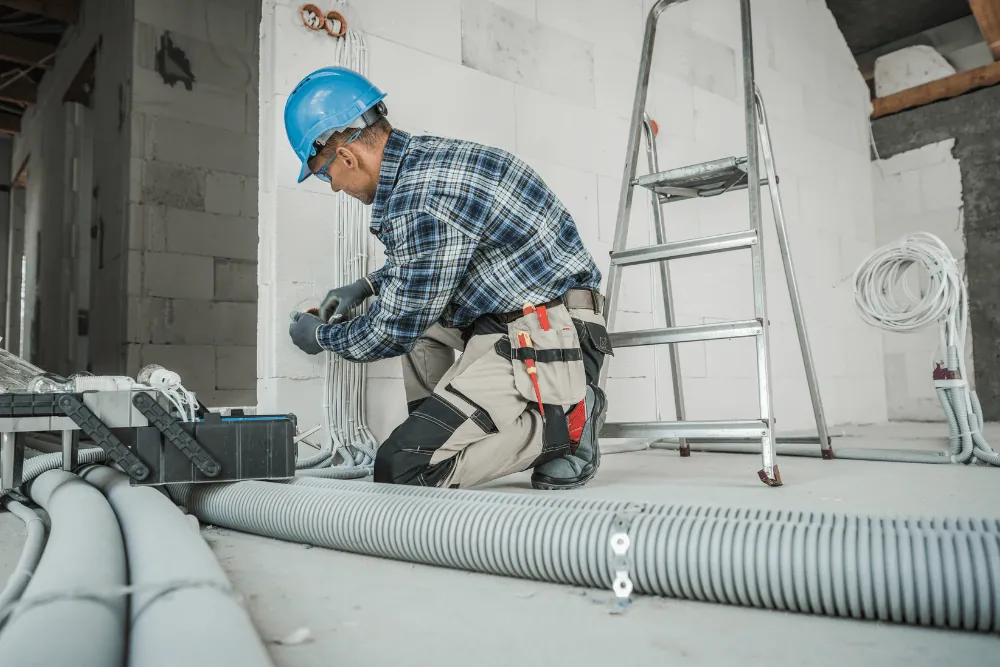
Conduit, Trunking and Cable Tray Installation in Dubai: PVC and GI Conduit, Ladder and Basket Tray, Concealed Wiring
Conduit, trunking and cable tray are the three ways to carry electrical cable so that it is protected, supported and easy to change later. Conduit is a pipe the cable is drawn through. Trunking is a closed channel fixed to a wall, ceiling or floor. Cable tray is an open support for many cables or for heavy cables. A building's wiring is only as safe and as easy to alter as the route it runs in.
Circuit Dubai installs conduit, trunking and cable tray in villas, apartments, offices, shops, warehouses and plant rooms across Dubai. We are electricians first, so the route, the cable that goes into it, the earth continuity and the repair to the wall or ceiling are one job with one person responsible. We also fit the junction boxes and the connectors on the route.
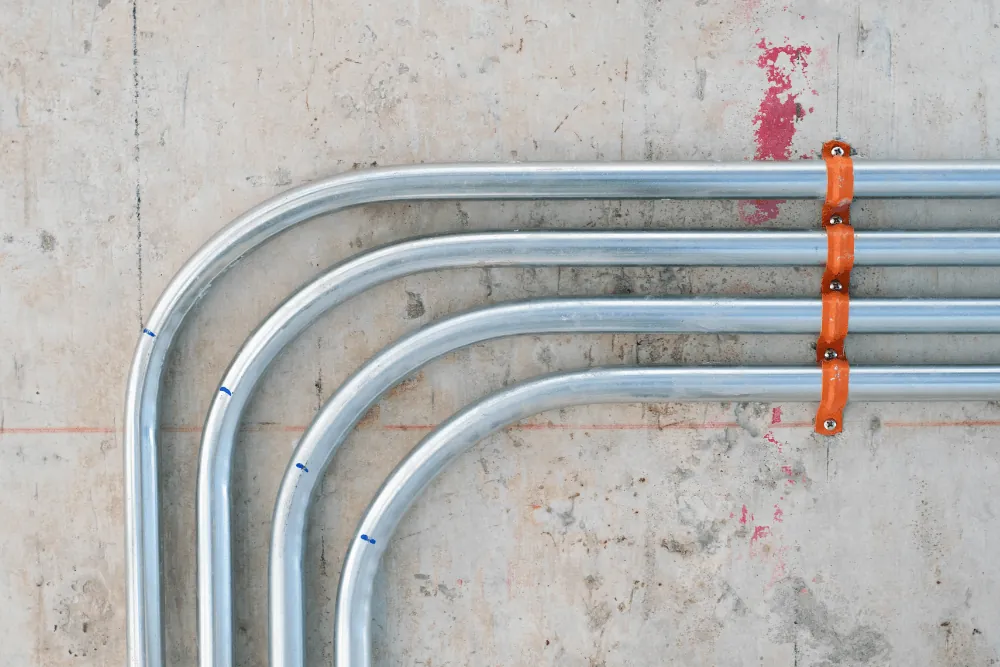
What conduit, trunking and cable tray with us includes
A survey of the route first, covering the wall and ceiling type, the cable count, the weight and the places where the route is wet, hot or exposed to impact.
The right system for each run, with conduit for concealed and outdoor routes, trunking for neat surface routes, and tray or ladder for many cables or heavy cables.
Sizing with room to grow, so a cable can be added later without a new route.
Proper fixing and joints, with supports, earth continuity, an allowance for expansion and sealed building entries.
Junction boxes that stay reachable, with every connection inside a box and every box labelled.
A drawing, tests and a handover, with photographs of each route taken before the wall or ceiling is closed.
The numbers at a glance
Typical answer for Dubai
Before you book conduit, trunking or tray work, photograph the route from the board or the device to the far end, and note whether the walls are blockwork, concrete or gypsum board and whether there is a false ceiling. Count the cables that will run now and the ones you may add later, and say whether the route is inside, outside, on a roof or underground. Measure the length or send the floor plan. That gives us enough to say which system fits and to give a first price. The sections below explain the choices, the sizing and the rules, so you can judge any quote before you accept it.
Conduit, trunking and cable tray terms: what people search for and what each means
People search for this work by the product they have seen or by the part of the job in front of them. The two tables below match the wording to what is involved, and the later sections give the detail.
Conduit and junction box terms
| If you searched | What it means |
|---|---|
| Conduit in electrical wiring, wiring conduit types | A pipe that protects cable and lets it be pulled in and replaced. The three main kinds are PVC, GI (galvanised steel) and flexible. See the conduit types section |
| PVC conduit for electrical wiring, PVC conduit installation, plastic conduit installation, electrical PVC pipe installation | Plastic conduit pipe fixed on saddles or buried in a wall, slab or trench. Plumbing pipe is not electrical conduit. See the PVC conduit installation section |
| Installing PVC electrical conduit, installing plastic conduit, installing plastic electrical conduit | The steps of plan, cut, deburr, join, bend, fix and draw in. Same section |
| GI conduit for electrical wiring, GI conduit installation, metal conduit for electrical wiring | Galvanised steel conduit for routes that need impact protection, earth continuity or fire performance |
| Flexible conduit for wiring, flexible conduit for electrical wiring | A bendable tube for the last stretch to a motor, a unit or a ceiling fitting. It does not replace fixed conduit |
| PVC conduit connector, cable conduit connector | The fitting that joins conduit to conduit, to a box or to a panel. See the connectors part of the PVC section |
| Conduit junction box connector, conduit to junction box connector, junction box conduit connector | The fitting at the point where conduit enters a box. Same part |
| Connecting PVC conduit to service panel | Bringing conduit into a distribution board through a proper entry. See the connectors part of the PVC section |
| Outdoor conduit for electrical wiring, external wiring conduit, outdoor wiring PVC conduit, conduit for outside wiring | Conduit on roofs, walls, gardens, driveways and car parks. See the outdoor section |
| Best conduit for outdoor wiring | No single type is best. Sun, impact, water and the length of the run decide. See the outdoor section |
| Installing PVC conduit outside, installing PVC conduit underground, PVC conduit underground installation | Outdoor and buried routes. See the outdoor and underground parts of the outdoor section |
| Flexible conduit for outdoor wiring, flexible conduit for underground wiring | Short flexible links outdoors are fine. Ordinary flexible conduit is not a buried duct. See the outdoor section |
| Conduit for garage wiring, kitchen island wiring conduit | Conduit to a garage, a gate or a floor box in a kitchen island. See the concealed and outdoor sections |
| Wiring concealed, concealed electrical wiring, concealed TV wiring | Cable hidden inside the wall, slab or ceiling in conduit. See the concealed wiring section |
| Concealed electrical wiring HDB, HDB concealed electrical wiring | HDB is Singapore's public housing, so this search comes from there and we do not work on HDB flats. The method of concealed conduit is the same as in a Dubai home. See the concealed wiring section |
| Junction box wiring, PVC junction box installation | The box where cables are joined. See the junction box section |
| Ceiling junction box installation, ceiling junction box wiring, install junction box in ceiling | A box above the ceiling or in the void. See the junction box section |
| Ceiling light junction box installation, ceiling light junction box wiring, ceiling fan junction box installation | The box that feeds a light or carries a fan. See the junction box section |
| Installing electrical junction box in wall, install light fixture without junction box, socket back box repair clip | Wall boxes, the question of a fitting with no box, and a loose back box. See the junction box section |
| Solar panel junction box wiring, solar panel junction box connection | The box on the back of a solar panel belongs to the panel. See the junction box section |
Trunking and cable tray terms
| If you searched | What it means |
|---|---|
| Trunking installation, cable trunking installation, fitting cable trunking, trunking electrical installation | A closed channel with a lid, fixed to a wall, ceiling or floor, carrying many cables. See the trunking section |
| Trunking wiring system, electrical wiring trunking, surface trunking wiring | The whole system of straight lengths, bends, tees, boxes and sockets. See the trunking section |
| PVC trunking installation, metal trunking installation | Plastic trunking for offices and homes, steel trunking for plant rooms and workshops. See the trunking section |
| Dado trunking installation, lighting trunking installation | A wall channel at dado or skirting height with sockets, and a suspended channel that carries lights. See the trunking section |
| Cable concealer near me, cable duct installation | A small cover or duct that hides a TV, data or charger cable on a wall. See the trunking section |
| Cable tray installation, electrical cable tray installation, cable tray electrical installation, fitting cable tray | An open metal support for cable, on a wall, a ceiling or a riser. See the cable tray section |
| Cable ladder installation, ladder cable tray installation, ladder type cable tray installation, cable ladder rack installation, cable rack installation | Two side rails with rungs for heavy cable over long spans. See the cable tray section |
| Perforated cable tray installation | A tray with a perforated base. See the cable tray section |
| Wire mesh cable tray installation, basket cable tray installation, cable basket installation | A light welded wire basket, cut on site, for data and small cables. See the cable tray section |
| Industrial cable tray installation, vertical cable tray installation, cable tray installation on wall | Heavy tray in plant rooms, risers and walls. See the cable tray section |
| Cable tray and trunking installation | A job that uses both, with tray on the main route and trunking at the end of it |
| Cable tray cover installation, cable tray divider installation, cable tray expansion joint installation, cable tray support installation | The covers, dividers, expansion couplers and supports that complete a tray run. See the fittings part of the cable tray section |
| Cable tray installation price, cable trunking price | See the cost section. A price per metre without a survey is a guess |
| Power cable laying contractors | Laying power cable in a duct, a trench, a tray or a conduit. See the cost and choosing section |
Choosing between conduit, trunking and cable tray
Each system solves a different problem, and one job can use all three. The first choice is by how many cables there are, how heavy they are, whether the route is hidden or on show, and how likely it is that cables are added later.
| Question | Conduit | Trunking | Cable tray, ladder or basket |
|---|---|---|---|
| Number of cables | A few circuits | A group of circuits | A large number, or large cables |
| Where it goes | Inside walls, slabs and ceilings, outdoors, underground | On the surface of a wall, ceiling or floor | Plant rooms, risers, ceiling voids, roofs, long corridors |
| Look | Hidden when concealed | A neat channel, painted or white | Open, set above a ceiling or in a service area |
| Adding a cable later | Possible with a pull string and spare room | Easy until the trunking is full | Easy, since the top is open |
| Mechanical protection | Good, and best in steel | Good with the lid on | Low to medium, so cable that can be hit needs conduit |
| Heat from cables | Cables sit close together | Cables sit close together, and a full trunking holds heat | Open air round the cable helps heat leave |
| Where it fits | A villa's concealed wiring | An office, a shop, a workshop wall | A warehouse, a plant room, a data room, a riser |
A route can use more than one
A route in a warehouse can run from the main board along a ladder tray in the ceiling, drop down the wall in conduit or trunking, and end in a box at the machine. In a villa, conduit runs in the slab and the walls, and trunking is the neat answer where a finished wall cannot be opened. Cable tray and trunking installation together lets the main route carry the weight while the end of it stays tidy. We choose the system for each stretch of the route and not one for the whole job. For the cable side of data and TV, see our TV, data and network cabling service.
The questions we ask at the survey
What cables are going in now, and what might come later? Power, data, TV, speaker, control and alarm cables each have their own rules for sharing a route.
Is the route hidden, or can it show? Hidden means conduit. On show means trunking, or tray above head height.
Is it inside, outside or underground? Sun, water and impact change the material.
Who will change it in five years? A route that is easy to open saves the next job.
Which buildings or authorities need to approve it? Slabs, fire walls, shared corridors and roofs belong to the building and not to the occupant.
Rules and standards for conduit, trunking and tray in Dubai: wiring regulations, joints and fire stopping
Conduit, trunking and tray sit under three sets of rules at once: the electrical wiring regulations, the fire rules for the building and the permission of the owner or the building management. We are electricians and not lawyers, so confirm what applies to your building with the building management, the fire consultant or the authority.
What applies and where it comes from
| Subject | What applies |
|---|---|
| Wiring regulations | DEWA publishes Regulations for Electrical Installations, and the 2017 edition is listed on its website. This page does not repeat DEWA's clause numbers. Where we give a figure, it comes from an international standard or a maker's guide, and we check the DEWA requirement for your building before work starts. |
| Joints and connections | BS 7671, the UK wiring standard, says every connection must be accessible for inspection, testing and maintenance, with listed exceptions: joints in the ground, compound-filled or encapsulated joints, welded, soldered, brazed or properly compression-made joints, joints made inside equipment by the maker, and maintenance-free accessories marked to BS 5733. We put every connection in a box that opens. |
| Size and fill | Conduit and trunking are sized from tables or from the cable maker's data, so cables can be drawn in and heat can leave. See the sizing section |
| Earth continuity of metal containment | A metal tray does not need a purpose-made earth unless it serves as a protective conductor, and where bonding is required the run needs enough electrical continuity. We bond metal containment and test the continuity. |
| Separating services | Keep power cable apart from data, alarm and control cable, or in a separate compartment of the same trunking. The UK tray makers' trade body, BEAMA, points to BS 6701 and BS EN 50174 for this. |
| Cable type on tray | Cable laid on tray or ladder needs a sheath or armour. Single insulated cable with no sheath belongs inside conduit or trunking |
| Fire stopping | A hole cut through a fire-rated wall or floor for conduit, trunking or tray has to be sealed again with fire-stopping material. We do not cut a fire-rated wall without the building's approval |
| Permission | A rented home needs the landlord's approval before walls are chased or ceilings opened. Slabs, roofs, shared shafts and corridors belong to the building, and its management decides. |
Why the joint rule changes how we work
A joint buried in plaster cannot be inspected, and a joint that heats up inside a wall fails unseen. So we make every joint in a box with a lid we can reach, and we show the box position on the drawing. Where a joint cannot be reached and has to be made, we fit a maintenance-free junction box. The IET explains that these boxes need screwless terminals and cable clamps, and that their terminals are tested for long-term connection, vibration, overload and thermal shock. A twist of wire and a roll of tape above a ceiling is never an acceptable joint.
Permission in rented homes, apartments and commercial buildings
A tenant who wants concealed conduit needs the landlord's agreement before a wall is chased. Surface trunking and a painted channel are the reversible alternative, and a landlord is more likely to accept them. In an apartment, coring through a slab or running tray through a shared shaft is the building's decision. In a commercial unit, the lease and the fit-out rules decide how far the tenant may go. We tell you at the survey which parts of the plan need a request.
Conduit types compared: PVC, GI, flexible and liquid-tight
The wiring conduit types you choose between are few, and each has a place. The table compares them, and the sections after it explain each one in turn.
| Type | What it is | Where it fits | Watch for |
|---|---|---|---|
| PVC conduit | Plastic pipe with solvent-welded or push-fit joints | Inside blockwork, slabs and ceilings, and on the surface in dry rooms | It expands and contracts with heat and is softer than steel against a knock |
| GI conduit | Galvanised steel pipe with threaded or compression joints | Plant rooms, workshops, garages and surface routes that can be hit | It is heavier, needs bending and threading tools, and its outdoor fittings need corrosion protection |
| Flexible conduit | Helically wound metal or corrugated plastic tube | The last stretch to a motor, a unit or a ceiling fitting | A metal flexible conduit is not made for outdoor or wet places. It does not replace fixed conduit |
| Liquid-tight flexible conduit | Flexible tube with a waterproof jacket and sealed fittings | Short outdoor and wet links to an AC unit, a pump or a pool plant | The tube and its fittings cost more than rigid PVC, and it is not for places where it can be damaged |
| Duct for burial | HDPE or other duct made for the ground | Long underground runs with few joints | Plain flexible conduit is not a buried duct, and plumbing pipe is not electrical conduit |
PVC conduit for electrical wiring
Rigid PVC is light, cheap and easy to cut and join with ordinary tools, which is why it is the main material for concealed wiring in blockwork and slabs. It resists damp and rust. Its limits are heat movement and impact: a PVC run in the sun needs allowance for expansion, and a PVC run where a vehicle, a trolley or a ladder can hit it needs steel instead.
GI conduit for electrical wiring
GI conduit is galvanised steel conduit. It is strong, hard to crush and can carry the earth continuity of the run. We use GI conduit where the route is exposed and can be hit, such as a plant room wall, a workshop, a garage ceiling or a riser. Steel conduit outside needs fittings, supports and fasteners that resist corrosion, and a cut thread or a cut end has to be treated so the zinc coating is restored. In metal conduit for electrical wiring, the conduit and its fittings must form a continuous earth path, so we test continuity at handover.
Flexible conduit for wiring
Flexible conduit for electrical wiring is for the final connection, where a rigid route would crack or the equipment moves. That includes a pump on a mounting, a motor that has to be adjusted, and the last metre to a recessed fitting in a ceiling. Keep it short. Long flexible runs sag, are hard to draw cable through and are not a neat finish. Where the connection is outdoors or in a wet place, we use the liquid-tight kind and its sealed fittings, and not the metal-only kind.
PVC conduit installation: cutting, joining, fixing and drawing in cable
Installing PVC electrical conduit is straightforward work, and the quality shows in the details: square cuts, clean joints, few bends and a route that the next electrician can find. The same steps apply to installing plastic conduit and installing plastic electrical conduit, whatever the brand.
How we install PVC conduit
- 1Plan the route on the drawing, with the fewest bends, a box at every corner that cannot be drawn through, and a box at every long straight run.
- 2Cut the conduit square with a cutter or a fine saw, then remove the burr inside and out so the cable sheath is not cut as it is drawn in.
- 3Join each length with a coupler, and use solvent cement or push-fit as the maker states, giving the cement its set time before the joint is moved.
- 4Make bends with the bending spring for that size or with a factory elbow, and never by kinking the pipe. Fewer bends between boxes make the draw-in easier.
- 5Fix the conduit on saddles at the spacing in the maker's table, with an extra saddle at each box and each bend. In a wall or slab, the conduit is fixed in the chase or on the formwork before it is covered.
- 6Allow for expansion on long surface runs and on runs in the sun, as explained below.
- 7Leave a pull string in every run, so the next cable follows the first without opening anything.
- 8Seal and label the ends, so that dust, plaster and water stay out and each run can be identified.
PVC conduit and Dubai heat
PVC lengthens as it warms. Using the published coefficient for PVC, a run grows about 3 millimetres per metre for a 50 °C swing in temperature, so a 10 metre run on a sunny wall moves about 30 millimetres. A maker of conduit fittings advises adding about 17 °C (30 °F) to the temperature swing where the run is in direct sun. In the US code, the trigger for an expansion fitting is a length change of 6 millimetres (0.25 inch) between fixed points. Those are American figures, and we use them as a guide. A conduit that is clamped rigid at both ends has nowhere to go and bows, cracks a joint or pulls a box off the wall.
So on long outdoor and roof runs and on runs in the sun, we fit an expansion coupling, clamp the barrel and strap the conduit loosely so it can slide. Where two couplings are used, we fix the middle of the run so both share the movement. Concrete-encased and buried conduit is held by the material around it and does not need the fitting. Choose conduit that is made for outdoor sun for any exposed run.
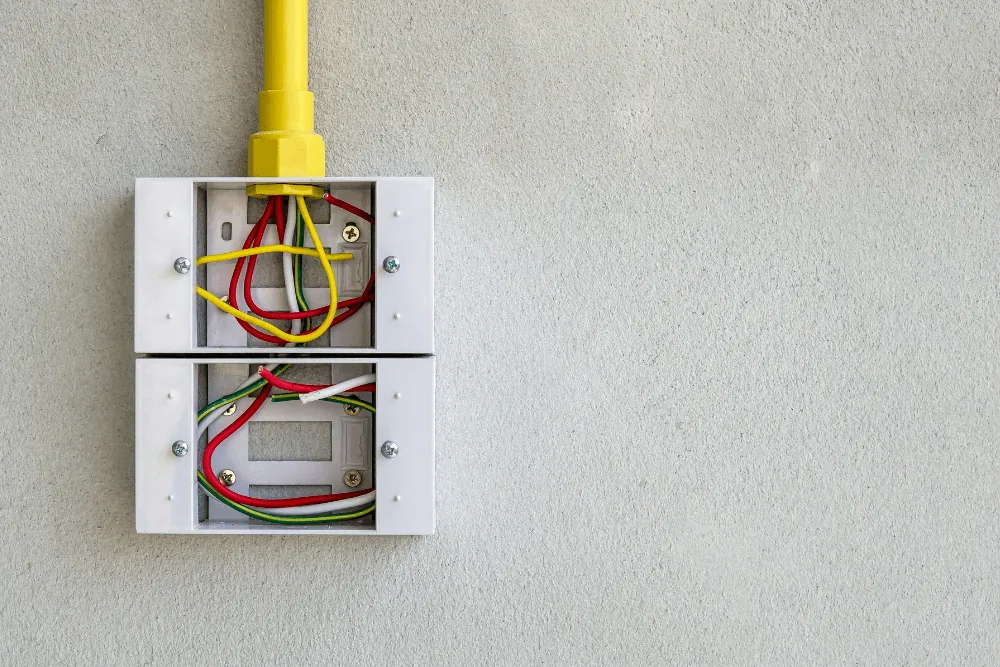
Conduit connectors and entries to junction boxes
The connector is the part that joins conduit to conduit, to a box or to an enclosure. A PVC conduit connector can be a coupler between two lengths, a male adaptor or a screwed entry to a box. A cable conduit connector for a steel conduit can be a coupler with a screw, a bush or a gland. A conduit junction box connector is the fitting at the point where the conduit enters the box. It holds the conduit square to the box, keeps the cable from rubbing on a raw edge and keeps the box's rating, so a dust or water-tight box stays dust or water-tight. When we fit a conduit to junction box connector outdoors, we choose one that matches the box's ingress rating.
Connecting PVC conduit to a service panel
A service panel is the American name for a distribution board, which in Dubai is the DB. Connecting PVC conduit to the board means bringing the conduit to the board's cable entry through an adaptor or a gland and fixing the conduit so its weight is not carried by the board. The conduit enters from the top, bottom or side as the board allows, and an unused entry is closed. The final terminations inside the board are done by our electricians with the board isolated. For the board itself, see our DB box and distribution board service.
Concealed electrical wiring: conduit in walls, slabs and ceilings
Concealed electrical wiring puts the cable inside conduit buried in the wall, the slab or the ceiling, so nothing shows after the finishes go on. It is the cleanest result and the cheapest time to do it is before plastering. Wiring concealed after the walls are finished is possible, but it costs more and has fewer routes.
What concealed wiring means
In a new build or a fit-out, conduit is fixed to the formwork or into chases cut in blockwork, the boxes are set at each switch, socket and light, and the plaster covers the conduit. The cable is drawn in afterwards through the conduit, which is why conduit allows a cable to be replaced without breaking the wall. In a finished home, the options are the ceiling void, a chase made good with plaster, or surface trunking. We say which is possible after we look at the walls.
Where the conduit goes
| Place | How it is done | Watch for |
|---|---|---|
| Blockwork wall | A vertical or horizontal chase, the conduit fixed in it and plastered over | Chase only to the depth the wall allows, and keep the plaster cover over the conduit |
| Concrete slab | Conduit laid on the formwork before the concrete is poured, with boxes fixed in place | The structural engineer decides what may be cast in. Coring a finished slab needs the building's approval |
| Gypsum board partition | Conduit or cable in the cavity, with boxes fixed to the board | Framing, insulation, fire barriers and other services in the cavity |
| False ceiling | Conduit or tray in the void, with junction boxes reachable through an access panel | Fire blocking, AC ducts and the weight on the hangers |
| Kitchen island | Conduit in the slab to a floor box in the island, laid before the floor finish | The position of the island must be fixed before the slab is poured |
Conduit for a kitchen island and for a garage
Kitchen island wiring conduit cannot be added after the floor is laid without cutting the floor, so the island's position, its sockets and its hob or sink supply are agreed before the slab is cast. The conduit runs in the slab from the nearest wall box to a floor box in the island, with a bend radius that lets the cable be drawn through, and a pull string. Conduit for garage wiring is a different problem: the garage wall is exposed to impact, damp and vehicles, so we use GI or heavy-duty PVC conduit on the surface and keep the route above the height a car door or a ladder reaches.
Concealed TV wiring
Concealed TV wiring is the conduit and the recessed box behind a wall-mounted TV, so the power and signal cables never show. The route and the wall type decide what is possible, and the TV wall, the speakers and the equipment rack are covered in our home cinema and audio wiring service. If the wall is already finished, a cable concealer or a short length of painted trunking is the surface alternative.
Concealed wiring in a rented home
A tenant has less freedom, because concealed wiring needs the wall opened and made good. Surface trunking and a cable concealer are the reversible answer, and they come off when the lease ends. We tell you at the survey which parts of the plan the landlord has to approve.
Stop and keep clear of chasing, cutting or drilling into a wall or a ceiling until the routes behind it are traced. A wall can carry concealed conduit with live cable, a water pipe or an AC drain line, and a drill through any of them is dangerous. Switch off the circuit and call an electrician who traces the route with a detector. Cutting a chase without checking what is behind it is how a small job becomes a repair.
Outdoor, garage and underground conduit: sun, water, impact and burial
Outdoor conduit for electrical wiring faces more than indoor conduit: sun, heat, dust, water, salt in the air near the coast, impact from vehicles and gardeners, and ground that moves. The material and the fittings have to suit the place, and so does the way the conduit enters a building.
Outdoor conduit: choosing the type
There is no single best conduit for outdoor wiring. The answer depends on where the run goes.
| Place | Conduit that fits | Reason |
|---|---|---|
| Garden path, boundary wall and low surface run | PVC made for outdoor sun, with sealed joints | Rustproof and light, and it can be fixed on the wall below hand height |
| Driveway, car park and any place a vehicle can hit | GI conduit, or PVC buried and encased | Steel resists impact where plastic does not |
| Roof run to solar panels, an AC unit or a water tank | UV-stabilised PVC with expansion couplings, or GI with corrosion-resistant fittings | Sun and heat move PVC, and steel needs protected fittings |
| Short link to a unit that vibrates or has to be moved | Liquid-tight flexible conduit with sealed fittings | It bends, and its sealed fittings keep water out |
| Garage wall | GI or heavy-duty PVC, kept above vehicle reach | Impact and damp |
| Underground | PVC conduit or duct rated for burial, in a trench with sand | See the underground part below |
Outdoor wiring PVC conduit, external wiring conduit and conduit for outside wiring all share the same rule: every joint, box entry and connector must keep the weather out, and the cable inside must be rated for the place. For the lights, see our outdoor and garden lighting service.
Installing PVC conduit outside
Installing PVC conduit outside follows the steps above and adds three things. First, the conduit is fixed on stand-off saddles or clips of a material that survives the sun, at the spacing in the maker's table. Second, long runs get expansion couplings. Third, every box entry and every joint is sealed against water, dust, insects and rodents, so the conduit does not fill with water and the cable stays dry. Where the run enters the building, the entry is sealed so water and air cannot travel along the conduit into the building. A low point in an outdoor run is a place for water to gather, so we avoid dips or give them a drain.
Flexible conduit for outdoor wiring
Flexible conduit for outdoor wiring is the liquid-tight kind: a flexible tube with a waterproof jacket and fittings that seal it. We use it for the short link to an AC condenser, a pump or a pool unit, where the equipment vibrates or has to be moved for service. It costs more than rigid conduit and its fittings cost more, so it is kept for the last stretch and not used for a whole run. Plain metal flexible conduit is not suited to wet or outdoor places.
Installing PVC conduit underground
PVC conduit underground installation is a trench job, and the trench decides the result. The depth, the bedding and the warning tape are set by the authority and the consultant for the site, and this page gives the method with US figures as an example.
| Item | Example from the US code, for a guide only |
|---|---|
| Cover over nonmetallic conduit in general locations | 18 inches (about 450 millimetres) |
| Cover under a street, road or car park | 24 inches (about 600 millimetres) |
| Cover over rigid or intermediate steel conduit | 6 inches (about 150 millimetres) |
| Bedding | A flat trench bottom, with fine sand or granular material round the conduit, and no broken concrete, bricks or large rock in the backfill |
| Warning tape | Detectable tape with a metallic strip above the conduit, so a locator can find a non-metallic duct |
| Bends | A total of 360 degrees or less between pull points, using long sweeps and not tight elbows |
Underground conduit is a wet location, so the cable inside must be rated for wet use, and the ends must be sealed where the conduit enters a building or a box. We pull a mandrel or rodder through the finished run to find a crushed section before the cable goes in, and we leave a pull string for the next cable.
Flexible conduit for underground wiring
Flexible conduit for underground wiring is a trap. Ordinary flexible conduit is not a buried duct, and plumbing pipe is not electrical conduit. If a long buried run needs fewer joints, a duct made and marked for burial, such as HDPE duct, is the answer, and a fibreglass conduit is made for corrosive ground. We choose and specify the product by its marking, and we keep the datasheet.
Power cable laying
Power cable laying contractors lay cable in ducts, trenches, tray and conduit. We lay power cable for villa outbuildings, gates, pump rooms, workshops and warehouse sub-circuits, in ducts or tray that we also install. The cable that belongs to the utility network is the utility's own work, and it is not part of what we do. For the cable side of a job, see our cable termination and jointing service.
Junction boxes: wall, ceiling and PVC boxes, and keeping every joint reachable
A junction box is an enclosure where cables are joined, split or changed from one type to another. Every joint on a conduit, trunking or tray route lives in one, and the box is the part of the system that has to be reachable for the life of the building.
Which box goes where
| Box | Where it goes | Watch for |
|---|---|---|
| Wall junction box | Inside a wall or on the surface where a joint is needed | Set flush, with the lid reachable and not behind a cupboard or a fixed finish |
| Ceiling junction box | Above a ceiling light, in a void or on the slab | Reachable through an access panel, and fixed to the structure and not hung on the cable |
| Back box | Holds a switch or a socket | Depth for the cable and the accessory, and a firm fixing |
| PVC junction box, surface | Garages, plant rooms, outdoors and workshops | The ingress rating and the entry fittings must match the place |
| Maintenance-free junction box | Where a joint has to be made in a place that cannot be reached | Marked to BS 5733, with screwless terminals and cable clamps, and installed as the maker states |
Junction box wiring: how a joint is made
Junction box wiring is basic work, and the quality is in the detail. The cable is stripped to the length the terminal needs, each conductor goes into a terminal rated for its size and type, and every strand of a stranded conductor is held. Where a cable cannot be clamped by the box, a box with a cable clamp is used, so the weight and pull of the cable do not fall on the terminals. The box is not overfilled, the lid fits without forcing, the circuit and the way each cable goes are written on the lid or on the drawing, and the earth conductors are joined and tested like the live ones.
Ceiling junction box installation
A ceiling junction box installation starts by fixing the box to something solid: the slab, a bracket between hangers, or a support made for the void. A box that hangs from its own cable pulls the joint apart over time. For ceiling junction box wiring, the supply cable comes in, the cable to the next light or to the switch leaves, and the light's own cable joins inside the box. We put the box where it can be reached through an access panel, and we show it on the drawing. To install a junction box in a ceiling that is already finished, the access panel or a removable tile is the route in.
A ceiling light junction box installation or ceiling light junction box wiring job is no different: the light is fed from the box, and the box stays reachable. We do not leave a joint behind a fixed plasterboard ceiling with nothing above it to reach. For the fittings themselves, see our lighting design and control service.
Ceiling fan junction box installation
A ceiling fan hangs a weight on the ceiling and moves it. The box or fixing that carries the fan has to be made for that load and that movement, and a box made for a light is not enough. We follow the fan maker's instructions for the fixing and fix it to the slab or to a support made for the purpose. See our ceiling fan installation service for the fan itself.
Installing an electrical junction box in a wall
Installing an electrical junction box in a wall follows the conduit route: the position is marked, the wall is cut to the depth of the box, the box is fixed flush with the finished surface and the conduit enters through a connector. We check what is behind the wall with a detector before cutting. A box set too deep or too shallow is hard to correct once the plaster is on, so the finished wall level is agreed first.
Socket back box repair clip
A socket back box repair clip is a small clip that grips a back box in a hole that has grown too big, in plasterboard or in crumbled plaster. It is a repair for a box that has come loose, and it keeps the socket from moving when a plug is pushed in. A box that keeps coming loose, or a wall that is soft all round, needs a proper fix: a box fixed to the structure and the plaster made good. A loose box is also a reason to look at the cable behind it, since a pull on the socket can loosen a terminal.
Can a light be fitted without a junction box?
The question comes up as "install light fixture without junction box". A connection has to be inside an enclosure and reachable. If the light has its own enclosed terminal block, that block is the enclosure, and the fitting itself is the access. If the cables meet above a ceiling with no box, the joint is hidden and unreachable, and we do not accept that. We fit a junction box, or a maintenance-free box where the joint cannot be reached. A joint of that kind is the wrong place to save a few minutes.
Solar panel junction boxes
A solar panel junction box is the small box on the back of the panel, and it belongs to the panel. The wiring between panels is done with plug-in DC connectors, and the DC cable runs in conduit or tray rated for the sun. The solar panel junction box connection and solar panel junction box wiring inside a module are the panel maker's work, and we do not open it. The boxes we install are the DC isolators and combiner boxes on the route, and the conduit and tray that carry the cable. See our solar panel installation service for the panels and the system.
Cable trunking installation: PVC, metal, dado and lighting trunking
Trunking is the neat surface answer. It is a closed channel with a lid, fixed to a wall, a ceiling or a floor, and it carries more cable than one conduit and hides it from sight. A trunking wiring system is the whole kit: straight lengths, bends, tees, junction boxes and the sockets that fit into it.
Trunking types
| Type | What it is | Where it fits | Watch for |
|---|---|---|---|
| PVC trunking | Plastic channel with a snap-on lid | Homes, offices and shops, in dry places | A knock can crack it, and it carries no earth, so metal accessories need their own earth |
| Metal trunking | Galvanised or painted steel channel | Workshops, plant rooms, switch rooms and warehouses | Every section must be bonded for continuity, and cut edges need treating |
| Dado trunking | A wall channel at dado or skirting height, in one, two or three compartments, with a base drilled for wiring accessories | Offices, clinics and shops | Compartments keep power and data apart, and the position of each outlet is set before the channel goes up |
| Lighting trunking | A channel run along or hung from the ceiling that carries cable and lighting fittings | Warehouses, shops and workshops | The weight of the fittings, and the hangers that carry it |
| Mini trunking and cable concealer | A small cover for one or two cables | A TV, data or charger cable on a finished wall | Neat on a straight run, and not meant for power cable of a large size |
How we install cable trunking
- 1Mark the route at a height that suits the use, with straight lines and with the fewest joints, and check for pipes and cables behind the wall.
- 2Fix the base with fixings made for the wall: plugs in blockwork, plasterboard fixings for gypsum, and a bracket or hanger system for the ceiling.
- 3Join the lengths with joint covers and make bends with the matching bend fittings and not by cutting and filling. Cut ends are square and clean.
- 4Fit dividers where power and data share the channel, so each service has its own compartment.
- 5Draw in the cable before the lid goes on, with the cable laid, not stuffed.
- 6Bond metal trunking across every joint and test the continuity.
- 7Fit the lids last and label the run.
Fitting cable trunking is quick work, and the visible part is the finish. A straight line, a clean mitre and a lid that sits flat make the difference between a planned wall and a repair.
How much can go in trunking
A trunking has a size for a reason. Cable needs room, and power cable gives off heat that trunking holds in. An overfilled trunking is hard to close, the lid can be forced off the base, and the trunking can distort. We size the trunking from the cable list and leave room for later, and grouped power cables are derated for the heat. See the sizing section for how that is worked out.
Dado trunking installation
Dado trunking installation is for rooms with a row of outlets along a wall, such as an office, a clinic or a shop. The channel is fixed at dado or skirting height, split into compartments for power and data, and fitted with sockets and outlets from the same range. We set out the position of each outlet with the occupant before the channel goes up, and we connect each to the board or to the floor outlet. Over-skirting types sit on top of the skirting and have back boxes in one or two gangs.
Lighting trunking installation
Lighting trunking installation puts the cable and the fittings on one run. The channel is fixed to the ceiling or hung from it, the lights clip into it, and the supply enters at one end. The structure that carries the run has to take the weight of the trunking and the lights together, and the hangers are fixed to the structure and not to the false ceiling. Metal lighting trunking is bonded for earth continuity.
Cable concealer and cable duct installation
A cable concealer is a small trunking or duct that hides a TV, data or charger cable on a wall. If you searched for a cable concealer near me, the job is a cover that hides a cable on a finished wall. Cable duct installation for one or two cables is a short job: a cover is fixed in a straight line, the cable is laid in, and the cover is closed. Our office is in Al Quoz, and we work across the areas listed below. For a TV wall that needs power as well, a recessed box and conduit is the neater answer, as set out in our home cinema and audio wiring service.
Cable tray installation: perforated, ladder and basket tray, covers, dividers and supports
Cable tray is an open support for cable. It holds many cables or heavy cables above a ceiling, along a corridor, up a riser or across a roof, and it lets air reach the cable and lets an electrician see and add cable later. The three main forms are perforated tray, ladder and wire mesh or basket tray.
Tray, ladder and basket compared
| Type | What it is | Load | Where it fits | Watch for |
|---|---|---|---|---|
| Perforated cable tray | A metal channel with a perforated base, in light, medium and heavy duty | Medium to high | Plant rooms, ceilings, corridors and risers | The weight and the span. Cut edges need treating |
| Cable ladder | Two side rails joined by rungs | Very high | Heavy power cable, long spans, rooftops and outdoor runs | Fewer supports are needed, but each carries more |
| Wire mesh or basket tray | A light welded wire basket, cut on site | Low | Data and small cable in offices and data rooms | It is for light cable, and cut ends need protecting |
| Solid tray | A channel with no holes | Medium | Where a closed base is wanted and heat is not an issue | Heat cannot leave through the base |
Cable tray installation, step by step
Cable tray installation and electrical cable tray installation start with the load, because the load sets the supports. The same steps apply to fitting cable tray of any type.
- 1List the cables and their weight, with the number to be added later.
- 2Choose the tray and its width from the load and the fill, with room for later cable.
- 3Fix the supports to the structure at the spans in the tray maker's safe working load table, with each support checked for its own load. Trays and ladders are never laid straight on a floor or a roof.
- 4Join the lengths with coupler plates, with the bolt heads inside the tray unless the maker says otherwise, tightened to the maker's torque.
- 5Fit the bends, tees and risers, each with its own local support.
- 6Allow for expansion with expansion couplers where the run is long.
- 7Bond the run where earth continuity is needed.
- 8Lay the cable over rollers so it is not pinched, fix it with cleats or ties at the stated spacing, and leave a loop at each expansion joint.
- 9Fit covers and dividers and label the run.
Cable ladder installation
Cable ladder installation is for heavy power cable and long spans. The side rails carry the load and the rungs hold the cable, so the ladder can span further between supports than a perforated tray of the same width. A ladder cable tray installation in a warehouse or a plant room can run along the ceiling beams on brackets or hangers. Cable ladder rack installation and cable rack installation are the same job under a different name. Ladder type cable tray installation outdoors or on a roof calls for a galvanised or stainless finish. On a cantilever bracket, bunched cable goes next to the fixed end, since a bunch acts like a point load.
Perforated cable tray installation
Perforated cable tray installation is the main route for power and control cable in a plant room, a corridor or a ceiling void. The perforations let air reach the cable and let ties pass through, and the open top lets us lay in new cable. Cables are fixed to the tray with ties or clips at the spacing for the cable type, and cleats on alternate rungs spread the load on a ladder.
Wire mesh, basket tray and cable basket installation
Wire mesh cable tray installation, basket cable tray installation and cable basket installation are for data and small cables. The basket is cut and shaped on site, and it goes up quickly with few fittings. It carries less weight than a tray, so heavy power cable goes on perforated tray or ladder. Cut ends of the wire are protected so they cannot cut the cable sheath, and the basket is kept for clean, indoor places.
Vertical cable tray, wall and industrial tray
Vertical cable tray installation takes cable up a riser or a shaft. The cable's weight hangs on the fixings, so the cable is fixed at the spacing the cable maker gives, and each floor the tray passes through is fire-stopped. Cable tray installation on a wall uses brackets fixed to the wall, with the fixings chosen for the wall type. Industrial cable tray installation carries heavier loads, and the supports are checked for the loads they carry. The support to the building is the designer's check, and we do not drill or cut a structural member without site approval.
Covers, dividers, expansion joints and supports
Four parts complete a tray run. Each is a separate item on a quote.
- Cable tray cover installation: a cover protects cable from knocks and, outdoors, from sun and falling debris. It is fitted as the maker states, and a cover on a roof run is fixed down so wind cannot lift it.
- Cable tray divider installation: a divider separates power from data or one voltage from another in the same tray. It is fitted before the cable is laid, with the fixings the maker supplies.
- Cable tray expansion joint installation: steel tray grows with heat, and a long run needs expansion couplers. The spacing between joints is the allowable movement divided by the expansion coefficient and the temperature range. For mild steel with a 28 millimetre movement and a 50 °C range, that gives about 43 metres, which is a coupler every 14th 3 metre length. PVC tray expands more, at about four times the rate of mild steel. Supports are kept within 600 millimetres of an expansion joint unless a special coupler is used.
- Cable tray support installation: supports carry the weight and set the span. The tray maker's safe working load table decides the spacing, end spans can be shorter than inner spans, and every fitting has its own local support.
Finish and corrosion
A tray that rusts early is a failed installation. Pre-galvanised tray suits dry indoor places. For outdoor, humid or coastal places, we use hot-dip galvanised or stainless steel, and where cut or drilled edges expose the steel, we treat them with zinc-rich paint. Copper cable on a galvanised tray needs an insulating sheath, and bare single-insulated cable does not go on a tray at all. Mixing metals invites corrosion, so the tray, brackets and fixings are of matching finish.
Bend radius and pulling cable
A cable has a minimum bend radius, and the tray's fittings must not be tighter than that of the largest cable on it. For data cable, the radius is 6 to 8 times the cable diameter unless the cable maker states otherwise. For power cable, the maker's data gives it. We pull cable over rollers and pulleys of a size that does not pinch it, and we anchor the pulleys to the structure and not to the tray.
Sizing conduit, trunking and tray: fill, spare capacity and keeping services apart
A conduit that is too small cannot be drawn through. A trunking that is too full cannot be closed. A tray that is too light sags. Sizing decides all three, and it is done before anything is bought, because the wrong size cannot be fixed once it is in a wall.
Conduit size by the factor method
For conduit, the IET On-Site Guide method gives each cable a factor by its size and type, adds the factors for all the cables, and picks the smallest conduit whose own factor is higher. Stranded cable has a higher factor than solid of the same size.
| Cable | Factor | Conduit diameter | Factor |
|---|---|---|---|
| 1.5 mm² stranded | 31 | 16 mm | 290 |
| 2.5 mm² stranded | 43 | 20 mm | 460 |
| 4 mm² stranded | 58 | 25 mm | 800 |
| 6 mm² stranded | 88 | 32 mm | 1400 |
As an example, six 4 mm² stranded cables give a total of 6 × 58 = 348. That is above the 290 of a 16 mm conduit and below the 460 of a 20 mm conduit, so the conduit is 20 mm. Those figures are for a straight run. A longer run, or a run with bends, needs more room to draw the cable, so we go up a size.
Trunking and tray fill
Guides for communications cabling set the design fill of a tray at 40 percent of its cross-section and the limit at 50 percent, and tell the designer to leave the rest for later cable. For power cable, the limit is heat. Cables in a group heat one another, so the current each can carry is lowered by a grouping factor, and an open tray lets heat leave more easily than a closed trunking. We size from the cable maker's data and the designer's calculation, and we do not fill a trunking to the point where the lid has to be forced.
Keeping power and data apart
Power cable sits apart from data, alarm and control cable, or in its own compartment of the same trunking or tray, with a divider between. Where the two have to cross, they cross at 90 degrees. The distances come from the standard and from the cable maker, and the design sets them for each job. Separation also keeps a fault in a power cable from reaching low-voltage equipment. For the data side, see our TV, data and network cabling service.
Spare capacity
Every route we install has room left in it: a conduit with a pull string, a trunking with a free compartment, a tray with a free width. How much is agreed with you at the design stage, from the cables you plan to add. A route with no spare room means a new route the first time a cable is added.
Conduit, trunking and cable tray cost: price per metre and how to choose an installer
Prices depend on the length, the material, the fixing and the access, so a figure without a survey is a guess. The things that move our price are the same things to compare between quotes.
| What changes the price | Why |
|---|---|
| Length and number of runs | Every metre is material, fixing and labour, and each bend, box and joint adds time |
| Material | GI conduit, metal trunking, galvanised or stainless tray and ladder cost more than PVC conduit and PVC trunking |
| Wall, ceiling and slab type | Chasing blockwork, opening a false ceiling or fixing into a slab take different time |
| Stage of the build | Before plastering the work is quick and the repair is small. In a finished building, the route is harder and the repair larger |
| Height and access | Tray at a high ceiling or a roof run needs scaffolding, a lift or extra time |
| Outdoor and underground work | Trench work, bedding, expansion couplings, sealed entries and a corrosion-resistant finish |
| Cable and mains work | The cable, the terminations and the connection at the board are added to the quote |
| Finish | Plaster, paint and fire stopping that make the route look planned |
The site visit costs AED 50, and the quote follows it.
A cable tray installation price quoted per metre of tray should say what a metre includes: the tray, the supports, the fittings and the labour. A cable trunking price per metre needs the same detail: the size of the trunking, the lid and the fittings. A low per-metre figure that leaves out the supports or the bends is not a low price.
Questions for any installer
| Question | A good answer |
|---|---|
| Do you do the cable and the connection to the board too? | Yes, by a qualified electrician, in the same visit |
| What material will you use, and why? | PVC, GI, trunking or tray, with the reason for each stretch of the route |
| How will you size it? | From the cable list, with room left for later |
| How are metal runs bonded and tested? | Bonded across every joint and tested for continuity |
| Will every joint be in a box I can reach? | Yes, with each box shown on the drawing |
| How do you seal fire-rated walls and building entries? | Fire stopping to the building's approval, and sealed entries outdoors |
| Do I get a drawing, photographs and test results? | Yes, at handover |
Contractor for power cable laying and tray
If the job is large, the contractor has to be able to carry the whole route: the tray, the cable, the terminations and the tests. For power cable laying contractors, ask for the cable sizes and lengths they have laid, the drawings they provide and who is named for support after handover. We take small and medium jobs ourselves and tell you if a job is larger than we can carry.
Testing, handover and fixing conduit, trunking and tray faults
A route that has not been tested is a guess, and a fault after the wall is closed is an expensive guess. We test while the route is open and again when the cable is in.
What we test
- 1Every conduit run by passing a rodder or mandrel through before cable goes in, and by drawing in the pull string.
- 2Every metal run for earth continuity across the joints, with bonding straps where needed.
- 3Every box for a firm fixing, a reachable lid and a label.
- 4Every tray support for tightness to the maker's torque and for a sound fixing to the structure.
- 5Every expansion joint and coupler for its position and its fixing.
- 6Every cable for insulation and continuity before it is connected.
- 7Every building entry and fire-rated opening for a sealed finish.
For the cable test itself, see our insulation and earth resistance testing service.
What you receive at handover
- A drawing of each route, with the boxes and the spare capacity marked.
- Photographs of each route before it was closed.
- The datasheets for the conduit, trunking, tray and cable we used.
- The test results.
- A note for anyone who adds a cable later.
Faults and where to look
| Symptom | Cause to check |
|---|---|
| Cable will not pull through the conduit | Too many bends, a crushed or joined-up section, a burr at a cut, a conduit that is too small, or a run with no draw-in box |
| PVC conduit cracked or bowed in the sun | No expansion coupling on a long run, a rigid clamp at both ends or a conduit not made for outdoor use |
| Trunking lid pops off | The trunking is overfilled, the cable is stuffed and not laid, or the lid is the wrong one for the base |
| Tray sags between supports | A span longer than the maker's table allows, a heavy bunch of cable in mid-span, or a joint in the wrong place |
| Rust on tray or conduit outdoors | The wrong finish for the place, a cut edge left untreated or a fixing of a different metal |
| A junction box is warm or discoloured | A loose or overloaded connection, a box that is too small or a joint that was never reachable. Turn the circuit off and call an electrician |
| Water in outdoor conduit | An unsealed joint or entry, a low point with no drain or a damaged conduit |
| A socket or box moves in the wall | A loose back box or a crumbled wall. Fix the box to the structure and make good the plaster |
| A hum or noise on a data cable | A data cable beside a power cable for a long run. Move it or separate it |
Send photos of the route and the symptom, and we tell you whether it is the route, the box or the cable.
Conduit, trunking and cable tray with Circuit Dubai
- Electricians first, so the route, the cable, the boxes and the connection to the board are one job with one person responsible.
- The right system for each stretch, chosen from the cables, the place and the load.
- Sized with room to grow, so the next cable does not need a new route.
- Every joint in a box you can reach, shown on the drawing.
- A drawing, photographs and test results at handover, so the route can be found and changed later.
We work across all of Dubai. Our office is in Al Quoz.
If you are also planning smart home installation, CCTV installation, fire alarm and smoke detector installation or a TV, data and network cabling job, we can plan one set of routes for all of it together with the conduit, trunking and cable tray.
Phone: +971 55 407 7427
Conduit, trunking and cable tray questions we hear from Dubai customers
How much does conduit or cable tray installation cost?
It depends on the length, the material, the wall, ceiling or slab type, the height and the stage of the build. A site visit costs AED 50, and the price follows it. We give a fixed quote after photos or a visit.
What is the difference between conduit, trunking and cable tray?
Conduit is a pipe the cable is drawn through, trunking is a closed channel with a lid fixed on a surface, and cable tray is an open support for many or heavy cables. Conduit suits hidden and outdoor routes, trunking suits a neat surface route, and tray suits plant rooms, ceilings and risers.
Should I use PVC or GI conduit?
PVC conduit suits concealed routes in blockwork and slabs and dry surface routes. GI conduit suits exposed routes where something can hit it, such as a plant room, a workshop or a garage. We choose for each stretch of the route.
What is the best conduit for outdoor wiring?
No single type is best. PVC made for outdoor sun suits a wall or garden run, GI suits a place a vehicle can hit, and liquid-tight flexible conduit suits a short link to an AC unit or a pump. We choose after we see the place.
Can PVC conduit be used in the sun?
Yes, if it is made for outdoor use, and the run has expansion couplings where it is long. PVC lengthens by about 3 millimetres per metre for a 50 °C swing in temperature, so a rigid clamp at both ends of a long run is a mistake.
How deep is underground conduit buried?
The depth is set by the authority and the consultant for the site. The US code gives 18 inches (about 450 millimetres) of cover over nonmetallic conduit in general locations and 24 inches (about 600 millimetres) under a road, and those figures are an example and not a Dubai rule.
Can I use flexible conduit underground?
Ordinary flexible conduit is not a buried duct. A long buried run needs a duct made and marked for burial, and flexible conduit is kept for short links above ground.
How big a conduit do I need?
It depends on the number and size of the cables and the length of the run. As an example, six 4 mm² stranded cables need a 20 mm conduit on a straight run, and a longer run or one with bends needs a size up.
Can a light be fitted without a junction box?
A connection must be inside an enclosure and reachable. A light with its own enclosed terminal block counts, but a joint hidden above a ceiling with no box does not, and we fit a box or a maintenance-free box.
Does a ceiling fan need a special junction box?
A ceiling fan hangs a weight and moves it, so its box or fixing has to be made for that load and that movement. We follow the fan maker's instructions and fix it to the slab or to a support made for the purpose.
Can you do concealed wiring in a finished home?
Yes, where the wall allows. The route can be a chase made good with plaster, the ceiling void or surface trunking, and we say which works after we look at the walls.
Can you hide the cables on my TV wall?
Yes. A recessed box and conduit is the neat answer, and a cable concealer or painted trunking is the answer where the wall cannot be opened. Our home cinema and audio wiring service covers the TV wall in full.
What is the difference between cable tray, ladder and basket?
Perforated tray is a channel with a perforated base for medium to high loads. Ladder is two rails with rungs for heavy cable over long spans. Basket is a light wire mesh for data and small cable.
Does metal cable tray need earthing?
A metal tray does not need a purpose-made earth unless it serves as a protective conductor, and where bonding is required the run needs enough electrical continuity. We bond metal containment and test the continuity.
How far apart should tray supports be?
The tray maker's safe working load table decides the spacing for the tray and the load, end spans can be shorter than inner spans, and every fitting has its own support. We follow the table for the product we install.
Do you install cable tray in warehouses and plant rooms?
Yes. We install perforated tray, ladder, basket and vertical tray, with the supports, covers, dividers and expansion joints.
Do I need permission to chase walls or core a slab?
Yes. A tenant needs the landlord's approval, and a slab, a roof, a fire-rated wall or a shared shaft belongs to the building, so its management decides. Surface routes are the reversible alternative.
Ready to book conduit, trunking or cable tray installation?
Send photos of the route and the places it has to reach, tell us the length if you know it, the number and type of cables, and whether the route is inside, outside, on a roof or underground, and say whether the building is new, being fitted out or finished. We reply instantly on chat with a view on what will work and a fixed price, so you know what you are buying before anyone cuts a wall.