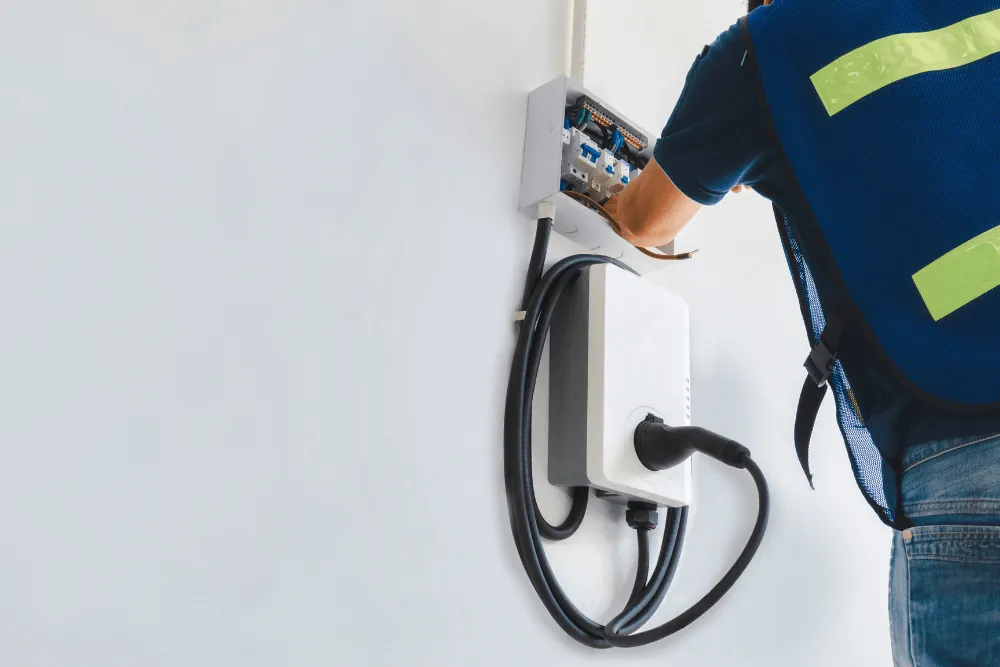
EV Charger Installation in Dubai: Home Wall Boxes, Load Checks and DEWA Approval
An electric car on a household socket takes 8 to 12 hours to fill and runs a plug and cable hot for the whole time, in a city where a garage gets very hot in summer. A proper home charger is a different job: its own circuit, the right cable and breaker, protection against earth leakage, a weatherproof mounting, and a check that your supply can carry it alongside the air conditioners. Most of the work is in that checking, not in the box on the wall.
Circuit Dubai installs home and building EV chargers across Dubai: single-phase 7.4 kW and three-phase 11 or 22 kW wall boxes for villas, apartments and compounds. We check your board and supply first, fit a dedicated circuit, mount and commission the charger, and test it with your car before we leave.
What EV charger installation with us includes
A load check of your main breaker, board and phases, with the real demand worked out before we quote.
A dedicated circuit with the cable, breaker and earth leakage protection sized to the charger and the cable route.
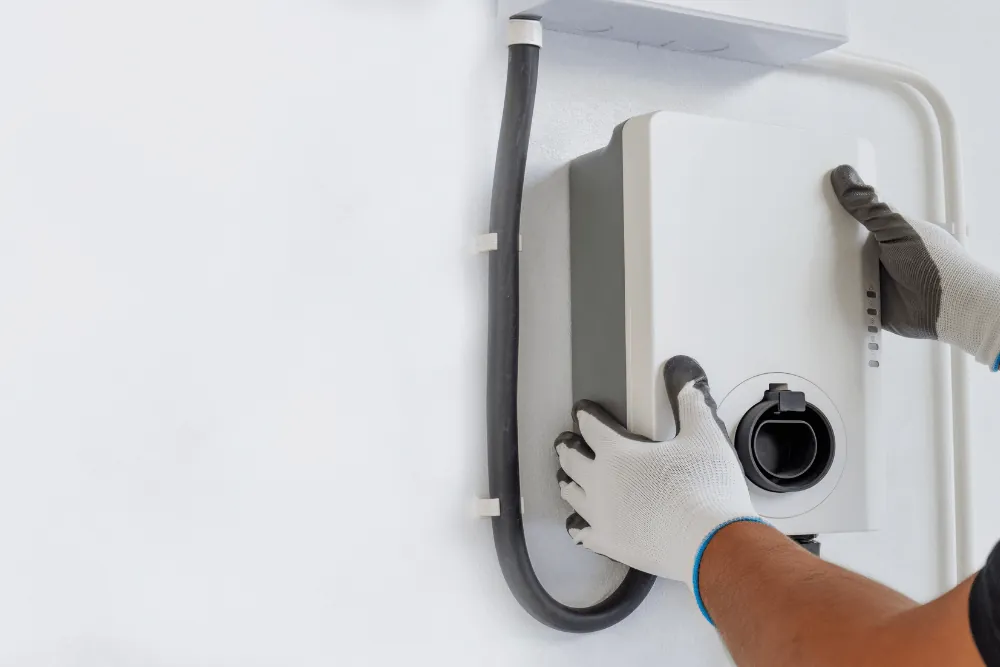
The charger mounted and commissioned, in the shade where we can, at a height and position that suits the car's charging port.
Surge protection and an isolator where the charger sits outside or on a long run.
Load management when two cars, or a charger and a heavy house, would otherwise overload the supply.
Testing and handover: earth and insulation tests, a trip test, a charge test with your car, and the settings written down.
The numbers at a glance
Typical answer for a Dubai home
Before you buy a charger, send us the model and the car's maximum AC charging rate. A 22 kW charger on a car that accepts 7 kW charges at 7 kW and costs more to install for nothing. We size the charger and the circuit to the car, and tell you if the cheaper model does the same job.
Choosing the charger power: 7.4, 11 or 22 kW
The charger's power is set by two things: your supply and your car. The supply decides how much current can safely reach the parking spot. The car decides how much it will accept, because every electric car has an onboard charger that converts AC to DC, and that limit is fixed. Many cars take 7 kW or 11 kW on AC, and few take 22 kW. A wall box faster than the car's limit does nothing. Tesla owners can see our Tesla Wall Connector service for the car-specific details.
| Charger | Supply | Current | Range added in an hour | 60 kWh battery, empty to full |
|---|---|---|---|---|
| 7.4 kW | Single-phase 230 V | 32 A | About 35 to 45 km | About 8 to 9 hours |
| 11 kW | Three-phase 400 V | 16 A per phase | About 60 to 70 km | About 5.5 to 6 hours |
| 22 kW | Three-phase 400 V | 32 A per phase | 100 km or more, if the car accepts it | About 3 hours, if the car accepts it |
The hours include the 10 per cent or so that is lost as heat in the charger and the battery. Real charging also slows as the battery nears full, so the last 10 per cent takes longer than the first 10.
For most Dubai households, 7.4 kW is the right size. A car parked overnight for ten hours receives about 73 kWh at 7.4 kW, which is more than most batteries hold. Faster charging earns its cost only for a household that returns from a long day with a nearly empty battery and leaves again within a few hours, or for two cars sharing a supply. A three-phase 11 kW charger needs three-phase supply at the parking spot, which a villa may have at the main board but not at the garage.
Tethered or socketed
A tethered charger has its cable permanently attached, usually 5 to 7 m, and stays on the wall. It is simpler to use and has no connector to lose. A socketed charger has a Type 2 socket, and you carry the cable. It suits a household with two different cars, and keeps a cable that is not in the sun. We ask which cars you have and where the port is. A charger on the wrong side of a car with a short cable is the commonest regret we hear.
What smart features are worth having
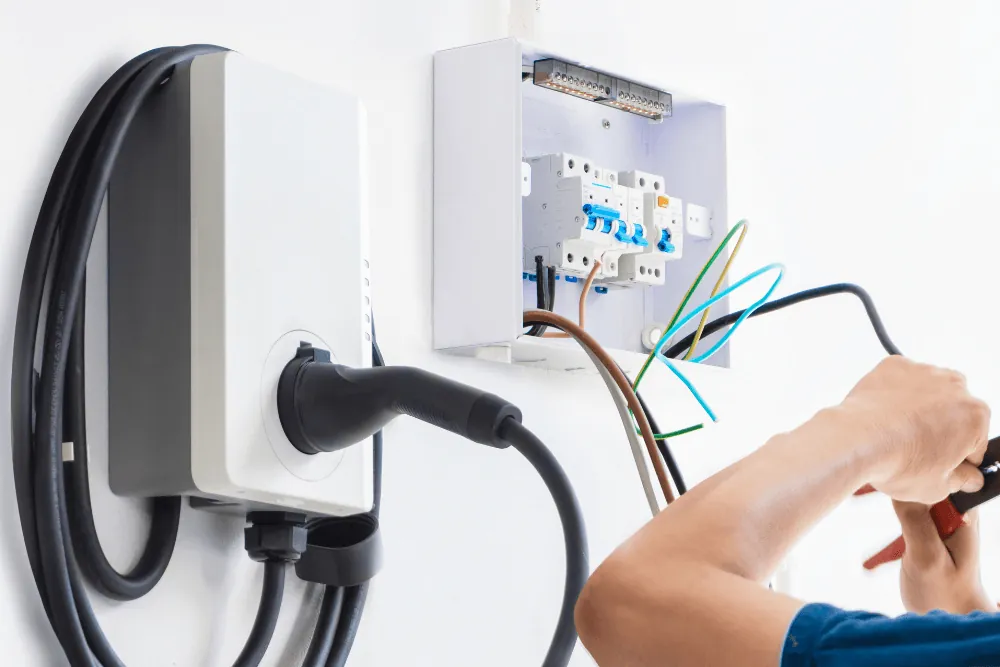
A Wi-Fi charger lets you set a schedule, cap the current and see how much energy each session used. In Dubai, the residential tariff is not cheaper at night, so scheduling mostly serves the car's heat and your own convenience. The useful features are a current limit that can be set from 6 to 32 A, and load balancing with a clamp on the incoming supply, which lowers the charge current when the house needs the power. Solar surplus charging, where the charger follows your panels, is available on some models and pairs well with solar panels on a villa roof, because the car is often at home at the weekend.
Why not a household socket
Most cars come with a portable charging cable that plugs into a 13 A socket. Plugged into an ordinary socket, it draws 10 to 13 A continuously for 8 to 12 hours. A socket is designed for appliances that switch on and off, not for hours at its full rating, so the plug, the socket terminals and the cable behind the wall all heat. In a hot garage, a loose terminal heats quickly. The DEWA technical regulations restrict portable Mode 2 cables used with extension cords for EV charging, and an extension lead is never acceptable. If you must use a socket for a week, send us a photo and we check that it is a dedicated socket on its own breaker with a sound connection. A wall box is the permanent answer.
Is your home ready? The load check
The load check is the first thing we do and the thing most often skipped. A 7.4 kW charger draws 32 A for hours. Add that to a villa's air conditioners on a July evening and the main breaker can trip, or the board can run hot for weeks before it fails.
We look at five things before we quote:
The main breaker and the supply. Its rating, whether the supply is single-phase or three-phase, and the cable that feeds the board.
The real demand. In the summer, a villa's demand peaks in the evening, when the car arrives home and the air conditioners are at full load. We estimate it from the connected loads, or log it with a clamp meter over a few days when the answer is not obvious.
A spare way in the board. A charger needs its own breaker, and an older board may have no space.
The state of the board. A loose busbar connection that runs warm with a small load runs much warmer with a 32 A load added.
The earthing. The charger depends on a sound earth, and we test earth loop impedance at the board and at the parking spot.
Our DB box and distribution board service covers a full or worn board, and our thermal imaging inspection service finds a warm connection before the charger does.
The sums are simple. For example, if the main breaker is 100 A single-phase and the house already draws 70 A at its summer peak, adding a 32 A charger takes it to 102 A, which is over the breaker. The options are a smaller charger setting (a 16 A setting is 3.7 kW and still adds about 20 km an hour), a load-management clamp, or a larger supply. Our three-phase and load upgrade service covers the supply change when that is the sensible fix.
Load management for two cars or a heavy house
Load management means a sensor on the incoming supply that reads the house's total current, and a charger or controller that lowers the charge current when the house needs more and raises it again afterwards. The charger yields to the air conditioners. It is how a villa that cannot take two 32 A chargers at full power runs two cars, and how a charger can be fitted without a supply upgrade. A single-car villa often needs none. We say so in the quote when we think you do not need it.
The circuit: cable, breaker and protection
A charger's circuit is a dedicated line from the board, with nothing else on it. An electric car is one of the few household loads that draws its full rated current for hours, and a circuit built for sockets, which spend most of their life idle, overheats under it. That changes how the cable, the breaker and the protection are chosen.
| Charger | Breaker | Cable | Notes |
|---|---|---|---|
| 7.4 kW single-phase | 32 A | 6 mm² for a short clipped run, 10 mm² for a long or buried run | Own breaker, no other loads |
| 11 kW three-phase | 16 A, three-pole | 4 mm², five-core | Check three-phase supply at the board |
| 22 kW three-phase | 32 A, three-pole | 6 mm² for a short clipped run, 10 mm² for a long or buried run, five-core | Needs spare capacity on all three phases |
The nameplate and the maker's manual override this table.
Cable size, heat and distance
The cable is chosen for two limits: how much current it can carry without overheating, and how much voltage it loses along the way. Both are tighter in Dubai. A 6 mm² twin and earth cable carries about 47 A at 30 °C when clipped directly to a wall, and roughly 37 A at 45 °C. A 32 A charger leaves a margin over that, but not much, and the margin disappears when the cable is bunched with others, or runs through insulation, or crosses a roof that reaches 50 °C. When any of those apply, we step up to 10 mm².
Distance matters for the voltage at the charger. For a 6 mm² cable carrying 32 A, the drop is about 7.3 mV per amp per metre, and for 10 mm² about 4.4 mV.
| Run from board to charger | 6 mm² voltage drop | 10 mm² voltage drop |
|---|---|---|
| 20 m | 4.7 V (2.0 per cent) | 2.8 V (1.2 per cent) |
| 40 m | 9.3 V (4.1 per cent) | 5.6 V (2.4 per cent) |
A common design limit for a power circuit is 5 per cent, so 6 mm² still passes at 40 m. A voltage that sags at the car makes the charger work harder and run hotter, and so beyond about 30 m we use 10 mm² and keep a margin. The cable goes in conduit or is armoured, and is clipped clear of the ground and of the sun where it can be.
The breaker and the earth leakage device
The charger gets its own breaker of the right rating, and its own earth leakage device. The wiring standards that DEWA's technical regulations refer to require each charge point to have an earth leakage device of 30 mA or less. The type of device depends on the charger. A charger that does not detect a smooth DC fault current itself needs a Type B device, which costs more. Most modern wall boxes include DC fault detection, typically a 6 mA detector, and for those a Type A device is enough. DEWA's technical regulations specify a 30 mA Type A device with auto recovery for AC chargers. We check the charger's data sheet, fit the device it calls for, and test the trip.
A charger that trips often on a Type A device may have a DC leakage that the detector in the box is catching, or a fault in the cable or the car. It does not mean the device is faulty, and replacing it with a less sensitive one is not a fix.
Earthing, surge protection and the isolator
The charger and the car are both connected to the earth through the circuit, so the earth must be sound. We test continuity and the earth fault loop impedance, and run the earth conductor the full length at the same size as the live conductors. Dubai's supply is a TN system, which means the earth comes back to the supply transformer, and a fault current large enough to trip the breaker flows when the earth is good. Our earthing and grounding service covers the case where the earth itself is poor.
A charger on an outdoor wall is exposed to lightning-induced surges on the cable, and the car's electronics are expensive. We fit a surge protector at the board for the charger circuit where the cable runs outside. Our surge protection service covers a whole-house device. We also fit a lockable isolator beside the charger so it can be switched off for servicing without going back to the board.
Where to mount the charger in Dubai's heat
Position matters more here than in cooler countries, because a charger sits in the heat for hours at full load and is itself a source of heat. Chargers lose a few per cent of the energy as heat, and the electronics throttle the current if they get too hot. A unit on a sunlit west wall at 3 pm in August charges slower than one in the shade, and wears sooner.
DEWA's technical regulations specify a protection rating of IP54 and IK10 for AC chargers, and a maximum ambient temperature of 55 °C, with humidity up to 95 per cent, indoors or outdoors. IP54 is dust and splashes, which suits a garage or a covered carport. An uncovered wall facing the sprinklers or the pool needs more care, and we choose a unit rated for it.
We choose the position on four things:
- Shade. A garage wall or a carport column in the shade beats a bare wall. If there is no shade, a small canopy over the unit is cheap.
- The car's port. We stand the car in its usual bay and measure from the port to the wall. A tethered 5 m cable reaches most bays, but a car that parks nose-in at one door and tail-in at another needs a socketed charger or a second position.
- Height. The unit sits at about 1.2 m, high enough to stay clear of splashes when the floor is washed, and low enough to reach without a stool.
- The cable run. The shorter the run from the board, the smaller the cable, the smaller the cost and the voltage drop. We route in conduit, along a wall that is not the hottest one, and not through a pool or garden area where someone digs.
Garage, carport or outdoor
In a closed garage the charger is out of the sun, but the air is hot and the charger adds its own heat, so we leave clearance on every side. A carport back wall in shade works well. On an outdoor wall in full sun we add a canopy and choose a unit rated for it. Near a pool or sprinklers we mount above splash height, on the dry side.
Two bays, two cars
For two cars, we fit two chargers on a single supply with load management, so that both can charge overnight without a supply upgrade, or one socketed charger whose cable you move between bays if you only ever charge one car at a time. Two chargers at full power is 64 A on a single-phase supply, which most villas cannot give, so a pair is almost always a load-managed pair.
DEWA, approvals and the paperwork
Two different things in Dubai are called a "DEWA charger", and it helps to separate them. The DEWA EV Green Charger network is DEWA's public charging service: stations around the emirate that you use with a charging card or app, and that bill per kWh. A home charger is yours. It is a private installation on your own circuit, billed through the same DEWA account as the rest of your electricity, at the ordinary residential tariff. Registering for the public network does not install anything at home, and installing a charger at home does not need the public card.
The approvals for a home charger run through DEWA and your building or community.
- DEWA's technical regulations for EV charging set the standards the charger and the installation must meet. They require AC chargers to use the Type 2 connector, and they refer the electrical work to the IEC and BS 7671 wiring standards and the IET code of practice for charger installation.
- The installer. The regulations call for a certified installation contractor. They also say to approach contractors and consultants enrolled with DEWA, and to apply for the building's electricity no-objection certificate and an electricity connection through DEWA's usual procedures. Ask any installer whether they are enrolled before you sign.
- Your community. In a villa community, the master developer or the owners' association may have its own rules about external wall work, cable routes and appearance. We check with the community office when the charger needs to go on a shared or front-facing wall.
- Tenants. If you rent, you need the landlord's written permission before any fixed installation, and a charger on the landlord's wall is the landlord's after you leave unless the agreement says otherwise.
The documents usually asked for are your title deed or tenancy contract, the charger's data sheet and an electrical drawing of the circuit. We prepare the drawing and the data sheet with the quote.
A charger is energised only after the installation is complete and tested. We do not leave a live charger on a wall that is waiting for an approval.
Apartments, shared parking and compounds
An apartment charger is possible, and the electrical side is rarely the hard part. The hard parts are permission, the cable route and the metering.
Permission. Building management must agree in writing, and in a building with an owners' association the association may have a say. Tenants need the landlord's permission too. Start here, since nothing else can happen without it.
The parking bay. A charger needs a bay you can use every night. An assigned bay is simple. A shared bay or a first-come bay is not, because the charger has no owner.
The cable route. The cable runs from your flat's board, or from a landlord or parking board, to the bay. In a high-rise that means shafts and slabs, and a cable that crosses a fire-rated floor or wall needs approved fire-stopping. A newer building may already have conduits or a parking sub-board, which shortens the job. A long vertical run is expensive, and a short horizontal run in a podium car park is cheap.
The meter. The simplest arrangement is a circuit from your own flat, so the energy lands on your own bill. When the bay is far from the flat, a building-run parking sub-board with sub-meters, or a managed charging service that bills you per kWh, may be the only practical way. Building rules decide which is possible.
If your building has a managed charging network, using it can cost less than a private cable run, though you pay per kWh and a fee. We survey the route and the board and tell you the cost of the private option, so you can compare it with what the building offers.
Compounds and extended-family villas
In a compound with several villas on a shared supply, the main question is the shared feeder. Each villa's charger adds to a load the feeder was sized for before cars were electric, and four villas each fitting a 7.4 kW charger can overload it on one evening. We read the feeder and the main breaker before we agree to anything, and recommend load management when the margin is small.
What an EV charger costs to install and to run in Dubai
A standard villa installation, with the charger within about 15 m of the board and a spare way available, typically costs AED 1,260 to 2,910 for the circuit, the isolator and the labour, not counting the charger. A wall box costs AED 1,650 to 3,105 depending on brand and features. The site visit costs AED 50, and the quote follows it.
| Job | Typical price (AED) |
|---|---|
| Circuit, isolator and installation only (you supply the charger), short run | 1,300 to 3,000 |
| 7.4 kW charger supplied and fitted, standard villa | 3,500 to 5,500 |
| 11 kW three-phase charger supplied and fitted | 4,500 to 7,000 |
| Longer run, trenching or extra containment | Quote after a site visit |
| Apartment, with building permission and a cable route | 4,000 to 7,000 |
| Board upgrade or three-phase upgrade, if the load check finds one is needed | Quote after the load check |
| Load management add-on | 800 to 1,500 |
What moves the price
The distance from the board to the charger is the main variable, because the cable and the conduit are charged by the metre. Next is the board: a spare way costs nothing, and for a full board our DB box and distribution board service covers the upgrade first. Third is the route: a cable that runs along a surface wall is cheap, and one that crosses a driveway, a pool or a slab needs trenching or core drilling. The charger itself is the last: a simple wall box and a smart, load-balancing unit can differ by AED 1,000.
What it costs to run
The cost of charging is kWh times the tariff. Dubai's residential electricity is billed in slabs, and a home that already runs air conditioners sits in the second or third. A charger adds to monthly use and every extra kWh is charged at the top slab the household reaches. With the fuel surcharge and VAT, that is about AED 0.36 to 0.46 per kWh, and AED 0.40 is a fair working figure. Public AC chargers on DEWA's network cost about AED 0.735 per kWh with VAT, and DC fast chargers about AED 1.26, at the tariff last published for 2025.
| Charging | Price per kWh | A full 60 kWh charge | 300 kWh a month |
|---|---|---|---|
| Home charger | AED 0.40 | AED 24 | AED 120 |
| Public AC charger | AED 0.735 | AED 44 | AED 221 |
| Public DC fast charger | AED 1.26 | AED 76 | AED 378 |
The monthly figure assumes about 1,500 km a month at 18 kWh per 100 km, and the 10 per cent of charging losses added back. It comes to about 300 kWh. A home charger saves a household about AED 100 a month against public AC and about AED 260 against DC fast charging, so a charger of AED 4,000 to 5,000 pays for itself in roughly three to four years against public AC, and faster for a driver who relies on DC fast charging today. Public charging stays useful for trips.
A solar system cuts the cost further, because the car charges from your own panels on a weekend afternoon. Our solar panels service covers the sizing, and a charger with solar-surplus mode can follow the output.
How an EV charger installation runs, step by step
- 1Survey. From photos or a visit we see the board, the meter, the parking spot and the route between them, and ask for the car's make, model and maximum AC charging rate.
- 2Load check. We work out the demand, the spare capacity and whether load management or a supply upgrade is needed, and say so before we quote.
- 3Quote and drawing. You get a price listing the charger, the circuit, the cable length and any board work, with the single-line drawing and the charger's data sheet.
- 4Approval and permission. Building or community permission, and DEWA's requirements, are in place before work starts.
- 5Circuit. We fit the breaker and earth leakage device, run the cable in conduit, and install the isolator and surge protection.
- 6Mount the charger. At the chosen position and height, connected and set to the current the circuit allows.
- 7Test. Earth and insulation tests, earth loop impedance, a trip test of the earth leakage device, and a check of the voltage at the charger under load.
- 8Commission and charge test. We plug in your car and watch it charge, check the current against the setting and the heat at the connection after some time.
- 9Handover. You get the settings, the test sheet, a short guide to the app and the error lights, and the warranty details.
A standard villa job is a half-day visit. An apartment, a long trenched run or a board upgrade takes longer and is scoped from the survey.
EV charger problems and repairs
Stop and switch off at the isolator if you smell burning, see a melted plug or a brown mark on the connector, or the charger's casing is too hot to hold. Running a charger again to see whether the fault returns can turn a loose terminal into a fire.
The charger does not start
Check the car first: is it set to charge, is the charge port door open, is a charge limit or a timer holding it off? Then the charger: is the display lit, and does it show a fault? A charger with no lights has lost its supply, and we look at the breaker, the earth leakage device and the isolator. If the supply is good and the charger shows a fault, the fault code in its manual tells you which side the fault is on.
The earth leakage device trips when the car connects
A leak to earth is flowing. The cause can be water in the charger or its connector, a damaged cable, a fault in the car, or a DC leakage that the charger's own detector is catching. We test the circuit with the car disconnected, then with the charger connected and no car, and then with the car. That finds which part has the fault. If the circuit and charger are clean and the leak appears only with one car, the car's dealer is the next call.
The breaker trips after an hour
A breaker that holds for a while and then trips is usually warm. Causes are an undersized cable, a loose terminal, a breaker that has aged from running at its limit, or a circuit shared with another load. The remedy is a better circuit: the cable, the terminal or the breaker corrected. A larger breaker on the same cable is not a remedy and is dangerous.
Charging is slower than it should be
The usual causes are a low current setting, a hot charger or a hot car battery that is lowering the rate, a voltage drop on a long thin cable, and load management lowering the current because the house needs it. We read the charger's settings and the voltage at its terminals while it charges. A car with a single-phase onboard charger charges at about 7 kW on any wall box, however many phases the box has.
A warm plug, connector or socket
Some warmth at the plug of a tethered cable after hours of charging is normal. A connector that is too hot to hold, or that has discoloured, is not. The usual cause is a poor contact, in the car's port, the charger's socket, or a loose terminal behind it. We check the terminals, and the connector's contact pins.
Charger errors in summer
A charger that works in the morning and stops in the afternoon may be protecting itself from heat. Shade over the unit, or a move to a cooler wall, is the cure. A charger that faults after a power flicker usually needs its supply cycled at the breaker. If it happens every time, the supply or the charger is at fault.
As a rule, if a repair touches the supply cable, we replace the length and do not join it. A joint on a circuit that carries full current for hours is a weak point, and a new cable run costs less than another visit.
EV charger installation with Circuit Dubai
- A load check before a quote. Your main breaker, board and phases are read, so the charger is not the thing that trips your house.
- A circuit built for hours at full load. Cable, breaker and protection chosen for Dubai's heat, with earth, insulation and loop tests recorded.
- The charger sized to the car. We check the car's AC limit and tell you if a cheaper charger does the same job.
- One team for the board and the charger.
- Records you keep. A test sheet, the settings and a drawing of the circuit.
We work across all of Dubai. Our office is in Al Quoz.
If you are also planning solar panels, battery storage installation, a three-phase upgrade, surge protection or a DB box upgrade, we can scope them at the same visit and save a second call-out.
Phone: +971 55 407 7427
EV charger questions we hear from Dubai drivers
How much does it cost to install an EV charger in Dubai?
Installation of the circuit, isolator and labour for a standard villa is typically AED 1,260 to 2,910 and the charger is AED 1,650 to 3,105. A supplied and fitted 7.4 kW charger usually comes to AED 3,395 to 5,335. Distance from the board and any board work move that.
How long does installation take?
A standard villa job takes half a day. An apartment with a long cable route, trenching, or a board upgrade takes longer, and approvals add time before the work begins.
Do I need DEWA approval?
DEWA's technical regulations for EV charging apply, and they call for a certified installer and the usual electricity no-objection and connection procedures. The detail depends on your property. Send us your area and property type and we tell you what applies.
Is the DEWA EV Green Charger the same as a home charger?
No. The EV Green Charger network is DEWA's public charging service, used with a card or app. A home charger is a private circuit on your own bill.
Can I charge from a normal socket?
For a short while, on a dedicated socket in good condition, and never through an extension lead. It takes 8 to 12 hours, and the plug and socket run warm for all of it. A wall box is the safer, faster answer.
Which charger do I need, 7.4 kW or 11 kW?
7.4 kW suits most homes. 11 kW needs a three-phase supply at the parking spot and a car that accepts 11 kW on AC. Send us your car model and we check.
Will a charger trip my house?
It can, if the supply is tight. That is why the load check comes first, and why we may fit a load-management sensor or set the charger to a lower current.
Can I install a charger in my apartment?
Usually, with the building's written permission. The difficulty is the cable route and the meter, not the electrical work. We survey the route and tell you the options.
Can I charge two cars?
Yes. Two chargers on one supply share the available current with load management, so both charge overnight without a supply upgrade.
Does the charger work in the Dubai summer?
Yes. DEWA's technical regulations expect chargers to operate in ambient temperatures up to 55 °C. A charger in the shade runs cooler and at a steadier rate, so we mount it out of the sun when we can.
Can I charge from my solar panels?
Yes, in daylight. Any charger draws from the house, so while the panels are producing they supply part of it. A charger with a solar-surplus mode goes further and follows the panels' output.
Do you install Tesla and other brands?
We install any charger that has a Type 2 connector, including Tesla Wall Connector, Wallbox, Zaptec, ABB and Schneider. Send us the model and the car and we confirm the circuit.
Do you supply the charger as well?
Yes, or we fit the one you have bought. If you have bought one, send us the model number first and we confirm the circuit.
Ready for a charger that is wired properly?
Send the car model, a photo of your distribution board and meter, and the route from the board to the parking spot. We reply instantly on chat with a price and a time, so you know what the job involves before anyone arrives.