Solar Panel Installation in Dubai for Homes and Villas
Most Dubai homes that go solar earn back the cost in roughly five to ten years, then keep cutting the DEWA bill for another fifteen or more. What decides that number is your electricity use. A villa that runs five air conditioners through July pays back much faster than a flat that uses a third of the power.
Circuit Dubai handles solar panel installation for villas and houses across Dubai: design, DEWA approval, installation and connection. We do the installation and the electrical work, and the Shams Dubai application goes through a DEWA-enrolled company of your choice, so we build to the design it gets approved.
What solar panel installation with us includes
A site survey of your roof, shade, distribution board and your last 12 months of DEWA bills.
A design sized to your roof and to the load limit DEWA applies to your plot, with a plain-language estimate of what it will produce and save.
The DEWA application, from the No Objection Certificate to design approval and the connection agreement.
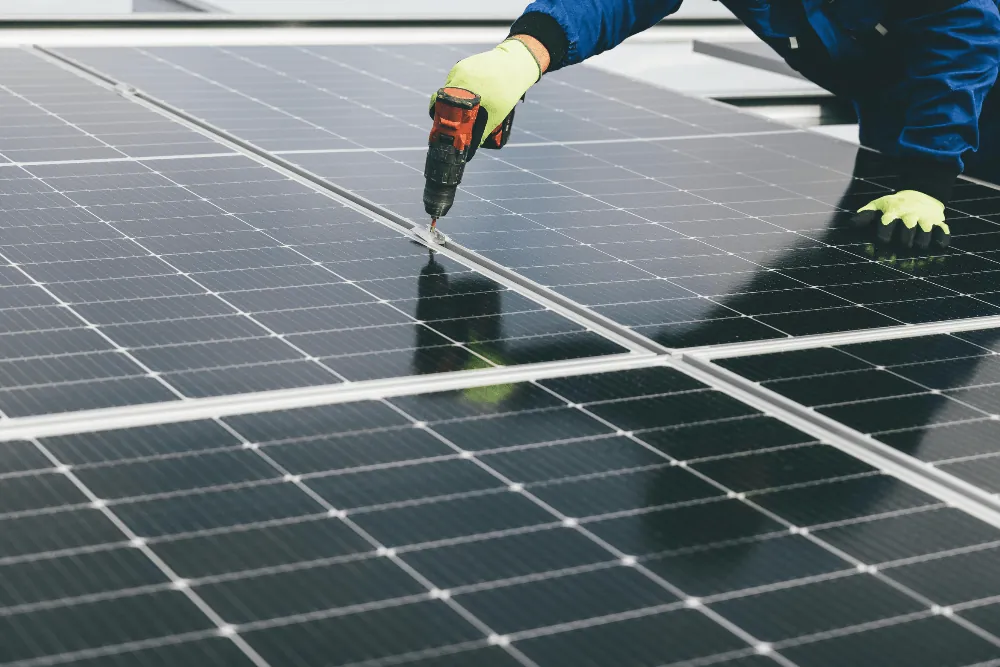
The installation, usually three to seven days of work on a home roof.
Testing and handover: inspection with DEWA, the new export meter, a working monitoring app and a walk-through of what the system is doing.
Aftercare: cleaning, checks and repairs when you want them.
The numbers at a glance
Typical answer for a Dubai home
If you own a flat, the roof belongs to the building, so solar is a decision for the owners' association and rarely suits a single unit. Villa owners are the main customers for this service.
Solar panels for your home: how the system works
A residential solar panel turns sunlight into direct current. An inverter changes that into the alternating current your home uses, and the power goes straight to your distribution board. Your lights, fans and air conditioners use it first. Whatever you do not use flows out through DEWA's bidirectional meter and is credited to your account. At night, and on cloudy or dusty days, you draw from the grid as you do now.
The panels have no moving parts, and the system does not need a battery to work. For a Dubai villa that stays connected to DEWA, the battery is optional.
Which type of system fits a Dubai home
Grid-tied
Panels and inverter feeding your board and the DEWA grid
Hybrid
Grid-tied system plus a battery and a hybrid inverter
Off-grid
Panels, battery and inverter with no DEWA connection
A grid-tied system shuts down when the grid fails. That is a safety rule: it stops your panels sending power into lines where DEWA crews may be working. If you want lights and the fridge on during an outage, you need a hybrid system with a battery, covered in our battery storage installation service.
How big a system do you need
To size a home solar panels system, start with your bills. Add up the kilowatt-hours you used in the last 12 months. A Dubai system produces roughly 1,500 to 1,700 kWh a year for every kW installed, so divide your annual use by that number to see what size would cover all of it.
A villa using 3,000 kWh a month uses 36,000 kWh a year. A 10 kW system would make around 16,000 kWh, about 44% of that. You can go larger, but two limits apply: your roof and the load DEWA allows for your plot.
- Roof space. Plan on 5 to 7 square metres of clear roof for each kW. A 10 kW system needs 50 to 70 square metres.
- Connected load. DEWA caps a home system by the total connected load of the property. Most homes end up between 4 kW and 12 kW. We check your load before we design anything.
- Your budget. The first kW you install earns back faster than the last, because it replaces your most expensive electricity. That is why we often size to 70% to 80% of yearly use.
What the roof needs to be
Orientation matters less in Dubai than in cooler countries, but it still counts. South-facing panels tilted at 10 to 25 degrees collect the most. Flat concrete roofs, which most villas have, let us set the tilt on a frame. East- and west-facing sections still work, at a small loss.
Shade matters more than direction. On a standard string inverter, one shaded panel pulls down every panel wired in the same string. Water tanks, parapet walls, satellite dishes and the neighbour's palm tree all cast shadows that move through the day. We map them on the survey, and where shade cannot be avoided we use panel-level optimisers or microinverters so that one dim panel does not drag down the rest.
DEWA approval: how Shams Dubai works
If a solar system connects to DEWA's grid, DEWA has to approve it first. The scheme is called Shams Dubai, and DEWA launched it in 2015. You cannot file the application yourself. It has to come from a solar contractor or consultant that DEWA has enrolled, and DEWA publishes the list of enrolled companies on its website. Before you sign with anyone, check their company name against that list. We do the installation and the electrical work, and we build to the design your chosen enrolled company gets approved.
An unapproved system cannot be connected, and without the connection agreement you cannot export a single unit. So the order is fixed: approval first, panels second.
The four stages
1. No Objection Certificate (NOC)
We send DEWA the application, site layout and the panel and inverter datasheets
2 to 3 weeks2. Design approval
We send the single-line diagram, string layout, load and inverter calculations and the protection and earthing details. DEWA replies with a fee estimate
1 to 3 weeks3. Installation
We build exactly what was approved. Any change means going back to DEWA
3 to 7 days4. Inspection and connection
DEWA inspects, fits a bidirectional smart meter and issues the connection agreement
1 to 2 weeksThe times are DEWA's, not ours, and they move with its workload. From the first application to switch-on, plan on 6 to 12 weeks. A clean first submission is the best way to keep to the short end, which is why we check every document before it goes in.
What DEWA requires of the system
- Placement. Rooftops, building facades and structures such as carport canopies and pergolas. Ground-mounted systems are not permitted under the scheme.
- Size. The system must stay within the load limit for your property. This is the main cap on a villa system.
- Approved equipment. Panels, inverters and protection devices must be on DEWA's approved equipment list. The panels and inverters must carry the international safety certificates DEWA names, and the inverter must have anti-islanding protection, the feature that shuts it down when the grid does.
- Protection. Surge protection is required. The earthing has to meet DEWA's rules, so we usually test the existing earth before we start. See earthing and grounding and surge protection.
Because models are added to and removed from the approved list, we check the list on the day we submit, not on the day we quote.
What you get for the power you export
Shams Dubai uses net metering. Power you export during the day is credited against your bill. DEWA does not pay cash for surplus power. The practical result is simple: build the system to cover what you use, not to export a lot, because exported units are only worth what they take off your bill. DEWA's 2025 conditions carry surplus credit forward from one bill to the next with no time limit, until the account is closed.
Fees and permissions
DEWA gives you a connection fee estimate after the design is approved. We include that fee in your quote. Two more permissions sit outside DEWA:
- Tenants need the landlord's written consent.
- Villa communities often have their own rules for roof equipment. Check with your community management early. We can write the technical letter they ask for.
What solar panels cost in Dubai and how fast they pay back
A 5 kW home system typically costs AED 20,000 to 35,000 installed and approved. A 10 kW system costs AED 35,000 to 55,000. The quote after the AED 50 survey gives the exact figure for your roof. The price per kW is not fixed. What moves it is listed below.
| System size | Typical installed price (AED) | Yearly output (kWh) | Roof space needed |
|---|---|---|---|
| 5 kW | 20,000 to 35,000 | 7,500 to 8,500 | 25 to 35 m² |
| 10 kW | 35,000 to 55,000 | 15,000 to 17,000 | 50 to 70 m² |
| 15 kW | 60,000 to 80,000 | 22,500 to 25,500 | 75 to 105 m² |
Prices include panels, inverter, mounting, cabling, protection, DEWA fees and labour. They do not include a battery, a new distribution board or structural work. Those are quoted separately and only if your site needs them.
What moves the price
- Roof type. A flat roof needs tilted frames. A pitched tile roof needs hooks and careful sealing. Both cost more than a simple flat-mount.
- Cable run. The distance from the roof to your distribution board changes cable and labour cost.
- Inverter choice. String inverters are cheapest. Optimisers or microinverters add cost but protect output where there is shade.
- Board condition. An old or full distribution board may need replacing before it can take a solar breaker. See DB box and distribution board.
- Battery. A home battery is the largest optional extra and is priced separately.
- Access. Four-storey villas and roofs with no easy lift access mean extra equipment and time.
How to work out your own payback
No one can give you a payback figure for household solar panels without your bill. This is the sum we run for every customer:
Take the yearly output for the system size from the table above.
Multiply by the rate per kWh on your bill. Use the all-in rate for the units at the top of your slab, because those are the units solar removes first.
Divide the installed price by that yearly saving.
Here is the sum for a 10 kW system at three different rates, using 16,000 kWh a year of output and two prices.
| Your rate per kWh | Yearly saving (AED) | Payback at AED 35,000 | Payback at AED 45,000 |
|---|---|---|---|
| AED 0.30 | 4,800 | 7.3 years | 9.4 years |
| AED 0.35 | 5,600 | 6.3 years | 8.0 years |
| AED 0.40 | 6,400 | 5.5 years | 7.0 years |
The heavier your summer use, the higher the slab you reach and the faster the system pays back.
Two costs belong in the sum. Panels lose about half a percent of output a year, which adds only a few weeks to a seven-year payback. The inverter is the bigger item: it will need replacing once, at around ten years. Ask for its replacement price and add it, with a cleaning allowance, to the cost side.
When solar does not make sense
We tell customers when to wait. Solar is a poor fit if:
- You use under about 1,000 kWh a month, so the system would have little to offset.
- The roof is shaded for much of the day and cannot be cleared.
- You plan to move within three or four years, and the sale price will not reflect the system.
- Your landlord will not give written consent.
If you are not sure, send us a photo of your last bill on WhatsApp. We give you the size, price and payback, and we will say so if the sum does not work.
How a solar installation runs, step by step
From your first message to the day the system is switched on takes 6 to 12 weeks. Most of that is waiting for DEWA. The work on your roof takes three to seven days. This is how it goes.
- 1You send a bill and photos. A WhatsApp message with your latest DEWA bill, three photos of the roof and your area is enough for a first estimate of size, price and payback.
- 2We survey the site. An engineer visits, measures the usable roof, maps shade through the day, checks the roof structure and opens your distribution board to see whether it can take a solar breaker. We test the existing earth. This visit usually takes about an hour.
- 3You get a written quote. It states the system size, the brand and model of every main part, the warranties, what is and is not included, the DEWA fees and the expected yearly output.
- 4We apply to DEWA. After you accept, we file the NOC and then the design application. You sign what DEWA needs from the owner. We keep you posted at each approval.
- 5We order equipment from DEWA's approved list once the design is approved, so that what arrives matches the drawings.
- 6We install. This is the PV panel installation itself, described below.
- 7We test. Before DEWA arrives we check every string and circuit ourselves.
- 8DEWA inspects and connects. DEWA checks the work against the approved design, fits the bidirectional meter and issues the connection agreement.
- 9We switch on and hand over. The monitoring app is set up on your phone, and you get the documents.
What happens during the installation days
Mounting
We fix the frames to the roof. On a concrete flat roof that means anchored or ballasted frames set at the design tilt. On a tile roof it means hooks under the tiles, resealed so the roof stays watertight. The frames are designed for the wind load at your roof height.
Panels and wiring
Panels are clamped on and wired into strings. Direct-current cable runs through conduit, away from sharp edges and out of standing water. Direct current stays live whenever light hits the panels, so there is no switch that makes the roof side safe in daytime. Only trained installers work on it.
Inverter and protection
The inverter goes in a shaded, ventilated spot, not in full sun, because inverters reduce output when they overheat. Next to it go the isolators, the breaker and the surge protection. The system is bonded to earth.
Connection to your board
An electrician connects the inverter's output to a dedicated breaker on your distribution board. If the board is old or full, this is where it gets upgraded.
Labelling
Every isolator and cable is labelled, and a warning label goes on the board.
What we test before DEWA arrives
- The open-circuit voltage and polarity of every string
- Insulation resistance on the direct-current and alternating-current cables
- Earth continuity on the frames and the inverter
- That the inverter shuts down when the grid is isolated, as the anti-islanding rule requires
- That the inverter reports power in line with the sunshine on the day
If anything fails, we fix it before the inspection, so DEWA's visit is a check, with nothing left to fix.
What you receive at handover
A copy of the approved drawings, the DEWA connection agreement, panel and inverter warranty documents with serial numbers, the test results and a one-page note on what to do if the system trips or the app shows an error.
Panels, inverters, batteries and mounting: what to ask for
Two systems with the same kW rating can perform very differently in Dubai's heat. The parts below decide that. Check each one against DEWA's approved list and the maker's datasheet.
| Part | What to check | Why it matters here |
|---|---|---|
| Panels | Temperature coefficient of power, performance warranty, DEWA approval | Panels lose output as they heat. A roof in July can push cell temperature past 60°C, which cuts output roughly 10% to 15% below the panel's label rating. A lower coefficient loses less |
| Inverter | Type, warranty length, local service, outdoor rating | The inverter works the hardest and is the part most likely to fail first. It must be certified for DEWA and rated for outdoor dust and heat |
| Mounting | Aluminium or stainless parts, wind-load rating | Dubai's humidity and coastal air corrode cheap steel quickly. Frames must hold in strong shamal winds |
| DC cable | UV-resistant solar cable, in conduit | Ordinary cable cracks in roof sun |
| Protection | Surge protector, isolators, breakers, earthing | Required by DEWA, and the main defence against lightning and grid surges |
| Monitoring | App and alerts | Shows when a string fails or the panels need cleaning |
Panels
Most home systems now use monocrystalline panels of 500 to 600 watts. Two numbers matter more than the brand name. The first is the temperature coefficient, a figure on the datasheet that shows how much power the panel loses for each degree above 25°C. Compare it between models. The second is the warranty. Look for a 25-year performance warranty that guarantees at least 80% output at the end, plus a separate product warranty against defects, and check who in the UAE honours it.
Inverters: string, optimiser or micro
A string inverter serves a group of panels. It is the cheapest and simplest, and it suits a clear roof with no shade. Optimisers are small devices on each panel that let a string inverter work around a shaded or dirty panel. Microinverters put a small inverter behind every panel, so one weak panel affects only itself. They cost more per kW and put electronics on the hot roof, so we use them where shade or an awkward roof layout justifies it.
The inverter usually carries a 5 to 10 year warranty, and you should plan to replace it once in the system's life. Ask for the warranty length in writing and whether it can be extended.
Do you need a battery?
For most villas, no. Under net metering, a unit you export earns the same credit as a unit you use, so storing it in a battery does not earn you more. A battery rarely pays for itself in bill savings. The reason to buy one is resilience: lights, fridge, Wi-Fi and a few fans during a cut.
If you want that, we fit a hybrid inverter with a lithium iron phosphate battery and wire the essential circuits to it. Size the battery to the essential load, not to the whole house. A battery that runs a 3 kW air conditioner overnight is far larger and dearer than one that runs lights, fridge and internet. See battery storage installation and UPS and inverter installation.
How to read a solar quote
When you compare quotes, look for these gaps:
- No brands or model numbers. "Tier 1 panels" is not a specification.
- No DEWA fees or approval in the price. You may be billed for them later.
- No mention of earthing, surge protection or the distribution board. These are required work.
- No yearly output estimate, or one far above about 1,700 kWh per kW.
- A price per kW far below the others. Something has been left out or downgraded.
- No warranty terms for the inverter and the workmanship.
Living with solar in Dubai: dust, heat and upkeep
A solar system needs little attention, but Dubai's dust is the one thing that does cost you output. A film of sand on the glass cuts production, and after a sandstorm the drop shows in the app.
Cleaning
We suggest cleaning about once a month, and after every sandstorm or a day of heavy construction dust nearby. Your monitoring shows how fast your roof gets dirty, so you can adjust.
- Use water and a soft brush or cloth. Hard scrubbing and abrasive cleaners scratch the glass coating.
- Clean early in the morning or in the evening. Cold water on hot glass in midday sun stresses the panel, and the water dries into marks.
- Do not walk on the panels. Cells can crack in ways you cannot see, and cracked cells lose output over time.
- Avoid high-pressure jets on edges and cable connections.
- Take the safe route to the roof. Working at height on a hot roof is the real risk in cleaning. We can do the cleaning for you.
Watching the system
The monitoring app shows the day's production. Learn what a normal clear day looks like for your system, and check three things now and then:
- Production on a clear day well below the same day last month. Dust is the first suspect. If cleaning does not fix it, message us on WhatsApp.
- A flat line at zero in daylight. The inverter has stopped. Look for an error code or a tripped breaker.
- One string far below the others. That usually means a shaded, dirty or faulty panel, or a loose connector.
Summer and winter
Production is highest from spring to early autumn, when the days are long and the sun is high. But summer heat trims each panel's output, and haze and dust cut it further, so the gap between summer and winter is smaller than the hours of daylight suggest. Your bill is highest in summer, so the electricity solar produces then is worth the most.
Faults to know about
| What you see | Likely cause | What to do |
|---|---|---|
| Inverter shows a grid error | The grid voltage went out of range, or DEWA had an outage | Wait ten minutes. Most reset on their own. If it repeats, message us on WhatsApp |
| Inverter shows an earth or insulation fault | Water in a connector, damaged cable or a failed surge protector | Do not reset it repeatedly. Message us on WhatsApp |
| Solar breaker trips | Overload, a faulty inverter or a wiring fault | Turn it off and message us on WhatsApp. See breaker tripping repair |
| A dark patch on a panel | A hot spot from bird droppings, or a cracked cell | Clean it first. If it persists, we inspect it. A thermal camera shows the fault clearly. See thermal imaging inspection |
| Output drops over a few weeks | Dust, new shade or a failing string | Compare against last month and message us on WhatsApp |
Yearly check
Once a year we recommend a visit. We tighten connectors, check the earth and surge protection, test the inverter, look for hot spots and cracked panels, and clean everything properly. Keep the report with your warranty papers, because a maker may ask for it when you claim.
If you sell the house, hand over the approved drawings, the DEWA connection agreement and the warranties with it.
Solar power installation with Circuit Dubai
Solar is mostly electrical work. The roof is half the job. The other half is your distribution board, earthing, protection and DEWA's rules, which we deal with every day.
- Our electricians are experienced in Dubai homes and buildings.
- The workmanship warranty is written on your quote, on top of the panel and inverter warranties.
Areas we cover
We install solar on villas and houses across Dubai. We serve villa communities across the whole of Dubai, including Arabian Ranches, Dubai Hills Estate, Mirdif, Al Barsha, Jumeirah and Palm Jumeirah.
How to book
Message us on WhatsApp with your latest DEWA bill, your area and three roof photos.
We reply instantly on WhatsApp with a first size and payback estimate and a time for the site survey.
The site survey costs AED 50.
Ten minutes of preparation before the survey
- Bills. Find your last 12 months of DEWA bills, in the DEWA app or on paper. The summer months matter most.
- Photos. Take one from the roof access door, one wide shot of the whole roof and one of anything tall nearby, such as a water tank or a neighbouring building.
- Shade. Look at the roof at about 9 am, noon and 3 pm and note where the shadows fall.
- Community rules. Ask your community management whether roof equipment needs approval, and what they want to see.
- Landlord. If you rent, get the landlord's written consent now.
Phone: +971 55 407 7427
Related services
If you are also planning an EV charger installation, a DB box upgrade, a three-phase and load upgrade or an electrical inspection, we can scope them at the same survey. For shops, warehouses and offices, see our commercial solar service.
Solar panel questions we hear from Dubai homeowners
Do I still get a DEWA bill after installing solar?
Yes. You still pay DEWA's fixed charges and any units you draw from the grid, mainly at night and on poor days. Solar reduces the units on the bill. It does not remove the bill.
Can solar run my air conditioners at night?
Not without a battery. Panels produce only in daylight, so at night your air conditioners run on the grid. The saving comes from daytime use and from exported power credited against the evening and night units.
Do panels work on hazy, cloudy or dusty days?
They do, at lower output. Thin cloud and haze cut production by part, not all. Heavy dust on the glass is a bigger loss, which is why cleaning matters.
Is a pool pump a good fit for solar?
Yes. Pool pumps usually run in the daytime, exactly when the panels produce most, so a villa with a pool, a few air conditioners and a water feature uses a high share of its own solar power directly.
Can I charge an electric car from solar panels?
Yes, with a grid-tied system. The car charges from the house supply and the solar power offsets what you use. Charging at midday matches the sun best. We can fit both together. See EV charger installation.
Can I add more panels later?
Sometimes. DEWA approves a specific design, so an extension is a new application, and your inverter and load limit decide whether it fits. If you may expand, tell us at the survey and we will leave room in the design for it.
Will solar panels damage my roof?
Not if they are fitted properly. On flat roofs we use frames that spread the load and keep the waterproofing intact. On tile roofs, every hook is sealed. We check the roof structure at the survey. Older buildings are where this matters most.
Can I install solar panels myself?
Not legally if you want to connect to DEWA. The application must come from an enrolled contractor, and the system must be built to the approved design. Direct current on a roof is also a shock and fire risk for anyone untrained.
Ready to see what solar would save you?
Send us your latest DEWA bill and three photos of your roof on WhatsApp. We reply instantly on WhatsApp with a size, a price and a payback in plain numbers.