Electrical Fault Repair in Dubai: Fault Finding, Faulty Wiring, Flickering Lights, Dead Sockets and Low Voltage Work for Homes and Businesses
Electrical fault repair begins with finding the fault, because a tripping breaker, a flickering light, a dead socket or a smell of burning is only the symptom. The cause sits somewhere along the circuit, and the quickest way to it is a method: ask what changed, isolate the circuit, test it with instruments and narrow the search until one joint, one cable or one device is left. We write down the readings so you can see what we saw.
Circuit Dubai does electrical fault diagnosis and repair for villas, apartments, offices, shops and warehouses across Dubai. That covers faulty wiring and house wiring fault finding, voltage that rises and falls, lights that flicker or dim, sockets and switches that have gone dead, and the electrical side of an appliance that will not start. Low voltage is a term with more than one meaning, so the page also explains what it covers and which low voltage jobs we take.
What electrical fault repair with us includes
Fault diagnosis by test, with the circuit isolated and checked with a multimeter, an insulation tester and a voltage tester, so the cause is measured and not assumed.
Fault finding in electrical circuits of every kind, from a dead socket on one ring to a loose neutral that upsets a whole villa.
Repair at the cause, by replacing a failed breaker, socket, switch or joint, or re-making a connection that has burned, and not by resetting and hoping.
Dimming, flickering and voltage problems traced to the lamp, the dimmer, the connection or the supply, and a clear answer on which part is ours to fix and which belongs to DEWA.
Low voltage work, meaning garden and landscape lighting, control wiring and transformers, which the terms section sorts out before you book.
A written result, with the readings before and after, the part that failed and a note of anything else we saw.
The numbers at a glance
Typical answer for Dubai
Before you book electrical fault repair, write down what happened and when: what was running, whether the breaker tripped, whether it is one socket, one room or the whole home, and whether it happens at a certain time of day. Do not reset a breaker that trips again straight away. If a socket is hot, a fitting smells of burning or there is any sign of water near an electrical part, switch off at the main board if you can do so safely, keep clear and message us on WhatsApp. Photograph the main board, the label on each breaker and the fault itself.
Electrical fault terms: what people search for and what each means
People describe an electrical problem in many ways, from a trade phrase such as electrical fault diagnosis to an American phrase such as half hot outlet. The tables below match each wording to the work behind it, so you can go straight to the part of this page that fits. Where a term is something we do not do, the table says so.
Fault finding terms
| If you searched | What it means |
|---|---|
| Electrical fault repair, electrical fault diagnosis | Finding why a circuit or a device has failed, then repairing the cause and not only the symptom |
| Electrical fault finding, fault finding electrical circuits | The same job named by its first half: tracing a fault along a circuit with tests until one part is left |
| Basic electrical fault finding | The first checks anyone can make safely: is there supply, has a breaker or RCD tripped, is the device itself dead. The planning section says where those checks end |
| House wiring fault finding | Tracing a fault in fixed wiring behind walls and ceilings: cables, joints, sockets, switches and lighting circuits |
| Faulty wiring | A cable, joint or fitting that is damaged, loose, burned, wet or wrongly connected. The fault types section lists the forms it takes |
| Electrical fault finding cost | What a visit costs and what moves the price. The cost section answers it |
Symptom terms
| If you searched | What it means |
|---|---|
| Flickering lights repair | Light that pulses or drops out. The cause is the lamp, the dimmer, a loose connection or the supply, and the symptoms section sorts them |
| Voltage fluctuation at home, voltage fluctuation in home | Voltage that rises and falls at the sockets and lights. It can come from a loose neutral, a large load starting or the supply outside the building |
| Dim lights Google Home | Lights that will not dim properly, or flicker, when controlled from a voice assistant. Usually a mismatch between a smart bulb and a wall dimmer |
| Half hot outlet | An American phrase for a twin outlet where one half works and the other does not. In Dubai it is a twin socket with one dead gang |
| Faulty lid switch washing machine | A washing machine that will not start because the lid or door switch fails. The switch is an appliance part. The supply to the machine is ours to test |
GFCI terms
| If you searched | What it means |
|---|---|
| Installing ground fault circuit interrupter outlets | A GFCI is the American name for a device that cuts the supply when current leaks to earth. Dubai uses the RCD, set at 30 mA for sockets. The earth leakage section explains the difference |
| Wiring a ground fault circuit interrupter | Connecting a device with a LINE side and a LOAD side. We explain what that means and why an American unit may not suit a Dubai supply |
Low voltage terms
The words low voltage carry two meanings. In the standards, low voltage means mains voltages up to 1,000 V AC, which includes the 230 V and 400 V in every Dubai building. In the trades, low voltage means the opposite: wiring at 50 V or less, such as thermostat wires, garden lighting and data cables. The low voltage section sets both out. The table matches the searches to the work.
| If you searched | What it means and where it is covered |
|---|---|
| Low voltage electrician, low voltage electrician near me, low voltage technician, low voltage technician near me, low voltage engineer | A person who works on low voltage systems, mains or extra low. We are electricians for both, within the scope on this page. Design is separate engineering work |
| Low voltage contractors, low voltage contractors near me, low voltage contractor near me, low voltage installation company | A firm that installs low voltage systems. We take homes and small buildings. A large package for a whole building is a design and contracting job, and we say so at the quote |
| Low voltage work, low voltage installation, low voltage wiring installation | The installing of low voltage circuits. The wiring jobs section lists what we do |
| Low voltage home wiring, low voltage house wiring, residential low voltage wiring | Wiring in a home that runs below 50 V, or a home's own mains wiring, depending on who is asking |
| Low voltage cable installation, low voltage structured cabling | Running cable for data, TV and controls. This is a cabling job |
| Low voltage home automation | Switches, sensors and controllers for a smart home. Smart home work is its own service |
| HVAC low voltage wiring, HVAC low voltage control wiring, low voltage HVAC wiring | The small wires that carry thermostat and control signals to an air conditioning or heating unit |
| Low voltage lighting installation, wiring low voltage lights, low voltage landscape lighting wiring, low voltage landscape lighting near me, designing low voltage landscape lighting system | Garden and outdoor lights run from a transformer at 12 V or similar |
| Installing a low voltage transformer, wiring a low voltage transformer, low voltage transformer installation | The transformer that steps mains down to the voltage the lights need. Not the large transformer in a substation |
| Conduit for low voltage, low voltage flexible conduit | The pipe that protects low voltage cable, often flexible where it turns or enters a box |
| Low voltage termination, low voltage termination kit | Ending a cable correctly with a lug, a gland or a termination kit |
| Low voltage inspection | A check and test of an installation, covered by the electrical inspection service |
| Low voltage insulation resistance test, megger test for low voltage cables | A test of the insulation on a cable or circuit at a stated voltage. The testing section gives the values |
| Low voltage switchgear maintenance, low voltage circuit breaker maintenance | Servicing the panels and breakers that distribute mains power inside a building |
See our electrical inspection, insulation and earth resistance testing, MCB and RCCB breakers, smart home installation, TV, data and network cabling, outdoor and garden lighting and cable termination and jointing pages for the work that belongs to each service on its own.
Planning an electrical fault repair: what to check, what to tell us and what to leave alone
A fault is found faster when the description is exact. Ten minutes spent noting what happened saves time on site, because it tells us which end of the circuit to start from. This section lists the checks that are safe for anyone to make, the details that help us most and the things that make a fault worse.
Basic electrical fault finding you can do safely
These checks need no tools and no opening of anything. Stop at the first one that explains the problem.
- 1Test the device, not only the socket. Plug a lamp or a phone charger that you know works into the dead socket. A dead appliance is not an electrical fault in the building.
- 2Check the switch on the socket. Most wall sockets in Dubai have a switch for each socket. A socket that looks dead may be switched off.
- 3Look at the board. Open the front door of the main board and the sub-board and look for a breaker that has dropped to the off position, or an RCD that has tripped. A breaker that has tripped sits between on and off on many models.
- 4Reset once. Switch the tripped breaker or RCD back on one time. If it trips again at once, stop. A fault that trips twice is a fault that needs to be found, and not a nuisance to be cleared.
- 5Ask whether it is only you. If the neighbours in the building or on the street have lost power or see lights dim and brighten, the cause is probably outside the property. Ask the building management or call DEWA.
- 6Note what was running. A new air conditioner, a kettle, a hair dryer or a pump starting at the moment of the trip points to an overloaded circuit or a faulty appliance.
What to leave alone
- Do not remove the cover of the board, a socket or a switch. The terminals behind them are live, and a main board stays live at the incoming side even with the main breaker off.
- Do not keep resetting a breaker that trips. Each reset can put current into a fault.
- Do not replace a breaker with a larger one. The breaker protects the cable. A bigger breaker lets the cable overheat before it trips.
- Do not bypass an RCD that trips. The RCD is telling you that current is leaking to earth, which may be through a person.
- Do not use a socket that is hot, scorched, buzzing or loose. Switch off its circuit and tell us.
What to tell us
| Question | Why it matters |
|---|---|
| When did it start, and was it sudden or gradual? | A sudden fault often has a single cause, such as a failed device. A gradual one suggests a loose or deteriorating joint |
| What changed just before? | New appliances, building work, a rain storm, an air conditioner service or a power cut each point to different places |
| One socket, one room, one circuit or the whole home? | The spread tells us where on the circuit the fault lies |
| Constant or intermittent? | An intermittent fault is usually a loose connection or a load that starts and stops, and it needs a different search |
| Any smell, heat, noise or sparks? | These make the job urgent and change what we bring |
| Which breaker trips, and what is its label? | It names the circuit to start with |
| How old is the wiring, and who worked on it last? | Old wiring, DIY work and extensions are places where faults start |
| Any shock or tingle from a tap, a fridge or a metal fitting? | That points to an earthing fault and is treated as urgent |
Photos that help
Send a photo of the main board with its door open, showing the breaker labels, and one of any sub-board. Send a close photo of the faulty socket, switch or light, taken without removing anything. If there is a scorch mark, a burned smell or water damage, photograph that too. Photos let us arrive with the right parts for a common failure, such as a socket or a breaker, and not return for them.
Villas, apartments and commercial units
In a villa the circuits are spread across a main board, sub-boards, a pool or plant room and sometimes an annex or a boundary wall, so a fault in one place can show up in another. In an apartment the supply to the building belongs to the building and to DEWA, and the wiring from your meter inward is yours or your landlord's, depending on the lease. We ask your landlord or building management for the approval for you. In a shop, office or warehouse the supply is often three-phase, and a fault on one phase can leave part of the unit working. Tell us who controls the building so we can arrange access and any shutdown that a tenant needs.
Planning the visit
Make sure someone can open the board, the ceiling hatches and any locked plant room. For a fault in a working office or shop, tell us the quietest hours, because finding a fault often means switching circuits off. If the fault comes and goes, leave it as it is: do not repair or replace anything in the meantime, because an intermittent fault is easier to catch while it is still there. See our breaker tripping repair page if the main symptom is a breaker that will not stay on.
Rules and safety for electrical fault work in Dubai
Fault repair is regulated work in Dubai. The rules below come from DEWA's Regulations for Electrical Installations, 2017 edition, which is the edition we read for this page. They shape what we test, what we are allowed to change and what we must report.
What the DEWA regulations say that affects a repair
| Topic | What the regulations state |
|---|---|
| Supply | 230 V single-phase and 400 V three-phase at 50 Hz, with a variation of plus or minus 10 per cent. That is 207 to 253 V on a single-phase supply and 360 to 440 V on three-phase |
| Residual current protection | A residual current device with a rated operating current of no more than 30 mA is required on socket outlets rated 20 A or less, on cables concealed in walls less than 50 mm deep, and on cables in walls that contain metal parts. Every water heater circuit is protected by a 30 mA device |
| Voltage drop | The maximum drop from the point of supply to any point of use is 4 per cent of the nominal voltage, which is 9.2 V on a 230 V circuit |
| Who may do the work | Consultants and electrical contractors enrol with DEWA, and each contractor has engineers and technicians who know the regulations and test the work before power is connected |
| Alterations | Extensions and alterations to an installation need DEWA's approval first |
| Testing | An installation is open to DEWA's inspection and testing, and the contractor tests it first. Commercial and industrial installations are inspected at least every two years |
A repair that puts back a like-for-like part, such as a socket, a switch or a breaker of the same rating, is a repair. Adding a circuit, moving a board, raising a load or changing a protective device is an alteration and goes through approval first. We say which one a job is before we start.
How we make a circuit safe
Find the circuit and switch it off at the board, and lock or tag the breaker so that nobody switches it back on.
Prove the voltage tester, by checking it on a known live source before the test.
Prove the circuit dead at the point of work, and confirm that no other circuit shares the neutral.
Prove the tester again on the known source, to show that it worked and did not fail halfway.
Test live only where the fault demands it, with insulated probes and one hand clear, and never on a socket, a switch or a cable that is damaged or wet.
A fault that is found live, such as a loose neutral, is measured at the board with the circuit protected. We do not open a fitting to look inside while it is live.
Signs that cannot wait
| Sign | What to do now |
|---|---|
| Sparks, a bang, or a burning smell | Switch off at the main breaker if you can do so without touching anything damaged, leave the room and message us on WhatsApp. If you see flames, call 997 |
| A socket, plug or fitting that is hot or scorched | Switch off its circuit at the board and keep clear until it is checked |
| A tingle or shock from a tap, a fridge, a metal frame or a switch | Stop using the item, switch off its circuit and message us on WhatsApp. It points to an earthing fault |
| Water near a socket, a board or a light | Switch off the circuit at the board from a dry position, and do not touch the wet item |
| A breaker or RCD that trips every time you reset it | Leave it off and message us on WhatsApp |
| A buzzing or crackling sound from a board or a fitting | Switch off the circuit and message us on WhatsApp |
Stop and keep clear of any socket, switch, board or appliance that sparks, smells of burning, feels hot or is wet. Switch off its circuit from the board if you can reach it without touching anything damaged, leave it off and message us on WhatsApp. Do not try to open it, wipe it or test it yourself.
Work we do not take, and where it goes
A fault inside the supply authority's equipment, such as the service cable, the meter or the transformer that feeds the building, belongs to DEWA, and we tell you when a test points there. A fault inside an appliance, such as a washing machine motor or a water heater element, belongs to an appliance technician or the maker, and we test the supply to it. We replace small electrical parts such as an element, a thermostat or a switch. A building's fire alarm or high-voltage equipment has its own specialist route, covered in our fire alarm and smoke detector installation and transformer and substation maintenance pages.
How an electrical fault is found: the method and the instruments
Electrical fault finding follows the same order whether the fault is a dead socket or a villa where the lights dim and brighten: gather the history, look, isolate, split the circuit, test, find the part, repair and prove the result. The instruments differ with the symptom. The method keeps the search short, because each step rules out half of what is left.
The method, step by step
- 1Take the history. What failed, when, and what changed. The planning section lists the questions.
- 2Look first. Check the board for tripped devices, heat marks and loose conductors, and look at the faulty fitting without opening it. Many faults leave a mark.
- 3Check the supply at the board. Measure the voltage on each phase and between neutral and earth, with the loads on and off. This shows whether the fault is in the building or arriving from outside.
- 4Isolate and split. Switch off the circuit and divide it at a midpoint, such as a junction box or the middle socket. Test each half on its own.
- 5Test the half that holds the fault, and split it again. Each split halves the search, so a circuit with sixteen fittings is down to one in four steps.
- 6Name the part. The cable, joint, fitting or device where the reading changes is the fault.
- 7Repair at that part, with a like-for-like replacement or a remade joint, tightened to the torque the maker states.
- 8Prove the repair. Repeat the tests that failed, and a full circuit test, before the circuit goes back on.
- 9Record it. The readings, the part and any other defect seen go on the report.
Instruments and what each one finds
| Instrument | What it measures | Faults it finds |
|---|---|---|
| Voltage indicator (two-pole tester) | Whether a conductor is live | Proves a circuit dead before work, and finds a missing live or neutral |
| Multimeter | Voltage, continuity and resistance | Open circuits, a failed switch or a device with no supply |
| Insulation resistance tester | Resistance of insulation at 250 V or 500 V DC | Damaged cable, moisture, a conductor touching earth or another conductor |
| Low-resistance ohmmeter | Very small resistances, on earth and circuit conductors | A poor connection or a broken earth |
| Earth fault loop impedance tester | The path the fault current takes | A breaker that would not trip fast enough in a fault |
| RCD tester | Trip current and trip time | An RCD that is slow or does not trip |
| Clamp meter | Load current, and leakage current to earth | A circuit that is overloaded or leaking, and an appliance that draws too much |
| Thermal camera | Surface temperature | A hot joint, a loose terminal, an overloaded breaker. See our thermal imaging inspection page |
| Cable tracer | The route of a hidden cable | A cable in a wall or ceiling that must be located before it is opened |
A worked example of splitting a circuit
A lighting circuit feeds eight lamps in a row. Lamps one to four work and lamps five to eight are dead. The fault is therefore at or just beyond lamp four. We switch off, open the fitting at lamp five and test the incoming live and neutral. If the live is missing there, the open joint is between lamp four and lamp five, and the search is down to one cable run and its two joints. If the live is present and the lamp is dead, the fault is in the fitting at lamp five. Two tests have replaced a search over eight lamps.
What the readings mean
- Live to neutral at the device is 230 V but the device is dead: the fault is in the device, not the circuit.
- No voltage at the device and none at the last good point: an open circuit lies between them, usually a loose or burned joint.
- Voltage between neutral and earth of more than a few volts under load: a neutral problem, which can raise or lower the voltage on other circuits. The symptoms section deals with it.
- Insulation resistance below 1 MΩ at 500 V: a leak to earth or between conductors. In the UK wiring rules a reading under 1 MΩ is a failure, one between 1 and 2 MΩ is investigated and one over 2 MΩ is satisfactory. Dubai work follows DEWA's regulations, so we use these figures as a guide and not as a standard.
- A breaker that trips only with one appliance on: the appliance, or the circuit overloaded by it.
Insulation tests apply a high test voltage, so dimmers, smart switches, LED drivers, surge protectors and other electronics are disconnected first. A test run across them can destroy them.
Intermittent faults
A fault that comes and goes is the hardest to find, because it is absent when we arrive. We ask when it happens, then try to recreate the conditions: run the air conditioner and the kettle together, tap the wall by the socket, flex the cable, or heat the room. Where that fails, we leave a logger on the circuit, or a clamp meter on the incoming cable, for a day or a week, and read the pattern when the fault returns. An intermittent fault comes from a loose connection, a damaged conductor that moves, or a load that starts and stops.
Types of electrical fault and what causes them
Almost every fault falls into one of a few types. Knowing the type tells us which instrument to reach for and which part of the circuit to suspect. It also explains why one symptom, such as a dead socket, can have a dozen different causes.
Fault types compared
| Fault type | What it is | What you notice | Common causes |
|---|---|---|---|
| Open circuit | A break in a conductor, so current cannot flow | A dead socket, switch or light, with no tripped breaker | A loose or burned terminal, a cable cut by a nail or a drill, a failed switch |
| Short circuit | A live conductor touching a neutral or another live conductor | A breaker that trips at once, sometimes with a bang | Damaged insulation, a crushed cable, a screw through a conductor, water in a box |
| Earth fault | A live conductor touching earth, so current leaks to it | An RCD that trips, a tingle from metal, or no trip at all if the earth is broken | Damaged or wet insulation, moisture in a fitting, a failing appliance |
| Overload | More current than the circuit is rated to carry | A breaker that trips after a delay, or a cable that feels warm | Too many appliances on one circuit, a heater or air conditioner added to a light circuit |
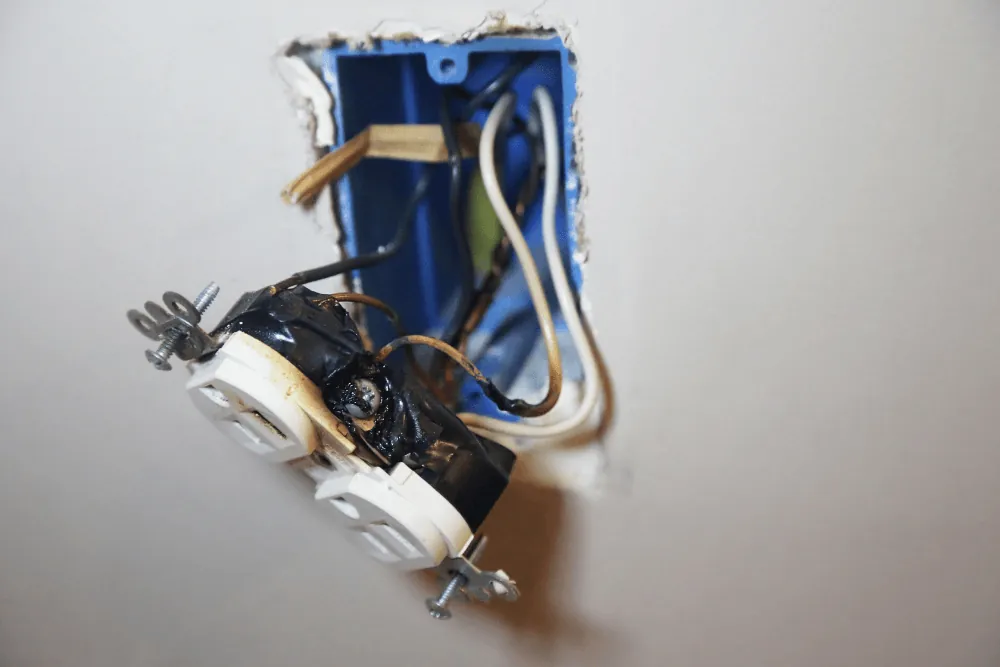
| High-resistance joint | A connection that has become loose or dirty and heats up under load | A warm or scorched socket, a smell of burning, lights that flicker | Terminal screws that have loosened with heat cycles, a poor crimp, a backstabbed connection |
| Neutral fault | The neutral is loose or broken, so the voltage shifts between circuits | Lights bright in one room and dim in another, appliances that fail | A loose neutral at the board, a broken neutral in a cable, a poor connection at the meter |
| Arcing | Current jumping across a gap in a damaged cable or joint | Crackling, buzzing, a burning smell, scorch marks | A cable nicked or crushed, a joint that has opened a little |
Where faulty wiring comes from
Faulty wiring is not only old wiring. Faulty wiring comes from these sources:
- Extensions and alterations. A socket spurred off another, a villa extension wired from the nearest light circuit, or a split ring that was never designed for the load.
- Work by unqualified people. Joints twisted and taped, a cable run through a hole without a bush, or a socket fixed over the cable it was cut from.
- Heat. Loft spaces, ceiling voids and plant rooms run hot. Terminals expand and contract with the day, and over years screws loosen.
- Moisture. Air conditioner condensate, a leaking pipe above a ceiling, a garden or pool wall socket and a bathroom light fitting all let water into places where electricity cannot tolerate it.
- Mechanical damage. A nail or a screw through a cable when a picture, a shelf or a curtain rail goes up.
- Poor first installation. Joints buried in the wall with no access, a cable that is too small for its breaker, or an earth that was never connected.
Signs of faulty wiring
- Breakers or RCDs that trip, especially with no obvious cause.
- Lights that flicker, dim, or change brightness when something else switches on.
- Sockets, plugs or switches that are warm, discoloured or smell of burning.
- Crackling, buzzing or fizzing from a socket, a board or a fitting.
- A tingle when you touch a tap, a metal appliance or a fitting.
- Sockets that are loose in the wall, or switches that stick.
- Repeated failure of bulbs or appliances on one circuit.
Any one of these is reason to have the circuit tested. A few together point to a wider problem, which is when a repair is not enough and the repair or rewire section applies.
Why a loose joint is dangerous
A loose joint adds resistance to the circuit. The heat given off in it is the current squared multiplied by the resistance. As an example, a 16 A circuit with a joint that has a resistance of 0.1 Ω gives off about 26 W at that one point, which is as much as a small soldering iron, sitting inside a wall or a plastic back box. The breaker does not trip, because the current is within its rating. The joint gets hotter, its resistance rises and the heat rises with it. This is why a warm socket is a fault, not a feature, and why a thermal camera finds joints that a multimeter cannot.
How we repair faulty wiring
We choose the smallest repair that removes the cause and leaves a sound installation:
Re-terminate a loose connection at the fitting or the board, with the right torque and a ferrule or a lug where the cable needs one.
Replace the fitting where a socket, a switch or a lamp holder has burned or cracked.
Replace a section of cable where it is damaged, with a joint made in an accessible junction box and not buried in the wall.
Replace the circuit where the cable is too small, too old or damaged along its length.
We tell you which of the four the job needs and why, before the work starts.
Symptoms and their causes: flickering lights, voltage fluctuation, half dead sockets and appliances that will not start
This section runs through the symptoms people most often describe and the causes behind each, in the order we would test them. The same symptom can come from a lamp costing a few dirhams or from a failing neutral at the board, so the aim is to tell them apart before anything is bought.
Flickering lights repair: finding the cause
| What you see | Likely cause | First check |
|---|---|---|
| One fitting flickers, others are steady | A loose lamp, a worn lamp holder or a loose connection at that fitting | Swap the lamp, then test the holder and the terminals |
| LED lamps flicker or buzz on a dimmer | A dimmer that does not suit LED lamps, or a load below its minimum | Check the dimmer and the lamp type for compatibility |
| Lights dip when the air conditioner, a pump or a kettle starts | The starting current of the motor pulls the voltage down on a shared circuit | Measure the voltage at the board and at the fitting while the load starts |
| Lights flicker in several rooms but no other circuits are affected | A loose joint or a failing neutral feeding that group | Test the joints and the neutral at the board |
| Every light in the home flickers, and neighbours see the same | A fault in the supply outside the property | Ask the neighbours and call DEWA |
| A switch that is warm, or a light that flickers when the switch is touched | A switch that is worn or loose | Replace the switch |
| Flicker with crackling, buzzing or a burning smell | Arcing at a damaged joint or cable | Switch off the circuit and message us on WhatsApp |
A flicker from a loose connection should not be left. The joint can arc and heat, which is how a nuisance becomes a fire. Flickering lights repair is therefore a repair at the connection and not a change of bulb, once the bulb has been ruled out.
Voltage fluctuation at home
Dubai's regulations allow the supply to vary by plus or minus 10 per cent, so the voltage at a 230 V socket can sit anywhere from 207 to 253 V without a breach. A brief dip when a large motor starts is normal. A fault shows up in other ways:
- A voltage that stays above 253 V or below 207 V with the loads steady.
- Some circuits bright and others dim at the same moment, which is the signature of a loose or open neutral.
- A voltage at the far end of a long run that is much lower than at the board, which points to a cable that is too small for its load or length. The regulations allow a drop of 4 per cent, or 9.2 V on a 230 V circuit.
- Lights or appliances that surge when a big load switches off.
We measure the voltage at the board and at the faulty point, with a heavy load on and off, and leave a logger on the supply where the fault comes and goes. The readings sort the cause into one of three places:
| Where the readings point | What it means | Who fixes it |
|---|---|---|
| Voltage wrong at the incoming supply, and neighbours see the same | A supply fault outside the property | DEWA |
| Voltage correct at the incoming terminals but wrong at the board or after it | A loose neutral, a loose main joint or a poor connection in the building | Us |
| Voltage correct at the board but low at the far point | Voltage drop in an undersized or overloaded cable | Us, by a new cable or a split load |
An open neutral is the most serious of the fault types, because the voltage on the circuits can rise well above 253 V and damage electronics. It is measured at the board under load and repaired by re-making the neutral connections. Equipment that is sensitive to over-voltage can be protected with the devices on our surge protection page.
Dim lights and Google Home
A light that will not dim properly from a voice assistant, or that flickers when dimmed, is a mismatch between the lamp and what controls it, unless the wiring behind it is faulty. There are three ways to set it up:
A smart bulb on an ordinary wall switch. The bulb dims from the app or the assistant. The wall switch must stay on, and if someone switches it off the bulb loses its connection.
A smart dimmer or smart switch with ordinary dimmable LED lamps. The dimming is done in the wall and the lamps are plain. This is the setup we favour for a room that several people use.
A smart bulb on a physical dimmer. The dimmer chops the supply to the bulb, and the bulb's own electronics fight it. The result is flicker, a bulb that drops off the network, or a lamp that will not go below a certain level. Avoid it.
If the lamps and the control are matched and the dimming still misbehaves, we test the lamp load against the dimmer's minimum, the neutral at the switch and the signal strength to the hub. See our dimmer installation, smart switch installation and smart home installation pages for the work on each.
Half hot outlet: half a socket that works and half that does not
In the United States a half hot outlet is a split receptacle, where one half is switched from a wall switch and the other is live all the time. In Dubai the equivalent is a twin socket plate with a switch on each gang, and a dead half has a short list of causes:
- The gang's own switch is off. The first thing to check.
- A loose wire on that gang's terminal, which gives a socket that works when it is pressed and fails when it is not.
- A failed socket or switch mechanism, with no continuity through it.
- A broken link in a spur, where one socket feeds another and the feed has opened.
- A tripped RCD on a shared circuit.
We test the dead gang with the supply off and again live from the board side, then replace the plate or re-make the connection. A socket that works by moving the plug is not a socket to live with, because a loose contact heats. See our socket outlet installation page.
Faulty lid switch on a washing machine
A washing machine that will not start, or fills and then stops, is often blamed on the lid or door switch, which is a safety switch that stops the drum turning while the lid is open. Test the supply first: the plug, the socket, the RCD and the breaker. A lamp plugged into the same socket shows whether it is live. If the supply is sound, the switch itself can be tested with a multimeter set to continuity. A reading with the lid closed that shows no continuity means the switch has failed.
The switch is an appliance part, so replacing it normally belongs to an appliance technician or the maker's service. We test the socket, the circuit and the protection, and tell you when the fault is in the machine.
Earth leakage trips and ground fault circuit interrupter outlets
A ground fault circuit interrupter, or GFCI, is the American name for a device that Dubai's regulations call a residual current device, or RCD. Both watch the current going out on the live conductor and coming back on the neutral. If the two differ by more than a small amount, the difference is leaking to earth, possibly through a person, and the device cuts the supply. People searching for GFCI outlets in Dubai are usually asking for one of two things: a socket that has an RCD built in, or an RCD at the board that protects a group of sockets. Both are covered below.
GFCI and RCD compared
| Point | GFCI (US term) | RCD (Dubai term) |
|---|---|---|
| Where it sits | Often built into a socket, or in a breaker | Usually at the board as an RCCB or RCBO, sometimes in a socket |
| Trip current | About 5 mA | 30 mA on the circuits that the DEWA regulations name |
| Trip time | A fraction of a second | Under 300 ms at its rated current. |
| Test | A test button and a reset button on the face | A test button on the device |
| Supply it suits | 120 V in the US | 230 V single-phase, 400 V three-phase |
The DEWA regulations require a 30 mA RCD on socket outlets rated 20 A or less, on cables concealed in walls less than 50 mm deep or in walls that contain metal parts, and on every water heater circuit. A fault repair therefore ends with checking that these circuits are protected, because a circuit that should have an RCD and does not is a fault in its own right.
Why an RCD trips and what to do
An RCD that trips is reporting a leak to earth. The causes to check, in the order we test them:
- An appliance with a failing element or motor, such as a water heater, a washing machine, a dishwasher or an old kettle. Unplug everything on the circuit, reset, then plug items back one at a time. The one that trips it is the culprit.
- Moisture in an outdoor socket, a pool or garden light, a bathroom fitting or a junction box.
- Damaged cable insulation, from a nail, a rodent or heat, found by the insulation test.
- An RCD that is old or worn, which trips with no real leak. We test it with an RCD tester and replace it if it is slow or oversensitive.
- Several appliances together, each leaking a little. Every appliance leaks a small current to earth by design, and enough of them on one RCD can add up to its trip current. Splitting the circuit across two RCDs solves it.
Do not keep resetting an RCD that trips at once, and do not remove it from the circuit. See our MCB and RCCB breakers page for the devices, and our breaker tripping repair page if the trip comes with no clear cause.
Installing ground fault circuit interrupter outlets
A GFCI or RCD socket protects the socket it is fitted in, and can protect other sockets wired downstream of it. It is a good fit where the board has no RCD for the circuit, or where one outlet in a wet area needs protection of its own, such as a kitchen splash zone, a balcony or a garage. Installing ground fault circuit interrupter outlets takes these steps:
- 1Switch off the circuit at the board, lock or tag the breaker, and prove it dead with a tester.
- 2Identify the incoming cable. The cable from the board goes to the terminals marked LINE. The cable going on to further sockets goes to the terminals marked LOAD.
- 3Connect LINE and LOAD correctly. Wiring the incoming supply to LOAD can leave the socket live with the device unable to trip, or stop it from resetting.
- 4Connect the earth to the earth terminal. A GFCI socket does not replace the earth.
- 5Fit the socket, switch the circuit on, press the test button to confirm that it trips, and press reset.
- 6Test with an RCD tester at the socket and at one downstream outlet, and label the downstream sockets as protected.
Wiring a ground fault circuit interrupter: what to check first
Wiring a ground fault circuit interrupter on a Dubai circuit needs a few checks that a US guide does not mention:
- The rating. A socket made for 120 V and 60 Hz is not suited to a 230 V, 50 Hz supply. We fit a unit that is rated for the supply and for the plug type on site.
- The face plate and the plug. Dubai uses the British-style three-pin socket as standard, so the unit and the plate must match it.
- The neutral at the box. A GFCI socket needs a neutral conductor. A circuit without one at that point cannot take it.
- Shared neutrals. If two circuits share a neutral, an RCD on one of them will trip as soon as it sees the current of the other. We find and separate the circuits first.
Where a board has room, we favour fitting the RCD or RCBO at the board and covering every socket on the circuit, as a single socket device protects only its own face and whatever sits after it.
What low voltage means, and who does low voltage work in Dubai
"Low voltage" is used for three different things, and a request for a low voltage electrician can mean any of them. Settling which one you mean before anyone visits saves a wasted trip and a wrong quote.
The three meanings
| Meaning | Voltage | Typical examples | Where it is used |
|---|---|---|---|
| Low voltage in the standards | Up to 1,000 V AC or 1,500 V DC (IEC 61140) | Every normal home and building supply: 230 V sockets, 400 V three-phase boards, breakers, switchgear, cables | Electrical codes and the electricity authority |
| Extra-low voltage in the standards | Below 50 V AC or 120 V DC | Doorbell transformers, landscape lighting, thermostat wiring, alarm and sensor circuits, 12 V and 24 V lighting | Safety rules, where it counts as safe against shock in most conditions |
| Low voltage in trade usage | Usually 50 V or less | Data and network cabling, CCTV, intercom, audio, home automation, thermostat control, garden lighting | Installers, quotes and search terms |
A trade search for low voltage work therefore finds the third group, and a standards document finds the first. We cover both and say which one a quote refers to.
What we take on
The first group, up to 1,000 V, is the main electrical installation: boards, breakers, cables, switchgear and the insulation and earth testing of them. Our low voltage circuit breaker maintenance, switchgear maintenance and cable termination work sits here and is described further down this page.
The extra-low group, which we treat as low voltage installation in the trade sense, covers the wiring that runs at 50 V or less: control wiring for air conditioning and ventilation, garden and landscape lighting, doorbell and intercom wiring, sensors and home automation. The next section covers the main jobs.
Some of the data and signal side, such as structured cabling, network points and CCTV, is a specialist trade of its own. We install the cabling and containment and test it, and we refer the network equipment, camera setup or programming to a specialist when a job calls for it. See our TV, data and network cabling and smart home installation pages.
Who does what: the job titles
People search for the same work under several job titles. This is what each means in practice, and who on our team does it.
| Title | What the work is | Where you will see it |
|---|---|---|
| Low voltage electrician | Installs, tests and repairs low voltage wiring and equipment, from circuits and boards to control wiring | Homes, villas and small commercial units |
| Low voltage technician | Fits, terminates, tests and maintains cables, devices and equipment, following a design | Maintenance visits and installation crews |
| Low voltage engineer | Designs, calculates and specifies the system, checks drawings and signs off the testing | Larger or more complex jobs |
| Low voltage contractor | A company that takes a low voltage job from quote to handover, with its own staff and insurance | Fit-out, development and building contracts |
| Low voltage installation company | The same as a contractor, with the emphasis on supplying and fitting the equipment | Tenders and supply and fit quotes |
Our team is made up of experienced electricians who work on Dubai homes and buildings every day, and the report names the one who did your job.
Finding a contractor near you
If you searched for a low voltage electrician near me, a low voltage technician near me, a low voltage contractor near me or low voltage contractors near me, the useful detail is where the team starts from. Our office is at Oasis Mall in Al Quoz 1, and we work across Dubai, so the response time to Al Quoz, Jumeirah, Dubai Hills, Arabian Ranches, Emirates Hills, Dubai Investments Park, Jebel Ali and Business Bay is set by traffic and not by a service boundary. A technician can be on site within 30 minutes anywhere in Dubai.
Questions to put to any low voltage contractor
- What is the voltage and standard for this job, in writing, so that two quotes mean the same thing.
- Who does the work and who signs it off. A named person is better than a company name.
- What testing is included, and whether you receive the readings.
- What is excluded, such as network equipment, programming, builder's work or DEWA fees.
- What happens at handover: drawings, labels, a test sheet and a warranty. The warranty depends on the work and is written on your quote.
Low voltage wiring jobs: control wiring, transformers, lighting, automation and cabling
Low voltage wiring faults are quieter than mains faults. Nothing trips, nobody gets a shock, and the symptom is a thermostat that resets, a light at the end of a garden run that glows dim, or a sensor that drops off. The jobs below are the control, lighting and cabling circuits we are called to, with the checks that find the fault and the points that get the installation right the first time.
HVAC low voltage wiring and control wiring
Air conditioning and ventilation equipment is switched by a control circuit that runs at a much lower voltage than the equipment it controls. In a typical residential system this is 24 V AC from a small transformer, wired to the thermostat in a multi-core cable. HVAC low voltage control wiring uses letter-marked terminals, which vary by maker but follow a common pattern:
| Terminal | Usual meaning |
|---|---|
| R | The 24 V supply from the transformer |
| C | The return side of that supply, which powers the thermostat |
| W | Call for heating |
| Y | Call for cooling, switching the compressor |
| G | Fan |
| O or B | Reversing valve on a heat pump |
Typical faults and what each tells us:
- A thermostat that resets or goes blank. It has lost its supply, often because the cable has no C conductor or a conductor is loose.
- A control fuse or transformer that keeps failing. A short between R and C, or between R and another conductor, from a nicked cable or a pinched wire at the unit.
- Equipment that will not start with the thermostat calling. An open conductor in the cable, a loose terminal, or a failed contactor or relay at the unit.
Some Dubai fan coil units and packaged units use mains-voltage controls and not a 24 V circuit, so we read the label on the unit before we say what the control circuit is. Where a cable runs through a ceiling void or a return-air space, the project's fire rating for cable applies. Our AC electrical connection page covers the power side of the same equipment.
Low voltage landscape lighting: transformer, cable and voltage drop
Garden lighting usually runs from a transformer that steps 230 V down to 12 V, and long cables at low voltage lose a lot of that voltage on the way. Designing a low voltage landscape lighting system is therefore a calculation as much as a layout. There are three rules:
Add up the fittings. The total load of all the fittings must not exceed the transformer's rating. Leave spare capacity for additions.
Pick the tap. Most garden transformers offer several output taps, such as 12, 13, 14 and 15 V. A higher tap compensates for the drop on a long run.
Check the end of the run. The voltage at the last fitting should stay above about 10 V for a 12 V system. Below it, lights dim and colour shifts.
A worked example: ten fittings of 10 W each on one cable, a total of 100 W at 12 V, give a current of 8.3 A. The run is 30 m out, so the cable carries the current 30 m there and 30 m back, 60 m in all. A 2.5 mm² copper conductor has a resistance of about 7.4 mΩ per metre, so the 60 m loop has a resistance of about 0.44 Ω. The drop is 8.3 A times 0.44 Ω, or about 3.7 V, which leaves roughly 8.3 V at the end of the run on a 12 V tap. That is below 10 V. Two fixes work: a larger cable, since 6 mm² cuts the drop to about 1.5 V and leaves about 10.5 V, or splitting the lights into two shorter runs, each fed from the transformer. A higher tap helps too, if the fittings accept it.
Placement counts. We fit the transformer in a sheltered spot, on a circuit protected by a 30 mA RCD, and run the low voltage cable in conduit where it crosses a path or a lawn edge. Fittings and connectors must suit outdoor use, because water in a connector is the usual cause of a garden light that has failed. Our outdoor and garden lighting page covers the fittings. If you searched for low voltage landscape lighting near me, the work above is what we do across Dubai villas and gardens.
Installing and wiring a low voltage transformer
Installing a low voltage transformer follows the same order for garden lights, doorbells, pool lights and 12 V strip lighting:
Choose the rating, the total load of the fittings plus a margin, and a type that suits the lamps. LED drivers must match the load and the dimmer.
Fix it where it can be reached and where it stays dry and ventilated, because transformers run warm.
Wire the 230 V side to a fused or breaker-protected supply, with a switch or isolator and an RCD, to the normal wiring rules.
Wire the low voltage side with the right cable size for the run, observing polarity on DC supplies.
Test the output voltage with the load connected, and at the far end of the longest run.
The input side of a transformer is a mains circuit and is treated as one. The output side is low voltage and carries far less risk of shock, but a short on it can still overheat a cable, so the output or the run is fused. Our low voltage lighting installation covers indoor 12 V lights, cabinet and cove lighting and strip lights on the same terms: load, drop and protection. See our lighting design and control page for the layouts.
Low voltage home automation and structured cabling
Home automation depends on wiring that is easy to ignore until it fails. Low voltage home automation uses cable for keypads, sensors, motor controls, intercoms and bus systems, and a mistake in it shows as a device that drops off or reads wrongly. We pull the cable before the walls are closed, label both ends and test each run.
Low voltage structured cabling is the data side: network cable run from each room back to a single cabinet, ending in a patch panel. A few rules keep it reliable:
- Run each cable in one piece from the wall plate to the cabinet, with no joints.
- Stay within the maximum length of 90 m for the fixed part of a copper link under the cabling standards.
- Keep data cable apart from mains cable, and cross it at right angles where it must cross.
- Do not kink or over-tighten. A tight bend or a cable tie that bites changes the cable's performance.
- Test and record each run, so that a fault later is a comparison and not a search.
See our smart home installation and TV, data and network cabling pages.
Conduit for low voltage and flexible conduit
Conduit protects low voltage cable and makes it replaceable. Conduit for low voltage cable in a new villa or fit-out is a small cost compared with chasing a wall to add a cable later, and spare conduit with a draw wire is cheap insurance. We choose by location:
| Where | Containment | Why |
|---|---|---|
| Inside walls and slabs | Rigid conduit, set before the plaster | A cable can be pulled or replaced without opening the wall |
| Surface in plant rooms, garages and warehouses | Rigid conduit or trunking | Protects against knocks |
| Short final connections to equipment, or where it must bend or move | Low voltage flexible conduit | Takes vibration and awkward bends |
| Outdoors and in damp areas | Conduit with sealed fittings | Keeps water out of the joints |
Flexible conduit is for the last short length to the device, not for long runs, and its fittings must match the conduit. See our conduit, trunking and cable tray page.
Low voltage cable installation, home wiring and house wiring
Low voltage cable installation is where the earlier points meet: the right cable type for the job, the right size for the load and run, containment, routing away from mains, and labels at both ends. Residential low voltage wiring, whether low voltage home wiring or low voltage house wiring, is easiest at the construction or renovation stage, when every wall is open. In a finished home we use existing conduits, ceiling voids and risers, and surface-mounted trunking in a few places where nothing else is possible. If you searched for a low voltage cable installer near me, send us the plan and the rooms and we price the cable, containment and testing as separate lines. The site visit costs AED 50, and the quote follows it.
Low voltage testing and maintenance: insulation tests, megger tests, terminations, breakers and switchgear
Fault finding is reactive. The jobs in this section are the planned side of the same work: tests that show a cable or board is failing before it trips, and maintenance that stops the loose joint or the worn contact from becoming the next fault.
Low voltage insulation resistance test
An insulation resistance test applies a direct current test voltage between conductors, and between each conductor and earth, and reads the leakage through the insulation in megohms. A healthy cable reads high. Moisture, damage and age bring it down. A low voltage insulation resistance test is the standard check after a repair, on a new circuit before it is energised, and on an old cable that is suspected of leaking.
The UK wiring rules (BS 7671) set test voltages and minimum readings by circuit voltage. Dubai installations follow DEWA's regulations, and we use these values as a guide, then confirm the figure that DEWA or the project specification requires.
| Circuit voltage | Test voltage (DC) | Minimum insulation resistance |
|---|---|---|
| Up to 50 V AC (extra-low voltage circuits) | 250 V | 0.5 MΩ |
| Up to 500 V, including normal 230 V and 400 V circuits | 500 V | 1 MΩ |
| Above 500 V and up to 1,000 V | 1,000 V | 1 MΩ |
The reading is only a minimum. A circuit that passes at 1.2 MΩ but read 200 MΩ last year is deteriorating, and a record of earlier readings is what shows it. A reading under 1 MΩ is a failure, and between 1 and 2 MΩ we investigate before we call it sound.
Before the test:
Isolate the circuit and prove it dead.
Disconnect equipment that the test voltage can damage: dimmers, smart switches, LED drivers, surge protectors, timers, pilot lamps and electronic controls. A test voltage of 500 V can destroy them.
Test each conductor to every other conductor and to earth, then record each result.
Discharge the cable after the test, because a long cable holds a charge.
Megger test for low voltage cables
"Megger" is the name of a well-known make of insulation tester that has become the common word for the test. A megger test for low voltage cables is the same test applied to a cable on its own, before it is connected, or after it has been disconnected at both ends. It is the right test for:
- a new cable before termination, to prove it left the drum undamaged and was not harmed in pulling;
- a buried or concealed cable that has tripped an RCD, to confirm which cable leaks;
- a long run such as a villa's feeder, a pool supply or a sub-main to an annex;
- a cable after a repair or a joint, to prove the new work.
For the test, each end is open and clear of any equipment, any sealing caps on the cable ends are removed, and the conductors are tested to each other and to the armour or screen and earth. The readings are compared with the cable maker's data, as the minimum depends on the cable's insulation and length, and the first reading is kept for later comparison. Insulation resistance falls as a cable gets longer, as it is the resistance of many parallel paths, so a long cable is compared against its own earlier readings, not against a short one. Our insulation and earth resistance testing page covers the wider test set.
Low voltage termination and termination kits
A cable is only as good as its ends. Low voltage termination is the work of preparing a cable end and joining it to a breaker, busbar, terminal or device so that the connection stays tight and sealed. A poor termination is a typical starting point for a high-resistance joint, and the heat it makes damages the cable and the device behind it.
A low voltage termination kit for armoured cable is a set of parts matched to the cable, and normally contains:
| Part | What it does |
|---|---|
| Gland | Holds the cable at the enclosure and earths the armour |
| Lugs | Crimped to each conductor so that it fits under a bolt or a stud without strands being cut |
| Shrouds or boots | Cover the lug and the cable core against touch and moisture |
| Heat-shrink sleeves or tape | Seal the core and the breakout against moisture |
| Identification | Phase and neutral colours, so that the cable is wired the same at both ends |
The steps are as important as the parts:
Strip the cable to the length the lug needs, without cutting the conductor strands.
Crimp the lug with the die that matches its size and a tool in good condition, which gives a joint that cannot be pulled free.
Tighten the bolt to the torque the device maker states, because under-tightening gives heat and over-tightening cracks the lug.
Check it again after the first heat cycle, as a new joint can settle.
Record it, noting phase, size and torque.
See our cable termination and jointing page for the full service.
Low voltage circuit breaker maintenance
A breaker that has not moved for years can stick, and one that sticks will not clear a fault. Planned maintenance on a low voltage circuit breaker normally covers:
- Visual inspection of the case, the terminals and the mounting for heat marks, cracks and dust.
- Torque check on every terminal, after isolating and proving dead.
- Mechanical operation: switching it on and off a number of times to free the mechanism.
- Thermal scan under load, to see any breaker or terminal that runs hotter than its neighbours. See our thermal imaging inspection page.
- Trip test of the protection functions on the larger moulded-case and air circuit breakers, with the results compared against the trip curve.
- Cleaning and a record of the work and any breaker that is near the end of its service life.
The maintenance interval for a given breaker comes from its maker. The interval depends on the work, and some equipment needs a check every month.
Low voltage switchgear maintenance
Switchgear is the assembly of breakers, busbars, contactors and metering that distributes power in a building, from the main LV panel down. Low voltage switchgear maintenance goes further than a single breaker:
| Task | What it prevents |
|---|---|
| Clean and vacuum the cubicle | Dust and moisture that track across insulation |
| Re-torque bolted busbar and cable joints | Hot joints at the points where most heat starts |
| Check the contact condition of breakers and contactors | Pitted or worn contacts that overheat or weld |
| Test insulation of busbars and cables | Leakage to earth before it becomes a fault |
| Test protection relays and trip settings | A breaker that does not trip when it should |
| Check labelling, earthing and the arc or touch barriers | Errors by the next person to work in the panel |
Work on switchgear is carried out with the board isolated and locked off. Where the supply cannot be shut down, planned outages are arranged with the building. See our DB box and distribution board and three-phase and load upgrade pages.
Low voltage inspection
A low voltage inspection is a structured look and test of the whole installation, and it is the best way to find a fault before it finds you. We check the condition of boards, cables, terminations, earthing and protective devices, run the insulation, continuity, loop and RCD tests, and report each defect with a priority. DEWA's regulations require commercial and industrial installations to be inspected at least every two years. The part of the regulations we read sets no such interval for a villa or an apartment, but an inspection on purchase, after a fault, or when the wiring is more than a few years old is good practice. See our electrical inspection page.
Repair or rewire: how we decide, and what house wiring fault finding shows
Most faults are repaired at one point and the circuit goes back to work. A smaller number are the first sign that the wiring has reached the end of its life. House wiring fault finding is the part of the job that tells the two apart, because it looks at the whole circuit and not only at the part that failed.
The signs that point to a rewire
| What we find | What it suggests | Likely route |
|---|---|---|
| One failed socket, switch or lamp holder, with sound cable behind it | A single worn part | Repair |
| One loose or burned joint, with cable that tests well | A single connection fault | Repair and re-terminate |
| A cable damaged in one place by a nail or a drill | Local damage | Replace that section, with an accessible joint box |
| Insulation resistance that is low on one circuit but sound on the others | One damaged or wet circuit | Replace that circuit |
| Brittle, cracked or discoloured insulation along the cable | Age or heat damage along its length | Replace the circuit |
| Low insulation readings on most circuits | The wiring is deteriorating throughout | Rewire, in stages if needed |
| Several joints twisted and taped inside walls, or sockets spurred off one another | Alterations made without a plan | Rewire the affected area |
| Boards with no RCD protection, or cables that are too small for their breakers | Design that does not meet the regulations | Upgrade the board and the circuits |
A single bad reading is a repair. A pattern of bad readings is a rewire. We show you the readings so that you can see which one it is, and we do not suggest a rewire to cover a fault that a repair would clear.
Repair first, rewire when the evidence says so
A repair costs less and disturbs nothing, and it is the right answer when the readings show that the rest of the circuit is sound. A rewire is the right answer when repairs would be chasing a failing installation. A rewire can be staged: the kitchen and bathrooms first, or one floor at a time, so that the home stays in use. See our house rewiring page for the full job, and our electrical design services page when the layout of the circuits needs to change.
Alterations need approval
Putting back a like-for-like part is a repair. Adding a circuit, increasing a load or moving a board is an alteration, and DEWA's regulations require approval for extensions and alterations. If the fault repair shows that the circuit is overloaded and needs a new feed, we tell you that the next step is an alteration and what it involves before we price it. We prepare and submit the approval application for you.
House wiring fault finding in an older villa
Older villas bring their own pattern of faults: a board that has had circuits added over the years, joints in ceiling voids that nobody has seen, wiring that has been overheated by a roof space, and a mixture of old and new cable types. In these properties we test the whole board first and then work outward, circuit by circuit, so that the report covers the installation and not only the complaint. This is where an electrical inspection and a fault repair are done in one visit. See our electrical inspection page.
Electrical fault finding cost: what sets the price and what is included
Electrical fault finding cost depends on how hard the fault is to locate, not only on how hard it is to repair. A dead socket with a loose wire is found in minutes. A fault that comes and goes, inside a wall, on a circuit with a dozen joints, can take hours. We quote on that basis, and we say what is included before the visit.
What sets the price
| Factor | Why it changes the price |
|---|---|
| Type of fault | A dead circuit is a short search. An intermittent fault or a leak to earth in a concealed cable is a long one |
| Access | Ceiling voids, risers, plant rooms and locked areas take longer to reach and open |
| Size of the property | A villa with several boards and an annex has more circuits to split than an apartment |
| Time of the visit | An emergency or out-of-hours job costs more than a booked appointment |
| Parts | A socket or switch is a small part. A breaker, an RCD or a length of armoured cable costs more |
| Making good | Opening a wall or a ceiling, and the plaster and paint to close it, are priced separately |
| Instruments | A thermal camera survey or a long-term logger is an extra over a standard visit |
The visit fee is AED 50. After that, labour is AED 125 an hour, and parts are priced on their own lines.
What the fault finding fee covers
We aim for a fixed fee that covers a stated time on site, so that the first price is also the price. The fee covers:
- The visit and the history, including the questions in the planning section.
- The tests and instruments needed to find the fault.
- A written finding, which names the fault, the part and the repair.
- A quote for the repair, where the repair is more than a small part.
The AED 50 visit fee covers the visit and finding the cause.
If the fault is found
Small repairs, such as a socket, a switch, a lamp holder or a loose terminal, are done on the same visit when the part is on the van, and are priced as a fixed line. Larger repairs, such as a replaced cable or circuit, are quoted separately. You decide before any extra work starts.
If no fault is found
Sometimes the fault does not appear while we are there. A fault that comes and goes may have to be caught on a second visit with a logger left on the circuit. We tell you what we tested, what we ruled out and what we recommend next. You pay the fault-finding fee and not an open-ended charge. A second visit to find a fault we missed on the first is free.
How to get an accurate quote
Send the photos and answers from the planning section on WhatsApp: the board with its door open, the faulty fitting, what happened and when. With those we can say whether the visit is a short one or a long one and what the fixed fee will be. We cannot give a firm price for a fault we have not seen, but we can give a range and the conditions that move it. A socket or switch repair is AED 170 to 280 and a fault that takes longer is quoted after the visit.
After the repair: proof, records and keeping the fault from returning
A repair that is not tested is a guess. The work is finished when the circuit has been proved and the cause removed.
How we prove the repair
Repeat the test that failed. The insulation, continuity or voltage reading that showed the fault is taken again and must now pass.
Test the whole circuit, not only the repaired point: continuity of the earth, polarity, insulation resistance and earth fault loop impedance.
Test the RCD for trip current and trip time, and confirm that it resets.
Run the load. The circuit is loaded with the appliance that was involved, and the voltage is measured at the far end.
Check for heat. After the load has run, we check the repaired joint and the breaker for warmth, with a thermal camera where one is on site. See our thermal imaging inspection page.
What you receive
- A written note of the fault, the part and the repair, in plain words.
- The test readings, so that the next person to work on the circuit has a starting point.
- Any other defect we saw, listed by priority and marked as urgent, soon or for information. We tell you about it. We do not fix it without your agreement.
- Photos of the fault and the repair where they help.
The warranty depends on the work and is written on your quote.
Keeping the fault from returning
The cause matters more than the symptom. The follow-up depends on the cause:
| Cause found | What prevents a repeat |
|---|---|
| An overloaded circuit | Split the load across a new circuit, or fit a breaker and cable of the right size |
| A loose joint | Re-terminate at the correct torque and check it after a few weeks of use |
| Moisture | Seal or replace the fitting, move the connection to a dry box, and protect the circuit with a 30 mA RCD |
| A failing appliance | Repair or replace the appliance, and stop it from tripping the circuit |
| Surges from the supply | Fit surge protection at the board. See our surge protection page |
| Unprotected circuits | Add an RCD where the regulations call for one |
| Ageing wiring | Plan a staged repair or a rewire |
When to message us again
Message us on WhatsApp if the same breaker trips again, if a socket or fitting gets warm, if lights start to flicker again, or if you notice a smell or sparks. A repeat of the symptom after a repair is a reason to come back, and a visit to check the work is not a new fault-finding job. If the same fault comes back after our repair, we return free of charge and fix it under our warranty.
Electrical fault repair with Circuit Dubai
- Electricians who test before they replace, so that a part is changed because a reading says it has failed and not because it was the nearest suspect.
- A search that halves at each step, with the circuit split, the readings recorded and the fault named at the part where the reading changes.
- The right instruments, from an insulation tester and a loop tester to a clamp meter, a logger and a thermal camera, for faults that come and go.
- Safe work, with the circuit isolated, locked off and proved dead before anything is opened, and a plain note of any other defect we see.
- A repair you can check, with the failed test repeated, the circuit proved and the readings given to you.
We work across all of Dubai. Our office is in Al Quoz.
If you are also planning a breaker tripping repair, an electrical inspection, an insulation and earth resistance testing visit, a house rewiring job, a surge protection installation, a smart home installation or a DB box and distribution board upgrade, we can read the circuits once and plan the repair and the follow-up work together.
Phone: +971 55 407 7427
Electrical fault repair questions we hear from Dubai customers
What does electrical fault repair cover?
It covers finding why a circuit, socket, switch, light or appliance supply has failed, and repairing it: dead sockets, tripping breakers and RCDs, flickering or dim lights, voltage that rises and falls, burning smells, faulty wiring, and faults on low voltage wiring. We also tell you what is outside our work, such as a fault inside an appliance or on DEWA's side of the meter.
How do you find an electrical fault?
We take the history, look at the board and the fitting, check the supply voltage, then switch off and split the circuit in half, test each half and split again. Insulation, continuity, loop, RCD and voltage readings show where the fault lies. Faults that come and go are caught with a logger. The method section lists each step.
How much does electrical fault finding cost in Dubai?
It depends on the fault, access and the size of the property, and we quote a fixed fee for a stated time on site. The visit fee is AED 50 and labour is AED 125 an hour. The price section lists what moves it.
Why does my breaker keep tripping?
A breaker trips on overload, a short circuit or, for an RCD, a leak to earth. Unplug everything on the circuit and reset once. If it trips with nothing connected, the fault is in the wiring. If it trips only when one appliance is on, the appliance is the cause. See our breaker tripping repair page.
Why do my lights flicker?
One fitting that flickers points to the lamp, the holder or a loose connection there. Lights that dip when a motor starts point to a shared circuit and voltage drop. Flicker in many rooms points to a loose neutral or a joint at the board, and flicker with crackling or a smell points to arcing. Do not leave a flicker from a loose connection. It can heat.
What causes voltage fluctuation at home?
The causes are a loose or open neutral, a cable that is too small for its load or length, a large motor starting on a shared circuit, or a fault on the supply outside the property. DEWA allows the voltage to vary by 10 per cent either side of 230 V, so only readings beyond 207 to 253 V, or lights that differ between circuits, point to a fault.
A socket is dead but the breaker has not tripped. What is wrong?
Check the switch on the socket, since most Dubai sockets have one for each gang, and try another appliance. If both are fine, the cause is a loose or burned connection, a failed socket, or a broken link in a spur. Do not open the socket yourself.
What is a half hot outlet, and does it happen in Dubai?
In the United States it is a socket where one half is switched and the other is always live. In Dubai the same symptom is a twin socket with one gang dead, from the gang's own switch, a loose terminal or a failed mechanism. We test the gang and replace or re-make it.
What is a GFCI, and do I need one in Dubai?
A GFCI is the American name for an RCD. DEWA's regulations require a 30 mA RCD on socket outlets rated 20 A or less, on cables concealed in shallow walls or walls with metal parts, and on water heater circuits. If your board lacks one for those circuits, we add it.
Can you install ground fault circuit interrupter outlets?
Yes, where a socket-type unit suits the circuit. We fit a unit rated for a 230 V, 50 Hz supply, wire the incoming cable to LINE and the downstream cable to LOAD, test it and label what it protects. A US 120 V unit is not suited to a Dubai supply.
What does low voltage mean, and do you do low voltage work?
In the standards, low voltage is up to 1,000 V AC, which includes every normal home supply. In the trade it means wiring at 50 V or less, such as control, lighting, data and automation circuits. We do both, and a quote says which one it covers.
What is the difference between a low voltage electrician, technician and engineer?
An electrician installs, tests and repairs. A technician fits, terminates and maintains to a design. An engineer designs, calculates and signs off the testing. A contractor or installation company takes the job from quote to handover. The job titles section sets out each role.
Can you wire a low voltage transformer for garden lights?
Yes. We size the transformer to the fittings with spare capacity, choose the cable for the run length so that the last light stays above about 10 V on a 12 V system, protect the supply with an RCD, and test the voltage at the far end. See our outdoor and garden lighting page.
What is a megger test and when is it needed?
It is an insulation resistance test that measures leakage through a cable's insulation at 250, 500 or 1,000 V DC. It is needed on new cable before termination, on a cable that trips an RCD, on a long run and after a repair. Readings are kept so that the next test can be compared.
Is faulty wiring dangerous, and how do I know I have it?
It can be. A loose or damaged joint heats and can start a fire without tripping a breaker. Warning signs are tripping, flickering, warm or scorched sockets, a burning smell, buzzing, a tingle from metal and bulbs that keep failing. Any of these is a reason to have the circuit tested.
Will you repair the wiring or tell me to rewire it?
We repair when the readings show that the rest of the circuit is sound, and recommend a rewire only when the readings show a pattern of failure, such as low insulation resistance on most circuits. You see the readings and decide. See our house rewiring page.
What happens if you cannot find the fault?
We tell you what we tested and ruled out. A fault that comes and goes may need a second visit with a logger left on the circuit. You pay the fault-finding fee and not an open-ended charge. That second visit is free.
Ready to book electrical fault repair?
Send a photo of the main board with its door open, and one of the faulty socket, switch or light. Tell us what is wrong, when it started, what was running at the time and whether anything is unsafe now. For a breaker that trips, tell us which one and what it is labelled. We reply instantly on chat with a view on the likely cause, how the visit works and the fee, so you know what you are paying for before we come.