
UPS and Inverter Installation in Dubai: Home Inverters, Hybrid Inverters, UPS Repair and Servicing
A UPS or an inverter does one job: when DEWA's supply drops, it keeps your router, computers, CCTV, lights and fans running without a break. When it is sized and wired properly, you do not notice an outage. When it is not, you find out at the worst moment, because a battery that was never checked has gone flat, a UPS was wired into a socket that was never on the backed-up circuit, or an inverter was connected to the mains in a way that puts voltage where it should not be. This page covers the whole job: choosing the right unit, UPS installation and inverter installation, the batteries, the wiring, and the servicing and repair that keep it working.
Circuit Dubai installs, services and repairs UPS systems and inverters across Dubai, from a small UPS behind an office network to a home inverter with a lithium battery, a hybrid inverter that works with solar panels, and a UPS behind a server room. The work starts with a list of what must keep running and for how long. We are an independent electrical contractor, so we recommend the unit that suits your load and not the one a single maker pays us to sell.
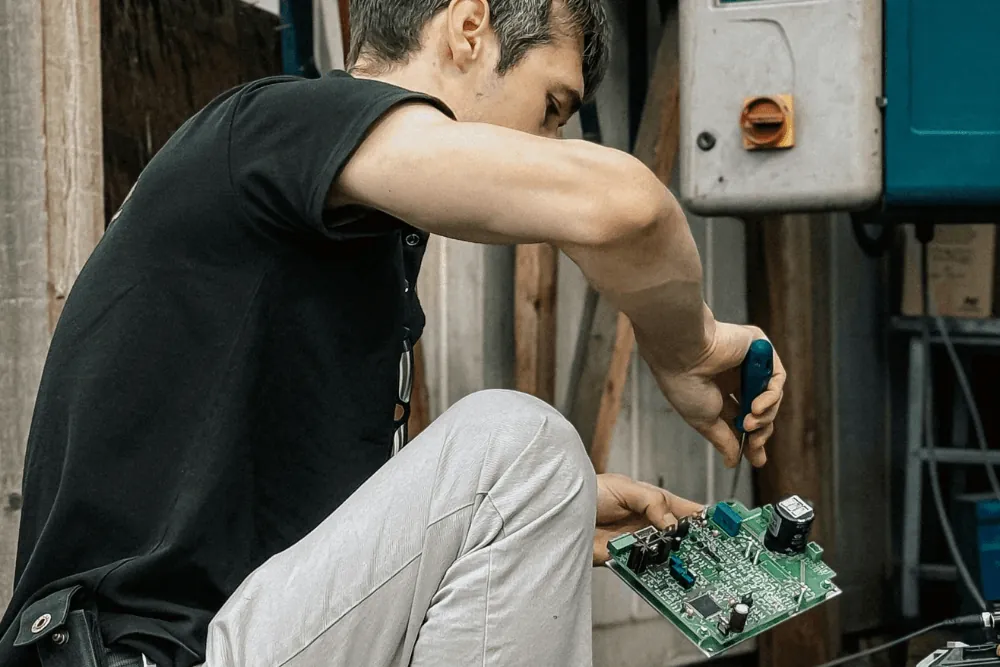
What UPS and inverter installation with us includes
A load check of what the unit must carry and for how long, so the size and the battery are worked out and not guessed from a box.
Supply and fitting of a UPS, a home inverter or a hybrid inverter, or fitting of the one you already own.
Wiring to a dedicated backup circuit, with a changeover or a protected output, earthing and labelling, so the unit feeds only what you chose and never feeds back into DEWA's network.
Batteries chosen for Dubai: tubular, VRLA or lithium, sized for the run time, fitted somewhere cool and ventilated, and wired with the right cable and fuse.
Servicing and battery replacement, on a schedule, with a written record and a test under load.
Repair of faults in UPS units, inverters and their batteries, on site where we can and at the workshop where we cannot.
The numbers at a glance
Typical answer for Dubai
Before you buy a UPS or inverter, be clear about how long you need it to run. A UPS that bridges a ten-minute outage to a safe shutdown is a small, cheap job. An inverter that runs a villa's lights, fans and a fridge through a four-hour outage is a larger one, and one that runs air conditioning is larger again. The sections below help you decide which of these you are buying.
UPS, inverter, hybrid inverter or generator: which backup suits you
The words overlap, and sellers use them loosely. Four kinds of backup are sold, and they are not interchangeable.
| Type | What it is | Good for | Weak at |
|---|---|---|---|
| UPS | A battery and inverter that switch in within milliseconds, or never switch at all | Computers, servers, networks, CCTV, medical and lab kit | Short run times unless the battery bank is large |
| Home inverter (inverter UPS) | A larger inverter and battery bank that backs up lights, fans, a fridge and Wi-Fi | Several hours of basic household power | Air conditioning, unless sized for it |
| Hybrid inverter with battery | A solar inverter and battery inverter in one box, with a battery | Backup and solar together, longer run times | Cost; needs DEWA notification when it joins an approved solar system |
| Generator | An engine and alternator | Long outages and heavy loads | Noise, fuel, servicing, a start delay |
In practice the line between a UPS and a home inverter is about purpose. A UPS protects equipment: it cleans the supply and keeps a computer or server running until it is shut down properly. A home inverter keeps a household going for hours. A hybrid inverter does that and also manages solar panels. Our battery storage installation service covers large fixed batteries for homes and businesses, and our generator installation service covers engines. This page covers the units in between and below them.
How to choose
- A router, a PC and a CCTV recorder for ten minutes to an hour: a UPS, usually a line-interactive model of 1,000 to 1,500 VA.
- A server, a network cabinet or a point-of-sale system that must never reboot: an online UPS, with a battery sized for the shutdown time.
- Lights, fans, a fridge, Wi-Fi and a TV for several hours: a home inverter of 1 to 3 kVA with a battery bank.
- Backup plus solar, or planning to add panels later: a hybrid inverter with a battery.
- One or two air conditioners through a night: a large inverter of 5 kVA or more with a battery of 10 kWh or more, or a generator.
- A whole villa for as long as the outage lasts: a generator, with a UPS in front of the sensitive kit.
Home battery backup power in Dubai is mostly about protection, not frequent outages. The grid is reliable, and outages are short and uncommon. For most homes the main reason to install backup is not the outages themselves. It is protecting a computer, a network, a safe, a medical device or a CCTV system from the occasional drop, and keeping the Wi-Fi up when someone is working from home. A small UPS answers that better than a large inverter bank.
A battery system is also not a way to save money. Charging a battery from DEWA and using it later costs more per kilowatt hour than using DEWA power directly, once the cost of the battery is counted. The reason to buy one is that you need the power during an outage.
Types of UPS and inverter, and the names you will hear
UPS types
UPS units fall into three families. International standard IEC 62040-3 names them by how they behave, and manufacturers call them by simpler names.
- Offline or standby UPS. The load runs from mains. When mains fails, a relay switches the load to the inverter, which takes a few milliseconds. These are cheap and suit a home computer or a router. Most small units you see in shops are this type.
- Line-interactive UPS. The same idea, with a transformer that corrects low and high voltage without using the battery. It is the usual choice for small offices, CCTV and networks, because it switches quickly and does not wear the battery on every sag.
- Online (double-conversion) UPS. The load always runs from the inverter. Mains charges the battery and feeds the inverter, and when mains fails nothing switches at all. The output is clean and steady whatever the input does. Online units cost more and run warmer, and they suit servers, medical equipment and anything that cannot tolerate even a short gap.
Most computers ride through a break of around 16 milliseconds, which is why a standby or line-interactive UPS is enough for many offices. A rack of servers, a switch that reboots at the slightest dip and lab equipment need an online unit.
Inverter types
- Home inverter (inverter UPS). A mains-powered inverter and charger, with a separate battery bank. On a power cut it supplies a dedicated set of circuits. This is the type sold under names such as Luminous, Microtek and V-Guard in India, and Mecer in South Africa.
- Off-grid or standalone inverter. An inverter charger that runs entirely from a battery and a generator or solar panels, with no grid. It suits a farm, a camp or a vehicle.
- Grid-tied (grid) inverter. A solar inverter that pushes power into your board and the grid. It has no battery and, as a safety rule, shuts down when the grid fails. It is not backup. A grid inverter and a storage inverter are different things: the first turns solar DC into AC, and the second manages a battery.
- Hybrid inverter. One box that does the work of a grid-tied inverter and a battery inverter. It takes solar, charges a battery, powers your loads and can run them in an outage. A batteryless hybrid inverter is a hybrid unit installed without a battery at first, so you can add storage later. A storage inverter or battery storage inverter, and what some makers call an ESS inverter (energy storage system), is the battery-side inverter, sometimes sold as a separate AC-coupled unit.
- Micro inverter. A small grid-tied inverter fitted behind each panel or pair of panels. It is not a backup unit.
- Pure sine wave versus modified sine wave. A pure sine wave inverter produces the same smooth waveform as the grid. A modified sine wave unit is cheaper and rough, and can make motors hum, run hot and fail early, and can upset sensitive electronics. Pure sine wave inverter installation is our standard for a house, and we do not fit modified sine wave units on fridge, pump or computer circuits.
DC coupled and AC coupled
A DC coupled inverter, including a DC coupled hybrid inverter, takes solar power and charges the battery directly on the DC side, with one conversion. An AC-coupled battery uses its own inverter on the AC side and can be added to an existing solar system. A high voltage hybrid inverter works with high voltage battery stacks, often 100 to 500 V DC, and a low voltage hybrid inverter works with 48 V batteries. Which suits you depends on whether you already have solar. Our solar panels service covers new systems, and the battery storage page covers how an existing system gets a battery.
The names you will see
A home inverter and battery, an inverter battery set, or a home inverter with a lithium ion battery all describe the same pair: the inverter converts, the battery stores. People also ask for backup power installation, or look for backup power installers, when they mean any of these. A mini home inverter or a small home inverter with a battery is a unit of about 500 VA to 1 kVA with a single 12 V battery, enough for a router, lights and a fan. A 5kVA inverter system is at the other end, a 48 V system that can carry a villa's essential circuits and, with enough battery, an air conditioner.
Sizing a UPS or inverter: VA, watts and run time
Three numbers decide the job: the power of the load, the size of the inverter and the energy in the battery. Getting them wrong is the commonest reason a backup system disappoints.
VA and watts
A UPS or inverter is rated in volt-amperes (VA) or kVA and, separately, in watts (W). The two differ by a power factor. A UPS rated 1,000 VA might deliver 600 W if its power factor is 0.6, or 900 W if it is 0.9. Modern units are often 0.9 or 1.0, and older ones are lower. Always check the watts on the label, and size the load against watts.
Appliances with motors or compressors need extra current to start. A fridge compressor, a pump or an air conditioner can draw three to six times its running power for a moment. An inverter must supply that surge, so we choose a unit with a surge rating that covers it, or arrange for the largest motor to start by itself.
Run time
The run time of a battery is simple to calculate:
Run time in hours = battery energy in kWh × usable fraction × 0.9 ÷ load in kW
The 0.9 allows for inverter losses. The usable fraction is how much of the battery you can draw without hurting it: about 50 percent for lead-acid, and 80 to 90 percent for lithium iron phosphate. Battery energy is voltage times amp-hours, so a 12 V, 100 Ah battery holds 1.2 kWh and a 48 V, 200 Ah lithium pack holds 9.6 kWh.
A worked example
Take a villa that wants these running during an outage:
| Load | Watts |
|---|---|
| Router and modem | 15 |
| CCTV recorder and four cameras | 60 |
| Desktop computer and monitor | 150 |
| Fridge (running) | 150 |
| Four ceiling fans at 70 W | 280 |
| Ten LED lights at 10 W | 100 |
| Total | 755 |
The fridge starts with a surge, so a 1.5 kVA pure sine wave inverter is a sensible size. For four hours of run time, the load needs 755 W × 4 h ÷ 0.9, about 3.4 kWh, from the battery. With lithium at 90 percent usable, that means a pack of about 3.7 kWh, for example a 25.6 V, 150 Ah LiFePO4 battery of 3.84 kWh. With tubular lead-acid at 50 percent usable, it means about 6.7 kWh, for example four 12 V, 140 Ah batteries wired as two series strings in parallel, giving 24 V and 280 Ah.
Add one 1.5-ton split air conditioner at about 1.2 kW, and the load is about 2 kW. For the same four hours, the battery must now supply about 8.9 kWh, which is about 9.9 kWh of lithium at 90 percent usable. That means a 3 kVA inverter and a 48 V bank of 10 to 12 kWh, since a 48 V, 200 Ah pack of 9.6 kWh falls just short. This is why air conditioning is where inverters stop being small.
Battery voltage
The battery bank voltage follows the inverter size, because at low voltage the current is large and cables become thick and hot. As a rule of thumb, we use 12 V for units up to about 1 kVA, 24 V for 1 to 3 kVA, and 48 V for 3 kVA and above. A 1,000 W load on a 12 V bank draws more than 80 A, and the same load on 48 V draws about 20 A. The inverter and the battery must match, which is why we do not mix a 24 V inverter with 12 V batteries.
UPS sizing for equipment
For a UPS behind computers, add the watts of every device on the UPS, add 20 to 30 percent headroom, and choose a UPS whose watts rating exceeds that figure. Do not plug a laser printer into a UPS: its heating element draws a large surge, and a printer can overload a small unit. Then check the run time on the maker's chart at that load. If it is too short, a model with an extended battery pack, or a larger UPS that runs at lower load, solves it.
Batteries: which battery for a home inverter
The battery decides how long the system lasts, how much maintenance it needs, and how much it costs over ten years. It is also the part most often chosen badly.
The three common choices
| Battery | Cycle life (typical) | Usable depth of discharge | Notes |
|---|---|---|---|
| Flooded tubular lead-acid | 500 to 1,500 cycles | About 50% | Cheapest to buy; needs distilled water topping up and a ventilated space |
| VRLA (AGM or gel, sealed) | 300 to 1,000 cycles | About 50% | No topping up; sensitive to heat; standard in UPS units |
| Lithium iron phosphate (LiFePO4) | 3,000 to 6,000 cycles | 80 to 90% | Costs more to buy, lasts several times longer, lighter, needs a battery management system |
These are typical ranges, and real life depends on temperature, charge settings and depth of discharge.
Best batteries for a home inverter
The best battery for a home inverter is the one that matches the inverter, the run time and the budget. For occasional short outages in Dubai, where the battery sits on float for most of its life, lead-acid is fine, and the cheapest set that fits the inverter is a reasonable choice. For daily cycling, for a hybrid inverter used with solar, or where you want ten years and not four, lithium iron phosphate is the better one. We do not recommend a brand without knowing your load. For a lithium battery for a home inverter, three checks matter: the battery has an internal BMS, the inverter's list names the battery or the protocol it speaks, and the maker has a local agent with warranty support.
Lithium ion battery for a home inverter
Searches for a lithium battery for home inverter use, a lithium ion battery for home inverter, or a home inverter with lithium ion battery usually mean LiFePO4, because it is the safest of the lithium chemistries for fixed storage. Other lithium-ion chemistries, such as NMC, store more in less space and are less tolerant of heat. We do not connect home-built packs of loose cells. A battery must come as a module with its BMS, and a fire in a flat in a tower is not a risk worth taking to save money. Our battery storage installation page covers the safety rules for lithium in more detail.
Battery for a home inverter: the checks
Voltage. The battery bank voltage must match the inverter, 12, 24 or 48 V.
Capacity. Amp-hours times volts gives energy. Work it out from the load and the run time.
Charge current. The inverter's built-in charger should suit the battery. A large lithium pack on a small charger takes long to fill, and a small lead-acid battery on a large charger is damaged.
Chemistry setting. The charger profile must be set to the battery type: flooded, gel, AGM or lithium. A wrong setting shortens life.
Communication. Many hybrid inverters talk to a lithium battery's BMS over CAN or RS485. If the battery and inverter do not speak the same protocol, the system either does not start or runs without protection.
High voltage and low voltage batteries
Low voltage lithium batteries run at 48 to 51.2 V and are common with Deye, Victron, Growatt low-voltage and similar units. High voltage battery stacks run at 100 to 500 V and are paired with a high voltage hybrid inverter. A Growatt high voltage battery goes with Growatt's high-voltage inverter range, and a Huawei LUNA2000 with a SUN2000 inverter. They are not interchangeable between makers. The safety rules for the installation differ too, because higher DC voltage needs more careful isolation and trained hands.
Connecting two batteries
Questions such as a UPS two battery connection come up often. Two 12 V batteries in series give 24 V at the same amp-hours, and in parallel they give 12 V at double the amp-hours. The UPS or inverter label says which it needs. Use two batteries of the same make, capacity and age, never an old one beside a new one, and use equal-length cables of the right size with a fuse or breaker on the positive. A wrong connection can destroy the inverter or start a fire.
Battery price
Prices change and depend on the make, so we quote on the day. The cost sections below give the ranges we use. The site visit costs AED 50, and the quote follows it.
Dubai heat, ventilation and where the unit goes
Heat is the main enemy of a battery in Dubai, and the position of the unit is the first thing we decide.
What heat does
A lead-acid battery ages faster as it gets warmer. The common rule is that life roughly halves for every 8 to 10 °C above 25 °C, which is why a UPS battery rated for five years in a cool server room may last two or three in a hot cupboard on a balcony. Lithium iron phosphate tolerates heat better but still loses life, and it cannot be charged below about 0 °C or at high temperature without the BMS cutting in. Powerwall 3 is rated to 50 °C and derates above 40 °C, and Huawei's LUNA2000 is rated to 55 °C, so even large makers publish limits that a Dubai summer approaches. An inverter has the same problem: above its rated ambient temperature it reduces its output to protect itself, so a 3 kVA unit in a hot, closed cupboard may deliver less than 3 kVA.
Where it goes
- Indoors, in a cool, ventilated space, such as a store room, utility room or a cabinet with air flow. This is the best position for batteries.
- Not in direct sun, and not against a wall that takes the afternoon sun.
- Not in a sealed cupboard. Inverters and online UPS units shed heat, and the air must move.
- Flooded lead-acid batteries need ventilation to the outside, because they release hydrogen when charging. They do not belong in a bedroom or a sealed living space.
- Not above a window, under a pipe or in a wet area. Dust and humidity both attack terminals.
- Close to the board for the AC side, and close to the inverter for the DC side. The DC cable between battery and inverter carries the largest current and should be as short as the layout allows.
Mounting and clearance
Inverter mounting is a fixings job as much as an electrical one. A 3 kVA inverter and a 50 kg lithium battery need a wall that takes the weight, with the right anchors, the gap the maker specifies around the vents, and the unit upright. A battery rack must be level and secured. For towers and apartments, we also check what the building allows on a balcony or in a service riser.
Storing a unit or a battery
Inverter storage matters when a spare unit or battery sits in a store for months. Lead-acid batteries must be kept charged and cool, since they self-discharge and sulphate when left flat. A lithium battery is best stored at roughly half charge in a cool, dry place and topped up every few months, following the maker's guidance. Keep an inverter dry and covered, and do not store it in a hot container.
Checking for heat after installation
A loose DC connection runs hot long before it fails. Our thermal imaging inspection service finds hot lugs, breakers and busbars in a loaded system, and we often scan the battery and inverter connections during the first service.
Wiring and connection: how a UPS or inverter is connected
The wiring is where installations go wrong, and where the safety rules matter most. The principle is the same for every unit: the inverter must supply a defined set of circuits through a path that isolates it from the mains whenever it is running on battery.
Plug-in or hard-wired
A small UPS usually plugs into a socket, and the loads plug into the UPS. That is a UPS installation in its simplest form, and the only electrical work is making sure the socket is on a healthy circuit and the UPS has an earth. A hardwire UPS is connected to the board with a fixed cable through a breaker or isolator, and its output goes to a distribution board or a set of outlets. Hardwiring is the right method for a unit above about 2 kVA, for any online UPS in a rack room, and wherever the load is on a dedicated circuit. A hard wired inverter, a hard wired power inverter and a hardwired power inverter in a vehicle follow the same rule: a fixed cable, a breaker, an isolator and a labelled output, and not a plug and a lead.
A home inverter, step by step
Home inverter wiring, also called home inverter connection or domestic inverter connection, has a standard layout:
- 1Choose the circuits to back up. Not every circuit should be on the inverter. Lights, fans, sockets for the router, computer and fridge suit it. Air conditioners, water heaters and cookers do not, unless the inverter is sized for them.
- 2Build an essential-load board. This is a small distribution board that holds only those circuits. The existing circuits are moved from the main board to it. This is the right answer to what people search for as inverter wiring in board, inverter board wiring, an inverter board connection or a board inverter connection.
- 3Connect the inverter between the main board and the essential board. The inverter's input is fed from the main board through a breaker, and its output feeds the essential board. This is the correct way to connect an inverter to the main board, and to the main supply. Searches such as inverter connection to main board and inverter connection to main supply mean this arrangement.
- 4Add a bypass or changeover if the maker's design calls for one, so the essential board can be fed straight from the main board when the inverter is off or being serviced.
- 5Fit the battery, with a DC breaker or fuse next to it, cables of the right size and equal length, and a clear polarity.
- 6Earth everything, and bond the inverter case, the battery rack and the essential board to the installation's earth.
- 7Test with the mains off, on battery, and with the mains returning.
Whether it is house inverter wiring, home inverter wiring connection, inverter wiring at home or plain inverter fitting wiring, these seven steps are the job. An inverter that is wired from a mains plug through a double-ended lead, or connected so that its output can reach the main board while it is running on battery, is dangerous. The first is a shock risk on the plug pins, and the second can send voltage back into DEWA's network.
If the main board has no room for a new essential board, see our DB box and distribution board service, which covers extending or replacing the board.
Connecting an inverter to the mains
People ask how to connect an inverter, how to connect an inverter to the mains, or about connecting an inverter to mains, and a short answer is useful. The inverter's AC input terminal goes to a breaker on the main board. Its AC output goes to the essential board and never to the mains. The battery connects only to the inverter's DC terminals. We do this work under the rules of DEWA's Regulations for Electrical Installations. If the inverter is a hybrid unit that also takes solar, the wiring includes a solar input, a battery connection, a grid connection and a backup output, and the manual's diagram must be followed.
The battery side: cable, fuse and lugs
The inverter to battery wiring is the part most often under-specified. At 12 V, an inverter drawing 1,000 W draws about 90 A from the battery, and a 3 kVA unit at 48 V draws about 70 A. The cable must carry that without heating. We use cable sized to the maker's table, crimped lugs and not twisted bare wire, a fuse or DC breaker within a short distance of the battery positive, equal cable lengths for a parallel bank, and the torque that the terminal asks for. A loose battery terminal is the most common cause of a melted connector, and an undersized cable is the second.
UPS wiring, panels and transformers
UPS wiring for a rack room or an office covers more than the UPS itself. A UPS panel connection typically includes an input breaker, a maintenance bypass switch that lets the UPS be isolated for service without dropping the load, an output distribution board, and labels showing which circuits are protected. In a large installation, a UPS transformer wiring job joins an isolation transformer on the input or output, used to match voltage, to provide galvanic isolation or to change a three-phase supply to single-phase output. The transformer must be sized for the UPS and its inrush current, and the earthing and neutral arrangement must be right. We work from the maker's drawings and test before we connect your load. For home UPS wiring or UPS wiring for home use, the same logic applies in a smaller form: a fixed supply, a breaker and clearly marked output sockets.
Hybrid inverter wiring and connection
A hybrid inverter connection has four sides: solar input, battery, grid and backup load. Most hybrid inverters have separate terminals for the backup output and for a grid or generator input, and some have an extra port for a smart-load or a generator. Hybrid inverter wiring needs the solar string voltage to be within the inverter's window, the battery to be on the maker's approved list, and the communication cable between the battery's BMS and the inverter to be in place. Hybrid inverter installation also needs a current-transformer or meter on the grid feed so the inverter knows how much is being exported or imported, and a correct installation of that clamp is one of the most common sources of faults. A hybrid inverter installation done wrongly can show nonsense readings or refuse to charge.
Makers and what we do with them
Searches by brand are common, and the same pattern applies to most of them.
| Maker or term | What it is | What we do |
|---|---|---|
| Victron (MultiPlus, Quattro) | Inverter chargers for off-grid, marine and backup systems | Install and wire; see the Victron section below |
| Deye | Hybrid inverters, low and high voltage | Deye inverter installation, Deye hybrid inverter installation, battery BMS setup (the Deye inverter BMS link) |
| Growatt | Hybrid and off-grid inverters, lithium batteries | Growatt inverter installation, wiring a Growatt inverter and battery, Growatt hybrid inverter setups, and Growatt inverter repair or fault finding |
| Fox ESS | Hybrid inverters and batteries | Fox ESS inverter, Fox ESS hybrid inverter and Fox hybrid inverter installation, and Fox ESS battery storage |
| Solis | Grid and hybrid inverters | Solis inverter installation and Solis hybrid inverter installation |
| Sungrow | Grid and hybrid inverters, batteries | Sungrow inverter installation, Sungrow battery storage |
| Huawei | SUN2000 inverters, LUNA2000 battery | Huawei inverter installation |
| GoodWe | Hybrid and grid inverters | GoodWe inverter installation |
| SolarEdge | Optimiser-based inverters, StorEdge | SolarEdge inverter install, installation and wiring |
| Fronius | Hybrid inverters, battery-ready | Fronius inverter installation; check the Fronius hybrid inverter compatible battery list |
| EG4, Sol-Ark | US-market hybrid inverters | EG4 hybrid inverter and EG4 inverter installation, and the Sol-Ark hybrid inverter, only where a 230 V, 50 Hz model exists |
| Axpert (Voltronic) | Off-grid inverter chargers sold under many badges | Axpert inverter installation, with the battery voltage and charge settings set to the battery |
| Alpha ESS, Atess | Storage and hybrid inverters | Alpha ESS inverter and Atess inverter installation and commissioning |
| LG | Home battery and inverter line | LG hybrid inverter: see the note below |
| Tesla Powerwall | Battery with its own inverter | The Powerwall inverter is built into the battery, so there is no separate inverter to wire; the battery storage page covers it |
| Luminous, Microtek, V-Guard, Smarten, UTL, Mecer | Home inverters and UPS units sold widely in India and South Africa | Luminous ups installation, luminous inverter installation, Microtek inverter wiring, V-Guard inverter installation, Mecer inverter installation, UTL hybrid inverter |
| APC | UPS units for computers, networks and racks | APC UPS installation, maintenance and repair |
A few notes on these. US-market inverters such as EG4 and Sol-Ark are built mainly for 120/240 V split-phase, 60 Hz supplies, and the UAE is 230/400 V, 50 Hz. A model must be made for our supply before we install it, and we will say so before you buy. LG's home battery and inverter business has been withdrawn in many markets, so check the support position for an LG hybrid inverter before you buy or keep one. A Fronius hybrid inverter works only with batteries on Fronius's own approved list, and the list differs by model. For Indian and South African home inverter brands such as Luminous, Microtek, V-Guard, Smarten, UTL and Mecer, we install and wire units you already own and units we supply where they are sold in the UAE. A Luminous inverter of 2 kilowatts, whether with a tubular battery or a lithium one, and a Smarten inverter of a similar size are standard home inverters of the type described above. Luminous inverter installation charges follow the same lines as any home inverter: the unit, the battery, the board and the labour.
Victron wiring
Victron units are popular in boats, vans and off-grid homes, and the wiring is where they differ from a basic home inverter. A Victron MultiPlus or Quattro is an inverter, a charger and a transfer switch in one box. Victron wiring starts with the DC side: cable of the right section for the unit's current, equal length for the positive and negative, a fuse or breaker near the battery, and a battery monitor shunt in the negative. The Quattro has two AC inputs, for example grid and generator, and the MultiPlus has one. The units talk to each other and to the GX device over VE.Bus. Victron MultiPlus wiring and Victron Quattro wiring need the grid input, the AC output, the earth and the neutral arrangement to match the manual. A temperature sensor on the battery lets the charger adjust its voltage with temperature, and Victron temperature sensor wiring is a short lead with a lug on the battery's negative terminal. In a hot place like Dubai, that sensor is not optional.
Victron publishes a free wiring guide, Wiring Unlimited, which sets out cable sizes, fusing and layouts for boats, vehicles and off-grid systems. Searches for Victron wiring unlimited, wiring unlimited Victron and Victron energy wiring unlimited all point to that book, and we follow it. We do Victron inverter installation and commission the units with VictronConnect.
Micro inverters
A micro inverter is a grid-tied unit fitted behind one or two panels. Micro inverter installation has its own wiring: a trunk cable, a connector per unit and an AC breaker. Enphase's IQ7A is a micro inverter of this kind, and the WVC-600 is a 600 W grid-tie micro inverter sold under several names. Micro inverters are not backup power. Without a battery system and a special arrangement, they shut down when the grid fails. A micro inverter on a DEWA-connected system must be one that DEWA accepts, so we do not fit unlisted units.
Rules and safety for UPS, inverter and battery work in Dubai
DEWA
The wiring of any installation must meet DEWA's Regulations for Electrical Installations and be done by a contractor enrolled with DEWA. A stand-alone UPS or home inverter that feeds only its own essential board, and is isolated from the mains when it runs on battery, does not export power and is an internal wiring matter. A hybrid inverter or a battery that joins a solar system is different. A grid-tied solar system must shut down when the grid fails, which is called anti-islanding, and a backup output on a hybrid inverter works because the inverter first isolates the house from the grid. If you have a DEWA-approved solar system and want to add a hybrid inverter or a battery, we notify DEWA before we connect anything. Our approach is to send the models, a revised single-line diagram and the operating modes. Our solar panels service covers new solar systems, and the battery storage installation page covers adding batteries to an existing one.
Lithium batteries and fire
A lithium iron phosphate battery in a certified module with its own BMS is one of the safer ways to store energy, but it needs rules: a position away from exits and escape routes, ventilation, a smoke detector nearby, the right DC protection and no stacking in a cupboard with stored goods. In a tower, building management and Civil Defence rules apply. In an emergency involving fire, call Civil Defence on 997, and call DEWA on 991 for an electrical emergency.
Earthing and surge protection
An inverter or UPS is only as safe as its earth, and a poor earth makes the output frame live in some fault conditions. Our earthing and grounding service tests and improves a building's earth when it needs it. Surge protection at the board protects the UPS and the equipment behind it from lightning and switching surges, and our surge protection service fits it. A UPS does not replace surge protection, because a large surge can pass through a cheap unit.
Combining a UPS, an inverter and a generator
A generator suits long outages. A UPS in front of the computers and network bridges the few seconds or minutes before it starts and the transfer completes. We design the two together, and a UPS fed from a generator needs a check that it tolerates the generator's frequency and voltage swings. Many online UPS models have a generator-compatible mode.
Handover paperwork
We leave you a single-line diagram or a simple schematic, a note of which circuits are backed up, the battery's type, date and serial number, test records for insulation and earth, the manual and warranty, and a service log. If DEWA, a landlord, an insurer or building management ask later, you have it.
What UPS and inverter installation costs in Dubai
An inverter for home installation is priced as a package, and the cost of inverter installation is the unit, the battery, the board and wiring, the labour, any approval and the commissioning. People search for it in many forms: the cost of inverter installation, inverter installation cost, inverter installation price, inverter installation charges, inverter setup price, inverter setup for home price, and inverter battery setup price. They all ask the same question, and the useful answer is the installed price for a stated load and run time, not the price of the unit.
| Job | Typical installed price (AED) | Notes |
|---|---|---|
| Small UPS, 600 to 1,500 VA, set up for a router, PC or CCTV | 390 to 1,940 | Unit and set-up; plug-in |
| Online UPS, 1 to 3 kVA, hardwired | 2,425 to 8,730 | With breaker and output sockets |
| Home inverter, 1 to 2 kVA, with tubular battery and essential board | 3,395 to 6,790 | Lights, fans, router, fridge |
| Home inverter, 3 kVA, with 5 kWh lithium battery | 11,650 to 21,350 | Several hours of basic load |
| 5 kVA inverter system with 10 kWh lithium | 24,250 to 43,650 | May carry one air conditioner |
| Hybrid inverter, 5 kW, with 5 to 10 kWh battery | 17,450 to 38,800 | With solar, subject to DEWA |
| Rack-room online UPS, above 6 kVA | Quote after the survey | Panel, bypass, battery cabinet |
They include the unit, the battery, cabling, a breaker and commissioning, and exclude new boards beyond the essential board, structural work and any DEWA fee.
Prices for particular makes
Searches for a Huawei 5kW hybrid inverter price, a Growatt lithium battery price or a Smarten inverter price are about one product, and the honest answer is that prices change often. We quote a current figure on WhatsApp once we know the model, and the quote lists the unit, the battery, the installation and the warranty on separate lines so you can compare.
What moves the price
- Size in kVA and kWh, the largest factor. The battery is often more than the inverter.
- Battery chemistry. Lithium costs more to buy than lead-acid and less to own over ten years if you use it every day.
- The essential-load board and the work to move circuits.
- Cable runs and DC protection.
- Online or line-interactive, for a UPS.
- Make and warranty.
- Approvals.
Battery replacement cost
An inverter battery replacement cost, or a UPS battery replacement cost, is the price of the new battery plus labour and disposal of the old one. A sealed UPS battery for a small unit is a modest sum, and a bank of large tubular batteries or a lithium pack is not. The cheapest replacement is the one you plan for: a battery tested before it fails can be bought at a fair price, while a UPS that fails at a bad moment is often replaced in a hurry. We quote the battery price on WhatsApp once we know the model.
Running costs
An inverter and a UPS use power themselves, and the charger tops up the battery. A small UPS draws a few watts to charge and hold, and a large online UPS draws tens of watts even with no load, because its inverter never stops. At 30 W round the clock, that is about 260 kWh a year, or roughly AED 115 at DEWA's top-slab rate of about AED 0.44 a unit. That is the price of readiness. A battery that is looked after, kept cool and replaced when its tests say so is the main running cost.
Inverters in vans, motorhomes, cars and vehicles
A vehicle inverter turns 12 V or 24 V DC from the vehicle's battery into 230 V AC. Vehicle jobs are different from a house: there is no mains to connect to, space is tight, the cable runs are short but the currents are high, and everything shakes.
What the vehicle systems are
- Plug-in inverter in the cigarette lighter socket, for a phone or a laptop. A socket can supply only about 120 to 180 W.
- Hard-wired power inverter, wired directly to the battery with a fuse, for tools, a fridge, a coffee machine or a laptop and screens. This is a car power inverter installation or a car inverter installation done properly, and the same applies to an auto inverter installation or a vehicle inverter installation on a utility vehicle.
- A full van or motorhome system, with a leisure battery, a DC-DC charger from the alternator, an inverter or inverter charger, a shore-power inlet and an AC board with a residual current device.
Installing an inverter in a van
Installing an inverter in a van, or wiring an inverter into a van, follows a set of rules we apply to every job:
- 1Size the inverter to the loads, not to the biggest unit that fits. Add up the watts and the start surges.
- 2Use pure sine wave for anything with a motor or electronics.
- 3Fuse at the battery. A fuse or breaker must sit as close to the battery positive as possible, and rated for the cable. An unfused cable can start a vehicle fire.
- 4Size the cable for the current and keep it short. A 1,000 W inverter on 12 V draws about 90 A, and needs heavy cable, for example 25 to 35 mm² over a short run.
- 5Charge the battery properly, usually with a DC-DC charger so the alternator does not overload, or with solar.
- 6Protect the AC side with an RCD, a breaker and a correct earth arrangement, which for a vehicle differs from a house.
- 7Mount it solidly, with ventilation, and away from the battery's gas vent if it is a flooded type.
A van inverter installation or motorhome inverter installation in Dubai also faces heat. A battery in a closed van in summer sees temperatures far above a house, and the unit needs shade and air.
Van inverter installation near me
If you searched for a van inverter installation near me, send a photo of the vehicle's battery space and the list of what you want to run. We tell you what is practical and what it costs. We cover the whole of Dubai.
How a UPS or inverter installation runs, step by step
A UPS installation and an inverter installation follow the same order, and the order is what keeps them safe.
1. Survey and load list
We look at the main board, the space, the circuits to be backed up and the loads on them. We read the ratings off the labels and note which loads have motors. If you send photos of the board and the space first, we can often quote before visiting.
2. Sizing and quote
We work out the load, the inverter size, the battery voltage and capacity, and the run time, and give you a written quote with the unit, battery, board and labour on separate lines. For a hybrid inverter or battery on an approved solar system, the quote also covers the DEWA notification.
3. Supply and delivery
We order the unit and battery. A lithium battery and a hybrid inverter may take days or weeks to arrive, and a UPS from stock may be ready the same day. We confirm the lead time when we quote.
4. Installation
The installation of inverter and battery is done as one job so the two are matched. For a small UPS this is plugging in, checking the socket and setting the unit up. For a home inverter, we build the essential-load board, mount the inverter and battery, run the cables, fit the breakers and fuses, and make the connections. For a hardwired UPS in a rack room, we fit the panel and bypass and connect the load. A UPS battery installation, an inverter battery installation or an inverter battery fitting follows the manufacturer's order of connection: the battery last, once everything else is checked and the polarity confirmed.
5. Programming
An inverter charger needs the right settings: battery type, charge voltage, low-voltage cut-off, priority between grid, solar and battery, and any generator input. A hybrid inverter needs its battery protocol selected. Wrong settings are the commonest reason for a unit that "works" but ruins its battery in two years.
6. Testing and commissioning
We test insulation and earth, then switch the mains off with the load running and watch the changeover. We run the system on battery for long enough to see the voltage and temperature settle, and then bring the mains back. For a larger UPS, we do a discharge or load test, covered below. We label every circuit.
7. Handover
You receive the paperwork described earlier, a short walk-through of the display and alarms, and a note of what to do when the unit beeps. Most home jobs take half a day to a day on site, and a rack-room UPS can take several days, because of the panel and the bypass.
UPS and inverter servicing, battery maintenance and replacement
A UPS or inverter that is never serviced is a unit you hope will work. The battery is almost always the part that fails.
Why servicing matters
A UPS sits idle for months and then must carry a load for several minutes with no warning. A battery that has aged shows a normal voltage when it is not working and collapses in seconds when it is. That is why UPS servicing includes a test under load, not only a visual check.
What a service includes
Visual check: swelling, leaks, corrosion, heat marks, dust in the fans and the vents.
Connections: tightness of battery terminals and DC cable lugs, checked against the torque the maker states, and a heat scan where useful.
Battery tests: voltage per block, an internal resistance or conductance reading where we have the meter, and a timed discharge on the load.
Alarms and logs: reading the unit's event history and clearing faults.
Settings: charge voltage, low-voltage cut-off and temperature compensation checked against the battery type.
Fans and filters: cleaned or replaced.
Changeover: a test with the mains switched off.
Report: a written note with the battery date and test results, and a recommendation.
Maintenance of a UPS battery
Maintenance of UPS battery is mostly about temperature, charge and age. Keep it cool. Keep the UPS powered, because a battery left on a shelf without charge deteriorates. Record the install date on the battery. Replace it when it fails a test, or when its capacity has dropped to about 80 percent of the rated figure, which is a common end-of-life point. For tubular batteries, top up with distilled water at the intervals the maker gives, keep the plates covered and the terminals clean and greased.
Replacing a UPS or inverter battery
You replace a UPS battery when it fails a test, shows swelling, or reaches the age at which the maker or our experience says it is time. A VRLA battery in a UPS commonly gives 3 to 5 years in good conditions and often less in heat. To replace a UPS battery, we match the voltage, capacity and terminal type, replace the whole string at once and not one battery in a string, dispose of the old ones properly and test the system afterwards. Replacing an inverter battery follows the same rules, and for a bank of tubular or lithium batteries the new units must be of the same type and age as each other. A UPS battery replacement or an inverter battery replacement is a small job. For UPS battery replacement near me, see the table below.
Load bank testing for a UPS
A UPS load bank test uses a resistive load bank to draw power from the UPS at set steps, such as 25, 50, 75 and 100 percent, while we record voltage, current, temperature and run time. It proves the UPS delivers its rated output and that the battery lasts as long as it should. For a critical site, a test at least once a year is sensible, and some operators test every six months. The interval depends on the work and is set on your quote. A UPS load bank test also works as a commissioning test for a new unit.
Suggested service schedule
| Site | Visual and connections | Battery test | Load bank test |
|---|---|---|---|
| Home UPS or inverter | Once a year | Once a year | Not usually |
| Small office UPS | Every six months | Once a year | Once every one to two years |
| Server room or clinic | Every three to six months | Every six months | Once a year |
| Data room or critical site | Quarterly | Quarterly | Every six months |
The visit schedule depends on the equipment, and some equipment needs a check every month. We offer a yearly contract.
Service contracts
A service contract covers visits on the schedule above, with response times and parts terms. We offer it for offices, shops and buildings. The terms depend on the work and are written on your quote. For APC UPS maintenance, APC UPS installation and other UPS makes, we cover the common ranges, and we tell you before a warranty requires the maker's agent.
Repair: UPS, inverter and battery faults
Many repairs are cheap. A few are not worth doing. We say which at the quote.
UPS repair
A UPS repair starts with the symptom:
| Symptom | Likely cause | What we do |
|---|---|---|
| Beeps continuously or shows a battery alarm | Battery ageing or failed | Battery test and replacement |
| Runs only a few seconds on battery | Battery capacity gone | Replace the batteries |
| Will not turn on | Blown fuse, failed board or flat battery | Test and repair or replace |
| Overload alarm | Load too large, or a printer on the UPS | Reduce the load, resize |
| Switches to battery constantly | Poor input supply or a failed sensing circuit | Check supply, repair the board |
| Fan alarm or heat warning | Blocked or failed fan | Clean or replace the fan |
| Bulging, hot or leaking battery | Overcharge or age | Stop. Replace the battery, check the charger |
For a computer UPS repair, a UPS repair service, or a UPS repair centre near me, we repair on site where possible, and take larger or board-level faults to a workshop. APC units are common, and APC UPS repair is often a battery replacement or a board swap. If the unit is old and the board is gone, replacement is better.
Inverter repair
Inverter repair covers a range:
- Home inverter faults: overload, battery low, no output, no charging, burnt smell or a tripping breaker.
- Battery inverter repair: a unit that will not charge its battery or drains it quickly.
- Board-level repair: inverter PCB repair, inverter board repair, inverter card repair and inverter MOSFET repair. A MOSFET or IGBT failure on a power board is often repairable if the rest of the board is sound, and not worth repairing if it has burned.
- Power inverter repair: the small vehicle and portable power inverters.
- Growatt inverter repair and other brands: error codes on hybrid and solar inverters are usually a settings, communication or wiring issue before they are a failed unit.
Inverter battery repair
An inverter battery repair, including inverter battery repair at home, is rarely a repair in the sense of fixing the cells. For a tubular battery we can check the water level, clean terminals, test the cells and top up. A cell that is shorted or heavily sulphated is rarely worth repairing, and a repair ups battery job for a small sealed battery means replacement. We say so plainly.
As a rule, if a repair costs about half the price of a new equivalent unit, or the unit is more than eight to ten years old, replacing it is the better choice. We give you both prices.
Stop and keep clear of a UPS, an inverter or a battery that is smoking, smells of burning, has a swollen or leaking case, or has a melted terminal. Switch off at the breaker only if you can do so without going near it, move people away and call Civil Defence on 997 if there is fire. Do not open a unit that has been on, and do not touch a battery that is hot.
Searches that are not this page
Some phrases that bring people to this page describe other work. We say what they are and who does them.
| If you searched | What it is | What we do |
|---|---|---|
| EL inverter, 12v EL inverter, electroluminescent inverter | A small device that powers EL wire and panels for decoration | Not our work; buy from the EL wire seller |
| LCD inverter board repair, LCD inverter repair | The backlight inverter board inside an old TV or monitor | A repair shop for TVs handles this; we do not |
| Inverter welder repair, inverter welding machine repair | An arc welder with an inverter inside | We can check the supply, plug and cable, but the board needs a welding equipment specialist |
| Toyota hybrid inverter repair | The power inverter in a hybrid car | A hybrid vehicle workshop, not an electrical contractor |
| SolarCity inverter, Sunrun inverter | Equipment from United States solar companies | Not sold in the UAE; if you own one, send a photo of the label |
| Solis inverter Eiffel Tower | We cannot tie this phrase to a product | Send a photo of the label if it is a Solis unit |
| Micro inverter WVC 600, IQ7A micro inverter | Grid-tied micro inverters | See the micro inverter notes above |
| Aircon inverter installation, inverter aircon installation, wiring aircond inverter | An inverter air conditioner, with a variable-speed compressor | See below |
Inverter air conditioners
An inverter air conditioner uses a variable-speed drive in the compressor. It is not a backup inverter. Its installation is an air conditioning job, with a dedicated circuit, a breaker and an isolator near the unit. Our AC electrical connection service covers the electrical side. Wiring an air conditioner with an inverter compressor follows the maker's drawings: power to the outdoor unit and a control cable between indoor and outdoor units.
Near me
People search for local help in different ways. The answer is the same.
| If you searched | What happens |
|---|---|
| UPS installation near me, ups electrician near me | Send photos and the load list on WhatsApp; we quote and visit |
| Inverter installer near me, inverter installers near me, inverter technician near me | Same; we survey and quote a fixed price |
| Inverter fitting near me, inverter battery installation near me | Same; we fit the inverter and battery |
| Inverter repair near me, inverter service near me, power inverter repair near me | Describe the fault or send a photo of the display |
| UPS repair near me, UPS repair center near me, UPS repair service near me | We repair on site or collect the unit |
| APC UPS repair near me, APC UPS repair service near me, computer UPS repair near me | We repair or replace the battery and test |
| UPS battery replacement near me | Send the model; we replace and test |
| Inverter PCB repair near me | We assess; board repair at the workshop |
| Van inverter installation near me | See the vehicle section above |
Searches in other words
Some searches are in other words. Inverter ki wiring and UPS ki wiring are the same questions as inverter wiring and UPS wiring, asked in Hindi or Urdu, and the answers are in the wiring section. An inverter services request is the same as inverter servicing, and an inverter repair service is the same as repair above.
Choosing a UPS and inverter installer
The market has electricians, solar companies, IT suppliers and small shops that all fit inverters. Some are good at it. Questions that help you choose:
- Are they an enrolled DEWA contractor? Ask for the number.
- Do they ask about the load before they quote? A company that quotes a unit without asking what it must run is guessing.
- How is the unit connected? The answer should include a dedicated backup board, a breaker, a fuse on the battery and an earth. A plug and a socket for a large inverter is a bad answer.
- Which battery and why? The battery's make, type, capacity, and warranty should be written on the quote.
- Where does it go? Ask how heat and ventilation are handled.
- What is tested at handover? A proper installer runs the unit on battery.
- Who services it? A service plan, and parts and battery supply for the future.
Red flags
- A quote for a "1 kVA" or "5 kVA" system with no battery capacity stated.
- The cheapest battery on the market, with no warranty.
- A modified sine wave inverter for fridges, pumps and computers.
- Batteries in a sealed cupboard or on a hot balcony.
- No fuse or breaker on the battery cable.
- Unlisted equipment on a DEWA-approved solar system.
- A quote that says nothing about what is excluded.
We will review another contractor's quote and say what is missing, whether or not you hire us.
UPS and inverter installation with Circuit Dubai
- Sized from your loads. We measure, count the starting currents and quote the unit and battery that suit, not the one in stock.
- Safe connection. A dedicated backup board and a changeover built so the inverter and the grid cannot meet.
- A tested handover. We run the system on battery and prove the changeover before we leave.
- Servicing that keeps it ready. A schedule, a log and a test under load, so the battery works when the grid does not.
- One team for the electrics and the unit. The wiring, the earthing, the breakers and the inverter come from the same contractor.
We work across all of Dubai. Our office is in Al Quoz.
If you are also planning a battery storage system, solar panels, a generator, a three-phase upgrade or a distribution board upgrade, we can survey it all in one visit.
Phone: +971 55 407 7427
UPS and inverter questions we hear from Dubai owners
How much does it cost to install an inverter at home?
A home inverter of 1 to 2 kVA with a tubular battery and a backup board is typically AED 3,395 to 6,790 installed, and a 3 kVA unit with lithium AED 11,650 to 21,350. A site visit costs AED 50, and the price follows it. The installed price matters more than the price of the unit.
What size UPS or inverter do I need?
Add the watts of everything it must run, add headroom, and choose a unit whose watts rating exceeds the total. Then check the battery gives the run time you want. We do this from your loads.
Which is better, a UPS or an inverter?
A UPS protects computers and networks with very fast or zero switching. A home inverter keeps lights, fans and a fridge running for hours. They solve different problems.
Which battery is best for a home inverter?
Tubular lead-acid is cheapest and suits rare outages. Lithium iron phosphate costs more and lasts several times longer, and suits daily use and hybrid systems. The battery must match the inverter's voltage and protocol.
How long does a UPS battery last?
Often 3 to 5 years, and less in heat. We test it every year and replace the set before it fails.
Can an inverter run an air conditioner?
Yes, if it is sized for it. One 1.5-ton split unit needs about 3 kVA and a 48 V battery bank for several hours.
Can I plug an inverter into a wall socket?
For a small UPS, yes. For a large inverter, no. It needs a fixed connection and a backup board, and never a double-ended lead.
Do I need DEWA approval for an inverter?
A stand-alone UPS or inverter that feeds only its own board does not export, and is internal wiring. A hybrid inverter or battery on a DEWA-approved solar system needs DEWA's notification first.
What is a hybrid inverter?
An inverter that handles solar, battery and grid in one box. It can run the house during an outage, which a grid-tied inverter cannot.
Is a pure sine wave inverter necessary?
For motors, fridges, pumps and electronics, yes.
Can I install an inverter in a van or car?
Yes, with a fused connection to the battery, the right cable and a pure sine wave unit.
How often should a UPS be serviced?
At least once a year with a test under load, and every three to six months for critical sites.
Do you repair APC and other UPS units?
Yes, for common faults and batteries. We tell you before a warranty needs the maker's agent.
Can you repair an inverter board?
Often. MOSFET and driver faults can be repaired, burned boards are not worth it.
Do lithium batteries catch fire?
A certified LiFePO4 module with a BMS, installed to the rules, is one of the safer ways to store energy, but it must be in a proper position. We do not connect home-built packs.
Can I use my solar panels with an inverter battery?
Only through a hybrid inverter or an AC-coupled battery. A grid-tied inverter alone shuts down in an outage.
Do you work outside Dubai?
We work across all of Dubai. Other emirates have different utilities and rules, so we confirm them before quoting.
Ready to size or service a UPS or inverter?
Send a photo of your main board, a list of what must keep running, and the space available, or the make, model and kVA of the unit you already have. We reply instantly on chat with the size we would suggest, a first idea of cost, or a service plan, so you know what the job involves before anyone visits.