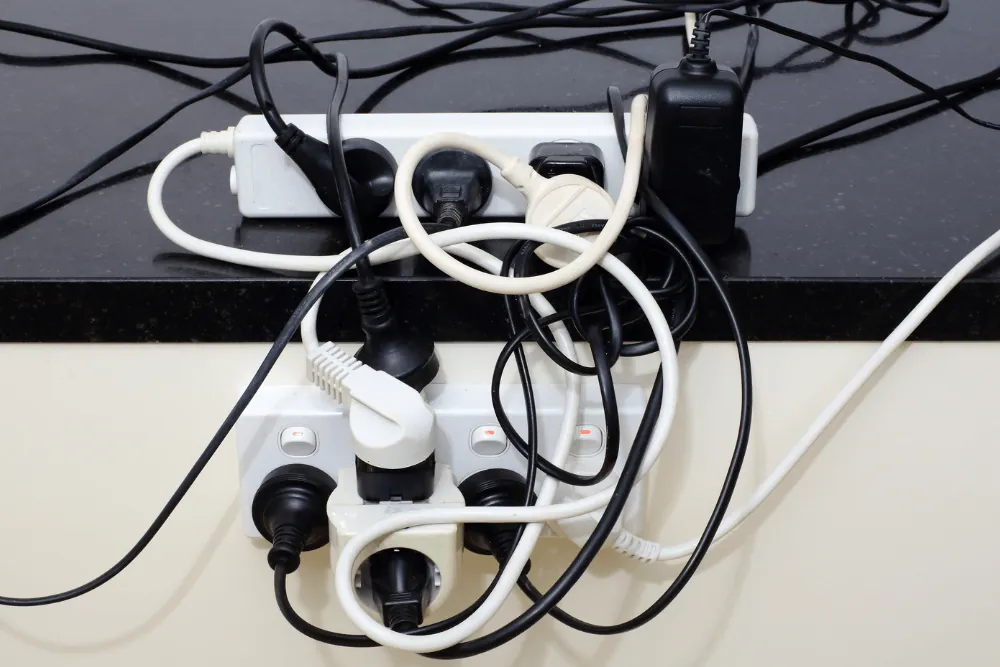
Breaker Tripping Repair in Dubai: Why Your Breaker, MCB or RCCB Keeps Tripping and How We Find the Cause
A breaker trips for one of three reasons: too much current for too long (an overload), a sudden surge of current (a short circuit), or current leaking to earth (an earth fault). Which one it is decides the repair, so the work starts with a test and not with a reset. We read the circuit, find which of the three is happening, and fix the cause so the power stays on.
Circuit Dubai does tripping breaker repair for villas, apartments, offices, shops and warehouses across Dubai. That covers a breaker that trips at once or after a few minutes, a main MCB trip that takes out the whole house, an RCCB that will not stay on, a blown plug fuse, and the appliances that set them off: water heaters, ovens, heaters and refrigerators. Where the cause is a worn breaker, an overloaded circuit or a board that has outgrown the home, we say so and quote the fix.
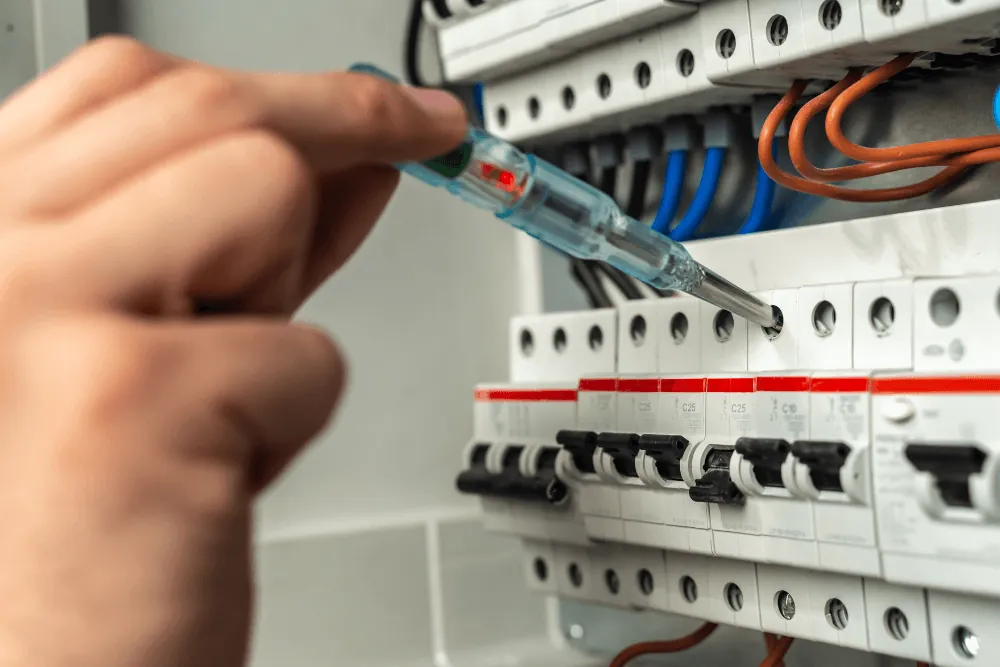
What breaker tripping repair with us includes
A test before a reset, with the circuit isolated and checked with an insulation tester, a multimeter and a clamp meter, so we know whether it is an overload, a short or a leak to earth.
The right device identified, because a trip from a main MCB, a branch MCB, an RCCB and a plug fuse each point to a different place.
Appliance checks, with the load measured on a water heater, oven, heater, refrigerator or air conditioner, so a failing appliance is named and not blamed on the wiring.
Repair at the cause, by splitting an overloaded circuit, replacing a worn breaker, re-making a loose or burned connection or changing a damaged cable.
Main breaker and selectivity advice, for the case where the main trips before the branch breaker that has the fault.
A written result, with the readings, the cause found and anything else we saw on the board.
The numbers at a glance
Typical answer for Dubai
Before you book breaker tripping repair, note which breaker trips and what is written on its label, whether it trips straight away or after a while, and what was running. Reset a tripped breaker once, with everything on that circuit unplugged. If it trips again, leave it off. If a breaker feels hot, buzzes, smells of burning or there is water near the board, switch off at the main if you can do so safely, keep clear and message us on WhatsApp. Photograph the board with its door open so the labels can be read.
Breaker tripping terms: what people search for and what each means
People describe a tripping breaker in many ways: a power trip, a breaker that keeps going off, a switch that trips, a fuse that keeps blowing. The tables below match each wording to what is actually happening and to the section of this page that deals with it, so you can go straight to the part that fits.
What tripped: the device wording
| If you searched | What it means |
|---|---|
| Breaker trip off, trip off breaker, circuit breaker trip off, electric breaker trip | A breaker that has moved to the off or middle position and cut the supply to its circuit. The first job is to find which breaker it is and why |
| Power trip electrical, power trip off, power trip circuit breaker, power circuit trip, power trip problem | The same event described from the room: the power goes off when a breaker or RCCB operates. The cause sections explain the three ways it happens |
| Trip in electrical circuit, if the circuit breaker trips | Any protective device opening a circuit. The how-it-works section lists what makes it open |
| Breaker box trip, circuit box trip, DB box power trip | A trip at the consumer unit or distribution board, which Dubai calls the DB box. It may be one branch breaker, the RCCB or the main |
| Switch trip off, electric switch trip, electrical switch trips breaker | Two different things share these words: a breaker switch that has tripped, and a wall switch that trips the breaker when it is used. The symptom section covers the second |
| Main MCB trip, main switch trip problem, house electricity trip | The main breaker at the incoming supply opens and the whole property loses power. The main breaker section covers it |
| Rccb trip test | The test button on a residual current device, and the test an electrician runs to measure its trip current and time. The RCCB section covers both |
| Elcb always trip | ELCB is the older name for an earth leakage breaker. One that always trips has found a leak to earth, which can be an appliance, damp or damaged cable |
| Plug in trip switch | A plug-in residual current adaptor that sits between a socket and an appliance. It protects that appliance only and does not replace the RCCB at the board |
| Circuit breaker trip circuit | The mechanism that opens a breaker. In a small MCB it is built in. In a large breaker it can be a shunt trip coil or a protection relay, which is tested separately |
| Circuit breaker trip current, overload breaker trip | The current at which a breaker opens, and a trip caused by current above its rating. The how-it-works section gives the figures |
| Circuit breakers trip because, circuit breaker always trip off | The reasons: overload, short circuit, earth fault, a failing appliance, a worn breaker. The causes section sorts them by symptom |
When it trips: the timing wording
| If you searched | What it means |
|---|---|
| Breaker trips immediately, breaker instantly trips, circuit breaker immediately trips | A trip within a second of reset or of switching something on. It points to a short circuit or a hard earth fault |
| Breaker automatically trips | A trip that happens with nobody touching anything. It points to a load that starts by itself, such as a water heater or an air conditioner, or to a fault that develops with heat or damp |
| Circuit breaker trips randomly | A trip with no pattern. It can be a loose connection, damp, a failing breaker or a load that cycles |
| Breaker trips with no load, breaker trips without load | A trip with everything unplugged. The fault is then in the fixed wiring, a switch, a fitting or the breaker itself |
| Breaker trips when switch is turned on, breaker trips when light switch is turned on, circuit breaker trips when light switch is turned on | A fault in the lighting circuit that the switch completes. It may be a faulty lamp, a damaged cable or a wet fitting |
| Breaker trips when light is turned off | A trip when a light is switched off. It can point to a neutral shared between circuits, or to a fault that the switching exposes |
| Heater trips breaker after a few minutes, water heater trips breaker after a few minutes | A trip after the element has warmed. It means a slow overload or a heating element that leaks to earth as it heats |
| Main breaker trips before circuit breaker | The main opens when a branch breaker should have. This is a selectivity problem and has its own section |
| Breaker doesn't trip | A breaker that stays on when it should have opened. This is dangerous and is covered in the how-it-works section |
Which appliance: the load wording
| If you searched | What it means |
|---|---|
| Water heater causing breaker to trip, water heater trips breaker after a few minutes | A failing element, a leaking tank or a circuit on too small a breaker. The appliance section covers each |
| Electric oven trips circuit breaker, oven trip circuit breaker | An oven on a breaker too small for it, a shorted element or a damaged supply cable |
| Electric heater trips circuit breaker | A heater drawing more than its circuit allows, or an element leaking to earth |
| Refrigerator causing breaker to trip | A compressor that draws a large current at start or a fault in the defrost heater |
| Electrical outlet trips circuit breaker | A socket that trips the breaker when something is plugged in. The fault is in the appliance, the plug, the socket or the cable behind it |
| Furnace trips breaker immediately | A furnace is a US heating appliance. In Dubai the same symptom appears on electric heaters, water heaters and air handlers, covered in the appliance section |
Fuses: the blowing wording
| If you searched | What it means |
|---|---|
| Blowing a fuse | A fuse that burns out when current is too high. A fuse is a one-use device, and the fuse section says what to do |
| 3 amp fuse blown | The small fuse in a British-type plug that protects a low-power appliance, such as a lamp, a TV or a computer |
| Cooling fan fuse blown | A fuse protecting a fan motor, in a plug, a fan unit or an air-conditioner outdoor unit. A vehicle fuse belongs to an auto electrician |
Planning breaker tripping repair: what to check, what to tell us and what to leave alone
A tripping breaker is found faster when the description is exact. Ten minutes spent finding the breaker, noting when it trips and unplugging what you can saves time on site, because it tells us whether to look at the wiring, an appliance or the breaker itself.
Checks you can make safely
These need no tools and no opening of anything. Stop at the first one that explains the trip.
- 1Find the right device. Open the board door only, not any inner cover. Look for a breaker lever that sits down or halfway, or an RCCB whose lever or window shows it has operated. Read its label and note its rating, such as 16 A or 32 A.
- 2Unplug everything on that circuit. Switch off or unplug each appliance fed from it, including anything on a timer or standby.
- 3Reset once. Push the lever fully down to off first, then up to on. If it trips again with nothing connected, the fault is in the fixed wiring, a switch, a fitting or the breaker. Stop there.
- 4Add loads back one at a time, waiting a few minutes between each. An appliance that trips it on its own is the cause. A trip only when two or three are on together is an overload.
- 5Check whether it is the whole building. If the neighbours or the whole block are off, the cause is the supply or the building's main board, not your breaker. Ask building management or call DEWA.
- 6Note the pattern. A trip at the same time each day points to a timed load such as a water heater or irrigation pump. A trip that follows rain, washing or humid nights points to moisture.
What to leave alone
- Do not hold a breaker on, tape it or wedge it. A breaker that is stopped from tripping is not protecting the cable behind it.
- Do not fit a larger breaker. The rating protects the cable. A bigger breaker lets the cable overheat before it trips.
- Do not keep resetting. Each reset on a faulted circuit puts current into the fault again.
- Do not remove the board cover. The incoming side of the main stays live when the main breaker is off.
- Do not bypass the RCCB because it trips. It is reporting a leak to earth.
What to tell us
| Question | Why it matters |
|---|---|
| Which breaker trips, and what does its label say? | It names the circuit and its rating, so we know what the circuit feeds |
| Does it trip straight away, after minutes, or at random? | The timing separates a short circuit, a slow overload and a loose or damp connection |
| What was running, and what did you just switch on? | A new appliance, a heater or an air conditioner pins the load |
| Does it trip with everything unplugged? | If yes, the fault is in the fixed wiring or the breaker |
| Is it the main, a branch breaker or the RCCB? | Each is tested differently |
| Has anything changed: new appliance, building work, rain, an AC service, a power cut? | Recent changes narrow the search |
| How old is the board, and has it been added to? | Boards that have grown by additions run out of capacity and selectivity |
| Any smell, heat, noise or marks at the breaker? | Heat at a breaker points to a loose connection and makes the job urgent |
Photos that help
Send one photo of the board with its door open, showing every breaker and label, and one close-up of the breaker that trips. Add the nameplate of the appliance that seems to set it off, and any scorch mark, damp patch or burnt smell source. With these we can arrive with the right breaker or part and not return for it.
Villas, apartments and commercial units
In a villa the supply may feed a main board, sub-boards, a pool or pump room, a maid's room and an annex, so a trip in one place can be caused by a fault in another. In an apartment the building owns the riser and the main supply, and your board starts after the meter. Tell us who controls the building so we can arrange access. In a shop, office or warehouse the supply may be three-phase, and a trip on one phase can leave part of the unit working. Tell us the quietest hours, because tests switch circuits off.
Planning the visit
Make sure someone can open the board, any locked plant room and the area where the trip happens. Leave the fault as it is: do not repair or replace anything in the meantime, because a trip that comes and goes is easier to catch while it still happens. If the main symptom is a fault elsewhere in the wiring, our electrical fault repair page covers fault finding in general.
Rules and safety for breaker work in Dubai
Breakers are the protective devices that the wiring rules are built around. The points below come from DEWA's Regulations for Electrical Installations, 2017 edition, which is the edition we read for this page. They shape what we test, what we may change and what we must report.
What the regulations say that affects a tripping breaker
| Topic | What applies |
|---|---|
| Supply | 230 V single-phase and 400 V three-phase at 50 Hz, with a variation of plus or minus 10 per cent. That is 207 to 253 V on a single-phase supply and 360 to 440 V on three-phase. A supply outside that band is a DEWA matter |
| Residual current protection | A residual current device with a rated operating current of no more than 30 mA is required on socket outlets rated 20 A or less, on cables concealed in walls less than 50 mm deep, and on cables in walls that contain metal parts. Every water heater circuit is protected by a 30 mA device |
| Voltage drop | The maximum drop from the point of supply to any point of use is 4 per cent of the nominal voltage, which is 9.2 V on a 230 V circuit |
| Who may do the work | Consultants and electrical contractors enrol with DEWA, and each contractor has engineers and technicians who know the regulations and test the work before power is connected |
| Alterations | Extensions and alterations to an installation need DEWA's approval first |
| Testing | An installation is open to DEWA's inspection and testing. Commercial and industrial installations are inspected at least every two years |
A breaker exists to protect the cable that it feeds, so its rating is chosen from the cable's current-carrying capacity and the load. That is why a larger breaker is never a fix. Replacing a breaker with one of the same rating and type is a repair. Changing its rating, adding a circuit, raising a load or moving a board is an alteration and goes through approval first. We say which one a job is before we start.
How we make a circuit safe
Find the breaker and switch it off, then lock or tag it so that nobody switches it back on.
Prove the voltage tester on a known live source before the test.
Prove the circuit dead at the point of work, and confirm that no other circuit shares its neutral.
Prove the tester again on the known source after the test, to show it did not fail halfway.
Work live only where the fault demands it, with insulated probes, one hand clear and never on a wet or damaged part. A fault that must be measured live, such as a voltage at the main, is measured at the board with the circuit protected.
Signs that cannot wait
| Sign | What to do now |
|---|---|
| Sparks, a bang or a burning smell at the board | Switch off at the main breaker if you can do so without touching anything damaged, leave the area and message us on WhatsApp. If you see flames, call 997 |
| A breaker or the board that is hot to touch | Switch off the circuit, keep clear and message us on WhatsApp. Heat at a breaker points to a loose connection |
| A tingle or shock from a tap, a fridge or a metal frame | Stop using the item, switch off its circuit and message us on WhatsApp. It points to an earthing fault |
| Water at or near the board, or dripping onto it | Switch off at the main from a dry position and do not touch the wet board |
| A breaker that trips every time it is reset | Leave it off and message us on WhatsApp |
| A buzzing or crackling sound from the board | Switch off the circuit and message us on WhatsApp |
Stop and keep clear of any board, breaker, socket or appliance that sparks, smells of burning, feels hot or is wet. Switch off its circuit from the board if you can reach it without touching anything damaged, leave it off and message us on WhatsApp. Do not try to open it, wipe it or test it yourself.
Work we do not take, and where it goes
A trip caused by DEWA's equipment, such as the service cable, the meter or the transformer that feeds the building, belongs to DEWA, and we tell you when a test points there. A trip caused by a fault inside an appliance belongs to an appliance technician or the maker, and we test the supply to it. We replace small electrical parts such as an element, a thermostat or a switch. Faults in high-voltage equipment have their own route, covered in our transformer and substation maintenance page.
How a breaker works and why it trips
A breaker is a switch that opens itself when it detects a current that its circuit cannot safely carry. Knowing which mechanism opened it is half the diagnosis, because each one is set off by a different fault. Circuit breakers trip because of one of three things: a sustained overload, a short circuit, or current leaking to earth.
Three ways a breaker opens
| Mechanism | What it senses | Speed | What sets it off |
|---|---|---|---|
| Thermal (overload) | Current above the rating for a period, which heats a bimetal strip until it bends and releases the latch | Seconds to minutes. The larger the excess, the faster | Too many appliances on one circuit, a motor that is stalling, a cable that is too small for the load |
| Magnetic (short circuit) | A sudden large current, which pulls a plunger in a coil and releases the latch at once | Within a fraction of a second | A live conductor touching neutral or another live conductor, a crushed or burned cable, a shorted element |
| Earth leakage (RCCB, RCBO, ELCB) | A difference between the current going out on the live and coming back on the neutral | Within a fraction of a second at the rated leakage | A leak to earth through damp, damaged insulation, a failing appliance or a person |
A standard MCB has the first two. An RCCB or ELCB has only the third. An RCBO combines all three in one device. The trip circuit in a larger breaker, such as an MCCB, can add an adjustable thermal setting and a shunt trip coil for remote or protective tripping.
Trip curves B, C and D
Under IEC 60898-1, MCBs are made with different magnetic trip points, named by a letter. The letter on the face, such as C16, gives the curve and the rating in amps.
| Curve | Magnetic trip at | Typical use |
|---|---|---|
| B | 3 to 5 times rated current | Lighting and sockets with resistive loads and little starting surge |
| C | 5 to 10 times rated current | General use with some starting current, such as small motors and air conditioners |
| D | 10 to 20 times rated current | Loads with a large starting surge, such as large motors and transformers |
The curve matters because a motor or a transformer draws a surge when it starts, and on a curve that trips too low the breaker opens although nothing is wrong. Changing the curve is not a guess. It changes how well the cable is protected and how the breaker works with the ones around it, so it is a designed change.
A worked example: an overload and a short circuit
Current in a simple heating load is power divided by voltage. A 3 kW water heater draws 3,000 W ÷ 230 V, about 13 A. A 2.4 kW kettle draws about 10.4 A. On a 20 A breaker, either one runs happily. Switch both on at the same time and the circuit carries about 23.4 A, which is 17 per cent over the rating. The thermal element heats and the breaker opens after some time, not at once. That is an overload.
Now take a 16 A breaker on curve C. Its magnetic trip lies between 80 A and 160 A, which is 5 to 10 times 16 A. A short circuit can pull hundreds of amps, far above that, and the breaker opens immediately. On curve B the same 16 A breaker trips magnetically between 48 A and 80 A. That is a short circuit. Time to trip is the clue: slow means overload, instant means short or hard earth fault.
Why a breaker can trip without a real fault
- Starting current. Motors, compressors, power supplies and LED drivers pull a surge for a fraction of a second that can reach the magnetic band even when the running current is fine.
- Heat. MCBs are calibrated for a stated ambient temperature. A hot board, packed breakers or a loose connection that heats the terminals moves the thermal trip lower, so it opens at less than its rated current.
- Loose connections. A poor terminal heats the breaker from the inside and can cause trips with a normal load.
- A worn breaker. After years of use or many trips, the mechanism and the thermal element can drift, so it trips early or late.
- Combined loads. Each appliance is fine alone and the circuit is not fine with all of them.
Reading a breaker label
| Marking | What it tells you |
|---|---|
| C16, B20, D32 | Curve letter and rated current in amps |
| 6 kA or 6000 | The short-circuit current the breaker can interrupt safely. A breaker with too low a rating can fail in a severe fault |
| 1P, 2P, 3P, 4P | Poles: how many live conductors the device switches. Three-phase work uses 3P or 4P |
| 30 mA | The leakage at which an RCCB or RCBO is rated to trip |
| Type AC, A | The kind of leakage the RCD senses. Type A also senses pulsing direct current from some electronics |
When a breaker does not trip
A breaker that stays on when it should have opened is more dangerous than one that trips, because the cable behind it is unprotected. The causes are:
- A breaker with contacts welded shut by a severe fault, which can no longer open.
- A breaker of too high a rating for its cable, so the cable overheats before the breaker reacts.
- A broken or missing earth, so a fault current cannot flow and the breaker never sees it. Only an RCD would catch it.
- A faulty or missing RCD on a circuit that should have one.
- A breaker tied, taped or held on.
A breaker that does not trip in a test has failed. We check it with a test instrument and replace it. A sticking mechanism is also a reason to replace a breaker that has not moved for years. See our MCB and RCCB breakers page for replacement.
Why a breaker trips: causes by symptom
The way a breaker trips tells you more than the fact that it did. This section runs through each pattern in the order we would test it, with the likely cause and the first check.
The patterns at a glance
| What happens | What it points to | First check |
|---|---|---|
| Trips the moment you reset it | A short circuit or a hard earth fault on that circuit | Disconnect everything on the circuit and reset. If it still trips, the fault is in the wiring |
| Trips straight after switching something on | The thing you switched on, or the circuit behind its switch | Unplug the appliance, or remove the lamp, and reset |
| Trips after a few minutes of use | An overload, or a load that heats, or a loose connection that heats | Add up the load on the circuit, then check for heat at the breaker |
| Trips at random | A loose connection, damp, a cycling load or a worn breaker | Note times and weather, then test insulation |
| Trips with nothing plugged in | Fixed wiring, a switch, a fitting or the breaker | Insulation test of the circuit, then test the breaker |
| Trips when a light switch is turned on | A fault in that lighting circuit, a lamp, a fitting or a driver | Remove lamps and reset, then reconnect one at a time |
| Trips when a light is turned off | A shared neutral, a driver or a switch arcing | Check the neutral and the driver |
| The main trips and the branch does not | A selectivity problem or a fault on the incoming side | See the main breaker section |
Breaker trips immediately or instantly
An instant trip is the magnetic release or an earth fault trip. Either a live conductor is touching neutral, another live or earth, or a load has failed short. The places to look are a damaged cable, a socket or fitting with a wire touching its back box, water in a fitting, or an appliance with a shorted element or motor.
The method is to split the circuit. Unplug everything and reset. If it holds, plug appliances back one at a time and the one that trips it is faulty. If it trips with everything unplugged, we isolate the circuit, disconnect it at the board and test the cable from the board end with an insulation tester: live to neutral, live to earth and neutral to earth. A low reading means a short or leak somewhere along the cable. We then open the circuit at a midpoint and test each half, as in the fault finding method. A circuit that trips instantly should stay off until it is tested, not reset repeatedly.
Breaker trips after a few minutes
A delayed trip is thermal. Something is drawing more than the rating, or something is heating the breaker. The usual causes are:
- A genuine overload. Heaters, ovens, water heaters, irons, kettles and air conditioners on one circuit add up. The worked example in the how-it-works section shows the sum.
- A load that fails as it warms. A water heater or heater whose element leaks to earth once it is hot, or a motor that overheats and draws more current.
- A loose connection. A poor joint at the breaker, a socket or a plug heats under load and warms the breaker with it.
- A hot enclosure. A board in a roof void, a hot plant room or an outdoor box runs hotter than the rating assumes.
We measure the running current with a clamp meter and compare it with the breaker rating. A reading near the rating means the circuit has too much on it. A reading well below the rating, with a breaker that still trips, points to heat or a loose connection. A thermal camera shows which terminal is hot. See our thermal imaging inspection page.
Breaker trips randomly or automatically
When a breaker trips with nobody touching anything, a load has switched itself on or a fault is changing with the conditions. Check the timing first. A trip at the same hour each day points to a timer, a water heater thermostat, a pump or an irrigation controller. A trip after rain, on humid nights or after cleaning points to moisture in a socket, a fitting, an outdoor box or an air conditioner's outdoor unit.
Random trips on a circuit with no obvious load are the hardest to catch. We insulation test the circuit, tighten and inspect the terminals, and where the trip is rare we leave a logger on the circuit to record current at the moment it opens. A breaker that trips at random and tests clean may itself be worn, and is replaced and watched.
Breaker trips with no load or without load
If a breaker trips with everything unplugged, the cause is not an appliance. It is the fixed wiring, a switch, a fitting, a junction box or the breaker. Typical causes:
- A damaged cable, from a nail or screw, a drill, rodents or heat.
- Water in a junction box, a ceiling light or an outdoor socket.
- A faulty switch or fitting with a wire touching metal.
- A neutral shared with another circuit, which makes an RCD trip when the other circuit is used.
- A breaker at the end of its life.
We disconnect the circuit at the board, test it with an insulation tester, then work along it. Where a shared neutral is the cause, we separate the circuits so that each has its own.
Breaker trips when a switch or light switch is turned on
A breaker that trips only when a light switch is turned on has found a fault that the switch completes. Switching on connects the lamp and its wiring to the supply, so the cause is on the lighting circuit behind that switch.
- A faulty lamp or lamp holder, especially one that has blown with a bang, or a holder with scorching.
- A shorted LED driver or transformer in a downlight, strip or fitting.
- A damaged cable in the ceiling or the wall run to the fitting.
- Moisture in a bathroom, kitchen, balcony or outdoor fitting.
- A faulty switch, with burned contacts or a loose wire behind the plate.
- A dimmer that does not suit the lamps, or a load that exceeds its rating.
The method is to switch off, remove the lamps, reset and switch on. If it holds, the fault is in one lamp, and we refit them one at a time. If it still trips, we test the circuit from the board. For a wall switch that trips the breaker on any use, we isolate and check the switch and the cable behind it. See our switch installation and replacement page when the switch is the fault.
Breaker trips when a light is turned off
A trip when a light is switched off is a less obvious pattern, and it has a few possible causes: a driver or transformer that fails as it loses its load, a switch whose contacts arc, or a neutral shared between circuits that shifts the leakage seen by an RCD when one circuit changes. We test the driver and the switch, then check the neutral at the board and at the fitting.
Appliances that trip a breaker: water heaters, ovens, heaters, refrigerators and sockets
When one appliance sets off the breaker, the appliance is the first suspect and the wiring is the second. The quickest way to tell them apart is the current the appliance should draw, which is printed on its nameplate. Divide the power in watts by 230 V and you have the amps. Compare that with the breaker.
What common appliances draw
| Appliance | Example power | Current at 230 V | What it does to a breaker |
|---|---|---|---|
| Portable electric heater | 2,000 W | about 8.7 A | Trips by overload when shared with other loads |
| Kettle | 2,400 W | about 10.4 A | Trips with a second heater on the same circuit |
| Water heater | 3,000 W | about 13 A | Trips on an element leak, or overloads a shared circuit |
| Electric oven or hob | 3,500 W | about 15.2 A | Needs its own correctly sized circuit |
| Refrigerator | Low running power | A few amps | Draws a much larger surge for a moment when the compressor starts |
These are example figures. Read the nameplate on your own appliance. An appliance that draws more than its circuit allows, or that shares a circuit with others, trips the breaker even when nothing is faulty.
Water heater causing a breaker to trip
A water heater trips breakers readily, because it is a large resistive load that runs for long periods and stands in water. There are two ways it trips.
- An overload. The heater and another load share a circuit, and together they exceed its rating. The breaker trips after a delay when the element is on. The fix is a dedicated circuit, sized for the heater.
- A leak to earth. The element, or its seal, is worn and leaks current into the water and the tank. The 30 mA RCD required on every water heater circuit under the DEWA regulations trips some minutes after the element warms up and the leakage rises.
A water heater that trips the breaker after a few minutes is the second case until a test says otherwise. With the heater isolated, we measure the element's resistance and its insulation to earth. A 3 kW element at 230 V should read about 17.6 Ω (230 × 230 ÷ 3,000). A reading far lower means a short. An open circuit means a burned element. A low insulation reading to the tank means leakage. A failed element is replaced. A tank that has started to leak is replaced. See our water heater installation page.
Electric oven or hob tripping the breaker
An oven that trips the breaker at once has a shorted element, a damaged supply cable or moisture in its terminal block. One that trips after a while has an overload, or a breaker that is too small for it. An oven and hob draw more than a socket circuit should carry, so they need a dedicated circuit with a breaker and cable sized from the nameplate. We check the element resistance, the supply cable and the terminals, and the circuit rating against the appliance.
Electric heater tripping the breaker
A portable or fixed electric heater that trips the breaker has an overload or a leaking element. Portable heaters get plugged into a socket that already carries other loads, or into an extension lead that overheats. A heater that trips after a few minutes warms its element and leaks as it heats, or draws its full current on a circuit that was already near its limit. Plug it into a circuit on its own and see. If it trips alone, the heater is faulty. If not, the circuit is overloaded. See our electric heating installation page for fixed heaters.
Refrigerator tripping the breaker
A refrigerator draws a surge when its compressor starts, several times its running current, and then settles. A breaker that trips just as the compressor starts may be too sensitive for the surge, may be on a curve too low, or may be sharing a circuit that is already loaded. A fridge that trips an RCD may have a defrost heater or a compressor winding that leaks to earth. Because a fridge holds food, a trip that is not noticed for hours spoils it. We test the circuit load, the RCD and the appliance's leakage, and in a villa we can give the fridge a circuit of its own.
Furnace and air handler trips
A furnace is a US term for a heating unit. Dubai homes use air conditioners and air handlers, so the same symptom, a unit that trips the breaker as soon as it starts, shows on the compressor, the fan motor or the electric heater strips in an air handler. The causes are a failed capacitor, a seized motor, a shorted contactor and a unit on a breaker that is too small. A unit that trips at once on start is a current problem. A unit that trips after running for a while has overheated. Our AC electrical connection page covers the supply side.
Outlet that trips the circuit breaker
When a socket trips the breaker as soon as something is plugged in, there are four possibilities, from the plug outward:
The appliance has a short or a leak. Try it on another circuit.
The plug or lead is damaged, with wires touching or water in the plug.
The socket has a loose or crossed wire, or has been damaged by heat.
The cable behind the socket has been nailed or crushed, or has moisture in it.
If a lamp plugged into the same socket does not trip the breaker and the appliance does, the appliance is at fault. If everything trips it, the socket or cable is. We test the socket's live, neutral and earth connections and the circuit's insulation. A socket with scorch marks or a loose fit is replaced, and our socket outlet installation page covers the work.
When the main breaker trips: main MCB, DB box and whole house trips
A main breaker that trips takes out the whole property, so it feels like a bigger problem than a single circuit. It is not always. The main opens for four different reasons, and three of them are within the building.
Which device tripped
| Device | What it protects | What its trip suggests |
|---|---|---|
| A branch MCB | One circuit | A fault or overload on that circuit |
| A sub-board breaker | A group of circuits, such as a floor, an annex or a pool room | A fault on one of the circuits it feeds, or the group's total load |
| The main MCB or main switch | The whole board | The total load, a fault on the board's incoming side, or a fault that the branch breaker did not clear first |
| The main RCCB | Everything behind it | A leak to earth on any circuit it covers |
| DEWA's meter-side device | The supply | A supply fault. This is not ours to reset or open |
If the main trips on its own, note which branch breakers are down when you reach the board. A branch breaker that has also tripped tells you where the fault was.
Why the main trips
Total load above the main's rating. The main is sized for the whole home. Switch on several large loads at once and it opens by overload.
A fault that the main reacted to before the branch. The main and the branch breaker both saw the fault, and the main opened first or with it. This is a selectivity problem.
A fault between the main and the branches, such as a loose busbar joint, a bad neutral or a damaged link inside the board.
A leak to earth on a circuit, where one RCCB covers the whole board.
A failing main breaker, which trips below its rating or is damaged by heat.
A worked example of total load
A villa has a 63 A single-phase main, which can carry about 14.5 kW at 230 V (63 × 230). On an evening when everything is on, the loads can add up quickly: three air conditioners at 2.5 kW draw about 32.6 A, two water heaters at 3 kW draw about 26.1 A, an oven at 3.5 kW draws about 15.2 A and a kettle at 2.4 kW draws about 10.4 A. Together that is about 84 A, well above 63 A. Not every load runs at once, which is why a home can run for months without a trip. When they do, the main opens by overload. A larger main is not a quick fix, because the incoming cable and the supply that DEWA provides set the limit. The answer is a load upgrade, spreading the load across three-phase or reducing what runs together. See our three-phase and load upgrade page.
Main breaker trips before the circuit breaker: selectivity
When a fault occurs on a branch circuit, the branch breaker and the main both carry the fault current. Selectivity, also called discrimination, means the breaker closest to the fault opens first and the main stays on. It depends on the time and current characteristics of the two devices, and on how large the fault current is. If the characteristics overlap, the main can open before the branch breaker, or with it, and the whole home goes dark although only one circuit was faulty.
Matching ratings does not guarantee the right order. A branch breaker and a main that are close in rating can both react in a short circuit, because the fault current is high enough to trip both magnetically. Selectivity is checked against the manufacturer's tables or time-current curves, and it is designed, not guessed.
The fixes depend on the cause:
- Fit a branch breaker that is selective with the main, or a main with a short time delay, where the board design allows it.
- Lower the branch breaker rating if the circuit's load allows it and the cable is protected.
- Replace a worn branch breaker that is slow to open.
- Split the board into sub-boards, each with its own protection, so that one fault does not reach the main.
DB box power trips and whole house trips
A DB box power trip, a breaker box trip or a circuit box trip that takes out everything has these tests:
- Switch all the branch breakers off, reset the main, then switch the branches on one at a time. The circuit that trips the main when it is switched on is the cause.
- Check the RCCB. If the RCCB trips and the main does not, the leak is to earth.
- Check the neighbours. If the whole building is off, the fault is outside the unit.
- Check the main at the terminals with a thermal camera under load. A hot terminal means a loose connection that can start a fire.
A house electricity trip that repeats at the same time each day follows a heavy load starting, such as an air conditioner and a water heater together. A trip that follows rain or humid nights points to moisture in an outdoor board, a pool or garden circuit.
Main RCCB that trips the whole board
A board where a single RCCB covers every circuit is a board where one leaking appliance takes out the lights, the fridge and the air conditioner. A split-load board has two or more RCCBs, so the circuits are shared between them and a leak on one group leaves the others on. A single RCBO per circuit goes further. Where a trip takes the whole home down, a board upgrade is part of the fix. See our DB box and distribution board page.
RCCB and ELCB trips: the trip test, leakage and plug-in trip switches
An RCCB or ELCB trips when it finds current leaking to earth. It does not care how much current the circuit carries. That makes an RCCB trip a different problem from an MCB trip, and it needs a different test. An ELCB that always trips is reporting a leak that is there every time, and an RCCB that trips now and then is reporting one that comes and goes.
RCCB, ELCB and RCBO: what the names mean
| Device | What it is | What it protects |
|---|---|---|
| RCCB (residual current circuit breaker) | Senses leakage and trips. It has no overload or short circuit protection of its own, so it needs an MCB in series | All the circuits behind it |
| ELCB (earth leakage circuit breaker) | An older name. The first ELCBs were voltage-operated. The name is also used loosely for an RCCB. A mA rating on the label marks a current-operated device | The circuits behind it |
| RCBO | An RCCB and an MCB in one unit, so it protects against leakage, overload and short circuit | One circuit |
| RCD | The general name for a device that senses residual current. It covers all of the above | Depends on the device |
Why an RCCB or ELCB trips
- An appliance that leaks to earth, such as a water heater element, a washing machine, a dishwasher, an iron, a pool pump or an air conditioner outdoor unit.
- Moisture in a socket, a junction box, a light fitting or an outdoor circuit, from rain, a leak, condensate or cleaning.
- Damaged cable insulation, from age, heat, a nail or a rodent.
- Standing leakage adding up. Every appliance leaks a small current to earth by design. Enough of them on one RCD can together come close to its trip current, so a small extra leak sets it off.
- A shared neutral between two circuits on different RCDs, so one circuit's return current is seen by the wrong device.
- A worn RCD that trips below its rating.
- A surge from the supply or from lightning, which can make an RCD trip once.
An ELCB or RCCB that always trips
When an RCCB trips every time it is reset, the leak is present all the time. We find it in steps:
Switch off every branch breaker behind the RCCB, and reset the RCCB. If it still trips with all branches off, the RCCB itself or the wiring between it and the breakers is at fault.
Switch the branch breakers on one at a time. The one that makes the RCCB trip has the leak.
On that circuit, unplug everything and try again. If it holds, add the appliances back one at a time until one trips it.
If it trips with nothing plugged in, the leak is in the fixed wiring. We insulation test the circuit and work along it as in the fault finding method.
An RCCB that trips and then resets without a fault being found may have a leak that is rare, or standing leakage that is too close to its limit. A clamp meter that reads leakage current on the live and neutral together, or on the earth conductor, shows how much leaks at the moment.
The RCCB trip test
There are two tests, and they are different.
The test button. The button on the device sends a small test current through it. When pressed, it should trip at once. If it does not, the device has failed and is replaced. Press it at the interval that the maker gives. UK guidance for homes is every six months, which is a sensible starting point. The interval depends on the work and is set on your quote. After the test, reset the device.
The instrument test. An electrician applies a measured leakage with an RCD tester and records the trip time. The test points for a 30 mA device are:
| Test current | What should happen |
|---|---|
| Half the rating, 15 mA | The device must not trip |
| The full rating, 30 mA | It trips within 300 ms |
| Five times the rating, 150 mA | It trips within 40 ms |
A device that fails any of these is replaced. We run the test after every RCCB repair and on every circuit that covers a socket.
Plug-in trip switches
A plug-in trip switch, or plug-in RCD adaptor, fits between a socket and an appliance. It trips on leakage in that appliance and its lead and nowhere else. It is useful for a power tool, a pump or a garden appliance that is used outdoors or moved around, and for an appliance on a circuit that has no RCD behind it.
It is not a substitute for the RCD at the board. It does not protect the fixed wiring, the socket or anything else on the circuit. If you need one because the circuit has no RCD, the right fix is to add the RCD to the circuit, because the DEWA regulations require 30 mA protection on sockets rated 20 A or less. See our MCB and RCCB breakers page.
Fuses: blowing a fuse, the 3 amp plug fuse and fan fuses
A fuse does the same job as a breaker, with one difference. A fuse is a thin piece of wire or element that melts when the current is too high, so it works once and is then replaced. A fuse that has blown is a symptom of too much current, and the question is why.
Where fuses are found
| Where | What it protects | Who deals with it |
|---|---|---|
| In the plug of a British-type three-pin plug | The lead and the appliance on that plug | You, if the plug is sound. We, if the fuse keeps blowing |
| Inside an appliance, such as a heater, a fan or a power supply | The appliance's own electronics or motor | The appliance technician or the maker |
| On a fan or air conditioner control board | The control circuit or the fan motor | The AC or appliance technician |
| In an older fuse board | A whole circuit | An electrician, who usually replaces the fuse board with breakers and RCDs |
A 3 amp fuse that has blown
Plug fuses come in a few ratings, and the right one depends on the appliance. Electrical Safety First, a UK charity, lists them like this.
| Fuse | Appliances it suits |
|---|---|
| 3 A | Table lamps, standard lamps, televisions, computers, soldering irons |
| 5 A | Older equipment. Plug fuses are now made as 3 A or 13 A |
| 13 A | Washing machines, dishwashers, fridges, freezers, vacuum cleaners, microwaves, kettles, toasters, irons |
As a guide, plugs on appliances rated 700 to 3,000 W take a 13 A fuse. The fuse in the plug protects the lead, so it is chosen to suit the appliance and the lead, and it is never raised to stop it blowing.
A 3 A fuse that blows on a lamp, a TV or a charger has found too much current. The common causes are a lamp or bulb that failed with a short, a power supply with a fault, a damaged lead or plug, or a loose connection inside the plug. Replace it once with a fuse of the same rating. If it blows again, the fault is still there. Do not fit a larger fuse, and do not use foil, wire or a nail.
Check the plug and lead for damage: a cracked plug, a scorched pin, a lead with cuts or exposed wires. A scorched plug or a fuse holder that has melted means a loose connection that has been heating. Replace the plug, or the lead. A power supply or charger that blows a fuse repeatedly is replaced, not repaired.
Cooling fan fuse blown
A cooling fan fuse protects the fan motor or its control circuit. A blown fan fuse is a sign that the motor drew too much current: a seized bearing, a failing winding, a capacitor fault or a blocked blade. On a plug-in fan, the fuse is in the plug, and the rule above applies. Inside an air conditioner or an appliance, the fuse is on the board, and the fan or the board needs an appliance or AC technician. A fan fuse that blows repeatedly means the motor is failing. Replacing the fuse again only repeats the stress.
A fuse in a car's cooling fan circuit is the work of an auto electrician, not ours. For an AC outdoor unit, we test the supply, the breaker and the isolator, and the technician deals with the unit. See our AC electrical connection page.
Blowing a fuse in an old fuse board
If your home still has a fuse board, a fuse that blows again and again is protecting a circuit that has a fault or too much load. Rewirable fuses are easy to misuse with the wrong wire, which leaves the circuit unprotected. We replace an old fuse board with a modern board that has MCBs and RCDs, because that gives protection that resets without a repair and covers leakage. See our DB box and distribution board page.
What to do when a fuse blows
Unplug the appliance and look for damage to the plug and lead.
Fit a fuse of the same rating as the one that blew. Check the appliance label if you are unsure.
Plug in and switch on. If the fuse holds, the first blow may have been a one-off surge.
If it blows again, stop. The appliance or the lead has a fault. Do not try a larger fuse.
Message us on WhatsApp if the same fault is on a fixed circuit, or if the plug is scorched, as the socket may be damaged too.
How we find the cause of a tripping breaker
A tripping breaker is found by measurement, in an order that rules out the cheap causes first. Each step answers one question: is the problem the load, the circuit, the breaker or the supply?
The method, step by step
- 1Take the history. Which device, when, what was running, what changed. The planning section lists the questions.
- 2Look at the board. Check for heat marks, discoloured breakers, loose conductors, damp, dust and signs that a breaker has been replaced with a different type.
- 3Read the label and the load. Note each breaker's rating and what it feeds, then add up what runs on the tripping circuit.
- 4Check the supply. Measure the voltage at the incoming terminals and compare it with the 207 to 253 V band. A supply outside it is a DEWA matter.
- 5Isolate the circuit and test it. With the circuit off and proved dead, run an insulation test between live, neutral and earth, and a continuity test along it.
- 6Split and narrow. Divide the circuit at a midpoint and test each half. The half with the low reading holds the fault.
- 7Test under load. Reconnect the circuit and measure its current with a clamp meter while the load runs. Compare the reading with the breaker's rating.
- 8Test the breaker itself. If the circuit tests clean and the load is within the rating, test the breaker's trip, and replace it if it trips low or does not trip.
- 9Record and report. The readings, the cause and anything else seen go on the report.
Instruments and what each one finds
| Instrument | What it measures | What it tells us about a trip |
|---|---|---|
| Voltage tester | Whether a conductor is live | Proves the circuit dead before work |
| Multimeter | Voltage, continuity and resistance | An open circuit, a shorted element, a failed switch |
| Insulation resistance tester | Leakage through insulation at 250 or 500 V DC | A damaged cable, moisture, a conductor touching earth or neutral |
| Clamp meter | Load current, and leakage current to earth | An overloaded circuit, a motor drawing too much, leakage to earth |
| RCD tester | Trip current and trip time | An RCCB that is slow, oversensitive or dead |
| Thermal camera | Surface temperature | A loose terminal, a hot breaker, a main that is overheating |
| Logger | Current or voltage over hours or days | A random trip, a load that starts and stops, a surge |
What the readings mean
- Insulation resistance under 1 MΩ at 500 V: a leak or short in the circuit. Under the UK wiring rules, a reading under 1 MΩ fails and one between 1 and 2 MΩ is investigated. We use these as a guide.
- Load current close to the breaker rating: an overloaded circuit. The fix is a second circuit or a lighter load.
- Load current well below the rating, but the breaker still trips: heat, a loose connection, or a worn breaker.
- A breaker that trips below its rating on test: replace it.
- Leakage current that is a large part of 30 mA with everything on: an RCD that will trip on a small extra leak. Split the circuits across more RCDs.
Insulation tests apply a high test voltage, so dimmers, smart controls, LED drivers, surge protectors and other electronics are disconnected first. Our insulation and earth resistance testing page covers the wider set of tests.
A worked example: a kitchen circuit that trips
A 20 A kitchen socket circuit trips after about ten minutes when a kettle, a toaster and a 3 kW portable oven are on. Together they draw about 10.4 A, 3.5 A and 13 A, which is about 27 A, so the clamp meter confirms an overload and the breaker opens as it should. The insulation test of the circuit reads high, so there is no leak. The fix is not a bigger breaker. It is a dedicated circuit for the oven, so the sockets carry only the kettle and toaster. If the same circuit tripped with a clamp reading of 12 A, we would look at heat: a loose terminal at the breaker or a socket, found by thermal camera, or a worn breaker.
Intermittent trips
A trip that comes and goes needs a different approach, because it is absent when we arrive. We ask when it happens and try to recreate it: run the air conditioner and the water heater together, tap the wall by the socket, flex the cable, or switch on the lights one at a time. Where that fails, we leave a logger on the circuit for a day or a week. The log shows what the current did in the minutes before the trip, and whether a surge, a rise or a loose connection preceded it.
Repair, replace or upgrade: what fixes a tripping breaker
Once the cause is known, the fix follows. The right one is the smallest change that removes the cause and leaves a protected circuit.
Fixes by cause
| Cause | The fix | Repair or alteration |
|---|---|---|
| A faulty appliance | Repair or replace the appliance | Neither, the circuit is unchanged |
| An overloaded circuit | Move a large load to its own circuit, or add a circuit | Alteration, which needs approval |
| A loose or burned connection | Re-terminate at the correct torque, replace the damaged part | Repair |
| A damaged cable | Replace the section, with a joint in an accessible box | Repair, or an alteration if the route changes |
| A worn or tripping-low breaker | Replace it with the same rating, curve and make | Repair |
| Moisture in a fitting or box | Seal or replace the fitting and protect the circuit with an RCD | Repair |
| A leaking element or motor | Replace the element or the appliance | Neither |
| An RCD covering too much | Split the circuits across more RCDs, or fit RCBOs | Alteration |
| A main that trips by total load | Spread the load, or upgrade the supply | Alteration, which needs approval |
| An old fuse board or a board that has outgrown the home | Replace the board | Alteration, which needs approval |
Replacing a breaker
A breaker is replaced like for like, and four things are checked:
- The rating and the curve, as printed on the old one, unless the cable and load have changed.
- The make and type, because a breaker is made to fit one maker's busbar. Fitting a different make into a board can leave a loose contact and a hot joint.
- The breaking capacity, which must be at least the fault current at the board.
- The number of poles, one for a single-phase circuit, three or four for three-phase.
After fitting, we torque the terminals, test the breaker's trip and the circuit, and record the result. See our MCB and RCCB breakers page.
Splitting an overloaded circuit
An overloaded circuit does not need a bigger breaker. It needs the load shared. A water heater, an oven or an air conditioner goes on its own circuit, with a cable and a breaker sized to its nameplate. That is an alteration, and in Dubai it goes through approval before the work starts. We prepare and submit the approval application for you. We say so when we quote.
When the board should be replaced
A board is replaced, not patched, when:
- it has no RCD protection, or one RCCB covers every circuit;
- breakers of several makes have been mixed in it;
- it shows heat damage or corrosion;
- there is no room for the circuits the home now needs;
- it still has a fuse board with rewirable fuses.
The new board has labelled MCBs, RCDs or RCBOs, and room to spare. See our DB box and distribution board page.
What we will not do
We will not fit a larger breaker to stop a trip, tie or tape a breaker on, bypass an RCD or remove one that trips. Each leaves a cable unprotected, and each can end in an overheated cable and a fire. If a breaker is too small for a load that the cable can safely carry, the cable and the load are checked first and the rating is changed as a designed alteration, not as a repair. If you want a trip stopped, we find the cause.
Tripping breaker repair cost: what sets the price
Tripping breaker repair cost depends on how long the cause takes to find and what has to be replaced. A breaker that trips because a kettle and a heater share a circuit is a short job. A trip that comes and goes, behind a wall, is a longer one. We state the diagnosis fee before we come and quote any repair once the cause is known.
What sets the price
| Factor | Why it changes the price |
|---|---|
| Type of trip | An obvious overload is a short visit. A random trip, an earth fault or a trip with no load takes longer to find |
| Access | A board in a locked plant room, a ceiling void or a roof space takes longer to reach |
| Size of the property | A villa with sub-boards, a pool room and an annex has more circuits to test than an apartment |
| Parts | A single MCB is a small part. An RCCB, an RCBO, a main breaker or a new board costs more |
| Cable work | Replacing a damaged section, opening a wall and making good are priced separately |
| Approval | An alteration that needs DEWA approval adds time and fees |
| Time of the visit | An emergency or out-of-hours job costs more than a booked appointment |
| Extra instruments | A thermal camera survey or a logger left on the circuit is an extra |
The visit fee is AED 50. After that, labour is AED 125 an hour, and parts are priced on their own lines.
What the diagnosis fee covers
We aim for a fixed fee for a stated time on site, so that the first price is also the price. The fee covers:
- The visit and the history, including the questions in the planning section.
- The tests and instruments needed to find the cause.
- A written finding, which names the cause and the repair.
- A quote for the repair, where it is more than a small part.
The AED 50 visit fee covers the visit and finding the cause.
If the cause is found
A small repair, such as replacing a breaker, re-making a connection or replacing a socket, is done on the same visit when the part is on the van and is priced as a fixed line. Larger work, such as a new circuit, a cable replacement or a new board, is quoted separately. You decide before any extra work starts.
If no fault is found
Sometimes the trip does not repeat while we are there. We tell you what we tested, what we ruled out and what we recommend next, such as a logger left on the circuit for a week. You pay the diagnosis fee and not an open-ended charge. A second visit to find a fault we missed on the first is free.
How to get an accurate quote
Send a photo of the board with its door open, a close-up of the breaker that trips, and answers to the planning questions on WhatsApp. With these we can say whether the visit is short or long and what the fixed fee will be. We cannot give a firm price for a trip we have not seen, but we can give a range and the conditions that move it. A socket or switch repair is AED 170 to 280 and a fault that takes longer is quoted after the visit.
After the repair: proving it and keeping the breaker from tripping again
A breaker repair that has not been tested is a guess. The work is finished when the circuit has been proved and the cause removed.
How we prove the repair
Repeat the test that failed. The insulation, current or leakage reading that showed the fault is taken again and must now pass.
Reset and run the load. The breaker is reset and the circuit runs with the appliance or loads that tripped it. We measure the current against the rating.
Test the breaker. Where a breaker was replaced, its trip is checked, and the RCCB or RCBO trip time is measured with an RCD tester.
Check for heat. After the load has run, we check the breaker and the terminals for warmth, with a thermal camera where one is on site. See our thermal imaging inspection page.
Test the rest of the board for any other breaker that trips low, and tighten every terminal we can reach.
What you receive
- A written note of the cause, the repair and what was replaced, in plain words.
- The readings, so that the next person to work on the board has a starting point.
- Any other defect we saw, listed as urgent, soon or for information. We tell you. We do not fix it without your agreement.
- A labelled board, where we have relabelled breakers, so that each one can be found.
The warranty depends on the work and is written on your quote.
Keeping it from tripping again
| Cause found | What prevents a repeat |
|---|---|
| An overloaded circuit | Keep large appliances on their own circuits and do not add to a circuit that is near its limit |
| A loose connection | Have terminals checked at the torque the maker states, and again after a few weeks |
| Moisture | Seal outdoor fittings, fix leaks and condensate, and keep the circuit on an RCD |
| A leaking appliance | Repair or replace it. Do not let it keep tripping the circuit |
| Extension leads and adaptors | Plug heavy loads straight into a wall socket and do not chain extension leads |
| A hot board | Keep the board ventilated and clear, and do not store things against it |
| An aging board | Plan an inspection and a board upgrade before the next failure |
Habits that help
- Press the RCCB test button at the interval the maker gives, and reset it afterwards.
- Label every breaker, so a trip can be traced to a room and a load quickly.
- Keep the board door clear and the area in front of it free of storage.
- Do not run heaters, ovens and kettles from one circuit at the same time.
- Have the board inspected if it is old, if it has been added to, or if breakers trip more often than they used to. See our electrical inspection page.
When to message us again
Message us on WhatsApp if the same breaker trips again, if a breaker or socket feels warm, if you smell burning, or if the RCCB begins to trip. A repeat of the symptom after a repair is a reason to come back, and a visit to check our work is not a new diagnosis. If the same fault comes back after our repair, we return free of charge and fix it under our warranty.
Breaker tripping repair with Circuit Dubai
- Electricians who test before they reset, so the cause is measured as an overload, a short or a leak to earth and not guessed.
- The right device named, whether it is a branch MCB, the main, an RCCB or a plug fuse, because each points to a different part of the installation.
- Honest advice on fixes, including when the answer is a second circuit, a worn breaker or a new board, and never a larger breaker to stop a trip.
- Safe work, with the circuit isolated, locked off and proved dead before anything is opened, and a plain note of any other defect we see on the board.
- A repair you can check, with the failed test repeated, the load run, the trip tested and the readings given to you.
We work across all of Dubai. Our office is in Al Quoz.
If you are also planning an electrical fault repair, an MCB and RCCB breakers replacement, a DB box and distribution board upgrade, a three-phase and load upgrade, a surge protection installation, a water heater installation or an AC electrical connection job, we can read the board once and plan the repair and the follow-up work together.
Phone: +971 55 407 7427
Breaker tripping questions we hear from Dubai customers
Why does my circuit breaker keep tripping?
A breaker trips for one of three reasons: an overload, where too much runs on the circuit for too long; a short circuit, where a live conductor touches neutral or another live; or an earth fault, where current leaks to earth. The timing tells you which. Slow means overload and instant means short. See the causes by symptom section.
What should I do when my breaker trips?
Unplug everything on that circuit, push the lever fully to off and then to on once. If it holds, add the appliances back one at a time. If it trips again, leave it off and message us on WhatsApp. Do not reset it repeatedly, and do not hold it on.
Why does my breaker trip immediately after I reset it?
An instant trip is a short circuit or a hard earth fault. Unplug everything and reset. If it still trips with nothing connected, the fault is in the cable, a switch, a fitting or the breaker. We test the circuit with an insulation tester.
Why does my breaker trip with nothing plugged in?
Without a load, the cause is the fixed wiring, a switch, a light fitting, a junction box, moisture or the breaker itself. The circuit is tested from the board end and split until the part is found.
Why does my breaker trip when I turn on a light switch?
Switching on completes a circuit that has a fault in it. It may be a failed lamp or driver, a damaged cable, moisture in a fitting or a faulty switch. Remove the lamps, reset, then refit them one at a time to find the one at fault.
Why does my breaker trip after a few minutes?
A delayed trip is thermal. Either the circuit carries more than its rating, or a loose connection or a hot board is heating the breaker, or a heater or water heater element leaks as it warms. A clamp meter reading shows which.
Why does my water heater trip the breaker?
Either the heater shares a circuit and overloads it, or its element has started to leak to earth and the 30 mA RCD on the water heater circuit is doing its job. We measure the element's resistance and its insulation to earth, then replace the element or the heater.
Why does my main breaker trip before the circuit breaker?
The main and the branch breaker both saw the fault, and the main opened first or at the same time. That is a selectivity problem. It is solved by choosing breakers that work in order, splitting the board or replacing a slow branch breaker, not by a larger main.
What does it mean when my RCCB or ELCB keeps tripping?
It has found current leaking to earth. The leak may be an appliance, moisture or damaged cable. Switch off all the branch breakers, reset the RCCB, then switch the branches on one at a time to find the circuit with the leak.
How do I do an RCCB trip test?
Press the test button on the device. It should trip at once. Reset it afterwards. UK guidance for homes is every six months. An electrician also tests it with an instrument: no trip at 15 mA, a trip within 300 ms at 30 mA and within 40 ms at 150 mA.
Why did my breaker not trip when there was a fault?
The breaker may have failed, may be rated too high for its cable, or may not see the fault because the earth is broken. A breaker that does not trip in a test is replaced. A circuit that should have an RCD and does not is a fault in its own right.
Is it safe to keep resetting a breaker?
No. A breaker that trips again straight away is protecting you from a fault. Each reset puts current into it. Reset once, with the load removed, and message us on WhatsApp if it trips again.
Can I replace my breaker with a larger one?
No. The breaker protects the cable behind it, so its rating is chosen from the cable. A larger breaker lets the cable overheat before it trips. If the circuit is overloaded, we add a circuit.
What does a blown 3 amp fuse mean?
The small fuse in a British-type plug found too much current in the lead or the appliance, such as a lamp, TV or charger. Replace it once with the same rating. If it blows again, the appliance or lead is faulty. Do not fit a larger fuse.
Why does my oven or heater trip the circuit breaker?
A shorted or leaking element trips it at once or after warming. An oven or heater on a shared or undersized circuit trips it by overload. We check the element, the supply cable and the circuit against the nameplate, and give a large appliance its own circuit.
How much does tripping breaker repair cost in Dubai?
It depends on how long the cause takes to find, and on the parts and cable work. We state a diagnosis fee before we come and quote any repair once the cause is known. The visit fee is AED 50 and labour is AED 125 an hour. The cost section lists what moves it.
What if you cannot find why it trips?
We tell you what we tested and ruled out. A trip that comes and goes may need a second visit with a logger left on the circuit. You pay the diagnosis fee and not an open-ended charge. That second visit is free.
Ready to book breaker tripping repair?
Send a photo of the board with its door open, a close-up of the breaker that trips and its label. Tell us when it trips, what was running and whether anything is unsafe now. If an appliance seems to set it off, send a photo of its nameplate. We reply instantly on chat with a view on the likely cause, how the visit works and the fee, so you know what you are paying for before we come.