
MCB and RCCB Replacement in Dubai: Circuit Breaker, RCCB, RCBO, Fuse and Contactor Replacement for Homes and Businesses
A breaker replacement looks like a one-minute swap: take out the old device and push in a new one. The work that matters happens before and after. The new breaker has to match the cable behind it, the load on it and the fault current at the board, and it has to be proved to trip. We replace and fit miniature circuit breakers (MCBs), residual current breakers (RCCBs), combined RCBOs, main breakers, fuses and contactors, and we test each one after it goes in.
Circuit Dubai does MCB and RCCB replacement, breaker installation and breaker maintenance for villas, apartments, offices, shops and warehouses across Dubai. That covers a breaker that is burnt, hot or will not stay on, an RCCB that trips for no clear reason, a rewirable fuse that is due for replacement, a failed air conditioner contactor, a main breaker switch replacement, and the larger moulded-case and air circuit breakers in commercial boards. The page also sorts out the breaker, fuse and contactor wording people use, including American terms such as GFCI and AFCI, and says which jobs belong to another trade.
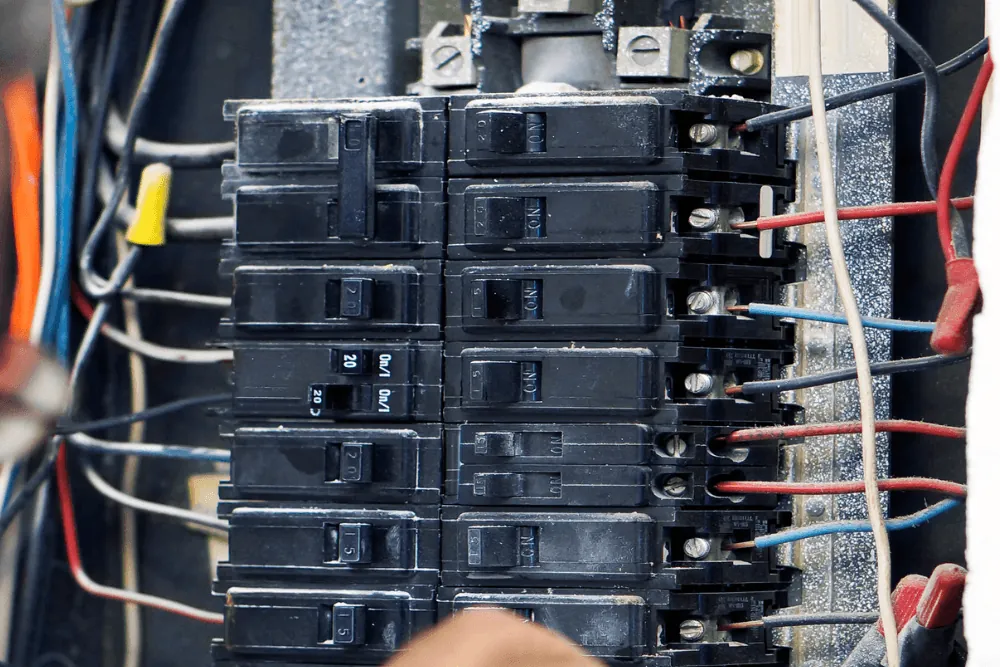
What MCB and RCCB replacement with us includes
A check that the breaker is the problem, because a breaker that trips is protecting a cable from a fault or an overload, and a larger one is never the answer.
The right device chosen from the cable and the load, with the rating, curve, poles, breaking capacity and fit to your board all stated.
Replacement and installation of single MCBs, RCCBs, RCBOs, main switches and three-phase breakers, with the circuit isolated and proved dead first.
Earth leakage protection tested, so an RCCB is proved to trip within the time it should, and a socket circuit that needs a 30 mA device has one.
Fuses and contactors, from a rewirable fuse and a plug fuse to the contactor that switches an air conditioner or a pump.
A written result, with the old and new device, the readings and a relabelled board.
The numbers at a glance
Typical answer for Dubai
Before you book MCB and RCCB replacement, open the board door and photograph it without removing anything. Note which device is the problem and what its label says, such as 20 A or 30 mA. Write down what happened: a trip, a hot smell, a lever that will not stay on, or a plate that is scorched. Do not swap a breaker for a larger one and do not tape a lever on. If the board is hot, discoloured or smells of burning, switch off at the main if it is safe to reach and message us on WhatsApp.
Breaker, RCCB, fuse and contactor terms: what people search for and what each means
The devices on a board go by different names in different countries. A search for a GFCI means an RCD in Dubai, a fuse can mean a plug fuse or a fuse in a car, and a contactor is not a breaker at all. The tables below match each wording to the work behind it and to the section of this page that covers it. Where a term belongs to another trade, the table says so.
Replacing and installing a breaker
| If you searched | What it means and where it is covered |
|---|---|
| MCB replacement, breaker installation, circuit breaker install, circuit breaker installation, install new circuit breaker, install breaker in panel, panel breaker installation, connecting a new circuit breaker | Fitting a new miniature circuit breaker into a board. The replacement section gives the steps and the choosing section gives the selection |
| Changing a breaker switch, replace breaker switch, replacing a breaker switch, replacing a circuit breaker switch, circuit breaker switch replacement, wiring a breaker switch | The same job named by its lever. A breaker switch here is the breaker itself |
| Main breaker switch replacement, circuit breaker main, wiring 3 phase breaker | The main device at the head of the board, and three-phase breakers. The replacement section covers both |
| Breaker repair, breaker repair near me, circuit breaker repair, circuit breaker repair near me, fix circuit breaker | A breaker is replaced, not repaired. A sealed breaker has no serviceable parts. If it will not hold, the cause is found first, and the replacement section explains |
| Replace mcb with rcbo, installing a circuit breaker in a live panel | Converting a breaker to a combined overload and leakage device, and working on a panel that is live. We isolate and prove dead first, as the rules section says |
| Miniature circuit breakers, breaker electricity, circuit breaker draw | The device itself and its current draw. The types section explains what an MCB does |
Brands, documents and cost
| If you searched | What it means and where it is covered |
|---|---|
| GE MCB replacement, general electric mcb replacement, mem mcb replacement, clipsal rcd wiring diagram | A replacement for a named make. Boards accept their own maker's breakers, and a mixed make is a fit question. The choosing section covers it. |
| Schneider mcb test certificate | A maker's type-test document for a breaker. We hand you the device's details and our own test readings. A maker's certificate is a document from the maker and not one we issue |
| MCB replacement cost, ac breaker replacement cost, cost to replace circuit breaker switch, how much does an electrician charge to replace a breaker | The price of the device and the labour. The cost section sets out what moves it |
Breakers that pop, blow, flip or switch off
| If you searched | What it means and where it is covered |
|---|---|
| Blowing a breaker, blowing breakers electrical, blowing circuit breaker, breaker popping, circuit breaker pop, pop circuit breaker, popped breaker, flipping circuit breaker | A breaker that has tripped. A breaker trips, it does not blow, but people search for it under that word. The replacing section says when the breaker is at fault and when it is not |
| Breaker keeps popping, breaker keeps going off, breaker keeps shutting off, breaker keeps switching off, circuit breaker keeps blowing, circuit breaker keeps going off, circuit breaker keeps popping, circuit breaker keeps shutting off | A trip that repeats. The cause to test first is the circuit, not the breaker. See our breaker tripping repair page |
| Why does my breaker keep blowing, why does my breaker keep flipping, why does my breaker keep popping, why does my breaker keep turning off | The same question, asked as a why. The replacing section sets out the three reasons |
| How to reset the main breaker, main breaker hot to touch | The main device, and a main that is hot, which is a connection problem to treat as urgent |
| Water heater blowing breaker, hot water circuit breaker, water heater circuit breaker | The breaker on a water heater circuit. See our water heater installation page |
Fuses
| If you searched | What it means and where it is covered |
|---|---|
| Fuse blow up, fuse blow out, blow a fuse in house, blow fuse in house, if a fuse blows what to do, cause of fuse blowing, reason for fuse blowing | A fuse that has melted, and why. The fuses section covers it |
| Fuse repair, fuse maintenance, fuse working, work of fuse, hrc fuse working, re wirable fuse, re wireable fuse, fuse getting hot but not blowing | How a fuse works, rewirable and HRC types, and a fuse that heats without blowing. The fuses section covers all of them |
| Changing fuse in plug, cooker switch fuse replacement, fuse sketch, fuse puller drawing | A plug fuse, a fuse in a cooker switch, and a drawing of a fuse and its puller. The fuses section covers them |
| Fuse in microwave keeps blowing, microwave blowing fuse, microwave keeps blowing fuse when started, tumble dryer keeps blowing fuse in plug, air conditioner keeps blowing fuse in circuit board | A fuse inside an appliance or its plug that keeps blowing. The fault is in the appliance. The fuses section says what we test |
| Radiator fan keeps blowing fuse, blown ecm fuse, efi fuse blowing, amp blowing fuses at high volume, inverter fuse repair | Car, truck and audio fuses, and an inverter's internal fuse. They are not building wiring. We do not repair car electrical systems, and an inverter's internal fuse is the maker's repair |
RCCB, ELCB, GFCI and AFCI
| If you searched | What it means and where it is covered |
|---|---|
| RCCB installation, rccb working, rcd inspection, elcb installation, elcb working, elcb wiring connection, elcb drawing, voltage operated elcb | Earth leakage devices, how they work and how they are wired. The RCCB section covers them |
| Elcb vs rccb vs mcb, mcb vs elcb vs rccb, mcb vs rccb vs elcb, rccb vs elcb vs mcb, rccb vs mcb difference | The three devices compared. The types section sets them side by side |
| GFCI installation, installing gfci outlet, gfci outlet wiring with switch, gfci outlet with switch installation, gfci outlet with switch wiring, gfci socket wiring, gfci wiring outlet, adding a gfci outlet to light switch, installing gfci breaker in panel, gfci breaker installation | An American ground fault circuit interrupter. In Dubai the equivalent is the RCD or RCCB. The RCCB section explains what we fit in its place |
| Afci breaker installation, afci receptacle | An American arc fault device. It is not part of Dubai practice, and the RCCB section says what we fit instead. |
Contactors and relays
| If you searched | What it means and where it is covered |
|---|---|
| Contactor replacement, replacement contactor, hvac contactor replacement, ac contactor replacement, replacement ac contactor, ac contactor relay switch replacement, carrier contactor replacement, furnas contactor replacement | Replacing the contactor that switches a motor or a compressor. The contactors section covers it |
| Ac contactor wiring, wiring ac contactor, contactor ac wiring, contactor wiring ac, contactor wiring ac unit, hvac contactor wiring, split ac contactor wiring, condenser contactor wiring, ac condenser contactor wiring, ac outdoor contactor wiring, daikin ac contactor wiring, daikin contactor wiring, ac contactor connection, ac contactor coil | How an air conditioner's contactor is wired. The contactors section covers it |
| Contactor wiring, relay wiring, ac relay wiring, ac relay connection, ac fan relay wiring, relay switch wiring, working of contactor, maintenance of relays, relay electrical drawing | How contactors and relays are wired and how they work |
| Coil contactor, contactor 24 volt coil, contactor 24v coil, contactor 220v coil, 24vdc coil contactor, 230v coil contactor, 240v coil contactor, dual coil contactor, a1 a2 contactor coil | The coil voltage of a contactor. The coil table in the contactors section lists each |
| 110v ac contactor, 110v coil contactor, 120v coil contactor, 12v coil contactor, 277v coil contactor, 415v coil contactor, 480v coil contactor, 240v contactor 120v coil, 240v contactor 12v dc coil | Coil voltages from other supplies. Dubai's supply is 230 V and 400 V, and the coil table says how each is read |
| 2 pole contactor 120v coil, 2 pole contactor 240v coil, 2 pole 30 amp contactor 24 volt coil, 3 pole contactor 120v coil, 3 pole contactor 240v coil, 3 pole 30 amp contactor 120 volt coil, 3 pole 60 amp contactor 120 volt coil, 3 phase contactor 120v coil, 3 phase contactor 240v coil, 4 pole contactor 120v coil, 4 pole contactor 240v coil, 4 pole contactor 24v coil, 32 amp 2 pole contactor, 40 amp contactor 24 volt coil | Pole count, current rating and coil voltage, the three things that define a contactor. The contactors section explains how to read them |
| Abb contactor 24vdc coil, abb contactor coil, schneider contactor coil, coil contactor schneider, siemens contactor coil, l&t contactor coil, tc contactor coil | Contactors by make. We match the coil to the control supply and the poles to the load, whatever the make |
| 24v relay current draw, 5v relay current draw, 12v relay wiring, 110v relay wiring | The coil current of small relays, and relay wiring at other voltages. The contactors section gives the method |
| Contactor single line diagram, relay one line diagram, relay single line diagram | A contactor or relay shown on a single line diagram. The records section explains how to read it |
Commercial and high-voltage breakers
| If you searched | What it means and where it is covered |
|---|---|
| Circuit breaker maintenance, breaker maintenance, circuit breaker inspection | Servicing and checking breakers. The commercial section covers the low-voltage ones |
| Air circuit breaker maintenance, abb air circuit breaker maintenance, draw out breaker, draw out circuit breaker, draw out type circuit breaker | Large low-voltage breakers on commercial boards, including the withdrawable type. The commercial section covers them |
| Vcb breaker maintenance, vcb circuit breaker maintenance, maintenance of vacuum circuit breaker, sf6 breaker maintenance, maintenance of sf6 circuit breaker, sf6 circuit breaker drawing, high voltage circuit breaker maintenance, 33kv breaker maintenance | Medium and high-voltage switchgear. This work is for the utility or a specialist, and the commercial section says where we stop |
Diagrams and calculations
| If you searched | What it means and where it is covered |
|---|---|
| Circuit breaker sketch, circuit breaker single line diagram, single line diagram circuit breaker, single line diagram mcb, mcb single line diagram | A drawing of a board and its breakers. The records section shows how we draw one |
| Breaker load calculator, circuit breaker load calculation, rccb load calculation | Working out what a breaker or an RCCB carries. The choosing section works an example |
Searches this page does not cover
| If you searched | What it is |
|---|---|
| Victron bmv 712 relay wiring, zigbee relay din, wiring light bar with relay, exhaust fan relay switch | A battery monitor, a smart relay module, a vehicle light bar and a fan switch. They follow the maker's instructions. See our smart home installation, exhaust fan installation, battery storage installation and UPS and inverter installation pages for the closest services |
| Irrigation pump start relay wiring diagram, orbit pump start relay wiring diagram, water pump relay wiring diagram, relay connection with water pump | Wiring a relay or a start relay to a pump. See our pump and pool equipment wiring page |
See our electrical fault repair, DB box and distribution board, three-phase and load upgrade, AC electrical connection, surge protection and electrical inspection pages for the work that belongs to each service on its own.
Planning breaker replacement: what to check, what to read on the label and what to tell us
A replacement is quoted and fitted faster when the old device is described exactly. The label on the breaker says most of what we need, and ten minutes with the board door open saves a second visit.
Checks you can make safely
These need no tools and no opening of anything. Open the board door only, not any inner cover.
- 1Find the device. Look for the lever that sits down or halfway, a plate that is brown or blistered, or a device that feels warm. Note its position on the board and any circuit label beside it.
- 2Read its label with the table below. Photograph it close up.
- 3Reset once with the load unplugged. Push the lever fully to off, then to on. If it holds, the breaker may be sound and the circuit was overloaded. If it will not stay on with nothing connected, the fault is in the circuit or the device.
- 4Check for heat. A breaker or a main that is hot to touch, or has a discoloured case or a burning smell, is a connection problem. Switch off at the main if you can do so safely and message us on WhatsApp.
- 5Note the pattern. A trip at the same time each day, a trip when one appliance starts, or a trip after rain tells us where to test.
- 6Press the RCCB test button once. A device that does not trip when tested is one of the reasons to replace it.
How to read a breaker label
| Marking | What it tells you |
|---|---|
| C20, B16, D32 | The curve letter and the rating in amps. C20 is a type C breaker rated 20 A |
| 6000, 6 kA or 10 kA | The breaking capacity, which is the largest fault current it can interrupt safely |
| 1P, 2P, 3P, 4P | The number of poles: one, two, three or four |
| 30 mA, IΔn 30 mA | The leakage current at which an RCCB or RCBO trips |
| AC, A, F or B in a symbol | The RCD type, which sets what kind of leakage it detects. The RCCB section explains |
| 230 V or 400 V | The voltage rating |
| T or a test button | The test button on an RCD |
| The maker's name and model | What the replacement must fit into |
What to leave alone
- Do not fit a larger breaker because the old one trips. The rating protects the cable, and a bigger one lets it overheat first.
- Do not tape, wedge or hold a lever on. A breaker that cannot trip does not protect.
- Do not remove the board cover. The incoming side of the main stays live when the main is off.
- Do not swap a breaker from another maker into a board that was not made for it. Plug-in and DIN-rail devices are not interchangeable between boards.
- Do not work in a live panel. The rules section explains why we do not.
What to tell us
| Question | Why it matters |
|---|---|
| Which device is it, and what does its label say? | It sets the rating, curve and poles of the replacement |
| What is wrong: trips, will not stay on, hot, burnt, noisy or just old? | It tells us whether the breaker or the circuit is at fault |
| Is it a breaker, an RCCB, an RCBO, a fuse or a contactor? | Each is tested and fitted differently |
| What make is the board? | The new device must fit its busbar or rail |
| What does the circuit feed, and what is on it? | The load decides the rating and the curve |
| Is it single-phase or three-phase? | Three-phase devices have more poles and need a phase check |
| Has the board been added to or changed? | An altered board may not suit a straight swap |
| Any smell, heat, noise or marks? | These make the job urgent |
Photos that help
Send one photo of the whole board with its door open, with every label legible, and one close-up of the device that is at fault. Add a photo of the appliance's nameplate if one appliance seems to set it off. With these we can bring the right device and a spare of the next size up for the cable, if the cable allows it.
Planning the visit
Replacing a breaker means switching off the circuit, and replacing a main or a board means switching off the whole property. Choose a time when that does least harm: not in the middle of a summer afternoon if a family is at home, and not during trading hours for a shop. Tell us about anything that must stay on, such as a fridge, a server or a medical device. In an apartment, the building controls the riser, and the main isolator of the building is not ours to touch. In a commercial building, a shutdown slot and a written method are agreed first. Leave the fault as it is until we arrive, because an intermittent fault is easier to catch while it still happens.
Rules and safety for breaker replacement in Dubai
A breaker is the device that stands between a fault and a fire, so a wrong one does harm quietly. This section sets out the rules that shape a replacement, how the work is done safely, and why we do not work in a live panel. The rules come from DEWA's Regulations for Electrical Installations (2017 edition), read for the parts that apply to homes and small buildings. Anything marked needs checking against the current edition before you rely on it.
Rules that touch a breaker replacement
| Rule | What it means for the job |
|---|---|
| Supply of 230 V single-phase and 400 V three-phase, with a variation of plus or minus 10 per cent | Devices must be rated for the supply. A 230 V device on a 400 V line-to-line circuit is the wrong device |
| 30 mA RCD protection on socket circuits up to 20 A, on cables concealed in walls at less than 50 mm depth or in walls containing metal, and on water heater circuits | A replacement keeps that protection, and a board without it is one of the reasons for an upgrade |
| Alterations to an installation approved, and work done by contractors enrolled with DEWA | A change of main breaker or a new board may need approval. We ask before we price. |
| A permitted voltage drop of 4 per cent | It governs the cable, and so the rating of the breaker that protects it |
| Inspection of commercial and industrial installations at least every two years | Commercial breakers are tested on that cycle. The part of the regulations we read sets no such interval for a villa or an apartment |
Where DEWA's text gives no figure, such as a minimum insulation reading, we use the UK wiring rules (BS 7671) as a guide and mark it for confirmation.
Two further principles are not DEWA clauses but are the basis of choosing any breaker. The device must be able to interrupt the largest fault current that can reach it, which is its breaking capacity. And the device must protect the cable behind it, which is why its rating comes from the cable and never from the wish for fewer trips.
Why we do not work in a live panel
Searches for installing a circuit breaker in a live panel come from a real situation: a board that cannot be shut down. Even with the main breaker off, a panel is not dead. The incoming cables and the incoming terminals of the main stay live, and so does the neutral. A US building guide that teaches breaker installation makes the same point: with the main off, the incoming poles still carry power, and a meter should be used to prove the busbars dead before anything is touched. We go further. We isolate the circuit, or the whole supply, lock it off and prove it dead, and we do not reach into a live board. Where a board cannot be shut down at all, we say so and plan an outage, not a risk. A fault in a live board can throw an arc that burns the person at it, and the saving of an hour is not worth that.
How we work safely
- 1Isolate the circuit at its breaker, or the whole board at the main, and lock it off.
- 2Prove dead with an approved voltage indicator, proved on a known live source before and after the test.
- 3Treat the incoming side of the main as live. For a main breaker replacement, the supply to it must be isolated upstream, by the building or by DEWA, before the incoming terminals are touched.
- 4Label the conductors before they come off, so each goes back to the right breaker.
- 5Torque every terminal to the maker's figure, because a loose terminal heats and damages a breaker that was sound.
- 6Test and re-torque after the first load cycle, then record the readings.
Devices must suit the board
A distribution board is built and type-tested with its own maker's devices. Fitting a breaker from another make, or a device that the board was not made for, can leave a poor connection to the busbar, change the heat the board runs at, and void the maker's approval of the assembly. The right replacement is the one the board maker lists for that board, or a device with a stated fit and a test to prove it.
Apartments, villas and commercial sites
In an apartment the building owns the riser and its main isolator. We replace what is on your side of it, and the building's own rules on permits, working hours and notice apply. In a villa the main board is yours, and the supply cable to it is DEWA's. A commercial site needs a shutdown slot, a written method and, where the site requires one, a permit to work. We ask for these at the quote and do not start without them. We apply for the permits for you.
Types of breaker: MCB, RCCB, RCBO, ELCB, MCCB and ACB compared
Breaker electricity questions start with the same confusion: a board holds devices that look alike and do different jobs. A breaker is a switch that opens itself when current goes wrong. What counts as wrong depends on the device. One senses too much current, another senses current leaking to earth, and a third does both. Choosing the replacement starts with knowing which job the old device did.
The devices side by side
| Device | What it senses | Protects against | Does not protect against | Where it sits |
|---|---|---|---|---|
| MCB (miniature circuit breaker) | Current through it, by heat and by magnetic force | Overload and short circuit | Leakage to earth at the levels that harm a person | One per circuit on a board |
| RCCB (residual current circuit breaker) | The difference between the live and neutral currents | Leakage to earth, and electric shock | Overload and short circuit, so it needs an MCB or fuse in series | Ahead of a group of circuits |
| RCBO (residual current breaker with overcurrent protection) | Both of the above | Overload, short circuit and leakage in one unit | Nothing it is not rated for | One per circuit, in place of an MCB |
| ELCB, voltage-operated | The voltage that appears on the earth conductor | A fault that raises the earth conductor's voltage | Leakage that does not reach the earth conductor, and any fault if the earth is poor | Old boards |
| ELCB, current-operated | The same as an RCCB | The same as an RCCB | The same as an RCCB | The name older boards use for an RCCB |
| MCCB (moulded case circuit breaker) | Current, with adjustable trip settings | Overload and short circuit at higher currents | Leakage, unless an earth fault module is fitted | Main and sub-main of larger boards |
| ACB (air circuit breaker) | Current, with electronic trip settings | The largest loads, and selective trip | Leakage, unless fitted with an earth fault function | Main low-voltage panels, in fixed and withdrawable types |
The comparisons people search for as elcb vs rccb vs mcb, mcb vs elcb vs rccb, mcb vs rccb vs elcb and rccb vs elcb vs mcb all come to the table above. The rccb vs mcb difference is the shortest to state: an MCB protects the cable from too much current, and an RCCB protects a person from current that leaks. A board needs both, and an RCBO gives both in one body.
The MCB and its curve
Miniature circuit breakers are thermal-magnetic. A bimetal strip heats and bends under a modest overload, which gives a delayed trip. An electromagnet pulls the mechanism open at once under a short circuit. The curve letter says how large a current the magnetic part tolerates before it acts. Manufacturer data, such as ABB's, gives these bands of the rated current:
| Curve | Magnetic trip band | Suited to |
|---|---|---|
| B | 3 to 5 times the rating | Lighting and ordinary socket circuits, with little surge current |
| C | 5 to 10 times the rating | Circuits with some surge, such as air conditioners and small motors |
| D | 10 to 20 times the rating | Large surges, such as transformers and heavy motors |
A breaker does not draw current. The circuit does, and the rating is the most current the breaker will carry without tripping in the long run. Choosing it from the cable and the load is the subject of the choosing section.
The RCCB and the ELCB
An RCCB compares the current going out on the live with the current coming back on the neutral. In a healthy circuit they are equal. If some current takes another path, through a person or through damaged insulation to earth, the difference trips the device. An RCCB with a 30 mA rating trips at a leakage that is small enough to protect a person, and 100 mA and 300 mA devices cover fire protection and groups of circuits. A leakage device is not an overload device, which is why one is never sold as a replacement for an MCB.
The ELCB name covers two designs. The older voltage-operated type watches the voltage between the earth conductor and true earth, and trips when it rises. It depends on a good earth connection and is slower than current sensing, and it has fallen out of favour in newer construction. The current-operated type is, in practice, an RCCB under an older name. When a board labelled ELCB is replaced, it is replaced with an RCCB or with RCBOs, after the earth system is tested.
RCD types: AC, A, F and B
An RCCB also has a type, which is the kind of leakage current it can detect. Hager's guide to RCD selection lists them as follows.
| Type | Leakage it detects | Loads it suits |
|---|---|---|
| AC | Sinusoidal AC only | Resistive and plain loads, such as immersion heaters, ovens and halogen lighting |
| A | AC and pulsating DC | Single-phase electronics, washing machines, induction hobs, lighting controls and single-phase inverters |
| F | Type A and high-frequency leakage | Equipment with frequency-controlled motors, such as some air conditioners |
| B | Type F and smooth DC | Three-phase electronics, speed-control drives, UPS and PV supplies |
The type matters on a replacement. A type AC device behind an induction hob or an inverter can fail to see a leakage that has a DC component, and so fail to trip. For an EV charger, the maker's instructions say which type and what DC protection to use, and our EV charger installation page covers it.
Moulded case and air circuit breakers
Above the range of an MCB, the main and sub-main of a larger board use moulded case breakers (MCCBs) and, at the head of a commercial panel, air circuit breakers (ACBs). They carry larger currents and have adjustable trip settings, and an ACB can be built to be drawn out of its cubicle for service. The commercial section covers their maintenance.
When a breaker needs replacing and when the circuit is the problem
Most breakers that trip are doing what they were built to do. Replacing one that is working only hides the cause and moves the heat somewhere else. A breaker is replaced when the device has failed, not when the circuit behind it has a fault. This section sets out how we tell the two apart.
Three reasons a breaker trips
A breaker that keeps popping, flipping or switching off is reacting to one of three conditions. The breaker tripping repair page covers each in depth.
| Cause | What happens | Is the breaker at fault? |
|---|---|---|
| Overload | Too much runs on the circuit for too long. The breaker trips after seconds or minutes | No. The circuit needs a second circuit, or the load needs moving |
| Short circuit | A live conductor touches neutral or another live. The breaker trips at once | No. The cable, a fitting or an appliance is damaged |
| Earth fault | Current leaks to earth. An RCCB or RCBO trips, and an MCB trips only when the leak is large | No. The leak is found and repaired |
The searches that read blowing a breaker, blowing breakers electrical or blowing circuit breaker, why does my breaker keep blowing, why does my breaker keep flipping, why does my breaker keep popping or why does my breaker keep turning off all describe one of these three. A circuit breaker that keeps popping, shutting off or going off is reporting a fault or an overload until a test shows otherwise. See our breaker tripping repair page, and our electrical fault repair page for faults that need tracing.
Signs that the breaker itself has failed
A device is the problem when the circuit tests sound and the breaker still misbehaves.
- It will not stay on with every load unplugged and the circuit proved healthy by an insulation test. The mechanism has failed.
- It trips well below its rating, such as a 20 A breaker tripping at 12 A in a cool room. The thermal element has drifted.
- It does not trip when it should, shown by a test or by a cable that is hot behind a breaker that stays on. This is the dangerous failure, and the device is replaced at once.
- Its case or terminals are discoloured, cracked or melted, or its lever is loose, gritty or noisy.
- It is hot to touch compared with its neighbours at the same load. A thermal image shows it clearly. The cause can be a loose terminal, and the cure is a new device, a tightened terminal and a check of the cable end. See our thermal imaging inspection page.
- An RCCB fails its test button, or trips with nothing connected and the circuits proved clean.
- The board is obsolete, with devices that can no longer be bought, or old rewirable fuses and no RCD protection.
Breakers have no stated life in years. They wear by the number of operations, the heat they have carried and the faults they have cleared.
The main breaker: reset, heat and replacement
How to reset the main breaker is a short routine. Unplug or switch off the large loads, push the lever to off and then to on once. If it holds, add the loads back one at a time. If it trips again, leave it off and message us on WhatsApp, because a main that trips twice is reporting a fault or an overload that a second reset will not cure.
A main breaker hot to touch is a different matter. A main carries the whole property's load, and heat at it comes from a loose or oxidised connection at its terminals or from a main that is too small for the load. Do not keep touching it, switch off the large loads and message us on WhatsApp the same day. A main breaker switch replacement involves the incoming supply, so the supply is isolated upstream before we work, as the rules section explains. When the main is replaced because the load has grown, our three-phase and load upgrade page covers the larger job.
Stop and keep clear of a breaker, board or main that is hot, discoloured, smoking or sparking, smells of burning, or has water near it. Switch off the large loads and, if you can reach the main switch safely with dry hands, switch off at the main. Do not open the board, do not keep resetting, and message us on WhatsApp.
Water heaters and air conditioners
Two appliances need their own notes when a breaker trips in a Dubai home. A water heater blowing a breaker is either an overloaded shared circuit or an element that has begun to leak to earth, in which case the RCD on the heater circuit is doing its job. The hot water circuit breaker is a dedicated device sized to the heater's nameplate, with the 30 mA protection that DEWA's rules call for on water heater circuits. A water heater circuit breaker that trips on warming points to the element, and the cure is the element or the heater. See our water heater installation page.
An air conditioner breaker that trips as the compressor starts may be a curve B device on a load that needs curve C, because the starting surge is several times the running current. Changing the curve is a real replacement, and it needs the unit's nameplate. A breaker that trips after the unit has run for an hour points to a dirty condenser, a failing capacitor or a loose connection, and the breaker is not the cause. AC breaker wiring is short: the breaker feeds the unit through a local isolator, on a cable sized from the unit's nameplate current. An AC MCB wiring job, or an AC MCB box connection where the breaker sits in a separate enclosure, follows the same order as any breaker: cable first, then rating and curve, then terminal torque. See our AC electrical connection page.
What we test before we replace
We do not replace on a guess. We read the label and the nameplate, then measure the load with a clamp meter, test the insulation of the circuit, check the terminals for heat, and operate the breaker. For an RCCB, a trip test at its rated leakage records the time it takes. Only when the circuit is sound and the device has failed do we quote the replacement. If the circuit is at fault, we say so, and the fix is the circuit.
Choosing the replacement breaker: rating, curve, breaking capacity and load calculation
A replacement breaker is chosen in a fixed order, and the first item is the cable. The breaker exists to protect the conductor behind it, so the cable sets the ceiling, the load sets the floor, and the breaker sits between them. This section sets out each choice and works two examples, so that the logic behind a quote can be checked.
The six choices
| Choice | Set by | The rule |
|---|---|---|
| Rating (amps) | The load and the cable | At least the current the circuit normally carries, and no more than the cable can carry after derating |
| Curve (B, C or D) | The surge the load draws on starting | B for lighting and sockets, C for air conditioners and small motors, D for large surges |
| Poles (1P, 2P, 3P, 4P) | The supply and the circuit | One live plus neutral for single-phase, three or four poles for three-phase |
| Breaking capacity (kA) | The largest fault current at the board | Above the prospective fault current at that point |
| RCD sensitivity and type | What the circuit feeds | 30 mA for sockets and water heaters, with a type that suits the load |
| Fit | The make and model of the board | The device the board maker lists for it |
A worked example: why the cable sets the rating
A socket circuit is wired in 2.5 mm² copper cable. The UK wiring rules (BS 7671), used here as a guide, give a current-carrying capacity of about 27 A for that cable clipped directly to a surface. In a ceiling void at 45 °C the cable cannot carry that much, and the standard's correction factor for 45 °C is 0.79.
- Corrected capacity: 27 A × 0.79 = about 21.3 A.
- A 20 A breaker is below 21.3 A, so the cable is protected.
- A 25 A breaker is above it, so a cable at its limit would overheat before the breaker acts.
That is why a 20 A breaker that trips on a loaded circuit is not replaced with a 25 A one. The answer is a second circuit or a heavier cable. Grouping several circuits together lowers the capacity further, and our design checks for it.
A worked example: a breaker or RCCB load calculation
A breaker load calculation, also searched as a breaker load calculator or a circuit breaker load calculation, starts with the current of each appliance: power divided by voltage, 230 V in Dubai. For a 40 A RCCB that serves a kitchen and a water heater, the calculation is:
| Load | Power | Current at 230 V |
|---|---|---|
| Water heater | 3,000 W | about 13.0 A |
| Kettle, toaster and microwave | 2,400 W + 800 W + 1,200 W = 4,400 W | about 19.1 A |
| Lighting on the same group | 800 W | about 3.5 A |
| Total if everything runs at once | 8,200 W | about 35.7 A |
The RCCB load calculation compares that total with the device. A 40 A RCCB carries 35.7 A with a margin. A 25 A one does not. Real homes rarely run every load together, so a diversity allowance is used on a large board. Two further rules apply. The RCCB must be protected by a fuse or MCB of no more than its own rating, since an RCCB has no overload protection of its own. And the RCCB is chosen for the circuits it serves, so a single RCCB across too many circuits trips all of them for one fault. That is a reason to use RCBOs.
Breaking capacity and fault current
A fault at the board is a very large current for a very short time. The breaker must be able to open it without welding or exploding. The measure is breaking capacity, marked as 6 kA or 10 kA. We measure the prospective fault current at the board with a loop tester, and choose a breaker whose rating is above it. A board close to a transformer sees more fault current than one at the end of a long cable. An old board with 3 kA devices on a modern supply is one of the findings an inspection reports. See our electrical inspection page.
Selectivity and coordination
When a branch breaker and the main both see a fault, the branch should open and the main should stay on. That needs the curves to be coordinated, which the maker's tables confirm for a given pair, such as a 20 A branch breaker below a 63 A main. Changing one breaker's curve or rating can break that coordination, so we check the upstream device whenever we change a downstream one. See our breaker tripping repair page for how a main trips ahead of a branch.
Fit: the board decides
A board is made for a family of devices. Some use plug-in breakers that clip onto the busbar, and some use DIN-rail devices that clip onto a rail and take a link bar. A device that looks right but sits wrongly can run hot. We replace with the board maker's listed part, or we name the fit and test it. For GE, general electric, MEM, Schneider and Clipsal boards, the same rule applies: the device must be from the board's own range.
How we do an MCB replacement: single breaker, three-phase breaker, RCBO conversion and main breaker
Changing a breaker takes minutes. Doing it so that the new device runs cool for years is a matter of the steps before and after the swap. This section sets out the order we follow, and how it changes for a three-phase device, for a conversion to an RCBO, and for the main.
The steps for a single breaker
These are the steps for replacing a breaker switch on a single-phase circuit, whether a search calls it changing a breaker switch, replace breaker switch or circuit breaker switch replacement.
- 1Isolate and prove dead. The circuit's breaker is off, and the board's main is off for any work that opens the cover. The inside of the board is tested with a voltage indicator.
- 2Photograph and label. One photo of the board before, and a tag on each conductor, so that nothing is returned to the wrong place.
- 3Release the conductor. Undo the terminal screw and ease the conductor out. For a plug-in breaker, release the clip and lift the device off the busbar.
- 4Inspect the cable end. Copper that is blue, black or brittle, or insulation that is cooked back from the terminal, means the connection ran hot. We cut back to clean copper and strip fresh insulation to the right length. A new breaker on a damaged end is the reason for a second failure.
- 5Fit the new device. A DIN-rail breaker clips on to the rail. A plug-in breaker seats on the busbar and is held by its clip.
- 6Connect and torque. The conductor goes fully into the terminal with no bare copper showing outside it, and the screw is tightened to the maker's figure, which is printed on the device or in its data sheet. We tug the conductor to check it.
- 7Close the board and label. The cover goes back, and the circuit label is renewed.
- 8Energise and test. We switch on, run the circuit at its normal load, check the breaker is not warming against its neighbours, and operate it a few times.
The same steps apply to circuit breaker installation of a new circuit and to a connection of a new circuit breaker to a new cable. A new circuit also needs the cable, its protection and its testing, which belong to the rewiring or the new circuit job. See our house rewiring page.
Why we do not install a breaker in a live panel
It is possible to push a plug-in breaker onto a live busbar. It is also how electricians get burned. We do not do it. The rules section says why, and the shutdown it needs is planned in advance. If the property truly cannot go dark, we plan the work in parts, with a temporary supply to the loads that must stay on.
Wiring a three-phase breaker
Wiring a 3 phase breaker uses a three-pole (3P) or four-pole (4P) device. The three phases go to the three poles in order, L1, L2 and L3, with the neutral on its own pole or on a neutral bar, depending on the board. Two points matter. First, the order of phases must be the same at the load as at the source, because a motor or a compressor runs backward if two phases are swapped. Second, a three-phase device on a shared handle trips all three poles together, which is what a three-phase load needs. Single-pole breakers tied together with a handle clip are not a substitute, because a fault on one pole may leave the others on. See our three-phase and load upgrade page.
Replacing an MCB with an RCBO
The request to replace an MCB with an RCBO is a good upgrade: the circuit then has its own leakage protection, so a fault on it does not take out the others the way a shared RCCB does. It needs three checks first.
- A neutral for each circuit, brought to the RCBO's own neutral terminal. An RCBO compares the live and neutral of one circuit, so the neutral must not be shared with another circuit or connected to the neutral bar.
- A circuit free of shared neutrals. Some older wiring takes one neutral for two circuits. That must be separated, or the RCBO will trip at once.
- Room on the board. An RCBO is wider than an MCB, and a crowded board may need a larger one. See our DB box and distribution board page.
With those done, the swap follows the steps above, and the RCBO's test button and a leakage test are added.
Main breaker switch replacement
The main is the device at the head of the board, and replacing it is not like replacing a branch breaker. The incoming cable stays live to the meter or cut-out unless the supply is isolated upstream. The meter and its seals belong to DEWA and are not ours to touch. We arrange the isolation first, and check that the new main is rated for the load and for the cable that feeds it. We also check coordination with the branch devices, because a main that is too sensitive will trip ahead of them. Hot terminals on an old main are replaced together with the main, and the incoming cable end is checked. When the main is changed to a larger rating because the load has grown, the cable and the meter must also suit it, which is a load upgrade and not a swap.
After the swap
The work ends with a written note: the old device, the new device, its rating, curve and breaking capacity, the test readings and the date. We relabel the board if the old labels were faded or wrong. A board that someone else can read is the reason the next fault is quick to find.
RCCB installation, ELCB, GFCI and AFCI: how earth leakage protection is fitted and tested
Leakage protection is the part of a board that saves lives, so it is the part that is tested most. This section explains how an RCCB and an ELCB work, how an RCCB is installed and wired, how it is inspected, and what the American GFCI and AFCI devices correspond to in a Dubai installation.
RCCB working
RCCB working comes down to a ring of iron and one comparison. The live and neutral conductors pass together through a magnetic ring, called a toroid. When the currents in them are equal, their magnetic effects cancel and nothing happens. When part of the current returns by another path, such as through a person or damaged insulation to earth, the ring sees the difference and a sensing coil trips a mechanism that opens the contacts. The test button deliberately passes a small current around the ring, which is why pressing it should trip the device. An RCCB with a rating of 30 mA trips when the difference reaches that level. It senses nothing about overload, which is why it is always paired with an MCB.
ELCB working
ELCB working depends on the design. A voltage-operated ELCB has a coil connected between the board's earth terminal and a separate earth electrode. If a fault raises the voltage of the earth conductor above the coil's setting, the coil trips the device. It needs a good, separate earth electrode to work, and one earth loop that touches another can stop it from sensing a fault. For those reasons the voltage-operated type has been replaced in newer work. A current-operated ELCB is an RCCB under the older name. If a board carries an ELCB, we test it, and we replace it with an RCCB or RCBOs when it is old or fails the test. See our earthing and grounding page.
RCCB installation and ELCB wiring connection
An RCCB installation follows the board maker's diagram printed on the device. Searches for an elcb wiring connection, an elcb drawing or a Clipsal RCD wiring diagram are asking for that diagram, and the one that matters is the diagram for the model in the board. These points are the same on every board:
- Supply side and load side are not interchangeable. The device is marked, and the supply must go to the marked terminals.
- Live and neutral both pass through. A two-pole RCCB breaks both. A four-pole RCCB serves three-phase circuits and breaks all four.
- Neutral must not be shared downstream. The neutral of the circuits behind an RCCB must not touch the neutral of circuits behind another RCCB or the neutral bar upstream of it, or the device will trip when nothing is wrong.
- A neutral that touches earth beyond the device also trips it. Finding a neutral-to-earth fault is part of the work when a new RCCB trips.
- The RCCB is protected from overload by an MCB or fuse of no larger rating, in series.
For a new RCCB installation we add the test: the trip time at rated leakage, and a check that nothing downstream trips it with the loads running. For an ELCB installation on an old board, we test the earth electrode before we trust a voltage-operated device.
RCD inspection: what we test and what the readings mean
An RCD inspection tests the device in place with a loop and RCD tester. The values below are guides from the UK wiring rules (BS 7671) for a general-purpose RCD, and each is marked for confirmation against the Dubai requirement or the project specification.
| Test | What it shows | Guide value |
|---|---|---|
| Half the rated leakage current | The device does not trip when it should not | No trip |
| Rated leakage current, such as 30 mA | The device trips when it should | A trip in no more than 300 ms |
| Five times the rated current, such as 150 mA | The device trips fast on a larger leak | A trip in no more than 40 ms |
| The test button | The mechanism works | A trip every time it is pressed |
For how often to press the test button, the IET, a UK body, advises every six months for an RCD in a home. The interval depends on the work and is set on your quote. A device that fails any of these is replaced.
GFCI is the American name for an RCD
A GFCI, a ground fault circuit interrupter, does the job of an RCD on a 120 V American circuit. It is built into an outlet or into a breaker, and trips at a leakage of about 4 to 6 mA. Dubai's supply is 230 V and its sockets are the British type, so American GFCI devices do not fit and should not be imported. The searches for GFCI installation, installing gfci outlet, gfci socket wiring and gfci wiring outlet mean the same job in a Dubai home: a socket circuit behind a 30 mA RCCB or RCBO, which DEWA's regulations call for on socket circuits up to 20 A.
Several GFCI searches add a switch. An outlet with a switch or a light switch with a GFCI is an American product form. In Dubai the socket outlets are switched already, and the protection sits at the board, so that every socket on the circuit is covered. The searches for gfci outlet wiring with switch, gfci outlet with switch installation, gfci outlet with switch wiring and adding a gfci outlet to light switch are answered by an RCD-protected circuit and a switched socket. Installing gfci breaker in panel and gfci breaker installation are answered by an RCBO in the board. If you want a local fix for one socket, a socket with its own built-in RCD can be fitted where one is approved for use. See our socket outlet installation page.
AFCI is the American name for an arc fault device
An AFCI breaker or receptacle detects the electrical signature of an arc, such as a damaged cable or a loose connection that sparks, and opens the circuit before it starts a fire. American rules require them on specified circuits. The equivalent under IEC and British practice is the arc fault detection device (AFDD). The part of DEWA's regulations we read does not require arc fault protection in homes. If you want it, as extra cover for a bedroom, an AFDD can be fitted on the circuit, and an AFCI breaker or AFCI receptacle from the US is not used.
Fuses: how a fuse works, why a fuse blows and when to replace it
A fuse is the oldest protective device on a board and the simplest: a part that is designed to destroy itself so that the circuit survives. It is replaced and not repaired. This section covers fuse working, the types you meet, the reasons a fuse blows, and what to do when it does.
Fuse working and the work of a fuse
The work of a fuse is to open a circuit when the current through it exceeds its rating for long enough. Inside is a narrow element of metal. Normal current warms it slightly. A current well above the rating heats it faster than it can lose the heat, and it melts. The larger the overcurrent, the faster it melts, so a short circuit clears in a fraction of a second while a modest overload takes longer. When it melts, an arc forms across the gap, and the fuse's construction has to put that arc out.
HRC fuse working
The HRC (high rupturing capacity) fuse is the cartridge type built for that. In HRC fuse working, the element sits inside a ceramic body packed with fine silica sand. When the element melts, the sand absorbs the arc's heat and turns to a glass-like fused mass that stops the current. This lets the fuse break a very large fault current safely, which a plain wire fuse cannot. HRC fuses are found at the head of commercial boards and in switch-fuse units, and the rating and breaking capacity are printed on the body.
The fuse types you meet
| Type | What it is | Where it appears |
|---|---|---|
| Rewirable fuse | A porcelain carrier with a length of fuse wire between two terminals | Old boards. It is replaced by an MCB |
| Cartridge fuse | A sealed glass or ceramic tube with an element | Plugs, appliances and fused switches |
| HRC fuse | A sand-filled ceramic cartridge | Commercial boards, switch-fuses and motor circuits |
| Plug fuse (BS 1363) | A small cartridge in a 13 A plug, in several ratings | Every British-type plug, including those in Dubai |
| Fuse in a fused connection or cooker switch | A cartridge in a switch unit | Fixed appliances |
A re wirable fuse, also written re wireable fuse, is the one that causes the most mistakes. Its protection depends on the right gauge of wire, and a thicker wire or a strip of foil lets the cable overheat. It has no arc control, so a large fault can blow its carrier apart. It is also not selective in the way a modern breaker is. If we find rewirable fuses, we replace the board's fuse bank with MCBs and RCD protection, and the testing section says how we prove the result. See our DB box and distribution board page.
Why a fuse blows
The cause of fuse blowing is the same as the reason for a breaker tripping: an overload, a short circuit, or leakage large enough to reach it. A fuse blow out in a plug points to a fault in the lead or the appliance, because plug fuses protect the flex. The reason for fuse blowing at a board is an overloaded circuit or a damaged cable until a test shows otherwise. A fuse blow up, where the glass tube is blackened or burst, points to a large short circuit. Our breaker tripping repair page has the full list of causes by symptom.
If a fuse blows, what to do
This is the answer to the search if a fuse blows what to do, and to the shorter blow a fuse in house and blow fuse in house.
Switch off or unplug whatever was running on that fuse.
Find the fuse and read the rating on its body.
Replace it once with the same rating and type. Never fit a larger fuse, wire or foil.
Switch on with the load reduced and add loads back one at a time.
If it blows again, stop. The fault is still there, and we find it.
Changing fuse in plug is the same job in small: switch off, unplug, open the plug, fit a fuse of the rating the appliance's label or instructions call for, and close it with the cable grip over the sheath. A cooker switch fuse replacement follows the same rule: isolate the cooker circuit at the board first, as the fuse in a cooker switch sits on a live supply, replace with the same rating and type, and look for the reason it blew before the cooker is used again.
A fuse that gets hot but does not blow
A fuse getting hot but not blowing is passing its rated current, or close to it, through a poor contact. Fuses run warm at their rating, but one that discolours its holder, or is hot enough to hurt a finger, has a resistive joint. The cause is a loose clip, a corroded end cap, a fuse holder that has lost its spring, or a circuit that runs at the fuse's limit all day. The cure is a new fuse and holder, and a check of the cable end. A thermal image shows it before it fails. See our thermal imaging inspection page.
Fuses that keep blowing inside appliances
- A microwave that keeps blowing its fuse, including the microwave that blows a fuse when started, has a fault in its high-voltage circuit, such as a shorted diode or capacitor or a failing magnetron. That is an appliance repair, and the capacitor holds a dangerous charge. We test the supply to it, and the appliance goes to a repairer.
- A tumble dryer that keeps blowing the fuse in its plug has a shorted or leaking heater element, a damaged flex, or a motor that draws too much. We test the supply and the flex.
- An air conditioner that keeps blowing a fuse in its circuit board has a failing compressor, fan motor or capacitor that is drawing too much, or a shorted control part. See our AC electrical connection page for the supply, and the unit's service technician for the board.
Fuses we do not repair
Car fuses, such as a radiator fan that keeps blowing a fuse, a blown ECM fuse, an EFI fuse blowing, or a car amplifier that keeps blowing fuses at high volume, are vehicle electrical work. We do not repair them. An inverter fuse repair, for the internal fuse of a battery inverter, is the maker's repair, because a blown DC fuse points to a battery short or an internal fault. See our UPS and inverter installation page for the supply side.
Fuse sketch, fuse puller drawing and fuse maintenance
A fuse sketch of a cartridge fuse shows two end caps joined by a body, with the element inside and sand around it. A fuse puller drawing shows an insulated tool with two jaws, used to pull a cartridge fuse out of its carrier without touching it. Fuse maintenance is a visual and thermal check: right rating and type, tight clips, no discolouration, no cracked body, and a spare of each type on site.
Contactors and relays: how they work, coil voltages, AC contactor replacement and wiring
A contactor looks like a breaker and does a different job. A breaker protects a circuit and opens when something goes wrong. A contactor is a switch that something else commands: a thermostat, a float, a timer or a start button. When a compressor, a pump or a bank of lights stops responding to its controls, the contactor or relay is a part to test. This section explains how they work, how to read one, and how to replace one correctly.
The working of a contactor
The working of a contactor is an electromagnet and a spring. A coil of wire is connected to a small control supply. When the coil is energised it pulls an armature, and the armature closes the main contacts, which carry the load. When the coil is switched off, a spring opens them. The main contacts are built for heavy current and arcing. A contactor does not itself protect against overload or short circuit. For a motor, a separate overload relay is wired in, and a breaker or fuse protects the circuit upstream.
A relay works in the same way at a smaller scale. Its contacts are rated for control signals and small loads, and its coil can be a few volts. Maintenance of relays is a matter of contact inspection, coil resistance, pick-up and drop-out checks and a replacement before the contacts pit or stick.
Terminal markings
| Marking | What it is |
|---|---|
| A1 and A2 | The coil terminals. The A1 A2 contactor coil connections are the control circuit, not the load |
| 1/L1, 3/L2, 5/L3 | The incoming conductors of the main circuit |
| 2/T1, 4/T2, 6/T3 | The switched outputs to the load or to an overload relay |
| 13 and 14 | A normally open auxiliary contact, used for holding or feedback |
| 21 and 22 | A normally closed auxiliary contact, used for interlocks |
| 95 and 96 | The normally closed contact of an overload relay, wired in series with the coil |
A2 is the coil's return and not always the neutral. It may go to neutral, to another phase, to zero volts on a DC coil, or to another control conductor. Treating A1 and A2 as load terminals, or assuming A2 is neutral, is one of the mistakes that stops a contactor from working.
Reading a contactor: poles, current and coil
Every contactor is defined by three things on its label, and an order or a replacement needs all three. Searches such as 2 pole contactor, 3 pole contactor, 4 pole contactor and 32 amp 2 pole contactor each name poles and rating, and the coil voltage completes the description.
- Poles. Two for single-phase, three for a three-phase load, four where the neutral is switched.
- Current rating, and its category. An AC-1 rating is for resistive loads such as heaters. An AC-3 rating is for squirrel-cage motors, and a compressor or a pump needs a contactor whose AC-3 rating covers its running current. A contactor rated 32 A in AC-1 will not carry a 32 A motor safely.
- Coil voltage and type, AC or DC, with the frequency for an AC coil.
Coil voltages
The coil is chosen from the control supply and never from the motor's voltage. A 400 V motor may be controlled by a 24 V, 110 V or 230 V coil. Contactor standards for motor starters (IEC 60947-4-1) set a closing range of 85 to 110 per cent of the rated coil voltage.
| Coil | Where the control supply comes from |
|---|---|
| 12 V DC | A small DC supply or battery system |
| 24 V AC or 24 V DC (24vdc) | A control transformer or a DC power supply, as in air conditioning controls and automation. A 24 V coil must be fed from 24 V of the right type |
| 110 V and 120 V | A step-down transformer. Dubai's mains is 230 V, so a 110 V or 120 V coil needs one |
| 220 V, 230 V and 240 V | Single-phase 230 V, line to neutral. This is the mains-controlled coil for a 230 V supply |
| 277 V | The line-to-neutral voltage of an American 480 V system. It is not a Dubai voltage |
| 400 V and 415 V | Line to line on a 400 V three-phase supply, with no neutral |
| 480 V | An American three-phase voltage, not a Dubai one |
Coils from other makes, such as ABB, Schneider, Siemens, L&T, TC and Furnas, differ in their data but not in the principle. A dual coil contactor has two coils or a dual-voltage coil: the nameplate says whether it is a latching contactor with separate close and open coils, or one that accepts two supplies. Match the nameplate, not the look of the part.
Relay current draw
The current a relay coil draws is its voltage divided by its coil resistance. A 24 V relay with a coil of 1,000 Ω draws about 24 mA. A 5 V relay with a coil of about 71 Ω draws about 70 mA. The maker's data sheet gives the figure, and it matters when a PLC output or a small power supply drives the coil.
AC contactor replacement
The contactor of an air conditioner sits in the outdoor or packaged unit and switches the compressor and, in some units, the condenser fan. When it fails, the unit hums or chatters, the compressor does not start, or the unit keeps running because the contacts have welded shut. An AC contactor replacement is done in this order:
- 1Isolate at the unit's isolator and the breaker, and prove dead.
- 2Photograph the wiring and mark each conductor.
- 3Read the old contactor: poles, current rating, coil voltage and type.
- 4Fit one to match, with an equal or higher rating for the compressor's current and the same coil voltage.
- 5Wire it the same way, with line on the top terminals, load on the bottom, and coil on A1 and A2. Check the capacitor and the compressor's windings while the unit is open, because a failing compressor kills a new contactor.
- 6Test the pull-in and the drop-out, then run the unit and check the current.
HVAC contactor replacement, replacement ac contactor, carrier contactor replacement and furnas contactor replacement all follow these steps. Inverter split units can switch the compressor with a power board and a relay and not a serviceable contactor. For those, an inverter relay repair is a board repair, and the unit's service technician replaces the board. See our AC electrical connection page.
AC contactor wiring and relay wiring
An AC contactor connection has two circuits. The power circuit runs from the supply, through the contactor's main poles, to the compressor and the fan. The control circuit runs from the thermostat or the control board, through any safety switches, to the coil. The wiring in the unit follows the diagram on its panel, and a Daikin contactor wiring job, a split ac contactor wiring job or a condenser contactor wiring job all work from that diagram. AC relay wiring and ac fan relay wiring follow the same pattern with a relay and a fan motor.
A water pump is switched in the same way, by a contactor or a relay controlled by a float, a pressure switch or a timer. Our pump and pool equipment wiring page covers pump circuits. A relay connection with a water pump needs a relay whose contact rating covers the pump's starting current, and a coil that suits the control supply.
Commercial breakers: MCCB, air circuit breaker, draw-out, VCB and SF6 maintenance
Breakers in a shop, an office or a warehouse run for years between visits, so a failure at the head of a commercial board takes everything down with it. Circuit breaker maintenance on these devices is planned work, and it covers a wider range of equipment than a home board. This section sets out what we maintain on low-voltage breakers, and where medium and high-voltage switchgear stops being ours.
Three voltage classes
| Class | Typical devices | What maintenance covers | Who does it |
|---|---|---|---|
| Low voltage, up to 1,000 V AC | MCBs, MCCBs, air circuit breakers, draw-out breakers | Inspection, cleaning, torque, operation, trip testing and thermal scanning | Us, within the scope on this page |
| Medium voltage, such as 11 kV | Vacuum circuit breakers (VCBs) and their panels | Mechanism checks, contact wear, vacuum integrity and timing | A specialist with authorised high-voltage staff. |
| High voltage, such as 33 kV | SF6 and vacuum breakers in substations | Gas pressure and quality, mechanism, protection relays and timing | The utility or an authorised specialist |
Low-voltage breaker maintenance
A breaker that has not moved for years can stick, and one that sticks will not clear a fault. The air circuit breaker maintenance and the moulded case breaker maintenance that we carry out normally cover:
- Visual inspection of the case, terminals, busbar connections and mounting for heat marks, cracks, dust and corrosion.
- Torque check on every terminal, after isolating and proving dead.
- Mechanical operation: switching on and off a number of times to free the mechanism, and checking the spring charge on those that have one.
- Contact checks, including contact resistance on a large breaker, because a pitted contact runs hot.
- Trip test of the protection settings, with the results compared to the settings on the drawing. A breaker whose settings have been changed without a record is a finding.
- Accessories: shunt trips, undervoltage releases and closing coils tested, and the control wiring checked.
- Thermal scan under load, to see any breaker or terminal that runs hotter than its neighbours. See our thermal imaging inspection page.
- Cleaning and a record of the work and of any breaker that is nearing the end of its service life.
The interval and the method for a given breaker come from its maker, and an ABB air circuit breaker follows ABB's manual as a Schneider or Siemens one follows its own. DEWA's regulations call for an inspection of commercial and industrial installations at least every two years, and a breaker service fits into that cycle. The interval depends on the work, and some equipment needs a check every month.
Draw-out and withdrawable breakers
A draw-out breaker, also called a draw-out circuit breaker or a draw out type circuit breaker, is built on a carriage that slides in and out of its cubicle. It has three positions: connected, test, and disconnected. In the test position, the main contacts are apart and the control circuits are live, so the breaker can be operated and tested without power on the busbar. In the disconnected position, it can be taken out for service. Shutters close over the live busbar stabs when the breaker is withdrawn. The advantages are safe isolation and quick replacement of a failed breaker with a spare. The care points are the racking mechanism, which must be clean and lubricated as the maker says, the interlocks that stop a breaker being racked in while closed, and the cubicle's stabs and shutters.
VCB and SF6 breakers
A vacuum circuit breaker (VCB) interrupts the arc inside a sealed vacuum bottle. Its maintenance checks the mechanism, the contact wear indicator, the operating times and, using a high-voltage test, the vacuum's integrity. An SF6 breaker interrupts the arc in sulphur hexafluoride gas, and its maintenance adds gas pressure and quality checks. SF6 is a potent greenhouse gas, so handling it is controlled and done by trained people. The maintenance of a VCB breaker, the maintenance of a vacuum circuit breaker and the SF6 breaker maintenance searches all describe medium-voltage and high-voltage work. A 33 kV breaker maintenance job is in the utility's network or a substation.
We take low-voltage breakers and the low-voltage side of a building. For a transformer room or a substation, our transformer and substation maintenance page covers what we do and where we hand over. A high-voltage circuit breaker is switched, tested and maintained under permits by authorised high-voltage staff, and we do not work on it without that authority.
Settings, records and spares
The records that make commercial maintenance useful are the breaker's schedule: make, model, rating, trip settings, last service date, and the readings. We keep one for each breaker and compare each service to the last. We also advise on spares: a spare of each breaker rating in use and the small accessories shortens an outage from days to hours.
Breaker replacement cost in Dubai: what sets the price and how to compare quotes
The price of replacing a breaker is two numbers added together: the device and the work. The device ranges from a small MCB to a large air circuit breaker, and the work ranges from a ten-minute swap to a shutdown with testing. We do not publish a Dubai figure that we have not priced, and we do not copy prices from other countries. The visit fee is AED 50 and labour is AED 125 an hour, with the device priced on its own line. This section shows what moves the price, so that any quote can be read.
How people ask for the price
| If you searched | What it comes down to |
|---|---|
| MCB replacement cost, how much does an electrician charge to replace a breaker | The device, the visit, and any diagnosis. A single breaker is the smallest job, and the cost is in having someone attend |
| Cost to replace circuit breaker switch, circuit breaker replacement | The same job, with the rating, poles and make of the device setting its share |
| AC breaker replacement cost | A breaker for an air conditioner, with a curve and rating set by the unit's nameplate, and sometimes with a check of the contactor and the cable. See our AC electrical connection page |
| RCCB or RCBO replacement | A device with leakage protection costs more than an MCB, and a test of its trip time is added |
| Main breaker replacement | The device, upstream isolation, and a check of the cable end. It is priced as a larger job |
What moves the price
| Factor | Why it matters |
|---|---|
| Type of device | An MCB, an RCCB, an RCBO, an MCCB and an ACB are in different price bands. A device with leakage and overload in one body costs more than an MCB |
| Rating and poles | A larger rating, or three or four poles, costs more |
| Make and availability | A current device from the board's own maker is in stock. A discontinued one may be hard to find, and the cost of finding it can exceed the cost of a new board |
| Number of devices | One breaker is a visit. Ten are a day on the board, and the visit cost is shared |
| Diagnosis | If the cause is not clear, finding it is a line of its own. It is credited if you go ahead |
| Shutdown and isolation | A job that needs the whole property off, or isolation by DEWA or the building, takes more time and coordination |
| Condition of the cable end | A burnt conductor is cut back and re-terminated. That is extra time and, if the cable is short, extra cable |
| Testing and records | Insulation, loop and RCD tests, and a written result, are priced and shown |
| Hours and access | Out-of-hours work, restricted building hours and permits add cost |
| Urgency | A same-day fault with a hot board is a different job to a planned swap |
Replace the devices or replace the board
When several devices fail, or the board is old, the sum of replacing them one by one can pass the cost of a new board. The test is simple. Add up the cost of replacing every device that needs it, including the labour of each visit, and compare it with a new board with RCD protection and spare ways. If the old board's parts are no longer sold, or it has rewirable fuses and no RCD protection, the new board wins even if it costs more today. See our DB box and distribution board page. Both are quoted after the AED 50 visit.
What a good quote shows
| Line | What to look for |
|---|---|
| Device | Make, model, rating, curve, poles and breaking capacity, for each one |
| Labour | The visit, the swap and the testing, priced apart from the device |
| Diagnosis | Stated, and credited against the job if you proceed |
| Isolation and shutdown | Who arranges it, who pays, and the time it takes |
| Testing | The tests included, and that the readings are handed to you |
| Warranty | The cover on the device and on our work. The warranty depends on the work and is written on your quote. |
Send a photo of the board and the label of the device, and we price from that. An approximate figure is given on the photo and confirmed on site, since the cable end and the board can change it.
Testing, certificates, single line diagrams and records after a breaker replacement
A replacement is finished when the new device has been proved and the board can be read by the next person. This section sets out the tests, the documents that belong to the device and to our work, and the single line diagram that shows how the board fits together.
Tests after the swap
The values below are guides from the UK wiring rules (BS 7671), used where DEWA's text gives no figure. Each is marked for confirmation against the Dubai requirement or the project specification.
| Test | What it proves | Guide value |
|---|---|---|
| Insulation resistance of the circuit | The cable behind the new device is intact | At least 1 MΩ on circuits up to 500 V, tested at 500 V, with electronics disconnected |
| Continuity of the protective conductor | The earth path is whole | Low resistance, compared with what the cable length predicts |
| Earth fault loop impedance | A fault will draw enough current to trip the new device quickly | Low enough that the fault current reaches the magnetic trip. For a 16 A type B breaker on 230 V, about 2.9 Ω or less |
| RCD operation | The RCCB or RCBO trips in time | A trip in no more than 300 ms at rated leakage, and no more than 40 ms at five times that |
| Prospective fault current | The breaking capacity is above the fault level | Below the device's rating |
| Load check | The breaker is not warming against its neighbours under load | Same temperature rise as the devices beside it |
A fuller explanation of each test is on our electrical inspection and insulation and earth resistance testing pages.
Circuit breaker inspection
A circuit breaker inspection is the visual part: the case, the lever, the terminals, the markings, the busbar connection and the neighbouring devices. It looks for heat marks, cracks, loose parts, wrong ratings and mixed makes. We photograph the board before and after, so the change is on record.
The maker's standard and the maker's certificate
Every device is built to a standard, and the standard is marked on it. The standards are IEC 60898-1 for household MCBs, IEC 61008-1 for RCCBs, IEC 61009-1 for RCBOs and IEC 60947-2 for industrial moulded case and air circuit breakers. A maker's type-test report or conformity certificate, such as a Schneider MCB test certificate, comes from the manufacturer and proves the design. It is not our test of your circuit. We hand you the device's details, and where you need the maker's document, we request it from the supplier. Our test readings are the record for the installed device.
Reading a single line diagram
A single line diagram draws a three-phase or single-phase system as one line, with a symbol for each device. It is how a board and a building are described on paper. Searches for a circuit breaker single line diagram, a single line diagram of a circuit breaker, a single line diagram of an MCB, an MCB single line diagram, a contactor single line diagram or a circuit breaker sketch are all asking for the same drawing. This is how a villa board reads from the supply down.
| Level | Device | Rating | What it feeds |
|---|---|---|---|
| 1 | Supply from DEWA, then the meter | 400 V, 50 Hz | The main board |
| 2 | Main breaker (4P) | 100 A | The busbar |
| 3 | RCCB, 30 mA | 63 A | The socket and heater circuits |
| 4 | MCB, curve B | 10 A | Lighting |
| 4 | MCB, curve B | 20 A | Sockets |
| 4 | MCB, curve C | 25 A | An air conditioner, through its isolator |
| 4 | MCB, curve B | 20 A | Water heater, with 30 mA protection |
The table is an illustration and not a design. On a real diagram each device has its symbol, its rating beside it, and the cable size on each outgoing line. A contactor is drawn as its main contacts in the power line and its coil in the control line, with the coil's voltage written beside it. A relay one line diagram or relay single line diagram shows protection relays as circles with a device number: 50 and 51 for overcurrent, 27 for undervoltage, 86 for lockout, which are the IEEE numbers. A relay electrical drawing for a small control relay is a schematic showing its coil and its contacts. A drawing of an SF6 circuit breaker, a VCB or a draw-out breaker adds the cubicle, the positions and the interlocks.
We draw or update the single line diagram for every board we change, and we put a copy in the door of the board and send you one.
Records that help the next fault
- A relabelled board, with the breaker, its rating and what it feeds.
- The single line diagram, current and legible.
- The test readings, so the next visit has numbers to compare.
- A note of the old device, with the reason it was replaced.
- The date, and the date for the next check.
Press the test button of any RCD at the interval the maker states, and tell us if it fails. We come back to any device we fitted that fails in the warranty period. The warranty depends on the work and is written on your quote.
MCB and RCCB replacement with Circuit Dubai
- A test before we replace, so a breaker that is doing its job is not swapped and a circuit fault is not hidden.
- The device chosen from the cable and the load, with rating, curve, poles, breaking capacity and fit stated on the quote.
- No work in a live panel. The circuit or the whole supply is isolated, locked off and proved dead, and the incoming side of a main is isolated upstream.
- A device that suits your board, from the board maker's own range or with its fit tested, and every terminal torqued to the maker's figure.
- A proved result, with the trip tested, the readings written down, the board relabelled and a single line diagram left in the door.
We work across all of Dubai. Our office is in Al Quoz.
If you are also planning an electrical fault repair, a breaker tripping repair, a DB box and distribution board upgrade, a three-phase and load upgrade, a surge protection installation, an electrical inspection or an AC electrical connection job, we can read the board once and plan the replacement and the follow-up work together.
Phone: +971 55 407 7427
Breaker replacement questions we hear from Dubai customers
How much does it cost to replace a circuit breaker in Dubai?
It depends on the device, the number of devices, whether a shutdown or isolation is needed, the condition of the cable end and the testing. We quote the device and the labour separately, with the diagnosis on its own line. A site visit costs AED 50, and the price follows it. The cost section shows what moves it.
Can I replace a breaker myself?
Fixed wiring and anything inside a board is work for an electrician. The incoming side of a board stays live when the main is off, a poor connection heats and fails later, and a device that does not suit the board can run hot. A plug fuse is different, and the fuses section covers it.
Why does my breaker keep tripping, and should I replace it?
Test the circuit first, because an overload, a short circuit or a leak to earth makes a sound breaker trip. Replace the breaker only when the circuit tests sound and the device has failed. See our breaker tripping repair page.
Can I fit a larger breaker to stop it tripping?
No. The breaker protects the cable behind it, so its rating is set by the cable. A larger breaker lets the cable overheat before it trips. If the circuit is overloaded, we add a circuit.
What is the difference between an MCB, an RCCB and an RCBO?
An MCB protects against overload and short circuit. An RCCB protects against leakage to earth and has no overload protection. An RCBO does both in one device for one circuit. The types section sets them side by side.
Is an ELCB the same as an RCCB?
A current-operated ELCB is an RCCB under an older name. A voltage-operated ELCB is an older design that senses the voltage on the earth conductor and has largely been replaced. We test either and replace an old one with an RCCB or RCBOs.
What is a GFCI, and do I need one in Dubai?
A GFCI is the American name for a device that does the job of an RCD on a 120 V circuit. In Dubai the equivalent is a 30 mA RCCB or RCBO, which DEWA's regulations call for on socket circuits up to 20 A. We do not fit American devices.
How do I choose the right breaker rating and curve?
Start from the cable and its derating, then the load, then the surge the load draws. A 20 A breaker suits a 2.5 mm² socket circuit that has been corrected for heat, and a curve C suits an air conditioner's start-up surge. The choosing section works two examples.
Can you replace a breaker without turning off the power?
We do not. We isolate and prove dead before we touch a board, and for a main we isolate the supply upstream. Where nothing may go dark, we plan the work in parts with a temporary supply.
What does a hot breaker or a hot main mean?
A loose or oxidised connection, an overloaded circuit, or a device that has failed. A hot device is checked the same day. Switch off the large loads and, if you can reach the main safely, switch off.
How long does a breaker replacement take?
A single breaker is a short visit. A main, a full set of devices or a board takes longer, and commercial work is planned around a shutdown.
Should I replace one device or the whole board?
When one device has failed and the board is sound, one device. When several fail, parts are no longer sold, or the board has rewirable fuses and no RCD protection, a new board is worth pricing against replacing device after device. The cost section gives the test.
What should I do when a fuse blows?
Switch off the load, replace the fuse once with the same rating and type, and add loads back one at a time. If it blows again, stop and message us on WhatsApp. Never fit a larger fuse, wire or foil.
How do I know my RCCB works?
Press its test button. It should trip every time. We test its trip time at rated leakage and at five times that, and replace any device that fails. See the RCCB section for the values.
How do you replace an AC contactor?
We isolate the unit, photograph and mark the wiring, match the poles, the current rating and the coil voltage, wire it the same way, check the capacitor and compressor, and test the pull-in and drop-out. The contactors section lists the steps.
Do you service commercial MCCBs and air circuit breakers?
Yes, for low-voltage breakers: inspection, torque, operation, trip testing and thermal scanning, to the maker's manual.
Do you work on 11 kV or 33 kV breakers?
No. Medium and high-voltage vacuum and SF6 switchgear is for the utility or an authorised specialist. We cover the low-voltage side of the building.
Ready to book MCB and RCCB replacement?
Send a photo of the board with its door open, a close-up of the device that has failed and its label, and a line on what went wrong. Tell us the type of property, whether it is single-phase or three-phase, and whether anything is unsafe now. We reply instantly on chat with a view on whether the breaker or the circuit is at fault, the likely device, and how the visit works and what it costs, so you know what you are paying for before we come.