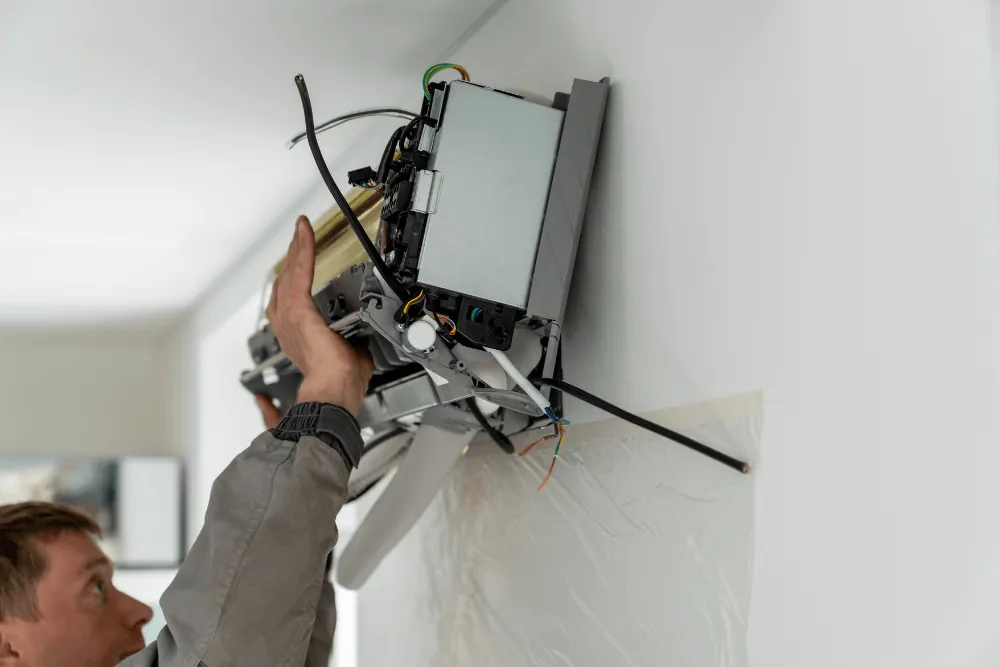
AC Electrical Connection in Dubai for Split, Ducted and Cassette Units
A split air conditioner needs four things from the electrics: its own circuit from the distribution board, a weatherproof isolator within reach of the outdoor unit, a cable sized to the unit's nameplate, and a correctly wired cable between the indoor and outdoor units. Leave one out and the fault turns up later, as a breaker that trips on hot afternoons, a burnt terminal, or a unit that stops just when the heat peaks.
Circuit Dubai makes the electrical connection for new and replacement air conditioners in apartments, villas and small offices across Dubai: window, split, multi-split, cassette and ducted units. We check the circuit, fit the isolator, connect the units and test them with the compressor running before we leave.
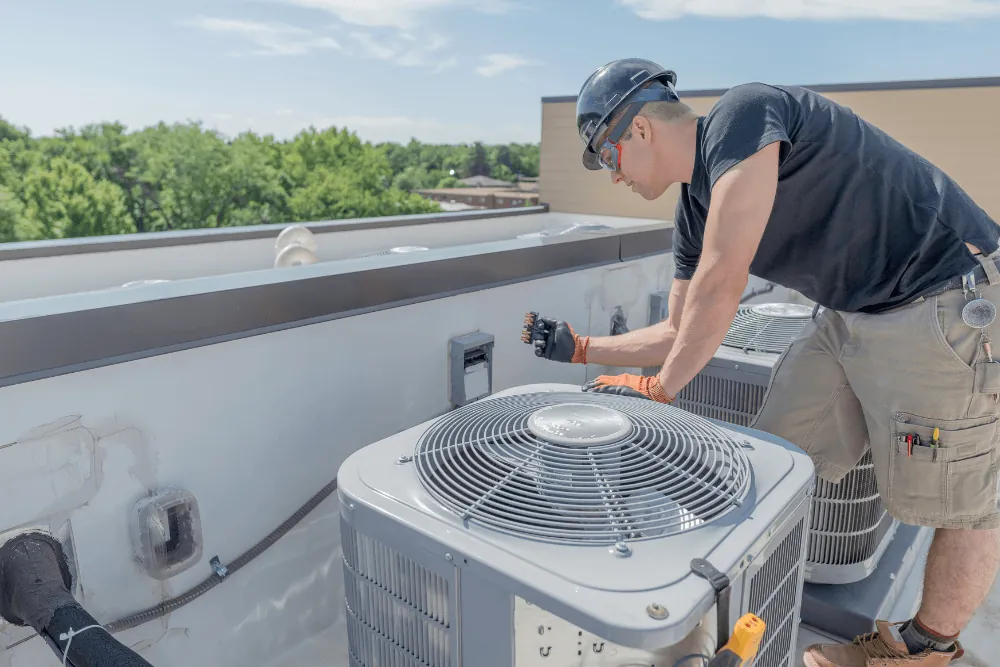
What an AC electrical connection with us includes
A site check of the board, the route from the board to the outdoor unit, and the labels on both units.
A dedicated circuit: its own breaker, or a breaker with earth leakage protection, and cable sized to the unit's nameplate.
A weatherproof isolator beside the outdoor unit, with the cable entry sealed against rain and dust.
The indoor to outdoor connection: the maker's cable, terminal to terminal, in one piece with no joints, and the earth connected at both ends.
Protection for Dubai conditions: earth leakage protection, and an under-voltage relay where your building or the unit calls for one.
Testing under load: insulation and earth checks, then voltage and current readings with the compressor running, and a trip test of the protection.
The numbers at a glance
Typical answer for a Dubai home
Check the nameplate. The table gives typical values, and the label on your own unit is exact. Send us a photo of it and we size the circuit from that, not from the tonnage.
What an AC electrical connection covers, and who does what
An AC installation is two trades working on one wall. The AC technician mounts the indoor and outdoor units, runs the refrigerant pipes, pulls the vacuum, charges the gas and sets up the condensate drain. The electrician supplies the power: the circuit from the board, the isolator, and the cable connections at both units. In Dubai the two jobs are often booked separately, so someone has to make sure there is a circuit worth connecting to.
Where the electrician's job starts and stops
| Electrician | AC technician |
|---|---|
| Checks the board has a spare way and the supply can carry the unit | Chooses the unit size for the room |
| Runs the circuit cable from the board to the outdoor unit | Mounts the indoor and outdoor units on their brackets |
| Fits the breaker, the earth leakage protection and the isolator | Runs and insulates the refrigerant pipes |
| Connects the supply and the indoor to outdoor cable at the terminals | Pulls the vacuum, charges the gas and checks the pressures |
| Earths the unit and tests insulation, earth and trip protection | Sets up the condensate drain, the remote and the app |
| Measures voltage and current with the compressor running | Commissions the unit and checks the cooling |
Wiring inside the unit, such as the compressor, fan motor, capacitor and control board, is the maker's design and the AC technician's repair. We connect to the unit's terminal block and do not alter what is behind it.
The boundary between the trades is not rigid. Either trade can connect the indoor to outdoor cable, and what matters is that it is done once, to the maker's diagram, with no joint in it.
Why the electrical side needs its own check
When nobody is responsible for the electrical side, the unit ends up on whichever circuit is nearest. A 1 ton window unit and a 2 ton split are different loads, and a cable that suited the first can be undersized for the second. A bigger replacement unit connected to the old circuit is an easy way to end up with a cable that runs warm every summer afternoon.
For a new location, the circuit goes in before the unit is mounted and, ideally, before the wall is painted, because the cable route is easier to hide when the wall is open. For a replacement, we can meet your AC technician on the day, check the existing circuit against the new unit's label, and either reuse it or tell you what has to change before the old unit comes down.
Which air conditioner you have changes the connection
Window units plug in. Everything else is wired in, and the larger the unit, the more the supply matters. Many Dubai flats have wall splits, villas often add ducted or cassette units for the main rooms, and some towers use district cooling and have no outdoor unit at all.
| Type | Usual supply | What the electrical job looks like |
|---|---|---|
| Window unit | 230 V, plug | A switched socket outlet on its own circuit, within reach, with no extension lead |
| Wall split | 230 V single phase | Own circuit, isolator at the outdoor unit, multi-core cable between the units |
| Multi-split | 230 V single phase, or three-phase on larger outdoor units | One circuit sized for the outdoor unit, one cable from it to each indoor unit |
| Cassette or ducted | 230 V, or three-phase above about 3 to 4 tons | Supply to the outdoor unit and to the ceiling unit, with an isolator you can reach |
| Package unit or VRF | Usually three-phase | Circuit and protection sized from the nameplate, phase sequence checked |
| Fan coil unit, district cooling | Small 230 V supply | Fused connection to the fan coil and its thermostat, no outdoor unit |
Window units
The UAE utility wiring regulations ask for a 15 A switched socket outlet for a room air conditioner up to about 18,000 BTU/h (1.5 tons), and for each room unit to have its own circuit. Larger window units get a double-pole switch with a flex outlet beside the unit. In both cases the unit is plugged into the wall and not into an extension lead or a multi-way adapter.
The reason is heat. A window unit draws 7 to 10 A for hours at a time, and a loose plug or a thin extension lead warms up under that load. A plug that is brown at the pins, or a socket face that has gone soft, means the socket needs replacing, and that is covered in our socket outlet installation service.
Wall split units
A wall split is the standard flat installation: an indoor unit high on the wall, an outdoor unit on a balcony, a roof or a service shaft, and a pipe and cable bundle between them. It gets its own circuit from the board to the outdoor unit and an isolator beside it. The indoor to outdoor cable and the question of which unit receives the supply are covered in the wiring section below.
Multi-split units
A multi-split uses one outdoor unit to serve two to five indoor units. The circuit is sized from the outdoor unit's nameplate, not by adding up the BTU rating of the indoor units, because the outdoor unit is rated for less than the indoor units added together. Each indoor unit has its own cable back to the outdoor unit, and the terminals are labelled by room, A, B, C and so on, or by number. If the cable for the master bedroom lands on the living room terminal, the master bedroom unit cools the living room. We label both ends of each cable before anything is connected.
Cassette and ducted units
Cassette and ducted indoor units sit in the ceiling void, so the electrical connection is above the false ceiling. The supply, the isolator and the condensate pump all need to be reachable through an access panel. An isolator you can only reach with a scaffold is not an isolator in any practical sense, so we agree the access panel position with you and the AC technician before the ceiling is closed.
These units are larger, often 3 to 5 tons, and the load is often split between an outdoor condensing unit and an indoor air handler, each with its own supply. We size the two circuits separately from their labels, and we do not assume that one feeds the other.

Package units and VRF
Package units, and VRF systems with several indoor units, are usually three-phase. The sizing comes from the nameplate, and there is one rule that single-phase units do not have: the phase sequence must be right. A scroll compressor connected to a reversed phase runs backwards, pumps no refrigerant, overheats and can fail. We check the sequence with a phase tester before the unit is energised. Where the supply is three-phase and the board is not ready for it, see our three-phase and load upgrade service first.
Buildings with district cooling
In a district-cooled building, chilled water from the provider's plant, such as Empower, runs to a fan coil unit in each flat, so there is no outdoor unit, no refrigerant circuit in the flat and no isolator on the balcony. The electrical work is a small supply to the fan coil and its thermostat, usually a fused connection from the board.
Because the cooling equipment belongs to the building and the provider, ask the management office before anyone opens it. A flat that is warm in a district-cooled building is usually a chilled-water or thermostat question for the building, not an electrical one.
Sizing the AC circuit: breaker, cable and the nameplate
Size the circuit from the nameplate on the outdoor unit, not from the tonnage. Two figures on it matter: the current the unit draws, and the largest breaker its maker allows. The cable has to carry the first without warming up, and the breaker has to stay at or below the second. Where a nameplate says "max fuse" or "max breaker", that number is a ceiling, not a starting point.
Typical circuit by unit size
A real unit shows the scale. A tropical inverter split of about 19,000 BTU/h from LG, for instance, is listed with 1.57 kW input, which is 6.8 A running under standard test conditions and 8.0 A under tropical (T3) test conditions, with a maximum of 16 A. The tropical figure is the one to read, because units sold here are tested with 46 °C outdoors, and a unit draws more at 46 °C than at the 35 °C of a standard test.
| Unit size | Running current (typical) | Breaker | Copper cable |
|---|---|---|---|
| 1 ton (12,000 BTU/h) | 4 to 7 A | 16 A | 2.5 mm² |
| 1.5 ton (18,000 BTU/h) | 7 to 10 A | 16 A | 2.5 mm² |
| 2 ton (24,000 BTU/h) | 10 to 14 A | 20 A | 2.5 mm², or 4 mm² on a long run or in a hot void |
| 2.5 to 3 ton | 13 to 19 A | 25 A or 32 A | 4 mm² |
| 4 ton | 18 to 25 A | 32 A | 6 mm² |
| 5 ton and above | Often three-phase | From the nameplate | From the nameplate |
These are typical values for a short run to a single unit. They do not replace the nameplate. We size each circuit from the unit's rated current and the maker's maximum breaker, the cable length, the way the cable is run, and the temperature it will sit in.
Why the breaker curve matters
A fixed-speed compressor draws five to seven times its running current for a fraction of a second when it starts. A Type C breaker is built to ride through that surge, because it trips between five and ten times its rating. A Type B breaker trips between three and five times and can trip on every start. Inverter compressors ramp up gently, so their start-up surge is small, but they work hard in July and still draw close to their rated current for hours.
We fit the breaker size and curve the maker's manual calls for. When the manual says 20 A maximum, we fit 20 A, not 25 A to stop an annoying trip. A breaker that never trips protects nothing, and a tripping breaker is usually pointing at a loose terminal, an undersized cable or a failing compressor, all of which we would rather find than hide.
Dubai heat changes the cable
Cable ratings are published for an ambient temperature of 30 °C. A 2.5 mm² twin and earth cable clipped to a wall is rated at about 27 A at 30 °C. At 45 °C the correction factor in BS 7671, the standard UAE wiring rules follow, takes that to roughly 21 A, and at 50 °C to roughly 19 A.
The cable to an outdoor unit often crosses a roof, a sunny wall, or a ceiling void that sits above 45 °C in summer. For a 20 A breaker, that is the difference between a cable that is comfortably rated and one that is not. It is why the 2 ton row says 4 mm² on a long run or in a hot void, and why we ask where the cable will run before we price the job.
Voltage drop on long runs
Every metre of cable costs a little voltage, and a long run to a roof can cost a lot. The drop in volts is the cable's millivolts per amp per metre, multiplied by the current in amps and the length in metres, divided by 1,000. For 2.5 mm² copper the figure is 18 mV/A/m, for 4 mm² it is 11, and for 6 mm² it is 7.3.
A 2 ton unit drawing 12 A at the end of 25 m of 2.5 mm² loses 18 × 12 × 25 ÷ 1,000 = 5.4 V, which is 2.3 per cent of 230 V. At 40 m the loss is 8.6 V, nearly 4 per cent, so we step up to 4 mm², which brings it back to 5.3 V. A compressor on a low supply draws more current to deliver the same cooling and runs hotter, so a long run on thin cable shows up as a unit that struggles in the afternoon.
Add up the whole home
A circuit that is correct for one unit can still be wrong for the home. On a July afternoon in a four-bedroom villa, three 2 ton units at about 12 A and two 1.5 ton units at about 8 A can all be running together, which is 52 A of air conditioning before anyone cooks or boils a kettle. Villas usually have a three-phase supply and flats a single-phase one, and the job is to spread the units so no one phase carries them all. Wiring practice here is to share single-phase loads such as air conditioners across the three phases.
Before we quote a new unit, we add up the nameplate currents of everything likely to run together and compare the total with the main breaker. If the margin is thin we say so, and the usual fixes are a DB box and distribution board upgrade or, for a villa, a three-phase and load upgrade.
Running air conditioners from solar
A grid-connected solar system feeds the air conditioners directly while the sun is up, and the grid makes up the difference, so no battery is needed for daytime cooling. At night, or in a grid outage, a grid-connected system without a battery supplies nothing, and by design it shuts down when the grid goes off. Running air conditioners from batteries needs a battery inverter sized for the compressors' start-up surge, which is a larger system than the same load in daylight. Our solar panels and battery storage installation pages cover that.
The isolator, the breaker and the protection between them
Between the board and the compressor sit three devices that do three different jobs. The breaker protects the cable, earth leakage protection protects people, and the isolator lets someone work on the unit safely. A circuit missing any one of them is incomplete.
A breaker is not an isolator
An isolator, which US installation guides call a disconnect, is a switch at the unit that cuts its supply. The outdoor unit is often on a balcony or a roof, and the breaker is in a cupboard 15 m away behind a locked door. A technician who switches the breaker off and then opens the unit is trusting that nobody switches it back on. An isolator beside the unit removes that trust: the person working on the unit holds the switch they need.
Manufacturers write this into their manuals. Mitsubishi's, for example, asks for a switch that opens every live conductor with a contact gap of at least 3 mm. A proper AC isolator is:
- Double pole, rated at or above the unit's current, so it breaks the live and the neutral.
- Weatherproof, in an IP65 enclosure with the cable entry sealed by a gland, because dust and rain get into a cheap box within a season.
- Beside the outdoor unit and not fixed to it, so the unit can be lifted or serviced without moving the isolator.
- Fitted with an indicator light, which the UAE regulations ask for on switches supplying air-conditioning units.
- Placed in shade where the layout allows, because sun and heat age a plastic enclosure.
Earth leakage protection
An earth leakage device, an RCD or an RCBO, trips when current leaks from the circuit to earth, for example through a damaged cable or water in a terminal box. UAE wiring rules require earth leakage protection on final circuits, and the usual setting for homes is 30 mA.
An air conditioner raises a practical problem: the filter in an inverter drive leaks a few milliamps to earth even when nothing is wrong. Several units behind one shared 30 mA device can add up to a trip. We give each air conditioner its own RCBO where the board has room, so one unit's fault does not turn off the others, and where the maker states a type, such as Type A for inverter drives, we fit that type.
Under-voltage protection
UAE wiring rules also require air-conditioning loads to have an under-voltage relay with an auto-reset timer, and DEWA publishes a circular on it. The relay cuts the unit off when the supply voltage drops well below normal and holds it off for a few minutes after the voltage returns. That delay stops every compressor in a district restarting in the same second after a dip, which is a heavy load on the network.
You may have met this without knowing. After a power flicker the lights come back but the air conditioner stays silent for several minutes. That is the relay working, not a fault. The relay sits in the unit, in its control panel, or in the board. Your building may already provide one, and we check before adding another so the two do not conflict. If your unit has none and the rules for your building require one, we fit it.
Surge protection
Inverter air conditioners carry a circuit board with sensitive electronics, and switching on the grid side can send spikes down the supply. A surge protective device at the board takes the worst of them before they reach the unit. Our surge protection service covers that, and we suggest it when the unit you are connecting is a large spend.
Split AC wiring: connecting the indoor and outdoor units
Most split systems join the two units with a multi-core cable that carries power and a control signal. The wiring diagram on the unit's cover shows which terminal goes to which, and it differs between makers and between models of the same maker. A wire on the wrong terminal can damage a board the first time the unit is switched on.
How power reaches the indoor unit
Two arrangements are in use. In one, the supply cable ends at the outdoor unit, and a cable from the outdoor unit carries power and a signal wire up to the indoor unit. In the other, the indoor unit has its own supply and the cable between the units carries only the signal. The wiring diagram says which one your unit uses. Guessing can put 230 V on a signal terminal and burn the indoor board.
Match the terminals
The terminal blocks are numbered or lettered, and the numbers on the indoor block must match those on the outdoor block, wire to wire. Mitsubishi marks its terminals S1, S2 and S3 plus earth. Other makers use numbers or letters for line, neutral and signal. Swapping two wires can stop the units talking, show an error code, or damage a board, and none of these is obvious from the outside.
We note the terminal marks on both units before connecting, and we use cable with the number of cores and the core colours the diagram calls for. We do not swap in a bell wire or a spare lighting cable for the signal core because it was to hand.
Do not extend the cable
Do not extend the indoor to outdoor cable, and do not joint it. Makers state it in their installation manuals, and the reason is practical. A joint in a cable that carries a live supply heats up and loosens as the outdoor end swings between a hot afternoon and a cool night, and a joint on the signal core causes an intermittent error that nobody can trace.
If the cable is too short for the pipe run, we replace it in one length. Where the old cable has to be reused, we check that its insulation is intact and that its ends have not been cut and rejoined.
Earth the unit properly
The outdoor unit's earth goes to the circuit's earth conductor, in the same cable as the supply, and the indoor unit gets its earth through the cable between the units. Maker's manuals say not to earth an air conditioner to a gas pipe, a water pipe, a lightning rod or a telephone earth. A water pipe is not a reliable earth, because the pipework is often plastic or has been renewed in part.
Some manuals also ask for the earth wire to be a little longer than the live and neutral, so that if the cable is pulled, the earth is the last wire to come away from its terminal. We follow that. A missing or loose earth does not stop the unit working, which is exactly why it goes unnoticed until someone touches the casing.
Tighten, then pull
Every terminal screw is tightened firmly, using the maker's torque where the manual gives one, and then each wire is pulled gently to confirm it does not move. Stranded wire is crimped into a ferrule or a lug so its strands cannot splay out of the clamp. We leave no bare copper outside the terminal and no strain on the connection: the cable is clamped inside the cover so a pull on the cable cannot reach the terminal.
A loose terminal carries the same current through a smaller contact, and the contact heats. That is how a terminal block turns brown over a summer.
Keep the control wiring apart
Wired controllers, Wi-Fi modules, condensate float switches and sensors use low-voltage cable. Running it in the same bundle as the supply or the indoor to outdoor cable can induce noise and cause error codes. We keep it clear of the power cables, and where the manual asks for a specific separation or a shielded cable we use one.
What differs by brand
Daikin, LG, Mitsubishi, Samsung, Gree, Midea, O General, Carrier, Trane and Haier all make units sold in Dubai, and they differ in terminal marks, in which unit takes the supply, in whether an under-voltage relay is built in, and in the cable they specify. We work from the manual for your model. Send a photo of the outdoor unit's label and, if you have it, the wiring diagram on the cover, and we check the connection details before we arrive.
What we test before the unit is switched on
The circuit cable is insulation-tested with the unit disconnected, because a 500 V insulation test across an inverter board can damage it. We read insulation resistance, earth continuity, and the polarity of live and neutral. Only then do we connect the unit.
With the unit running we measure voltage at the outdoor terminals, current on the live conductor in the first minutes and after the compressor settles, and we compare both with the nameplate. We then trip-test the earth leakage protection and confirm that the isolator switches the unit off completely.
What AC electrical work costs in Dubai
A new circuit, isolator and connection for one split unit, with the unit within 10 m of the board, usually costs AED 340 to 680 in Dubai. A like-for-like reconnection on a circuit that passes our check is AED 95 to 195. The site visit costs AED 50, and the quote follows it.
| Job | Typical price (AED) |
|---|---|
| Fit only, like-for-like on an existing circuit that passes the check | 100 to 200 |
| New circuit, isolator and connection, one split unit, up to 10 m from the board | 350 to 700 |
| Extra cable beyond 10 m, per metre | 20 to 45 |
| Replacement indoor to outdoor cable, up to 5 m | 120 to 250 |
| New breaker or RCBO way in the board, where there is spare space | 150 to 350 |
| Cassette, ducted, package or VRF unit | Quote after a site visit |
What moves the price
The cable length is the biggest variable. A unit beside the board is a short job, and a unit on a roof 40 m away needs thicker cable, a conduit or tray, and more time. Chasing into a finished wall, drilling through a structural wall, working above a false ceiling and opening a shaft all add labour, and we price them after seeing photos.
The state of the board is the second. A board with a spare way is quick. A board that is full, or that needs an RCD added, needs a board upgrade first.
What the circuit costs compared with what the unit costs to run
Dubai's residential tariff in 2026 is 23 fils per kWh for the first 2,000 kWh in a month, 28 fils for the next 2,000, then 32 and 38 fils, with a fuel surcharge of about 6 fils on top and 5 per cent VAT. A 1.5 ton inverter unit drawing 1.6 kW for ten hours uses 16 kWh, which is about AED 5.40 a day at 34 fils (28 plus 6), or around AED 160 a month for one unit before VAT. DEWA has said air conditioning accounts for 60 to 70 per cent of household electricity use in the summer months.
Set against that, a new circuit is a one-off cost of a few hundred dirhams. The cable's own loss at 2.3 per cent voltage drop is about 12 fils a day, so thicker cable cannot save more than that. We choose cable for safety and voltage drop, not for the bill. The real savings are in the unit's efficiency, its settings and its maintenance.
How an AC electrical connection runs, step by step
- 1Photos and quote. You send photos of the unit labels, the board and the route to the outdoor unit. We quote a price and a time, and we say if anything looks like extra work.
- 2Check the circuit. On site we open the board, read the main breaker and the spare ways, and compare the existing circuit, if any, with the new unit's label.
- 3Isolate. We switch off at the board, prove the circuit dead with a tester, and lock off where we can.
- 4Run the cable. New circuit cable goes from the board to the outdoor unit position, clipped or in conduit, kept clear of the pipes and out of direct sun where possible.
- 5Fit the breaker and isolator. The breaker or RCBO goes into the board, and the weatherproof isolator beside the outdoor unit, with the cable gland sealed.
- 6Test the circuit. Insulation, earth continuity and polarity, with the unit still disconnected.
- 7Connect the units. Supply to the outdoor terminals, then the indoor to outdoor cable, terminal to terminal, earth connected, covers closed.
- 8Run under load. We switch on, let the compressor start and settle, and read voltage and current against the nameplate. We trip-test the earth leakage protection.
- 9Handover. We show you the isolator and the breaker, label the board, and leave a note of the breaker size and the unit's running current.
Electrical problems on an air conditioner that is already installed
Stop and switch off at the isolator if you smell burning, see a brown or melted terminal, or feel a tingle when you touch the outdoor unit. Those are not ordinary tripping problems, and running the unit again to see whether it comes back can make an overheating terminal worse.
Electrical faults on a working air conditioner usually show up in one of the ways below. Which trade fixes them depends on where the fault is: the supply side is ours, and the refrigerant circuit and the unit's own parts are the AC technician's.
The breaker trips when the compressor starts
Common causes are a breaker too small or of the wrong curve for the unit, a cable that is undersized or has a loose terminal so the voltage collapses at the start, a circuit shared with another heavy load, and a failing compressor or start capacitor on a fixed-speed unit. We measure the start-up current and the voltage at the outdoor terminals while the compressor starts. If the circuit is at fault, we correct the breaker, the cable or the terminal. If the unit's current is high for its size, we tell you to call the AC technician, because a larger breaker will not fix a failing compressor.
The earth leakage device trips
If the RCD trips as soon as the unit switches on, current is leaking to earth. Water in the outdoor terminal box or isolator, a damaged cable, and a failing compressor winding are the usual causes. If it trips after several units start together, the cause may be the combined small leakage of several inverter drives on one device, which we fix by giving each unit its own RCBO. Switch the unit off at the isolator and leave it off until the cause is found. Resetting the RCD again and again can hide a fault that will shock someone.
The unit stops in the afternoon heat
A unit that works in the morning and cuts out at three in the afternoon has one of a few problems. The condenser coil may be clogged with dust, which is an AC technician's job. Or the voltage at the unit may be low, which is ours. With the unit running, we measure the voltage at the outdoor terminals. A reading more than 10 per cent below 230 V, which is below about 207 V, points to a long or thin cable, a loose terminal or an overloaded phase, and we correct the circuit.
The power is back, but the air conditioner stays off
After a flicker or an outage, the lights return and the unit stays silent for several minutes. This is usually the auto-reset timer on the under-voltage relay, holding the unit off so that it does not restart in the same second as every other compressor. It is normal, and waiting is all that is needed. If the unit never restarts, the relay or the unit's own control may have a fault.
Hot isolator or discoloured terminals
A warm isolator is a loose connection. A brown or blackened terminal block, a melted plastic cover or a smell of hot plastic means a connection has been overheating. Switch off and message us on WhatsApp. We cut back the damaged conductor, replace the terminal block or isolator if it has been damaged, and re-terminate the connection with the cable properly seated. If the heat came from an undersized cable, we replace the cable, since a new terminal on the same cable will heat again.
A tingle from the outdoor unit
A slight shock when you touch the casing of the unit or a metal pipe next to it means the earth is missing or broken, and some current is finding its way to your hand. It happens on units that were connected without an earth, or where the earth core was cut or left loose. Do not touch the unit, switch off at the isolator, and message us on WhatsApp for an earth and insulation test.
Repair the circuit or replace it
As a rule, if a repair touches the cable itself, we replace the cable instead of joining it. A joint in a supply cable is a weak point under 45 °C summer temperatures, and the cost of a new cable run is small compared with the cost of a second visit. A burnt isolator, a cracked weatherproof box or a terminal block that has been through a heating event is replaced as a unit. The breaker and the cable are not replaced because they are old, but because a test or a visible fault says so.
AC electrical connection with Circuit Dubai
- One visit for the board and the unit. The same team checks the board, runs the circuit and connects the unit, so nobody has to coordinate an electrician and an AC contractor.
- A price from photos, before we start. The quote lists the circuit, the isolator, the cable length and any board work, so you can compare it line by line.
- A tested finish. Insulation, earth, voltage and current readings, and an RCD trip test, every time.
- The nameplate decides. We size every circuit from the label on your unit and the maker's manual.
- Any brand, wired from the wiring diagram for your model, not from habit.
We work across all of Dubai. Our office is in Al Quoz.
If you are also planning a DB box upgrade, a three-phase upgrade, surge protection or solar panels, we can scope them at the same visit and save a second call-out. If a unit keeps tripping and you want the electrical side checked first, a thermal imaging inspection of the board and isolator under load shows hot connections.
Phone: +971 55 407 7427
AC electrical connection questions we hear from Dubai homeowners
How long does an AC electrical connection take?
A like-for-like reconnection on a circuit that passes the check takes one to two hours per unit. A new circuit with an isolator takes three to five hours, depending on the cable run. Cassette, ducted and three-phase units take half a day or more.
Can my AC technician do the electrical connection?
They can connect the cable between the indoor and outdoor units, and many do. The circuit from the board, the breaker, the isolator and the earth are electrical work, and they should be done and tested as such. Many Dubai buildings and communities also expect the work to be done by approved contractors, so ask your management office before anyone starts.
Does every air conditioner need its own breaker?
Yes. Each unit gets its own circuit, and a multi-split system counts as one unit. Sharing a circuit with sockets, lights or another air conditioner overloads it on hot days, and one fault takes out everything on it.
What size breaker does a 1.5 ton or a 2 ton air conditioner need?
Typically 16 A for 1.5 ton and 20 A for 2 ton, with 2.5 mm² copper cable for both on a short run. The maker's maximum on the nameplate overrides those numbers, so send us a photo of the label.
Can I plug a split air conditioner into a normal socket?
A window unit up to about 1.5 tons can use a 15 A switched socket on its own circuit. A split should be hard-wired through an isolator. A 2 ton split can draw 12 A or more, which is too close to the limit of an ordinary plug and socket, and the connection will run hot.
Can the cable between the indoor and outdoor units be extended?
No. Makers say not to extend or joint it. If the cable is too short, it is replaced in one length.
Why does my air conditioner take a few minutes to restart after a power cut?
Most likely an under-voltage relay with an auto-reset timer. It holds the unit off for a few minutes after the supply returns, so that compressors across the network do not all restart at once. It is a normal feature. If the unit never restarts, we can check the relay and the unit's supply.
Do I need a voltage stabiliser?
Usually not. The Dubai supply is 230 V within a tolerance of about 10 per cent, and modern inverter units have their own protection. A stabiliser adds a failure point and does nothing about a low voltage caused by a long thin cable. If the voltage at your unit measures low, the fix is a better circuit.
Do I need an electrician if my building has district cooling?
For the cooling itself, usually not. The fan coil unit is part of the building's cooling system, and faults in it are for the management office or the provider. If a thermostat, a fan coil supply or a socket in the flat has a fault, we can help, and we suggest you tell the management office first.
Can solar panels run my air conditioner?
Yes, in daylight. A grid-connected system feeds the units directly and the grid supplies the rest. At night, or in a grid outage, a system without a battery gives nothing. Running air conditioners from batteries needs a larger battery inverter than daytime use does.
Do you repair inverter boards and AC compressors?
No. The electrical side is ours, and the unit's own repair belongs to the AC technician. We check the supply, the earth and the terminals first, because a poor supply or a loose terminal can damage a board, and a new board on the same fault fails again.
Do you connect commercial units?
Yes, for small offices and shops. Larger systems need an electrical design before installation, and we can scope that with you.
Ready for an air conditioner that is wired properly?
Send a photo of the unit's label, your distribution board, and the route from the board to the outdoor unit. We reply instantly on chat with a price and a time, so you know what the job involves before anyone arrives.