
Battery Storage Installation in Dubai: Home Battery Backup, Solar Storage and Sizing
A home battery in Dubai does two jobs, and it is much better at one than the other. It is very good at keeping the fridge, lights, Wi-Fi and a few air conditioners running when the grid goes down. It is not a good way to cut your DEWA bill, and anyone who tells you otherwise has not done the sums for DEWA's tariff. This page sets out what a battery can and cannot do in a Dubai villa or building, how to size one, and what the installation involves.
Circuit Dubai does battery storage installation for homes and businesses across Dubai: the battery, the inverter or backup box that controls it, the circuits it feeds, and the tests that prove it switches over when the grid fails. Whether you call it home battery installation, battery backup installation or installing battery storage systems, the work starts with one question: what must stay on, and for how long? We install batteries on new and existing solar systems, and as stand-alone backup. We are an independent electrical contractor and are not part of any battery maker.
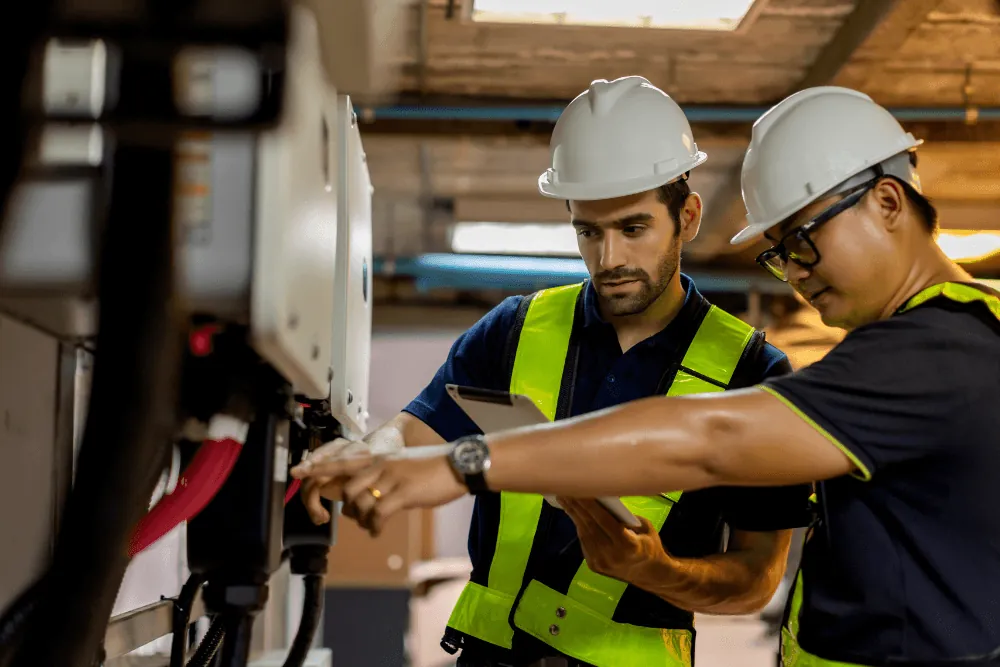
What battery storage installation with us includes
A load check of what you want to keep running, measured and listed in kW and kWh, so the battery is sized to a real number.
System design: battery, inverter or backup box, essential-load circuits, and the single-line drawing.
Safe siting: a position that keeps the battery inside its temperature range, away from escape routes, with space to work on it.
Installation and wiring of the battery, inverter, protection, earthing and the essential-load board.
A real backup test: we switch off the supply and prove the loads stay up, and that the system returns to the grid correctly.
App, settings and handover: monitoring set up, backup reserve chosen, and a walk-through of what each light and alarm means.
The numbers at a glance
Typical answer for a Dubai home
Before you buy a battery, decide what it is for. If the goal is to lower your bill, solar panels do that, and a battery adds cost without adding much saving. If the goal is to keep the house running through an outage, a battery is the right tool and the size follows from what you want to keep on.
What a home battery does in Dubai, and what it does not
A battery stores electricity and gives it back later. A home battery storage system is that store plus an inverter, which changes the battery's direct current into the alternating current your sockets use, and a controller that decides when to charge and discharge. People ask for it under many names: a home battery pack, a battery power storage unit, an electric storage battery, home battery power, or electric battery storage for homes. Home energy battery storage is the wider trade term. Sellers also say house battery backup, house battery backup systems, domestic battery storage or residential battery storage. A battery storage system for home use, whatever it is called, is the same equipment.
Backup when the grid fails
This is what a battery is for. When DEWA's supply drops, the system switches your chosen circuits onto the battery in a fraction of a second, and switches back when the grid returns. Dubai's grid is very reliable, so outages are short and rare: DEWA reported about 49 seconds of lost supply per customer in 2025, and the value of a home battery backup is peace of mind and protection for specific things: a freezer full of food, a home office, a medical device, a security system, a well pump, or a villa that is empty for weeks in summer.
Backup is also the case for a house with a poor supply, a building with a history of local faults, or a property outside DEWA's network. If an outage would cost you more than the battery, the battery is justified.
Bill savings
Dubai's net metering already does what a battery does in other countries. A solar system exports at noon and DEWA credits those units against what you use in the evening, at your own tariff rate. You do not need a battery to use your own solar power at night. Residential electricity is billed at 23 to 38 fils per kWh across four slabs, with a surcharge of about 6 fils and 5 per cent VAT, so a unit stored in a battery and used later saves at most about AED 0.44 to 0.46. The cost per stored unit, covered in the cost section below, is higher than that.
So for bill savings, a battery loses money in Dubai. That is the opposite of what you will read from countries with time-of-use tariffs or high electricity prices.
Solar with a battery
A battery makes sense with solar when you want backup and want the panels to keep working during an outage, which a plain grid-tied system cannot do. A grid-tied inverter shuts down when the grid fails, so that it does not push power into lines that DEWA crews may be working on. With a hybrid inverter and a battery, the panels charge the battery and run the essential circuits through the outage. Our solar panels service covers the panels and the approvals, and this page covers the battery side.
Which battery is best, and which is cheapest?
The best home battery storage for you is the one that carries your essential loads for as long as you need, at a temperature it can tolerate, from a maker who will still be there in ten years. Cheap home battery storage, and even the cheapest home battery storage per unit on the shelf, is often a poor buy once you count usable capacity, the warranty, the battery management system and the heat. We explain how to compare them in the cost section.
Battery sizes explained: kWh, kW and the sizes people search for
The commonest mistake when buying a battery is mixing up kW and kWh. They measure different things.
- kWh is energy: how much the battery holds. A 10 kWh battery can supply 1 kW for 10 hours, or 2 kW for 5 hours.
- kW is power: how fast the system can deliver that energy. A 5 kW inverter can run 5 kW of loads at once, however big the battery is.
A battery needs both numbers to make sense, and sellers often quote only one. When you see a 5 kW battery, a 15 kW battery or a 30 kW lithium battery, the figure is usually the inverter or output rating, or a loose way of saying kWh. We ask for both.
| What you may have searched | What it usually means | What it runs |
|---|---|---|
| 5kWh battery backup, 5kWh home battery | 5 kWh of energy | Fridge, lights, Wi-Fi and fans for most of a night |
| 5 kW battery, 5kw powerwall | 5 kW of output power, often with 5 to 10 kWh of energy | Up to 5 kW of loads at once, such as two split ACs and the basics, for an hour or two |
| 10kWh battery storage, 10kwh battery backup, 10kwh home battery, 10kwh lithium battery, 10kwh lithium ion battery | 10 kWh of energy | Essential loads for about 5 hours |
| 10 kw battery backup, 7kw lithium battery, 8kw battery storage system | A power rating, usually with 10 to 15 kWh of energy | A bigger share of the house for a shorter time |
| 15 kw battery, 15kw battery storage | A 15 kW inverter with a battery of 15 to 30 kWh | Most of a villa's loads for a couple of hours |
| 20kwh battery storage, 20kwh home battery, 20kwh lithium battery, 20kwh lithium ion battery | 20 kWh of energy | Essential loads overnight, or part of the house for a few hours |
| 30kw lithium battery, 50kwh battery storage, 100kw battery storage | Business-scale systems | See the commercial section below |
Sizes labelled by voltage and amp-hours convert to energy by multiplication. A 48 V 200 Ah lithium ion battery holds 48 × 200 = 9,600 Wh, or 9.6 kWh. A 51.2 V 100 Ah pack holds 5.12 kWh, which is why a 48v 5kw lithium battery is really a 5 kWh unit. A 12 V 100 Ah battery holds only 1.2 kWh, so a 12 volt battery bank of four of them stores under 5 kWh. The lithium ion battery 48v 200ah price tells you little until you know the usable capacity, the chemistry and what protects it. The same goes for a powerwall 48v 200ah, the rack-style 48 V units sold as a power wall: at 9.6 kWh it is a mid-sized battery, and what matters is the BMS and the certificates behind it.
Not all of a battery's nominal energy is usable. Makers set a limit on how deep it can be discharged, and some units give up a few per cent in the inverter. A battery sold as 10 kWh may deliver 9 kWh at the sockets. We size on usable energy.
How to size a home battery: a worked example
Sizing starts with a list of what must stay on, with the power each item draws, not with a battery size. For a Dubai villa the essential circuits usually look like this.
| Essential load | Power (kW) |
|---|---|
| Fridge and freezer, average | 0.15 |
| Lighting, LED | 0.25 |
| Wi-Fi router, TV and chargers | 0.15 |
| Two ceiling or pedestal fans | 0.10 |
| One 1.5 ton inverter split air conditioner, running | 1.20 |
| Total | 1.85 |
A battery with 10 kWh of usable energy supplies that 1.85 kW for about 5.4 hours. If the outage may last through a night, we add a second air conditioner or a larger battery. We also check the inverter: the air conditioner's compressor draws several times its running current for a moment when it starts, so the inverter must handle that surge as well as the 1.85 kW.
Whole-home battery backup
Whole-home battery backup systems carry the entire villa, including every air conditioner, the water heaters and the pool pump. It is possible, and the cost of whole home battery backup is far higher than for essential circuits, because the numbers are large. A villa with several air conditioners running on a summer evening can draw 10 to 20 kW, and a large Dubai villa can use 100 kWh or more on a summer day. A 10 kWh battery would carry that load for under an hour. Whole-house backup therefore means a 15 to 20 kW inverter and a battery of 30 to 60 kWh, and a price to match. Most owners choose essential circuits plus one or two air conditioners, which gives long run times at a fraction of the cost.
We measure your loads with a clamp meter and a few days of logging where the load is unclear, rather than guessing from a list. Our three-phase and load upgrade service covers a supply that is too small for the loads you want to keep, and our DB box and distribution board service covers moving the essential circuits onto a separate board.
Battery chemistry, the battery management system and what is inside
A home battery is cells, packaged into modules and managed by a battery management system, or BMS.
Which chemistry
| Chemistry | Typical life | Behaviour in heat | Where it is used |
|---|---|---|---|
| Lead-acid | A few hundred to 1,500 cycles | Ages quickly in heat; needs ventilation | Old backup systems, some substations |
| Nickel manganese cobalt (NMC) lithium | About 1,000 to 3,000 cycles | Dense, but runs closer to thermal runaway if damaged or overheated | Some older home batteries and electric cars |
| Lithium iron phosphate (LiFePO4, LFP) | About 3,000 to 6,000 cycles | More stable and tolerant of heat | Most home batteries sold today |
We install LiFePO4 for homes. LiFePO4 battery storage costs more per kWh than lead-acid but lasts several times longer and is safer. The lifepo4 home battery is also the chemistry behind most of the lithium power wall and LiFePO4 power wall products on the market. Lithium ion battery for home power storage is a wider term that includes NMC, so we always ask which chemistry the model uses.
What the BMS does
The BMS watches each cell's voltage and temperature, balances the cells, limits charge and discharge currents, and disconnects the battery if something goes wrong. A LiFePO4 battery BMS is the part that makes the difference between a safe battery and a pile of cells. It also tells the inverter how much energy is left and how fast the battery may charge.
A good BMS is built into the module by the maker and has been tested with the cells and the inverter as a system. Searches such as 12v lithium BMS or lifepo4 battery BMS usually come from people building their own packs.
Building your own pack
Some owners build a bank from loose cells and a hobby BMS, and a few look at an Arduino BMS for LiFePO4 cells. We do not connect home-built or unbranded packs to a villa's wiring. A pack with no certification, no tested protection and no insurer behind it is a fire risk in a building where people sleep, and it may void your home insurance. If you want to experiment, do it at your own risk, on a bench or in a shed away from the house. For the house, use a certified battery sold with a BMS, a datasheet and a warranty. Brand names such as Lvtopsun LiFePO4 appear in these searches too: we install what the maker certifies and supports, and we check the datasheet, the certificates and the warranty before we agree to fit anything.
Heat: what Dubai does to a battery
Heat is the main thing that separates a battery installation in Dubai from one in Europe or North America. Most guides assume a garage that stays under 30 °C. A Dubai garage in August can sit above 45 °C, a bare west wall in the sun is hotter than that, and a battery that is working hard warms itself as well.
Makers publish the temperature window, and it is worth reading before you choose a position. Tesla's Powerwall 3 datasheet gives an operating range of -20 °C to 50 °C and says performance may be derated above 40 °C. Huawei's LUNA2000 home battery lists -20 °C to 55 °C and an outdoor-rated enclosure with natural convection cooling. A wide range does not mean the battery likes the top of it: the cells age faster the hotter they run, and a battery that derates above 40 °C delivers less power on the afternoon you may need it.
So we choose the position first, and treat it as part of the design.
- Outdoors in shade on a north or east wall, under a canopy, with air moving around the unit. Many batteries are rated for outdoor use, and the shade matters more than the rating.
- Indoors in a utility room or store that has ventilation or air conditioning, away from the kitchen and from bedroom doors.
- Not in a closed, uncooled garage or roof space where heat builds and does not leave.
- Not behind a door that is kept shut with no air path, because the battery and inverter give off heat when working.
- Clear of water. Away from sprinklers, pool equipment and a washing machine, and above any flood line.
Heat ages lead-acid cells roughly twice as fast for every 8 to 10 °C above 25 °C, and lithium cells age faster with heat as well, so the maker's warranty and its temperature conditions are worth reading together. Many warranties carry a temperature condition, so a battery left in a hot, closed garage can lose its cover. We keep the batteries we fit inside the range the maker states.
Power wall batteries and the brands you hear about
People use "power wall" to mean any wall-mounted home battery, and also to mean Tesla's Powerwall product. A power wall for home use, a power wall battery or wall mounted battery storage can be any maker's unit hung on a wall or stood on a floor. They are not the same thing, and the difference affects what you buy.
Tesla Powerwall in the UAE
Tesla's Powerwall is a wall-mounted lithium battery. The Powerwall 2 holds 13.5 kWh and delivers about 5 kW continuously, which is where searches such as 5kw powerwall come from. The Powerwall 3, which people search as power wall 3, holds 13.5 kWh, delivers up to 11.5 kW from the unit, and has a solar inverter built in. According to its datasheet it weighs 130 kg and carries a 10-year warranty, and it uses lithium iron phosphate cells. Tesla has a Powerwall page for the UAE.
Those figures come from Tesla's North American datasheet, and the UAE supply is 230 V single-phase or 400 V three-phase, not 120/240 V split-phase. The model, the output and the warranty terms for the UAE may differ.
Powerwall cost and price. Tesla sets its own prices, and we do not quote them. A power wall price seen online and a power wall cost once it is installed in a villa are two different numbers. For a rough idea of where it sits, the cost of a Powerwall is the battery plus a backup switch, installation, and the circuits it feeds, so the Powerwall price for a home is more than the figure on the product page. When you compare a Powerwall cost with another battery, compare the cost per usable kWh and the output in kW, not the headline price.
Powerwall installers. Searches for Powerwall 2 installers and Powerwall installation reflect the fact that Tesla controls who installs it in some markets. In the UAE,. Whoever installs it, the wiring side is an electrician's work: the circuit, the earthing, the protection, the backup arrangement and DEWA's requirements.
Powerwall fire: how real is the risk?
Lithium batteries can catch fire, and it is better to say so plainly. A cell that is damaged, overcharged or overheated can go into thermal runaway, where it heats itself until it burns, and the fire can spread to the cells beside it. A Powerwall fire, or a fire in any home battery, is rare compared with the number of batteries installed, and the cause is usually a defect, damage, a fault in the wiring or an installation that ignored the maker's instructions.
Three things reduce the risk. First, lithium iron phosphate cells are more stable than NMC cells and tolerate abuse better. Second, a certified battery has been tested to a safety standard such as IEC 62619, and a UL 9540A report shows how a fire would spread between cells, though a test report is not a guarantee of safety. Third, the installation: the right cable, tight terminals, correct protection, a position with air around it and no combustible store beside it, and no unauthorised changes. We also check the maker's recall notices by model and serial number before we fit a used or older unit. LG's RESU home batteries, for example, were recalled in 2020 and 2021 over a fire hazard, so for any LG unit we ask for the model and serial number first.
Other wall-mounted batteries
Names from the lists you will have seen online, and what they are:
- Huawei: the LUNA2000 is a modular lithium iron phosphate battery in 5 kWh blocks that pairs with Huawei hybrid inverters, and Huawei's UAE site lists a three-phase whole-home backup box. A Huawei battery storage system suits villas with three-phase supply.
- Fronius, SMA and Sonnen: European makers of hybrid inverters and batteries. People search for Fronius battery storage, SMA battery backup and a Sonnen home battery when they already have, or want, equipment from that maker. We install them when you have them, and we confirm the model and its UAE support before quoting. We supply batteries and inverters, or fit the ones you have bought.
- LG, including LG Chem home batteries and LG battery storage: some people call these an LG power wall. See the recall note above.
- Sunrun and SunPower: US companies. Sunrun battery backup, Sunrun battery storage, SunPower battery storage and the SunPower lithium battery are offers tied to their own US programmes. Those offers do not apply in the UAE. If you own equipment from either, check the maker's current support for the UAE before you rely on its warranty.
We do not rank brands in the abstract, because the best power wall for a villa depends on its supply, its loads and the support the maker offers here. When you ask us which to choose, we give you two or three options and say why.
How the battery connects: DC-coupled, AC-coupled and hybrid
There are three ways to wire a battery, and the choice depends on whether you already have solar.
| Arrangement | How it works | Best for |
|---|---|---|
| DC-coupled (hybrid inverter) | Panels and battery share one hybrid inverter. The panel power goes to the battery as direct current, with few conversions. | A new solar and battery system |
| AC-coupled | The battery has its own inverter and connects on the AC side, next to the existing solar inverter | Adding a battery to a solar system that is already working |
| Stand-alone backup | A battery and inverter charge from the grid and supply the essential circuits when it fails | A home without solar, or where solar is not wanted |
A DC-coupled battery loses less energy because the solar power passes through one inverter, and a hybrid inverter often costs less than two separate ones. AC coupling is the way to add a battery to an existing system, where replacing the solar inverter would cost more. Whichever you choose, a panel battery setup is configured in the inverter: when to charge, how much reserve to hold for an outage, and what to do when the grid fails.
The essential-load board and the backup box
For backup, the circuits that must stay on are moved to a separate essential-load board, or served through a backup box that switches the whole supply. When the grid fails, a changeover device isolates the house from the grid, so that the battery does not feed power back into lines outside, and runs the essential circuits from the battery. A whole-home backup box handles a three-phase supply in one unit: Huawei's for the UAE handles a 63 A supply and up to 36 kW of backup.
The changeover time matters for things like computers. Some systems switch in a few milliseconds, which most equipment will not notice, and others take a second or more. We tell you the figure for the unit we propose, and where a computer or a medical device is involved, we add a small UPS behind it. Our UPS and inverter installation service covers those smaller systems.
DEWA, safety and approvals for a battery in Dubai
A battery in Dubai sits between several sets of rules, and not all of them are published in a single place. This is what we know, and what we confirm for every job.
DEWA and solar. DEWA's Shams Dubai process covers grid-connected solar and requires an enrolled contractor to apply. A plain solar system does not need a battery. If you add a battery to a system that DEWA has already approved, the existing approval does not automatically cover it. We give DEWA the battery and inverter models, a revised single-line diagram, and the operating modes, and ask which application or amendment applies.
Standards. For the battery itself we look for IEC 62619 certification, which covers the safety of lithium batteries for stationary use, and we ask the maker for the UL 9540A fire test report where they have one. The inverter must meet the grid standards DEWA requires. We ask for the certificates before we order.
Fire safety. The position, separation, access, detection and ventilation of a battery depend on the building and the authority that governs it. We ask the building's management or the relevant authority for their requirements before we fix a location, and we follow the maker's installation manual as a minimum. In an emergency involving a fire, call Dubai Civil Defence on 997 and leave the building. DEWA's emergency line is 991. Update your family's fire plan to include the battery's position and the isolator.
Other emirates. Abu Dhabi's Department of Energy announced a solar-and-battery self-supply policy in February 2026 and extended it to residential customers in March 2026. Its rules differ from Dubai's. Sharjah and the Northern Emirates have their own utilities. We work in Dubai.
What a home battery costs in Dubai
A home battery system's price is the battery, the inverter or backup box, the protection, the cabling, the essential-load board and the installation. It is quoted per kWh of usable capacity, because that is the part that varies with size.
| Usable capacity | Typical installed price (AED) | Notes |
|---|---|---|
| 5 kWh | 8,730 to 14,550 | Backup for the basics; the smallest sensible size |
| 10 kWh | 17,450 to 29,100 | The usual villa size: essential loads and one AC |
| 15 kWh | 26,200 to 43,650 | Longer run times or a second air conditioner |
| 20 kWh | 34,900 to 58,200 | Overnight essential backup, or part of the house |
| Whole-home backup | Quote after the load check | 30 to 60 kWh and a 15 to 20 kW inverter |
The site visit costs AED 50, and the quote follows it. They include a hybrid or battery inverter, installation and testing, and exclude roof solar, a new distribution board and any supply upgrade. A 10 kWh system at AED 2,200 per kWh costs about AED 22,000.
What a stored unit costs, and why the payback does not work
A battery has a finite number of full cycles in its life. Take that 10 kWh system at AED 22,000, used once a day for ten years: it stores and returns about 36,500 kWh (10 kWh × 365 days × 10 years). That works out to about AED 0.60 per kWh stored. The most you can save by using a stored unit instead of a grid unit is about AED 0.44 to 0.46. Even if the battery lasted 16 years, the cost per stored unit would be around AED 0.38, which is no better than the grid.
That is why we call a battery a purchase for resilience in Dubai and not an investment in savings. Solar already earns its credit through net metering, so adding a battery does not raise it. If your DEWA bill shows a demand charge, which is unusual for homes, send it to us and we model it.
The cost of a home battery system, compared fairly
When you compare quotes for the cost of a home battery system, line them up on these:
Usable kWh, not nominal.
Continuous kW the inverter can deliver, and the surge it can start a compressor with.
Warranty: years, and the capacity the maker guarantees at the end, with the temperature conditions.
What is included: inverter, backup box, essential-load board, protection, DEWA application, commissioning test.
Chemistry and certificates: LiFePO4, IEC 62619, and the maker's installation manual.
Home battery prices that look low usually leave one of those out. A cheap home battery sold as 10 kWh with 70 per cent usable capacity, a two-year warranty and no certificates is not cheaper than a 9 kWh unit that has all of them. Per usable kWh over the warranty period, the cheaper battery on the shelf often costs more. Searches for a 10kw battery storage price (usually meaning 10 kWh) and the 5kw lithium ion battery price are best read the same way: ask what is included before you compare.
Commercial battery storage, BESS and larger systems
Business batteries use the same cells as home batteries, in cabinets, with bigger inverters and a stricter approach to fire safety. A BESS, short for battery energy storage system, is the industry's name for a complete installation: batteries, inverter, controller, protection and the enclosure around them. When someone searches for BESS battery storage, they usually mean a cabinet or a container of this kind.
Sizes businesses ask about
| Size | Typical use | Notes |
|---|---|---|
| 30 kW lithium battery system | A clinic, a small office, a shop's critical circuits | Usually 30 to 60 kWh of storage |
| 50 kWh battery storage | Cold room, server room or security systems for a few hours | One cabinet, often indoors in a plant room |
| 100 kW battery storage | A small factory or a building's essential supply | 100 to 200 kWh or more, with a three-phase inverter |
| Container BESS (hundreds of kWh up to MWh) | Utilities, solar parks, large industrial sites | Needs a site-specific fire and grid study |
For scale, DEWA itself has run a grid battery: a Tesla Powerpack system of 1.21 MW and 8.61 MWh at the Mohammed bin Rashid Al Maktoum Solar Park, inaugurated in September 2021 as a pilot.
Commercial battery storage costs
The cost of commercial battery storage per kWh falls as the system grows, because the inverter, the protection and the enclosure are shared over more cells. It rises when the building needs a new switchboard, a cooled battery room or fire detection.
| Usable capacity | Typical installed price (AED) | Notes |
|---|---|---|
| 30 kWh | 48,500 to 82,450 | Critical circuits of a small unit |
| 50 kWh | 77,600 to 126,000 | A cold room or server room for a few hours |
| 100 kWh | 145,500 to 242,500 | A larger essential supply |
| 200 kWh and above | Quote after the survey | Fire study and DEWA review |
As at home, a commercial battery does not earn money in Dubai from tariff savings, because DEWA's published commercial and industrial tariff is a rate per unit with no demand charge. Peak shaving, which pays well elsewhere, does not pay here. The case is protection: cold-room stock, server uptime, a clinic's equipment, a production line that loses a batch when it stops. If your bill does show a demand charge, send it to us. Where the building has solar as well, see our commercial solar service for the panels and the approvals.
Batteries that are not for a house
Some searches come from people with a different job in mind, and it is better to say where we can and cannot help.
- Community battery storage. A shared battery serving a street or a group of homes, common in countries where the utility or a council runs one. We know of no scheme in Dubai that lets a household buy a share in one. Within one building, a battery that serves the common areas is an ordinary commercial installation.
- Battery storage for wind turbines. Small wind turbines charge a battery through a controller in remote or off-grid sites. This is specialist work with its own design, and it is not part of our home and building service. If you have a farm or camp with a turbine, tell us what you have and we say whether it fits.
- Substation and switchgear batteries. Substations use a battery and charger to trip breakers and run protection when the AC supply is lost. Battery maintenance in a substation is a scheduled job on lead-acid cells, usually sealed valve-regulated (VRLA) ones: record the float voltage of each cell against the maker's figure, check connection resistance, look for swollen cases and corrosion, and run a discharge test to see whether the bank still holds its rated capacity. The usual references are IEEE 450 for vented lead-acid batteries and IEEE 1188 for VRLA. We carry out this testing for building owners with their own substation or switch room.
How a battery installation runs, step by step
A home installation takes one to two days on site, and most of the time before that goes on choosing the equipment and agreeing the position.
- 1Brief and bill. You send your DEWA bill, a photo of the distribution board and a list of what must stay on. We tell you within a day or two whether a battery makes sense and what size to expect.
- 2Survey. We visit, measure the essential loads with a clamp meter, check the board, the supply, the earthing and the proposed positions for the battery and the inverter.
- 3Design and quote. The battery and inverter, the essential-load circuits, the position, the single-line diagram, the price and what it does not include.
- 4DEWA. If solar is involved or being changed, we raise the battery with DEWA through the route that applies and send the models and the diagram. We do not energise a battery on a DEWA-approved solar system until we know what DEWA requires.
- 5Order and delivery. Equipment ordered against the approved design, with the certificates.
- 6Installation. Mounting the battery, fitting the inverter or backup box, moving the essential circuits to their own board, protection, earthing and labelling.
- 7Commissioning and the backup test. Settings entered, the battery charged, insulation and earth tests recorded, and then the part that matters: we switch off the grid supply and watch the system carry your loads, then switch back and watch it return.
- 8Handover. App and monitoring, the backup reserve you chose, the drawings and test sheets, and a walk-through of the isolators and what each light means.
What happens on the day
The battery is heavy: a Powerwall-class unit weighs well over 100 kg, so we plan the lift and the fixing to the wall or floor, and check the wall can take it. The supply is switched off for the connection work, usually for a few hours, and the essential-load board needs a short outage for the circuits to be moved. We tell you the time in advance, and we avoid the middle of the day in summer. Everything is labelled, and the single-line diagram goes inside the board cover.
The backup test, in detail
Many installations are never tested under a real outage. Ours are. With the loads running, we open the main supply and record: how long the switchover took, whether the essential circuits stayed up, whether the inverter held the starting current of the air conditioner, and what the battery showed. Then we close the supply and confirm the system reconnected and charged. We give you the result in writing.
Looking after a battery: maintenance and faults
A modern lithium battery needs very little, and what it needs is simple.
What to do and not do
- Keep the air clear. Dust, boxes and bags around the unit trap heat. Keep a clear gap, as the maker says.
- Look at the app now and then. A battery that shows a fault, a falling capacity or a repeated alarm should be reported.
- Keep it out of the sun and the wet, and keep the area around it free of anything that could burn.
- Do not open it, extend it or change the settings on an installed system. The protection settings belong to the installer.
- Do not leave it empty for months. A battery left at zero for a long time can be damaged. If the house will be empty, leave it with some charge and connected.
What we check at a service visit
- Terminals and cables: tightness and signs of heat, with a thermal camera on a sample under load.
- The battery and inverter: fault logs, firmware, capacity against the rated figure, cell balance.
- Ventilation and temperature: whether the position is staying within the maker's range through summer.
- The backup arrangement: a short test that the changeover still works.
- Labels and isolators.
Our thermal imaging inspection service can also be booked on its own if you want a check on a battery that is already installed. Both are quoted after the AED 50 visit.
Faults we see
A battery that does not carry the load in an outage. Usually the inverter is smaller than the load at start-up, or the essential-load board holds a circuit it should not. We check the starting current and move circuits.
A battery that reads full but empties quickly. Capacity has fallen, or a cell is out of balance. We read the BMS data and test the capacity against the datasheet. If it is under warranty, we claim.
A system that will not switch over. A changeover device, a setting or a protection trip. We read the log and test the device.
A battery that shuts down on hot afternoons. The unit is in direct sun or a closed space, and it is protecting itself. A shade, a gap or a move solves it.
An alarm that returns after a reset. Do not keep resetting it. The alarm has a cause, and we find it.
Stop and keep clear if you smell burning, hear popping or hissing, see smoke or a swollen case, or feel the battery is hot to the touch. Leave the building, call Dubai Civil Defence on 997, and do not try to move or extinguish the battery yourself.
As a rule, if a repair involves opening a battery module or changing cells, we replace the module or send it back to the maker and do not repair it on site, because a cell that has been opened or mixed with others is where a fault starts.
Choosing a battery storage installer in Dubai
Many companies advertise as a battery storage installer, from solar companies and distributors to general electrical contractors. Quotes are hard to compare because the headline price depends on what is left out. These questions separate them.
Questions to ask any installer
- Are you enrolled with DEWA, and what is the number? For any battery that joins a solar system, the installer's enrolment matters.
- What will the battery run, in kW and for how many hours? A good installer answers with your loads, not a brand.
- Usable kWh or nominal? And what continuous kW and surge the inverter delivers.
- Which chemistry, and which certificates? LiFePO4, IEC 62619, and the fire test reports.
- Where will it go, and why? The position should be explained with the heat and the fire in mind.
- What is the warranty, and under what temperature conditions?
- What does the price include? Backup box, essential-load board, DEWA application, commissioning test.
- Will you run a real backup test?
- Can I see a similar job?
Red flags
- A price far below the rest, usually with a smaller usable capacity, no certificates or no backup box.
- A claim that the battery will pay for itself in two or three years from bill savings in Dubai.
- No mention of DEWA, or an offer to connect a battery to a solar system without telling DEWA.
- A pack built from loose cells, a hobby BMS or unbranded modules.
- No position plan: "we will put it wherever is easiest."
Battery storage installation with Circuit Dubai
- Sized from your loads. We measure what must stay on, and the battery follows from it.
- Honest about savings. If a battery will not help your bill, we say so before you spend.
- One team for the battery and the electrical work. The board, the circuits, the earthing, the protection and the battery come from the same contractor.
- A tested backup. We switch off the supply and prove it.
- DEWA raised properly. The models and the diagram go to DEWA before the battery is energised.
We work across all of Dubai. Our office is in Al Quoz.
If you are also planning solar, a three-phase upgrade, surge protection or an EV charger installation, we can survey it all in one visit.
Phone: +971 55 407 7427
Battery storage questions we hear from Dubai homeowners
How much does a home battery cost in Dubai?
About AED 1,745 to 2,910 per usable kWh installed, so a 10 kWh system is roughly AED 17,450 to 29,100. A site visit costs AED 50, and the price follows it. The final figure depends on the inverter, the backup box and the circuits it feeds.
Will a home battery save me money on my DEWA bill?
Not by much. Net metering already credits your solar exports against your evening use, and a stored unit costs more than the grid unit it replaces. A battery is for backup.
How long will a 10 kWh battery run my house?
The fridge, lights, Wi-Fi, fans and one split air conditioner for about five hours. A whole villa's air conditioning would flatten it in under an hour.
What is the difference between kW and kWh?
kWh is how much energy the battery holds. kW is how much power it can deliver at once. You need both to know what it will run and for how long.
Is a Tesla Powerwall available in Dubai?
Tesla lists the Powerwall on its UAE site. We cannot confirm the UAE model, price or installer route from here, so ask Tesla or send us the quote you have and we check the wiring side.
Is a Powerwall a fire risk?
Any lithium battery can burn if it is faulty, damaged or poorly installed. LiFePO4 cells are the more stable kind, and the risk falls with certified equipment, correct protection and a position with air around it.
Does a battery need DEWA approval?
DEWA has no simple published rule that we can point to. If the battery joins a DEWA-approved solar system, we send DEWA the models, a revised diagram and the operating modes, and ask what applies.
Can I add a battery to my existing solar system?
Yes, usually with an AC-coupled battery and its own inverter, or by replacing the solar inverter with a hybrid one. We check which is cheaper for your system.
Will my solar panels work in a power cut if I add a battery?
Only with a hybrid inverter or a battery inverter and a changeover device. A plain grid-tied system shuts down when the grid fails.
Can a battery run my air conditioners?
One or two, yes, if the inverter can handle their starting current. All of them, for hours, takes a 15 to 20 kW inverter and 30 to 60 kWh of battery.
How hot is too hot for a home battery?
Check the datasheet: Powerwall 3 is rated to 50 °C and derates above 40 °C, and Huawei's LUNA2000 is rated to 55 °C. Shade and ventilation matter more than the rating.
How long does a home battery last?
LiFePO4 batteries are warranted for about ten years and typically cycle 3,000 to 6,000 times. Heat shortens that. Ask for the capacity the maker guarantees at the end of the warranty.
Can I install a battery myself?
The cabling, protection and backup arrangement are an electrician's work, and DEWA requires enrolled contractors for solar. We do not connect home-built packs.
Do you install outside Dubai?
We work across all of Dubai. Other emirates have different utilities and rules, so we confirm them before quoting.
Ready to size a battery for your home?
Send your last DEWA bill, a photo of your distribution board, and a list of what must stay on in an outage. We reply instantly on chat with whether a battery makes sense, the size we would suggest and a first idea of cost, so you know what the job involves before anyone visits.