Water Heater Installation in Dubai for Homes and Villas
A like-for-like water heater swap takes two to three hours, and a heater above a false ceiling takes half a day. Either way, the job is only finished when the heater has its own breaker, an isolator beside it, a safety valve with a visible drain, and a dry ceiling underneath. Heaters fitted in a hurry usually skip at least one of those.
Circuit Dubai installs and replaces water heaters in apartments and villas across Dubai: storage tanks, electric tankless heaters, heat pumps, and the tank and electrics of solar hot water systems. We fit the heater, run its supply, connect the water and test everything before we leave.
What water heater installation with us includes
A site check of where the heater sits, how you reach it, the water pressure and the circuit that will feed it.
The right heater for your hot water use, bought through us or supplied by you.
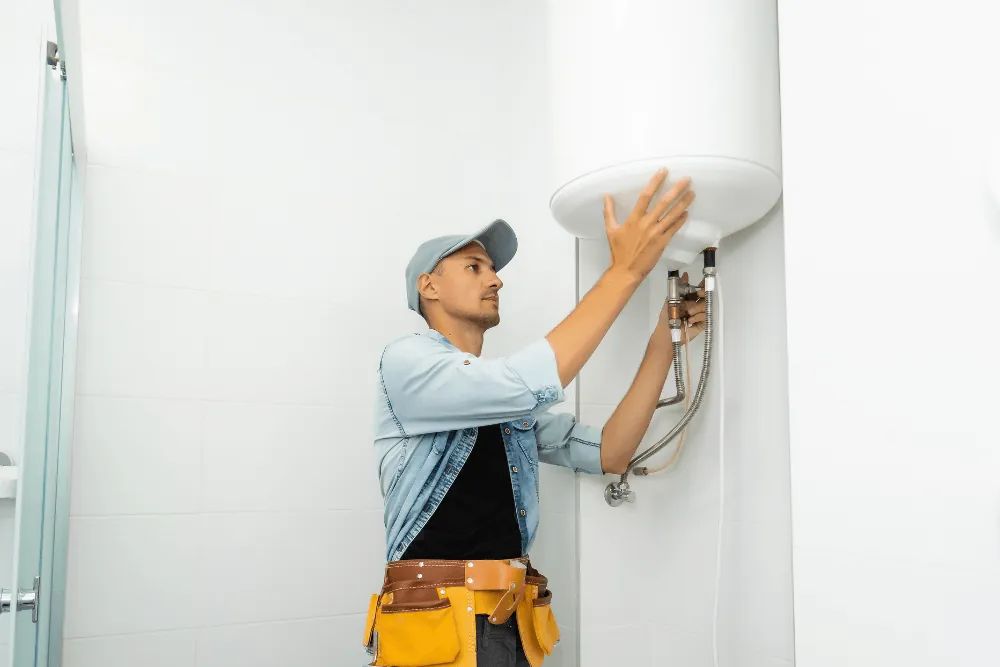
A dedicated electrical supply: breaker, cable and an isolator switch with an indicator light beside the heater.
Safe connections: earthing, bonding, new flexible hoses, an inlet valve, a pressure relief valve and a drain line that ends where you can see it.
Removal of the old heater, drained and taken away.
Testing and a walk-through: leak test, thermostat set, breaker and RCD trip-tested, and a look at where the isolator and valves are.
The numbers at a glance
Typical answer for a Dubai home
If you rent, read the "If you rent" note under the costs section before you book. The landlord usually carries the cost of a heater that fails from age.
Which water heater to install: storage, tankless, heat pump or solar
For one or two bathrooms, a 50 to 80 litre storage heater is the default and the cheapest to fit. A whole villa is better served by a central tank or a heat pump, and a villa built after 2012 probably has a solar system already. Electric tankless heaters look compact, but they ask the most of your wiring, so check the board before you buy one.
Storage heater
A storage heater warms a tank in advance and keeps it hot. Bathroom models hold 30 to 100 litres. Central models for a whole villa hold 150 to 300 litres.
The element draws 1.5 to 3 kW, which an ordinary dedicated circuit carries without trouble. The trade-offs are space, weight, and a standing loss: a well-insulated 80 litre tank still loses roughly 1 to 2 kWh a day keeping its water hot, whether or not you use any. A timer removes most of that loss. Tanks commonly fail from corrosion at the base, which is why the anode rod inside matters (see the upkeep section below).
Electric tankless heater
A tankless heater heats water only while the tap is open, so it takes no space and has no standing loss. Its limit is power. The kilowatts you need equal the flow in litres a minute, multiplied by the temperature rise in degrees, multiplied by 0.07.
A shower at 6 litres a minute, warmed to 38 °C from winter supply water at 20 °C, needs 6 × 18 × 0.07 = 7.5 kW. That is a 33 A load at 230 V. A small 3 kW unit can only lift 2.4 litres a minute by the same 18 degrees, which suits a basin or a kitchen tap but gives a weak shower. Shower-capable units of 7 to 9 kW need a 40 A breaker and heavy cable, and some larger units are three-phase.
Heat pump water heater
A heat pump moves heat from the air into the tank instead of making it with a resistive element. A unit with a seasonal efficiency of around 3 delivers three units of heat for every unit of electricity, so it uses about a third of the power of an element heater for the same hot water.
It needs a spot with free airflow, such as a ventilated plant room or an outdoor pad, a drain for condensate, and tolerance for fan noise about like a fridge. It costs more to buy than a storage heater. It only pays back where hot water use is large and steady, which means a villa with four or more bathrooms and a full household. The running-cost sums are below.
Solar water heater
Dubai Municipality's circular 183 of 6 December 2011 asks consultants and contractors to use solar heating for hot water in villas, hotels, labour camps and most other building types "wherever possible", sized to cover at least 75% of the building's hot water. Pools need their own solar system for at least 50% of heating. It applies to building permit drawings submitted from 4 March 2012, so most villas built since then have roof collectors and a storage tank.
Those systems still depend on electrics: a backup element for cloudy days and winter, a pump and controller, temperature sensors and an isolator. We fit and repair that side and the storage tank. For the roof collectors and the glycol circuit, we tell you at the visit whether we do the work or a specialist does. A solar heater that runs cold has several possible causes: the backup element, the controller, a stuck pump, a faulty sensor or scaled collectors. We start with the electrical ones because they are quickest to test.
The four types side by side
| Type | Typical size | Electrical load | Suits | Watch for |
|---|---|---|---|---|
| Storage | 30 to 100 L (bathroom), 150 to 300 L (villa) | 1.5 to 3 kW per element | One or two bathrooms close together | Weight, standing loss, ceiling access |
| Tankless, basin or kitchen | Instant | 3 to 5 kW | A single tap far from the main heater | Weak flow if used for a shower |
| Tankless, shower | Instant | 7 to 9 kW, 40 A | Small flats with no room for a tank | Cable, breaker, and the main supply |
| Heat pump | 200 to 300 L tank | 0.5 to 1 kW, plus a backup element | Villas with big, steady hot water use | Space for airflow, noise, price |
| Solar | 200 to 300 L tank plus roof collectors | Backup element and pump | Villas, where the permit rule applies | Roof access, summer overheating, pump faults |
How we choose
One bathroom in a flat: a 50 litre storage heater, usually above the ceiling. A flat where the kitchen is far from the bathroom: a small 10 to 15 litre heater under the sink, so you do not run the tap for a minute waiting for hot water. A villa with long pipe runs: heaters near each bathroom group, or a central tank with a circulation pump.
How big the water heater needs to be
Size the heater for the hot water you draw in your busiest half hour, not for the number of people in the house. A shower is a blend of stored hot water and cold, so it uses far less than its own volume from the tank.
The share of hot water in a shower is (shower temperature − cold water temperature) ÷ (tank temperature − cold water temperature). With the tank at 60 °C, a shower at 38 °C and cold water at 28 °C, that is 10 ÷ 32, or about 31%. In winter, with cold water at 20 °C, it is 18 ÷ 40, or 45%.
| Use | Mixed water | Hot water from the tank (cold at 28 °C) | Hot water from the tank (cold at 20 °C) |
|---|---|---|---|
| Shower, 6 minutes at 8 L a minute, 38 °C | 48 L | 15 L | 22 L |
| Bath, 120 L at 40 °C | 120 L | 45 L | 60 L |
| Washing up, 12 L at 45 °C | 12 L | 6 L | 8 L |
A tank does not give all of its stated volume as properly hot water. As you draw, cold water enters at the base and the temperature at the tap starts to drop, so plan on about three quarters of the label. The table below uses that, and it works out how long each size takes to reheat from fully cold in winter, with the element that size usually carries.
| Tank size | Usual element | Showers back to back (cold at 28 °C) | Reheat from 20 °C to 60 °C |
|---|---|---|---|
| 30 L | 1.5 kW | 1 | 56 minutes |
| 50 L | 2 kW | 2 | 1 hour 10 minutes |
| 80 L | 3 kW | 4 | 1 hour 15 minutes |
| 100 L | 3 kW | 5 | 1 hour 35 minutes |
| 200 L | 6 kW, two elements | 10 | 1 hour 35 minutes |
Add about 10% to the reheat times for heat lost through the tank wall. Both tables assume 60 °C storage and 15 litres of hot water per shower in the warmer case. If your roof tank is hotter than 28 °C in summer, the tank has an easier job and gives more showers.
From that, the sizes we recommend most often are:
- One person or a couple, one shower a morning: 50 litres.
- A family of four sharing one bathroom, or a bathroom with a bath: 80 to 100 litres.
- A master bathroom with a rain shower or a large tub: 100 litres on a 3 kW element.
- A villa with four or more bathrooms: a central 200 to 300 litre tank, or separate 80 litre heaters per bathroom group, depending on the pipe runs.
When a new heater is the same size as the old one, send us the label. It carries the model, the litres and the kilowatts, so we can match the size, the bracket spacing and the pipe connections.
Where the heater goes, and why it changes the job
Position decides how long the job takes, what it costs, and what a leak does to the room below. These are the five situations we plan for in Dubai homes.
Above the bathroom ceiling
A horizontal heater on a bracket in the false ceiling is a common arrangement in Dubai flats and villas. It frees the bathroom wall, and it hides the tank. It also hides the problems, so four things have to be right.
- An access hatch under the heater, at least 600 × 600 mm, placed so the front plate with the element and thermostat can be reached. A hatch that is off to one side means every repair starts with a ceiling saw.
- A fixing into the slab. A full 80 litre heater weighs about 100 kg: 80 kg of water and around 20 kg of steel. It hangs from the concrete above, never from the ceiling grid or gypsum board.
- A drip tray under the tank, with a drain pipe that runs to the floor drain or to a visible outlet. When a tank leaks, the tray decides whether you find a damp patch or a collapsed ceiling.
- A new heater that fits through the hatch. A replacement that is longer than the old one may not turn the corner. We measure the hatch and the void before you order.
On a bathroom wall
Vertical heaters are fixed high on the wall, out of the shower's splash area. The isolator switch goes outside the bathroom or well away from the shower, and the heater's wiring runs in conduit. Hollow partition walls cannot carry a full tank, so we bolt into block or concrete, or fit a steel plate that spreads the load across the studs.
Under or above the kitchen sink
Small 10 to 15 litre heaters of 1.5 to 2 kW suit kitchens, laundry rooms and guest basins. They keep the pipe run short, which means you get hot water in seconds instead of after a minute of running the tap. They need a solid wall, a dedicated fused supply from the board, and a relief valve that can drain into the sink waste or a tray.
In a villa plant room or on the roof
Central tanks and heat pumps live here. A plant room needs a floor drain, ventilation for a heat pump, and room to open the front panel. A roof or outdoor position needs weatherproof isolators, UV-resistant cable and pipe insulation, because summer sun at 45 °C or more bakes exposed valves and softens ordinary flex.
Replacing an existing heater
When the new heater matches the old one, the hardest part is often what is behind it: a corroded bracket, an old cable with brittle insulation, or a tank connected with rigid pipe that cannot be moved by a centimetre. We check these before we quote, from your photos, so the quote is firm before we arrive.
The electrical side of a water heater installation
A water heater is the heaviest steady load in a bathroom, so it gets its own circuit from the distribution board to an isolator next to the heater. It never shares a circuit with sockets or lights.
Breaker and cable by heater size
The current is the power divided by 230 V. The breaker has to protect the cable, and the cable has to carry the current without warming up, including in a hot ceiling void.
| Heater | Current at 230 V | Breaker | Copper cable |
|---|---|---|---|
| Storage, 1.5 kW | 6.5 A | 16 A | 2.5 mm² |
| Storage, 2 kW | 8.7 A | 16 A | 2.5 mm² |
| Storage, 3 kW | 13 A | 16 A or 20 A | 2.5 mm², or 4 mm² on a long run |
| Tankless, 5.5 kW | 24 A | 32 A | 6 mm² |
| Tankless, 7.5 to 9 kW | 33 to 39 A | 40 A | 10 mm² |
These are typical values, not a substitute for the nameplate. We size each circuit from the heater's rated power, the cable length, how the cable is run, and whether the ceiling void is insulated. A central tank with two elements gets a circuit for each element or a single heavier circuit, depending on the board.
What goes between the board and the heater
- A double-pole isolator of 20 A or 32 A with an indicator light, within reach and outside the shower's splash area. It lets you switch the heater off, and it lets an engineer isolate it, without opening the ceiling.
- Heat-resistant flexible cable from the isolator to the heater's terminals. Ordinary PVC flex softens next to a hot element and the insulation fails.
- A 30 mA RCD or RCBO protecting the circuit. It trips in a fraction of a second if current leaks to earth, for example through a cracked element, before anyone in the shower feels it.
- Earthing and bonding. The heater's earth terminal goes to the circuit's earth conductor, and the metal pipework is bonded to earth so that every metal part in the bathroom sits at the same voltage. A mild tingle from a tap can be a sign that this link is missing.
Timers and smart switches
A timer that heats the tank for two hours before you wake removes most of the standing loss described above. Use a timer or smart switch rated for the load, which means 16 A or 20 A, not the 2 A rating of a lighting module. A lighting-grade smart switch on a 3 kW heater can overheat, which is a fire risk. Our sensor and timer installation and smart switch installation services use parts rated for heater loads.
When the distribution board is the real problem
Some jobs stop at the board. A distribution board with no spare way, no RCD, or burnt terminals cannot take a new heater circuit safely. A flat that already runs several air conditioners may not have the spare capacity for a 9 kW tankless unit. We check the board and the main breaker before we quote, and if the board needs work we say so up front. The usual fixes are a DB box and distribution board upgrade, new MCB and RCCB breakers, or, for a villa, a three-phase and load upgrade.
On a like-for-like swap onto existing wiring, we measure the insulation of the existing cable and check the terminals for scorching. A cable that has run hot for years gets replaced, because it will not survive another heater.
The plumbing side: valves, pressure and the drain
Leaks and dripping valves usually trace back to four things on the plumbing side: the pressure, the relief valve, the hoses, and what happens when the tank is first filled.
Pressure
Water reaches a Dubai heater from a rooftop or ground tank, often through a booster pump. Heaters are built for a stated working pressure, commonly 6 to 8 bar on the label, but a pump that overshoots wears seals and valves early. We put a gauge on the line. If the pressure sits above about 4 bar, we fit a pressure-reducing valve ahead of the heater.
The relief valve and the drain line
A pressure and temperature relief valve sits on the heater. It opens if the pressure or the temperature climbs too high and stops the tank from becoming a pressure vessel with no exit. It needs a drain pipe of the same bore, running downhill to a place where you can see water come out. It is never capped, plugged or tiled over.
A relief valve that drips while the heater warms up is usually not faulty. Water expands by about 1.5% when it is heated from 20 °C to 60 °C, so an 80 litre tank has to find room for another 1.2 litres. If a one-way valve on the supply stops that water from flowing back, the pressure climbs and the relief valve lets a little out. A small expansion vessel on the cold inlet takes up the extra volume. A valve that drips all day, at any temperature, is worn or the supply pressure is too high.
Valves, hoses and fittings
- An isolating valve on the cold inlet, so the heater can be serviced without shutting off the whole house.
- A one-way valve on the inlet, so hot water cannot push back into the supply.
- New braided stainless-steel flexible hoses with new washers. Reused old hoses are how a leak that was fixed last week returns this week.
- Dielectric nipples or brass connectors where the steel tank's outlet meets copper pipe, because steel and copper in contact corrode each other in damp conditions.
- Hot and cold in the right order. The cold inlet is marked, and swapping them leaves you with a cold shower and a tank that never fills correctly.
Filling the tank before the power goes on
This is a step that destroys elements. An element switched on in a tank that is not full overheats within minutes and burns out. We open a hot tap until air stops spitting out and a steady stream runs, and only then do we switch on at the isolator.
Thermostat setting
We set stored water at about 60 °C. Water held between about 25 and 45 °C is where the bacteria that cause Legionnaires' disease grow, so a tank is not left lukewarm. Water at 60 °C can scald within seconds, and scale builds faster the hotter the tank runs. Where there are young children or older people in the home, a thermostatic mixing valve at the shower or bath limits the tap temperature to around 45 to 50 °C whatever the tank holds.
Moving a heater to a new position means new pipework, which we quote separately.
What a water heater installation costs in Dubai
A like-for-like swap of an 80 litre storage heater, with the heater supplied and fitted, usually costs AED 580 to 1,360 in Dubai. Fitting alone is AED 245 to 435. The site visit costs AED 50, and the quote follows it.
| Job | Typical price (AED) |
|---|---|
| Fit only, customer supplies a like-for-like storage heater | 250 to 450 |
| Supply and fit, 80 L storage heater, like-for-like | 600 to 1,400 |
| Extra when the heater is above a false ceiling (access, tray, drain) | 500 to 1,500 |
| Electric tankless heater, supplied and fitted | 1,100 to 3,350 |
| Heat pump or solar water heater | Quote after a site visit |
What moves the price
- Brand and size. A 30 litre and a 100 litre heater from the same maker differ in price before any labour.
- Ceiling access. A hatch that must be cut, a ceiling that must be reopened, or a long drain run adds hours.
- Cable run and breaker. A new circuit across a villa from a distant board costs more than a short spur next to the board.
- The board. A board that needs a new breaker, an RCD or an upgrade turns the heater quote into a bigger job. We tell you before work starts.
- Tankless wiring. A 9 kW tankless unit needs heavy cable and a large breaker, so its fitting cost can exceed its price.
- Old pipework. Corroded or rigid pipes that will not join to the new heater need replacing.
What the heater costs to run
Three steps give the monthly figure. Multiply the litres of 60 °C water you use a day by 40 degrees of temperature rise (20 °C to 60 °C in winter) and by 0.001163 to get kWh a day. Add the tank's standing loss, about 1 to 2.5 kWh a day depending on size. Multiply by 30 days and by your rate per kWh. The table uses AED 0.35 per kWh as a round all-in figure; use the rate on your own bill.
| Hot water used a day (60 °C) | Element heater, AED a month | Heat pump, AED a month |
|---|---|---|
| 50 L (one or two people) | 35 | 12 |
| 100 L (a family of four) | 65 | 22 |
| 200 L (a large family) | 119 | 40 |
| 400 L (a villa with guests and staff) | 222 | 74 |
The heat pump column assumes a seasonal efficiency of 3. Compare the saving with the price difference. At 100 litres a day, the heat pump saves about AED 520 a year, so if a heat pump costs AED 5,000 more than a storage heater, it takes about ten years to pay back. At 400 litres a day it saves about AED 1,770 a year, and the case changes.
Beside air conditioning, a heater is a small line on a Dubai bill. The part worth acting on is the standing loss in summer, which the section on seasons below covers.
If you rent
Under Dubai's tenancy law, Article 16 of Law 26 of 2007, the landlord is primarily responsible for maintenance, and a water heater is normally treated as a major appliance. A heater that fails from age is generally the landlord's cost, while damage from misuse is the tenant's. The tenancy contract can move that split, so read it first and tell the landlord or the property manager in writing before you pay for a replacement. We give an itemised quote you can forward.
How a water heater installation runs, step by step
- 1Photos and quote. You send photos of the old heater, its label, the ceiling hatch or wall, and your distribution board. We quote a price and a time, and we say if anything looks like it will need extra work.
- 2Isolate and drain. We switch off at the board, prove the circuit dead with a tester, close the inlet valve, open a hot tap and drain the tank to a bucket or hose. Nothing is unscrewed before this.
- 3Remove the old heater. We take it down, check the bracket, the cable and the pipework behind it, and note anything that has to be replaced.
- 4Fix the bracket and mount the heater. Into concrete or block, rated for the full weight, level, with the access side facing the hatch.
- 5Electrical connections. New heat-resistant flex, the breaker and isolator, earth and bonding. A new cable run is added if the old one fails the check.
- 6Water connections. Isolating valve, one-way valve, pressure relief valve with its drain line, new flexible hoses, and a drip tray where the heater is above a ceiling.
- 7Fill and purge. We open the hot tap, fill the tank, let the air out and check every joint is dry. The power stays off until a full stream runs.
- 8Heat-up test. We switch on and wait for the first heating cycle, usually 30 to 60 minutes. We watch the thermostat cut out, check the relief valve stays shut, and trip-test the RCD.
- 9Handover. We show you the isolator and the inlet valve, set the thermostat, leave the receipt and any warranty paperwork, and take the old heater away.
Living with a water heater in Dubai: seasons, upkeep and repairs
Summer and winter
In July and August the cold water entering a Dubai home can be hotter than the water in the heater. Roof tanks and outdoor pipes sit in air that reaches 45 °C or more, so the cold tap runs warm and the hot tap, when the heater is on, runs hotter. Many households switch the heater off from around June to September and use the hot tap for warm water, then switch back in the cooler months. Switching off removes the standing loss and avoids heating water that is already warm.
Shading or insulating the roof tank and the exposed pipes cuts the heat they pick up, and it costs little. Whatever the season, never leave a heater switched on with the inlet valve closed or the tank empty.
Yearly upkeep
- Lift the relief valve lever for a second. Water should flow and then stop when you let go. If it keeps running, the valve needs replacing.
- Check the anode rod. A magnesium rod inside the tank corrodes in place of the steel. Replace it once most of it has gone; a tank with no anode left starts rusting through.
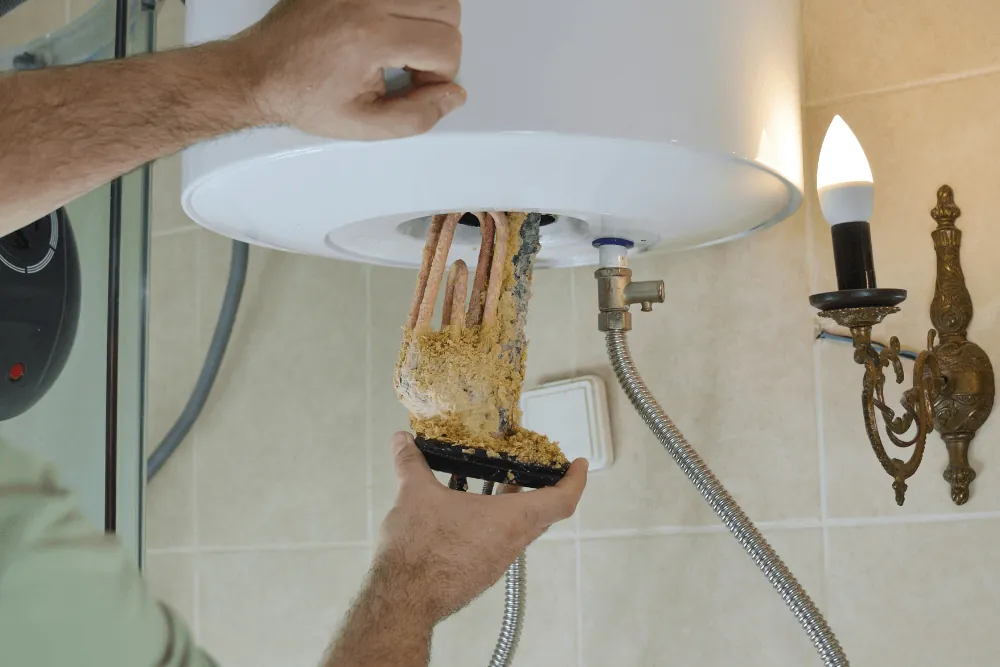
- Flush the tank to clear sediment. A layer of scale on the element makes it work harder, heats more slowly and shortens its life.
- Look at the joints and the drip tray for stains or drops.
- Press the RCD test button every three months. It should trip, and you reset it.
Signs a heater is failing
- Hot water runs out faster than it used to, which points to a failed element or a thermostat that cuts out early.
- Rumbling or popping when it heats, which points to scale on the element.
- The RCD trips each time the heater switches on, which points to an element leaking to earth.
- Rust-coloured hot water, or a tank that is stained at the base.
- A damp ceiling, or water in the drip tray.
- A relief valve that drips all day.
- A tingle from the taps, which points to missing earthing or bonding. Switch the heater off at the isolator and message us on WhatsApp.
Repair or replace
| Fault | Usual fix | Our advice |
|---|---|---|
| Thermostat fails | New thermostat | Repair if the tank is sound |
| Element burns out | New element | Repair if the tank is sound and under about 8 years old |
| Relief valve drips constantly | New valve, check pressure | Repair |
| Water runs hot then cold | Element or thermostat | Repair first |
| Leak from the tank body or seam | None | Replace. A corroded tank cannot be fixed. |
| Rusty hot water | Check the anode | Replace if the tank itself is rusting |
As a rule, if a repair costs more than about half the price of a new heater, or the heater is past eight to ten years old and has a second fault, replace it.
Water heater installation with Circuit Dubai
- One visit for the electrics and the water. The same team runs the circuit, mounts the heater and connects the pipes, so nobody has to coordinate an electrician and a plumber.
- A price from photos, before we start. The quote lists the heater, the labour, any circuit work and any ceiling access, so you can compare it line by line.
- A tested finish. Leak test, thermostat cycle, relief valve check and a trip test of the RCD, every time.
- The old heater taken away, drained, with the ceiling and the floor left clean.
- Any brand. We fit Ariston, AO Smith, Bajaj, Crompton and others, and match the circuit to the heater's label.
We work across all of Dubai. Our office is in Al Quoz.
If you are also planning a heater timer or smart switch, a new distribution board or RCD, a three-phase upgrade, or solar panels for the roof, we can scope them at the same visit and save a second call-out.
Phone: +971 55 407 7427
Water heater questions we hear from Dubai homeowners
How long does a water heater installation take?
A like-for-like swap of a bathroom heater takes two to three hours. A heater above a false ceiling, a new circuit across the house, or a tankless unit takes half a day. Central tanks and heat pumps take a day.
Can my handyman or the building maintenance team fit it?
They can mount it, but the electrical connection, the earth and the relief valve drain are where home jobs go wrong. Many Dubai buildings and communities also expect maintenance work to be done by approved contractors, so ask your management office before anyone starts.
What size water heater does a family of four need?
One bathroom: 80 to 100 litres. Two bathrooms used in the same morning: a heater for each, or a 150 to 200 litre central tank.
Should I switch the water heater off in summer?
In the hottest months the cold water often comes out warm already, so many households turn the heater off and use the hot tap for warm water. Switch it back on in the cooler months. Fill the tank before you switch it on again.
Is a tankless water heater worth it in Dubai?
For a kitchen tap or a guest basin, yes. For a shower, it needs 7 to 9 kW, a 40 A breaker and 10 mm² cable, and some flats cannot supply that. If you have the room for a tank, a storage heater is cheaper to fit and kinder to the board.
Why does the RCD trip when the heater switches on?
Usually the element has cracked and is leaking current to earth, or water has reached the terminals. Switch the heater off at the isolator and leave it off. Resetting the RCD again and again can hide a fault that will shock someone.
Can you fit the heater the same day?
Often, when the heater is a stock size and the board needs no work. The common sizes, such as 50, 80 and 100 litres, are the ones we can fit the same day.
Can you add a heater to a bathroom that never had one?
Yes. It needs its own circuit from the board, a cold water supply and a drain for the relief valve, and a place the tank can be carried to. The new circuit is usually the biggest part of the cost, and we price it after a survey.
Do you repair solar water heaters?
Yes. We repair the electrical side: backup element, thermostat, pump, controller and sensors, and the tank. Send a photo of the control unit and the roof tank.
Ready for a water heater that is fitted properly?
Send a photo of the old heater's label, your distribution board, and the wall or ceiling it sits on. We reply instantly on chat with a price and a time, so you know what the job involves before anyone arrives.