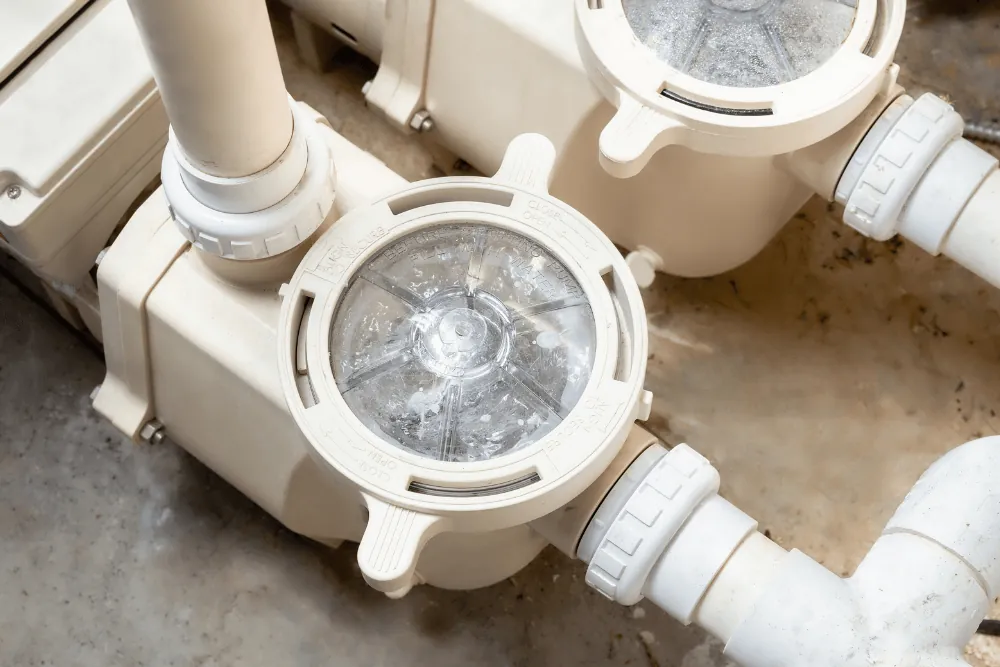
Pump and Pool Equipment Wiring in Dubai: Water Pump, Submersible Pump, Pool Pump, Hot Tub and Sauna Wiring
A pump is an electric motor attached to water, and the wiring around it has more to do than the wiring for a light or a socket. It has to start the motor, protect it, stop it when the water runs out and keep the supply safe in places where water and electricity sit close together. A pump sits in a pit, a tank room, a plant room, a borehole or a garden, and each of those places gets wet, hot or dusty.
Circuit Dubai wires water pumps, submersible pumps, booster and pressure pumps, shower pumps, pool pumps and pool plant rooms, hot tubs and jacuzzi baths, sauna heaters, sump pumps and solar pump systems in villas, apartments, farms, offices and plant rooms across Dubai. We are electricians, so we do the supply, the starter or control box, the protection, the cable and the testing. The plumbing, the pool shell and the drilling of a well belong to other trades, and this page says where each boundary lies.
What pump and pool equipment wiring with us includes
The nameplate read first, covering voltage, phase, current, power and protection class, before anything is ordered or connected.
The right supply and protection, with a circuit breaker, a residual-current device and, for motors, an overload setting that matches the plate.
A starter, control box or panel that suits the pump, from a switch and a pressure switch to a submersible control box or a panel with level control.
Water-safe cable and connections, with cable, glands and joints chosen for wet, buried and hot places.
Bonding and earthing round pools, tubs and wet rooms, with the metal parts tied together as the standard for the place requires.
Tests and a handover, including insulation resistance, direction of rotation, running current and a trip test on the residual-current device.
The numbers at a glance
Typical answer for Dubai
Before you book pump or pool wiring, take a photo of the pump's nameplate and of the wiring label on any heater, control unit or panel, because the plate says what supply the equipment needs. Note where it sits, how far it is from the main board and whether the place is ever wet, hot or closed in. Write down what has gone wrong: it does not start, it hums, it trips the breaker, it runs and gives no water, or it is new and not yet connected. Say who is fitting the pump itself, since the plumber, the pool builder or the supplier may be on site as well. That is enough for us to say what the job needs. The sections below explain the choices so you can judge a quote before you accept it.
Pump and pool wiring terms: what people search for and what each means
People search for this work by the pump they own, the place it sits or the make on the label. The three tables below match the wording to what is involved, and the later sections give the detail. Some of the terms come from other countries, and the tables say so where that is the case.
Pump and motor terms
| If you searched | What it means |
|---|---|
| Water pump wiring connection, water pump wiring, wiring of water pump, electric water pump wiring, water pump electric connection | Connecting a mains pump to its supply, switch and protection. See the water pump motor section |
| Motor pump wiring, water pump motor wiring, water pump motor connection | Connecting the motor inside the pump, single-phase or three-phase. See the water pump motor section |
| Electric pump repair, electric pump repair near me, electric water pump repair | Fixing the electrical side of a pump: the control box, capacitor, starter, cable or motor. Our office is in Al Quoz and we work across Dubai. See the faults section |
| Submersible pump wiring, submersible pump wiring connection, submersible pump electrical connection, submersible pump electrical connections, submersible water pump electrical wiring, submersible wiring connection, electrical connection of submersible pump | Wiring a pump that works under water to a supply through a control box or a starter. See the submersible pump section |
| Submersible pump motor connection, submersible motor connection | The motor end of the same job. See the submersible pump section |
| Submersible pump control box wiring, submersible pump control box connection, submersible box wiring | The box that holds the capacitor and relay for a three-wire single-phase pump. See the submersible pump section |
| Submersible motor starter connection, submersible motor starter wiring, submersible pump starter connection, submersible pump starter wiring, submersible starter wiring | The switch that starts and protects the motor. See the submersible pump section |
| Submersible motor panel connection, submersible pump panel wiring | A panel that holds the starter, the protection and the level control. See the submersible pump section |
| Wiring panel pompa submersible 1 phase | Pompa is the Malay and Indonesian word for pump. This is a control panel for a single-phase submersible pump. See the submersible pump section |
| Submersible pump winding, submersible pump winding cost | The copper coils inside the motor, and what it costs to rewind them or replace the motor. See the submersible pump section and the cost section |
| Booster pump electrical connection, pressure pump wiring | A pump that raises water pressure, with its pressure switch. See the booster pump section |
| Wiring a shower pump | A pump that boosts a shower. See the booster pump section |
| Recirculation pump installation | A small pump that keeps hot water moving round a loop. See the booster pump section |
| Shurflo pump wiring | Shurflo is a make of diaphragm pumps. We wire to the maker's diagram for the model. See the booster pump section |
| Well pump connection, water well pump electrical wiring | A pump in a well or borehole. See the solar pumps and boreholes section |
Pool, hot tub and spa terms
| If you searched | What it means |
|---|---|
| Pool pump wiring, pool pump electrical connection, pool pump electrical installation, swimming pool pump electrical connection, wiring a swimming pool pump | Connecting a filter pump to its supply, timer and protection. See the pool section |
| Pool pump motor wiring | The motor terminals and the supply setting. See the pool section |
| Wiring a 220v pool pump | Dubai's supply is 230 V. A pump plate that says 220 V or 220 to 240 V is read against 230 V. See the pool section |
| Pool pump timer wiring | A timer that switches the pump on and off each day. See the pool section |
| Pool equipment wiring | The pump, chlorinator, heater, lights and controls in the plant room. See the pool section |
| Hot tub wiring, wiring for hot tub, wiring up a hot tub, hooking up a hot tub electrical, hot tub electrical installation, hot tub electrical installation near me, jacuzzi hot tub electrical installation | The supply, protection, isolator and bonding for a tub. Our office is in Al Quoz and we work across Dubai. See the hot tub section |
| Jacuzzi electrical, jacuzzi electrical connection, jacuzzi electrical installation, jacuzzi bath electrical installation, jacuzzi tub power requirements | Jacuzzi is a brand name that people use for hot tubs and whirlpool baths. See the hot tub section |
| Spa panel wiring | A spa panel is a North American term for a small outdoor board with a switch and protection beside a tub. See the hot tub section for the Dubai equivalent |
Sauna, solar, sump and other terms
| If you searched | What it means |
|---|---|
| Sauna electrical wiring, wiring a sauna heater, wiring a 240v sauna heater | The heater supply, the isolator and the heat-rated cable. 240 V is a label from other countries, and Dubai's supply is 230 V. See the sauna section |
| Harvia sauna heater installation, harvia sauna heater wiring | Harvia is a make of sauna heaters. We wire to the maker's diagram and we do not claim to be a dealer. See the sauna section |
| Solar pump installation, solar powered pump for water tank, solar powered water tank pump | A pump run from solar panels. See the solar pumps and boreholes section |
| Solar borehole installation, solar borehole pump installation, solar powered borehole installation | The solar pump, panels and controls for a borehole. We do not drill the borehole. See the solar pumps and boreholes section |
| Solar pool heater installation | Roof collectors that heat pool water, which is a different system from solar electric panels. See the solar pumps and boreholes section |
| Water heat pump installation | A heat pump is a heating appliance and not a water pump. We wire its supply. See the solar pumps and boreholes section |
| Sump pump battery backup, existing sump pump battery backup, installing battery backup for sump pump, installing battery backup sump pump, sump pump battery backup installation | A second pump on a battery for a pit. See the sump pump section |
| Water powered backup sump pump installation cost | A backup that runs on water pressure, not electricity. See the sump pump section and the cost section |
What a pump circuit needs: supply, protection and controls
Every pump circuit has the same four parts: a supply that matches the motor, protection that stops the motor burning out, a control that starts and stops it at the right time and a safe way to isolate it for work. The pump's job changes the control, and the rest stays the same.
Read the nameplate first
The nameplate is a metal or printed label on the motor or the pump body. It is the only reliable statement of what the pump needs, and we read it before we choose a breaker, a cable or a starter.
| On the plate | What it tells us |
|---|---|
| Voltage and phase | 230 V single-phase or 400 V three-phase. A plate with two voltages, such as 230/400 V, is wired differently for each |
| Frequency | 50 Hz in Dubai. A 60 Hz pump from another market may not run correctly |
| Power, in kW or hp | The size of the motor, which sets the starter and the cable |
| Full-load current, in amps | The current the overload protection is set to |
| Capacitor value, if shown | A single-phase motor uses a capacitor to start or run, and the plate may give its size |
| Protection class, IP number | How well the motor resists dust and water |
| Duty or service | Whether it can run continuously or only for short periods |
| Maximum depth or head | For submersible pumps, how deep the pump can work |
A pump that has no readable plate is a reason to stop. Guessing the voltage or the current can burn out a motor on its first start.
Single-phase or three-phase
A single-phase motor runs from one live and a neutral, and a three-phase motor runs from three lives. A villa or an apartment supply may be either, and the main board shows which. A pump that needs three-phase cannot be run from a single-phase supply with a plug and a wish, so the choices are a pump that matches the supply, a larger supply or a drive made for the purpose. See our three-phase upgrade page if the supply is the limit.
What stops a pump burning out
A pump motor is cooled by the water it moves or by the air round it, and its failures come from a short list of causes: running dry when water stops flowing, a locked shaft from seized bearings, repeated starting and stopping, and electrical overload. Each cause has a device that answers it.
| Cause | The device | Where it is used |
|---|---|---|
| Overcurrent and short circuit | A circuit breaker sized to the circuit | Every pump |
| Motor overload | An overload relay or a thermal cut-out set to the plate current | Motors on a starter, and built into some submersible motors |
| Earth leakage | A residual-current device, 30 mA for wet places | Pools, tubs, wet rooms, pits and outdoor pumps |
| Running dry | A dry-run or low-water cut-off, or a level probe or float | Booster pumps, tank pumps, wells and boreholes |
| Short cycling | A correctly sized pressure tank and a pressure switch set properly | Pressure pumps |
| One phase missing, or low voltage | A phase failure relay | Three-phase pumps |
| Lightning and switching surges | Surge protection at the board | Outdoor pumps and boreholes |
For the surge side, see our surge protection page. For the breaker and residual-current device, see our MCB and RCCB breakers page.
Isolation and the circuit layout
A pump has its own circuit from the main board, so that a fault on the pump does not take down the lights. An isolator beside the pump lets a person switch it off in sight of the work. Switching off only one conductor of a circuit can leave the other live at the pump, so the isolator we fit breaks every live conductor. The cable runs in conduit or is protected where it could be cut, crushed or soaked, and cable that goes underground or into water is made for it. See our conduit, trunking and cable tray page for the routes.
Sun, heat and dust
A pump in a Dubai garden or on a roof sits in direct sun, and the motor, the cable and the enclosure all heat up. We place the starter in shade where we can, choose an enclosure with a protection class that suits the place, and keep the motor's cooling air clear. A maker's guide on boosting water from a roof tank warns that a pump on a roof is exposed to temperature swings, wind, rain and dust, and says that placing it under the roof reduces this.
Rules and standards for pump, pool and hot tub wiring in Dubai
Pump and pool wiring sits under several sets of rules at once: the wiring regulations, the standards for the special place, the maker's instructions and the authorities that look after pools and groundwater. We are electricians and not lawyers, so confirm what applies to your property with the authority, your consultant or your building management.
What applies and where it comes from
| Subject | What applies |
|---|---|
| Wiring regulations | DEWA publishes Regulations for Electrical Installations, and the 2017 edition is listed on its website. This page does not repeat DEWA's clause numbers. Where we give a figure, it comes from a maker's manual or an international standard, and we check the DEWA requirement for your property before work starts. |
| Pools | The international standard for electrical installations in swimming pools and fountains is IEC 60364-7-702, which sets rules for the equipment and wiring around a pool basin. |
| Private pools in Dubai | Dubai Municipality publishes Private Swimming Pools Safety Guidelines for villa pools that can hold water 300 mm deep or more. The guideline says a pool is registered with Dubai Municipality before construction or installation, that pipes, filters and motors are kept in working order, that equipment is serviced as the maker says, and that the retention time of the pool water is no more than 4 hours. It contains no wiring requirements |
| Hot tubs and spas | A hot tub is a product made to a product standard, such as BS EN 60335-2-60 in the UK and Europe, and the maker's installation manual sets its supply. UK guidance applies the rules for pools to a tub in a garden. |
| Wells and boreholes | Drilling a well in Dubai needs a permit from Dubai Municipality, and a property portal's guide to the service says farm owners and contractors apply, and that a flowmeter must be installed within 2 months of drilling and not tampered with. Dubai has a law on the protection of groundwater, Law No. 15 of 2008. |
| Sauna heaters | The heater maker's installation manual sets the supply, the cable, the isolator and the clearances. We wire to it |
| Pump makers | The pump's manual sets its voltage, protection, cable and setting depth. Fitting against it protects the warranty |
| Permission | A rented home needs the landlord's approval, and a community may have its own rules for pool equipment and noise. |
What the Dubai Municipality pool guideline means for the pump
The guideline's 4 hour retention time is a water circulation requirement, and the pump is what meets it. It follows that a pump timer is not the place to cut the daily run to save electricity without the pool contractor agreeing the hours first. The guideline also says pool equipment is serviced as the maker says, which is the same advice we give on the electrical side: the starter, the timer, the residual-current device and the bonding are checked on a schedule and not only when something fails.
Why the rules matter for a pump
A pump and the people near it share one hazard: water on live parts. A cable with a nick in its sheath, a loose connection in a damp box or a motor with a failing winding can put a voltage on the pump body, the pipework or the water itself. Wet skin conducts better than dry skin, which is why the rules for wet places are stricter.
Water pump motor wiring: single-phase and three-phase connection
The motor inside a water pump is an ordinary electric motor, and the wiring is the wiring of that motor. The job is the same for a house pump, a pool pump or a garden pump. It is to bring the right supply to the right terminals, through protection, and to check that the shaft turns the right way.
Single-phase pump motors
A single-phase motor is not self-starting in the way a three-phase motor is, so it carries parts that give it a push at the start. The parts below are the ones an electrician finds in a terminal box or a control box.
| Part | What it does |
|---|---|
| Main winding | The winding that runs the motor |
| Start winding | A second winding that gives the motor a turning force at the start |
| Capacitor | Stores charge to shift the start winding's current. A start capacitor is used for a short time at the start, and a run capacitor stays in circuit while the motor runs |
| Centrifugal switch or relay | Takes the start winding out of the circuit once the motor is up to speed |
| Thermal overload | Cuts the supply to the motor if it gets too hot, and may reset itself when it cools |
| Terminal box | Holds the supply terminals, the earth terminal and the links, with a diagram inside the lid or on the plate |
A single-phase pump that hums and does not turn has a short list of suspects: a failed capacitor, a start winding or switch that is not working, a locked shaft or a supply that is too low. We measure the supply at the pump while it tries to start, and then the capacitor, before we condemn the motor.
Three-phase pump motors
A three-phase motor has three windings, and its terminal box has six terminals with links that connect the windings in star or in delta. The link position has to match the supply voltage, and the plate says which.
| Motor plate | Supply | Link position |
|---|---|---|
| 230/400 V | 400 V three-phase | Star |
| 400/690 V | 400 V three-phase | Delta |
A motor linked wrongly for its supply either runs underpowered and overheats or sees too high a voltage and burns out. This is why we read the plate and look in the terminal box and do not assume.
Direction of rotation
A three-phase pump runs in the direction set by the order of its three lives, and swapping any two of them reverses it. A centrifugal pump has an arrow on its casing showing the correct direction. A pump that turns backwards still moves some water, which is why the fault is easy to miss, and it delivers less flow and pressure than it should. We check the arrow and the motor fan or shaft on a first start, with water in the pump casing, since a pump should not be run dry to find out. A single-phase motor's direction is set by its connections and its diagram, and we do not change it without the maker's diagram.
Cable, glands and terminations
The motor cable is sized from the plate current, the cable length and the way it is laid, so that the voltage at the motor stays within the pump maker's limits when it starts. A long run to a garden pump or a borehole needs a larger cable than the plate current alone suggests. The cable enters the terminal box through a gland that suits the cable and the box's protection class, and each terminal is tightened and checked. A loose terminal heats up, and a heated terminal can burn out. See our cable termination and jointing page for lugs, glands and joints.
Starting methods
How a motor is started changes the current drawn at the start, which affects the cable, the protection and the supply.
| Method | What it does | Where it is used |
|---|---|---|
| Direct on line starter | Connects the motor to the full supply through a contactor and an overload relay | Smaller motors, including a domestic pump |
| Star-delta starter | Starts the motor in star to reduce the starting current, then switches to delta | Larger three-phase motors |
| Soft starter | Raises the voltage gradually | Pumps where a gentle start protects the pipework |
| Variable speed drive | Changes the motor frequency and so its speed | Pumps that run at varying flow, such as a booster set or a pool pump with speed settings |
A drive brings its own wiring rules: a supply to the drive, a screened cable to the motor and a protective setup that the drive maker specifies. See our motor and lift wiring page for larger motors and drives.
Submersible pump wiring: control boxes, starters and panels
A submersible pump has the motor and the pump sealed into one unit that is lowered into a well, a borehole, a tank or a sump. The supply comes down a cable, and the starter or control box stays above ground. The searches for submersible pump electrical connection, submersible motor starter wiring, submersible pump control box wiring and submersible pump panel wiring all describe parts of the same job.
Two-wire and three-wire single-phase pumps
A single-phase submersible motor comes in two forms, and the form decides the box. A trade magazine on single-phase submersible components describes them as follows, with horsepower ranges that are US figures and are examples.
| Two-wire | Three-wire | |
|---|---|---|
| Start capacitor | None. The motor has a switch inside its housing that gives the start winding full power for about a third of a second at start | A start capacitor in a control box above ground |
| Cable down the well | Two current-carrying conductors and an earth | Three current-carrying conductors and an earth |
| Control box | Not needed | Needed, and matched to the motor |
| Horsepower range (US example) | 1/3 hp to 1.5 hp | 1/3 hp to 15 hp |
The earth conductor is extra to both counts. The words two and three describe only the current-carrying wires.
What is inside a control box
A control box for a three-wire pump holds the start capacitor, a relay that switches the start circuit out when the motor is running, and in some boxes a run capacitor and an overload. On a three-wire pump described in a trade magazine, the control box sits inside the house, the capacitor, relay and electronics are in its cover and the cover can be replaced without rewiring. The three conductors are start, run and common, and on that pump they are red, black and yellow. Those are one pump's colours, and other makes use others, so colours are no guide. We follow the diagram printed inside the box lid and on the motor.
A control box is matched to the motor by the maker. The capacitor and relay values depend on the motor, so a box from another model is not a substitute.
Three-phase submersible pumps
A three-phase submersible pump has three motor leads and an earth. It has no control box. It is run from a starter or a panel, with an overload relay set to the plate current, and the direction of rotation is checked by the maker's method. A pump that turns backwards delivers less water, and the cable gets the blame, so we check rotation before anyone digs.
Control panels for submersible pumps
A panel is the starter, the protection and the controls in one enclosure. It is the right choice for three-phase pumps, for pumps on a timer or a tank level and for any borehole where the owner wants to see what the pump is doing.
| Part in the panel | What it does |
|---|---|
| Isolator and breaker | Isolates the panel and protects the supply cable |
| Contactor | Switches the motor on and off |
| Overload relay | Trips if the motor draws more than the plate current |
| Phase failure and voltage relay | Stops a three-phase motor if a phase drops out or the voltage is wrong |
| Selector switch | Hand, off and automatic, so the pump can be forced on or off |
| Level control input | A float or probe in a tank, or a probe in the well, that starts and stops the pump |
| Dry-run protection | A relay or sensor that stops the pump if the water runs out |
| Ammeter and lamps | Show the running current, the run state and a trip |
| Surge protection | Protects the panel from a surge on the supply or on the cable |
| Earth terminal | Ties the panel, the motor and the pipework to earth |
A single-phase panel follows the same pattern, with a single-phase contactor and overload. The Malay and Indonesian search for a wiring panel pompa submersible 1 phase is for this panel. See our earthing and grounding page for the earth side.
The cable down the well
The cable is made for use in water, is sized for the plate current and the length, and is supported so that the pump's weight is not carried by the cable. At the pump end the cable meets the motor leads, and the joint is made with a kit that keeps water out. A joint that lets water in is one of the ways a good motor is lost. We test the insulation resistance of the cable and the motor before the pump goes down and again with the pump in place, so a fault is found while the pump is still reachable. See our cable termination and jointing page for the joint, and our insulation and earth resistance testing page for the test.
Troubleshooting a submersible pump that has stopped
The steps below are the order we work in on a three-wire single-phase pump, with the power locked off whenever anyone touches wiring.
- 1Check the supply at the control box input, to confirm that the house wiring and the pressure switch are working.
- 2Check the control box, since the capacitor, relay and electronics are in it and the cover can be replaced.
- 3Divide the circuit at the wellhead. If there is voltage at the wellhead and no current on a clamp meter, the fault is above the pump and not in the buried cable.
- 4Pull the pump and motor when the fault is below. Inspect the cable for damage and test it with a meter.
- 5Read the current. Excessive current with no cable damage points to shorted windings, a seized motor or a pump that will not turn.
- 6Turn the shaft by hand. A sealed motor that is seized cannot be opened on site, so it is replaced.
- 7Test the motor only briefly out of water. The motor is cooled by the water around it, so any dry test is a very short one with the casing earthed and hands clear.
- 8Check for a sand-bound pump. The pump is stripped, cleaned and inspected, worn impellers are replaced and the pump is set a few feet higher.
Partial cable damage may not show on a visual check, and more than one fault can be present at once, so fixing one does not always restore the pump. We say so before we start.
Submersible pump winding: repair or replace
The winding is the coil of insulated copper wire inside the motor that creates the turning force. When insulation fails, the winding shorts or opens, the pump trips or does not start, and the choices are to rewind the motor or to replace the motor or the pump. A rewind is a workshop job: the motor is taken out of the unit, the old coil removed and a new one wound, and the motor is tested. Whether it is worth doing, or possible at all on a sealed motor, depends on the motor's size and type, the cause of the failure, the availability of a replacement and the cost of a new pump. The cause is worth finding, because a motor rewound without fixing a leaking joint, a dry run or a supply problem fails again.
A fair quote for winding work lists the motor tests before and after, the cost of the rewind and the cost of the alternative, so you can compare them. See the cost section.
Booster, pressure, shower and recirculation pumps: wiring and controls
These pumps start and stop on demand, so the control decides how long the pump lives. A booster pump or a pressure pump that starts every time a tap opens and a pump that keeps running with no water are two ways a motor is lost.
Pressure switches and pressure tanks
A pressure switch senses the pressure in the pipe and switches the pump. The pump starts when the pressure falls to the cut-in setting and stops when it rises to the cut-out setting. Examples are the 30/50 and 40/60 PSI pairs sold in the US, which are about 2.1 to 3.4 bar and 2.8 to 4.1 bar. The settings for your system come from the pump and the pipework.
The supply to the motor passes through the switch contacts, so the contacts must carry the motor current. A larger pump is switched by a heavy-duty relay and not by the pressure switch directly, so the pressure switch drives a relay or contactor when the motor is larger than the switch's rating. A pressure tank holds a reserve of water at pressure, so the pump runs for longer and less often. Repeated starting can cause motor, control or pump failure, which is why we check the tank's air charge on a pump that starts too often.
For booster pump electrical connection and pressure pump wiring, the order is board, breaker and residual-current device, isolator, then the pressure switch and the motor, with the earth carried to the motor and the pipework as the maker shows.
Dry-run protection
Pump overheat damage is caused when water stops flowing and the pump keeps running. A pump with no water is not cooled, and its seal runs dry. Two kinds of protection answer this. A low-water cut-off or dry-run switch senses that the water has gone, either from the pressure or from the motor's load, and stops the pump. A float or probe in the tank stops the pump when the level falls to a set point. We fit one or both on a booster that draws from a tank, a well or a borehole.
A roof tank can run dry if use outpaces filling, so a pump that draws from one needs dry-run protection. One pump maker's range adds a leakage alarm that puts the pump in an alarm mode when a leaking pipe is detected, and a run-time limit of 30 minutes on one model, so a leak read as demand does not keep the pump running. Those are examples of what to ask for in a pump, and a pump without them needs the protection added in the wiring.
Pumps for a ground tank and a roof tank
A building with a ground tank and a roof tank uses a pump to move water up, and the control is a pair of floats. A float in the roof tank starts the pump when the level falls, and a float in the ground tank stops it when that tank is low. The pump's switch, the floats and the starter are wired so that either float can stop the pump. A pump on a roof sits in the sun and weather, so the starter goes in a shaded, rated enclosure, and the cable to it is protected.
Wiring a shower pump
A shower pump boosts the flow where the supply is too weak for the shower. The plumber fits the pump and checks the water side. The electrical job is the supply: a circuit with its own protection and a 30 mA residual-current device, an isolator placed outside the wet area and out of reach of the shower, cable sized for the pump's plate current and, where the pipework is metal, bonding as the rules for the room require. A shower pump switches itself on when water flows, through a flow switch or a pressure sensor inside the pump, so the wiring job does not include a control cable.
Recirculation pump installation
A recirculation pump is a small pump that keeps hot water moving round a loop of pipe, so that hot water reaches the tap without a long wait. It sits near the water heater, and the plumber fits the return pipe, the check valve and the pump. The electrical job is a supply with an isolator and a control that decides when the pump runs: a timer, a thermostat on the return pipe or both. Where the heater is far from the taps, the loop saves running the tap while the cold water clears. See our water heater installation page for the heater's own supply. A recirculation pump on a pool or a pond is a different pump with a different job, and it is wired as a pool or water feature pump.
Small DC and diaphragm pumps
Shurflo is a make of diaphragm pumps, and the searches for Shurflo pump wiring come from owners of those pumps. We do not claim to be a dealer of any make. Models differ in voltage, and the plate and the maker's diagram give the supply and the wiring. A 12 V or 24 V DC pump needs a DC supply that can carry its current, a fuse near the supply, the right polarity and a cable sized for the current and the length, because a thin cable drops voltage and starves the motor. A mains model is wired like any other mains pump.
Pool pump wiring and pool equipment: timers, bonding and the plant room
A pool pump moves water from the pool through the filter and back, and it runs for hours every day, so a poor connection has hours each day to heat up. The searches for pool pump wiring, pool pump electrical connection, swimming pool pump electrical connection and wiring a swimming pool pump all start here.
Wiring the pool pump motor
A pool pump motor may be single-phase on 230 V or three-phase, and the plate says which. The terminal box holds the supply, the earth and, on a dual-voltage motor, the link or plug that sets the voltage. The supply must match the motor's voltage, phase and frequency, and a motor made for markets with both 115 V and 230 V carries a selector that must be set to the supply. We set it to 230 V and check it against the plate. A plate that says 220 V or 220 to 240 V is a plate from a market with a different nominal supply, and the pump runs on 230 V if the plate's range covers it.
The motor connection follows the order used on any single-phase pump: supply live to the protection and the timer, then to the motor, neutral to the neutral terminal, and the earth to the earth terminal. The motor is also bonded to the pool's bonding system through a connection point on the motor housing, and pool pump motor wiring that skips the bonding connection is incomplete.
Bonding and earthing round a pool
Bonding ties the metal parts around a pool together and to earth, so that no two of them can sit at different voltages. An Australian work-safety bulletin, which applies that country's wiring rules, warns that a very low voltage is enough to be a serious hazard to a person in the water. It lists what is bonded where equipment is in the pool zones or where a metal pump motor touches pool or filter water:
- the pump's metal motor, which is Class I equipment and so relies on its earth
- the metal reinforcement in the pool shell and deck
- fixed metal parts such as ladders and diving board fittings
- fixed metal items within arm's reach of the pool edge, such as fences, lamp posts and pipework
Connections that pool water can reach are covered or sealed in a suitable compound. UK guidance adds that the reinforcement is connected by welding or clamps and does not have to be welded throughout. Those are two countries' rules. The rules for Dubai pools come from the DEWA regulations and the standard for pools, and we work to what applies to your pool. See our earthing and grounding page for the earth system the bonding connects to.

Residual-current protection
A pool circuit has a 30 mA residual-current device, which cuts the supply in a fraction of a second if current leaks to earth. It is the second line of defence after the bonding. A variable-speed pool pump has drive electronics inside, and the type of residual-current device that suits it is a question for the pump maker, so we ask before we fit one. See our MCB and RCCB breakers page for the devices.
Pool pump timer wiring
A timer switches the pump on and off at set times. A mechanical timer has a dial with pins, and a digital timer has a display and programs. Pool pump timer wiring puts the timer in the live feed to the pump, after the breaker and the residual-current device. A digital timer also needs a permanent live and neutral so that its clock runs when the pump is off, and the pump circuit is switched through its contacts. The timer's contact rating has to be above the pump's running and starting current. Where it is not, the timer drives a contactor and the contactor switches the pump. A manual override is wired in so the pump can run outside its program, for a cleaning or a dosing.
Before the timer is set, the pool contractor's hours are the starting point. Dubai Municipality's retention time of no more than 4 hours is the reason the run is not cut at will.
Pool equipment wiring in the plant room
A plant room holds more than the pump. Each item below has its own circuit and its own protection, and the plant room has a small board for them.
| Equipment | What the circuit needs |
|---|---|
| Filter pump | Its own breaker, residual-current device, timer or contactor, and a bonded motor |
| Chlorinator or salt cell | A supply for its power unit, and the cell cable run as the maker shows |
| Dosing pumps | A supply on the same timer or interlock as the filter pump, so that chemical is dosed only while water flows |
| Pool heater or heat pump | A dedicated circuit sized from the plate, an isolator within sight, and an interlock with the pump if the maker requires it |
| Pool lighting | Low-voltage lights run from a transformer that sits outside the pool zones, with the cable routed as the standard requires |
| Cover motor | A supply and limit switches wired as the maker shows |
| Water feature or fountain pump | A pump on its own residual-current device, wired as a pool pump |
| Control panel | A panel that gathers the timer, the interlocks and the indicators, for larger pools |
An interlock links one circuit to another. A dosing pump that runs while the filter pump is off can put a slug of chemical into still water and pipework, so the dosing is wired to stop when the circulation stops.
The plant room as a place
A plant room should be shaded, dry and ventilated, with the board above the floor and away from any place water can pool. Dubai Municipality's guideline says pool chemicals are stored in a dedicated storage area with a locking device. We keep the board and the starters away from that store, because pool chemicals attack metal and contacts. A plant room below ground level, or a pit, needs a drain or a sump pump so water does not reach the board. See the sump pump section.
Stop and keep clear of the water if a pool light, pump or cable is damaged, or if anyone feels a tingle or a shock in the water. Get everyone out without stepping into the water yourself, switch off the supply at the board if you can reach it dry, and call an electrician. Current leaking into water cannot be seen, so a tingle is treated as a warning.
Hot tub, jacuzzi and spa wiring: hot tub electrical installation, spa panel wiring and power requirements
A hot tub is a sealed unit with a heater, one or more pumps, a blower and a controller, and it is supplied with electricity as one appliance. The wiring brings a protected circuit to the tub, and the tub's own wiring is the maker's. The searches for hot tub wiring, wiring for hot tub, wiring up a hot tub and hooking up a hot tub electrical are for that circuit.
What to read off the tub before wiring it
The tub's installation manual and its plate set the supply. The jacuzzi tub power requirements people search for are on that plate and in that manual, not in a general table.
| What to find | Why it matters |
|---|---|
| Supply voltage and phase | A tub may be single-phase 230 V, and a large spa may need three-phase. The plate says which |
| Total current, in amps | Sets the breaker, the cable and the board's spare capacity |
| Heater rating | The heater adds to the load and may be switched in steps |
| Wiring method | A hard-wired supply or a cord and plug |
| Protection the maker requires | The residual-current device rating and type |
| Cable the maker requires | The cable size and the way it is protected |
| Distance and position | How far the isolator is from the tub, and where the tub may stand |
Jacuzzi is a brand name that people use for hot tubs and whirlpool baths in general. We do not claim to be a Jacuzzi dealer. Whatever the make, the plate is the authority.
Dedicated circuit, residual-current device and isolator
A hot tub has its own circuit from the board. UK guidance for hot tubs says the supply to the tub should be protected by a 30 mA residual-current device, and that cables should be protected against foreseeable damage by armour or a suitable enclosure and not clipped to wooden fences. An isolator is fitted so the tub can be switched off for service. It is placed near the tub and out of reach of a person in the water. That isolator box, with its protection, is the Dubai equivalent of what North American texts call a spa panel, and the search for spa panel wiring is for it.
UK guidance gives a buried cable depth of 500 mm below the lowest local ground level, with warning tape about 150 mm below the surface, under the UK's regulation for buried cables. That is the UK's figure, so we take the depth for Dubai from the rules that apply here and from the ground at your property.
Check the board before adding the load
UK guidance says the rating and condition of existing equipment and the existing earthing must be adequate for the added load. We check this first: the board's spare capacity, the main breaker, the earthing and the condition of the cable. A tub added to a board that is already full, or to a supply with a weak earth, needs the board dealt with first. See our DB box and distribution board page and our earthing and grounding page.
Bonding and the outdoor tub
UK guidance says that for a tub outdoors in the open air, such as in a garden, the rules for swimming pools and other basins in the wiring regulations apply. We treat an outdoor tub the way we treat a pool: the metal frame and pipework are bonded and the circuit has its residual-current device.
Jacuzzi bath and indoor whirlpool wiring
A jacuzzi bath is a whirlpool bath, with a pump under the tub and an access panel to reach it. The jacuzzi bath electrical installation is a circuit with a 30 mA residual-current device, a switch or control placed out of reach of the bath, bonding of the metal parts and pipework as the rules for a bathroom require and an access point to the pump that does not need the bath to be removed. The plumber fits the bath and the pipework, and the electrician wires the pump and the control. BS EN 60335-2-60, the product standard that UK guidance names for hot tubs, also covers whirlpool baths.
Commissioning a tub
We follow the maker's start-up order. A tub is filled with water to the right level before the supply is switched on, since the heater is made to be covered. We then test the residual-current device, record the running current against the plate and leave the manual and the settings with you.
Sauna heater wiring: Harvia sauna heater installation, sauna electrical wiring and heater supply
A sauna heater is a fixed electric heater that warms a stack of stones in a small, hot room. The room runs at a high temperature and the air can be damp, so the wiring has a harder job than wiring in a normal room. The electrician supplies the heater, isolates it, runs heat-rated cable, connects the control unit and sensor and earths everything. The searches for sauna electrical wiring, wiring a sauna heater and wiring a 240v sauna heater are for this job.
What a heater maker's manual asks of the electrician
Harvia is a make of sauna heaters and controls, and the searches for Harvia sauna heater installation and Harvia sauna heater wiring come from its owners. We do not claim to be a Harvia dealer, and we wire any make to its own manual. The table below uses one Harvia manual as an example. It is written for the North American market, at 60 Hz, and it shows what a maker asks of the person who wires a heater.
| Subject | What the example manual says | What it means for us |
|---|---|---|
| Who connects it | Only a licensed electrician, to the supplied wiring diagram and local codes | The heater is connected by an electrician, to its own manual |
| Wire inside the sauna walls | Copper wire suitable for 90 °C (194 °F) | Heat-rated cable, not ordinary building cable |
| Connection | Permanent, with seal-tight conduit between the heater and the wall of the sauna room, and no pigtails or plugs inside the sauna room | A fixed connection, with no plug and no socket in the hot room |
| Disconnection | A fixed device that disconnects all poles, with full disconnection under overvoltage category III conditions | An isolator that breaks every live conductor, placed outside the hot room |
| Earthing | Grounding terminals used as the code requires | The heater, the control and the metal parts are earthed |
| Control unit | Wiring diagrams are in the control unit's installation instructions | We follow the control unit's own diagram |
| Signs | A metal caution sign inside the sauna and a warning sign on its door | We fit the signs the manual supplies |
The manual also has a separate section on the insulation resistance of the heater. We read it before we test a heater that has electronic controls, because the test has to be done the way the maker says.
The supply: 230 V, 240 V and single-phase or three-phase
The 240 V in the search is a label from North America and from older UK practice. Dubai's supply is 230 V single-phase or 400 V three-phase, and the heater's plate states what it runs on. In the example manual, the listed models run from 1.7 kW to 3.5 kW, and the larger the heater, the larger the load. When a heater's plate calls for three-phase and the property has single-phase, the choices are a smaller heater or an upgrade to the supply. See our three-phase upgrade page.
Cable, conduit and fittings in a hot room
Ordinary PVC cable softens in a hot room, so the cable inside the walls of a sauna, and the cable that reaches the heater, is rated for the heat. We run as much of the cable as possible outside the hot room and bring only the heater feed through the wall. The cable goes in conduit or a sleeve that the manual allows. We fit no sockets, no lights that are not made for the heat and no junction boxes inside the hot room unless the maker's manual and the standard allow it.
Control unit, sensor and isolator
The heater's power goes through the control unit, which switches it by a contactor and reads the temperature from a sensor in the room. The sensor cable is a low-voltage cable and is kept as the control unit's diagram shows, and the heater's power cable is run separately. The order is board, breaker and residual-current device, isolator, control unit and heater. A steam room generator and an infrared cabin are different appliances with their own manuals, and we wire them from their own manuals too. See our electric heating installation page for heaters in general.
Solar pumps, boreholes, wells and heat pumps: solar pump installation and what each term means
The pumps in this section take their power from the sun, from a well or from a heat source, and the searches in it have more than one meaning. This section separates a solar pump, a borehole, a pool heater and a water heat pump, so you can tell what you need.
How a solar pump system works
A solar pump system has solar panels, a controller or a drive and a pump. The panels make direct current, and what happens next depends on the pump. A US retailer's solar-pumping guide describes pumps that run on direct current and, without a battery, many of them need a controller, which it calls a specialised DC to DC converter. The controller boosts current in low light, and the retailer puts the gain in daily water delivered at 25% to 50%. That is one retailer's figure for its own pumps, and it is an example of what a controller does. Pumps that run on alternating current are run from an inverter or drive made for solar pumping.
Because the flow from a small pump is low, the water has to be stored. There are three ways to do it: pumping straight into a pressure tank, pumping to a storage tank with a booster pump, or pumping to a raised tank with gravity flow. The tank is the store, so the system keeps water and not electricity, and it needs no battery for the pump to work in daylight. We call this a solar powered pump for a water tank.
A solar pump system is either dedicated, which powers only the pump and works when the grid is down, or integrated, which wires the pump into the home system and can use surplus solar power or battery reserves. A dedicated system with a long low-voltage run needs costly cable. See our solar panel installation page for panels on a roof, and our UPS and inverter installation page for an inverter.
What we need to size a solar pump
The retailer's sizing method uses US units, so we convert them. We add the vertical lift to the pressure the system must supply, using 1 PSI as about 2.31 ft of lift, which is about 0.7 m of head per 1 PSI. We then read the pump's data sheet for the flow and current at that head, and multiply the current by the hours the sun supports to get amp-hours a day.
| We need to know | Why |
|---|---|
| Daily water volume | Sets the pump's flow and the size of the tank |
| Lift and pressure | Sets the head the pump must work against |
| Depth to the water and the source's yield | Sets the pump's setting depth and the risk of running dry |
| Where the tank is | Sets the pipe run and the control wiring |
| Distance from the panels to the pump | Sets the cable size, since a long run loses voltage |
| A clear, unshaded place for the panels | Sets how much of the day the pump runs |
The retailer's rule is that where a well's yield is more than double the pumping rate, the pump is set 5 to 10 ft, about 1.5 to 3 m, below the static water level, and where it is less, the pump is set below the expected drawdown. The setting depth is the water engineer's decision, and we wire to it. Dust on the panels cuts the output, so we plan a way to reach and clean them.
Solar borehole installation: what is ours and what is not
A borehole is a drilled well. Dubai Municipality issues the permit for drilling, and a property portal's guide to the service says the permit is for farm owners and contractors and is needed before a well is drilled, permanent or temporary. It adds that a flowmeter must be installed within 2 months of drilling and must not be tampered with, and Dubai Municipality lists licensed drilling companies on its website. We do not drill. Where a borehole has been drilled lawfully, we do the electrical side: the panels, the controller or drive, the cable to the pump, the protection and the earthing.
Dry running is the risk with any well. A controller with water level sensors can shut the pump off when the water drops too low, and that is what we fit where the yield is low or not known. A borehole in open land also takes the full force of weather and lightning, so surge protection and earthing belong in the design. See our surge protection page and our lightning protection page.
Well pump connection and electrical wiring
A well pump may be a submersible pump, and its wiring is the wiring described in the submersible section: a control box or a panel above ground, a cable down the well and a joint at the motor. At the wellhead the cable enters through a sealed gland, and the earth is carried to the pump and the casing as the design requires. The searches for well pump connection and water well pump electrical wiring come to the same job, with one addition: a well can be far from the board, so the cable's size is set by the length as well as the current.
Solar pool heater installation
A solar pool heater is a set of collectors, on a roof or a frame, that heat pool water as it passes through. It is solar thermal, which heats water directly, and it is not the same as solar electric panels. The pool's filter pump pushes water through the collectors, and a controller reads temperature sensors and moves a diverter valve so that water goes through the collectors only when they are warmer than the pool. The collectors, the pipework and the valve belong to the plumber or the pool contractor, and the electrical job is the controller, the sensors, the valve actuator and the pump circuit.
Water heat pump installation
A heat pump is a heating appliance with a compressor, and it does not pump water in the sense of the rest of this page. A water heat pump can mean a pool heat pump, a hot water heat pump or a heat pump that heats water for a building. In all of these, the electrician's job is the supply: a dedicated circuit sized from the plate, an isolator within sight of the unit and protection that suits the compressor. The refrigerant circuit and the water pipework belong to the installer. See our electric heating installation page and our AC electrical connection page.
Sump pumps and battery backup: sump pump battery backup installation
A sump pump sits in a pit and removes water that collects there. A float switch starts it when the level rises, a check valve stops water running back when the pump stops and a discharge pipe carries the water away. In a building, the pits are a basement sump, a lift pit, a car park sump, a below-ground plant room or a tank pit.
How a battery backup works
A manufacturer's guide on backup sump pump systems says a backup runs when the main pump cannot. Its float detects the water level and starts the backup pump when the level rises past the float of the inactive main pump. It says backups can operate on battery power or on water pressure. A battery backup kit is a second pump with its own float switch, a battery, a charger and an alarm, and it runs the pit when the supply fails or when the main pump or its breaker trips.
Installing a battery backup for a sump pump
The steps for sump pump battery backup installation are these.
- 1Measure the pit and check there is room for a second pump beside the first without the floats tangling.
- 2Fit the backup pump at a height that lets the main pump's float act first, so the backup starts only when the main pump has failed.
- 3Run the discharge so the two pumps do not push water against each other, with a check valve on each.
- 4Place the battery and charger above flood level, in a dry, ventilated place, with the charger on a protected circuit.
- 5Wire the alarm so a person is told when the backup has started or the battery is low.
- 6Test it by raising the main float and then the backup float, and by checking that the alarm sounds.
The plumber fits the discharge pipework, and the electrician wires the pumps, the floats, the charger and the alarm. See our UPS and inverter installation page for the second approach.
Adding a backup to an existing sump pump
Searches for an existing sump pump battery backup are from owners who already have a main pump. We check the pit's size, the float positions, whether the discharge pipe can take a second pump through a check valve and the condition of the main pump's circuit. Where the pit is too small for a second pump, an inverter and battery can run the existing pump instead, and the battery and inverter are sized for the pump's starting current.
Water powered backup sump pumps
A water powered backup uses the pressure of the building's water supply to push water out of the pit, so it works with no electricity. It is a plumbing device and it is connected to the water supply, and it uses water to move water. The question about the installation cost of a water powered backup is a plumber's question, and we do not quote it. If a building wants the pit protected by electricity, the battery system above is ours.
Pump, pool and hot tub wiring cost: what sets the price and how to compare quotes
The price of pump wiring is set by the pump, the distance and the protection, and not by a single rate. A quote that gives one figure with no list cannot be compared with one that shows what each part is. This section lists what goes into a price, so you can read any quote for a pump, a pool, a tub, a sauna or a borehole.
What goes into the price of pump wiring
| Factor | Why it changes the price |
|---|---|
| Pump size and phase | A larger or three-phase motor needs a bigger starter, breaker and cable |
| Starter, control box or panel | A switch, a control box and a full panel are different pieces of equipment |
| Cable length and type | A long run to a garden or a borehole costs more cable, and cable made for water or burial costs more than indoor cable |
| Route | Conduit, trenching, drilling through a wall or crossing a roof take different time |
| Protection | A residual-current device, an overload relay, dry-run protection, a phase failure relay and surge protection are separate parts |
| Level control | Floats and probes in tanks and wells, and their wiring |
| Board capacity | A full board may need work before the new circuit can go on it |
| Testing and handover | Insulation, rotation, current and trip tests, with the figures written down |
| Access | A pump in a pit, a roof or a well takes longer to reach |
What goes into the price of pool, tub and sauna wiring
| Factor | Why it changes the price |
|---|---|
| Number of circuits | A plant room may have a pump, a heater, a chlorinator, lights and a cover motor, each on its own circuit |
| Bonding | The reinforcement, the pump, the ladders and the pipework are connected, and the work depends on how the pool was built |
| Plant room board | A board with protection for each circuit, or a control panel for a larger pool |
| Heater or heat pump load | A heat pump or a tub heater adds load that sets the cable and the breaker |
| Distance | The run from the board to the pool, the tub or the sauna |
| Underground cable | Trenching, conduit and the cable made for burial |
| Heat-rated parts | Cable and fittings rated for sauna heat are priced differently from ordinary ones |
| Making good | Paving, plaster and paint after a trench or a chase |
What goes into a submersible pump winding cost
The winding cost is the price of rewinding the motor, set against the price of replacing it. The factors are the size and type of the motor, the cause of the failure, the tests before and after, the cost of pulling and refitting the pump and the availability of a replacement motor or pump. A quote for a rewind lists the tests and the alternative, so you can see whether the rewind is worth doing. The site visit costs AED 50, and the quote follows it.
Choosing someone to wire it
When you compare quotes for pump or pool wiring, ask each one the same questions.
- 1Will you read the nameplate and wire to the maker's diagram? A pump wired from memory is a pump at risk.
- 2What protection is in the price? A breaker, a residual-current device, an overload setting and dry-run protection are different items.
- 3How will the cable be routed and protected? Wet, buried and hot places need cable and fittings made for them.
- 4Will the pool, tub or sauna be bonded and earthed, and to which rules?
- 5Will every circuit be tested, and will I get the figures?
- 6What does the quote leave out? The pump, the plumbing, the drilling and any work on the board are the items a quote can leave out.
Be careful of a price that gives no protection and no test, a quote for a pool or tub with no mention of bonding and a company that cannot say what it will do about the residual-current device.
How we price
We give a fixed price after photos of the nameplate and the board, or after a short visit, with the starter, the cable, the protection and the testing on separate lines. If a smaller job does the work, we say so on the quote. We quote the sump, solar or borehole job as the electrical work only, and we say what is left to the plumber, the pool builder or the driller.
Testing, commissioning, faults and maintenance for pumps and pool equipment
A pump is hidden in a pit, a well or a plant room, so the tests that show it is safe and healthy are done before we leave. The figures are written down, so the next person has something to compare against.
The tests we run
- Insulation resistance. A test of the motor and cable windings against earth, before and after the pump goes into place. See our insulation and earth resistance testing page.
- Earth continuity and bonding. A reading from the pump body, pipework and pool metalwork to the earth point.
- Residual-current device trip test. A test that the device trips when it should, and the time it takes.
- Direction of rotation. A check against the arrow on a three-phase pump, with water in the casing.
- Running current. A clamp meter reading against the plate current, with the overload set to it.
- Voltage at the motor. A reading while it starts and runs, to see the drop along the cable.
- Controls. The float, probe, pressure switch, dry-run protection and timer are each made to act.
- Alarm and backup. For a sump, the backup pump starts when the main float is raised and the alarm sounds.
Handover
You receive the figures, a note of the settings for the overload, pressure switch and timer, the manuals for the pump or heater and a note of what to check and how often. We label the isolator and the breaker with what they feed.
Fixing pump and pool equipment faults
| Symptom | Likely cause | Fix |
|---|---|---|
| The pump hums and does not turn | A failed capacitor, a start switch that does not act, a locked shaft or a low supply | Measure the supply at the pump while it tries to start, then test the capacitor, then check the shaft |
| The breaker trips as it starts | A locked shaft, a short in the motor or cable, or a breaker too small for the starting current | Test the insulation and the current, and compare the breaker with the plate |
| The residual-current device trips, especially after rain or washing down | Water in a joint, a junction box or the motor | Dry and test each part, and replace the joint or the part that has let water in |
| The pump runs and gives no water | A dry source, an air lock, a blocked inlet or a three-phase pump turning the wrong way | Check the water level and the rotation |
| The pump starts and stops again and again | A pressure tank that has lost its air, a pressure switch set too narrow or a leak | Check the tank, the switch settings and the pipework |
| The overload trips after some minutes | Dry running, a blockage, low voltage or a wrong setting | Measure the current and the voltage and check the setting against the plate |
| The pump will not stop | A stuck float, welded pressure switch contacts or a leak | Inspect and replace the part, and look for the leak |
| The pool pump does not run on its timer | A failed timer, a contactor coil that does not pull in, or a tripped overload | Test the timer output and the coil |
| A sauna heater does not heat | A tripped thermal cut-out, a sensor fault, an isolator that is off or a failed element | Follow the heater's manual, and test the supply and the control |
| A hot tub trips its residual-current device | Water in the heater, a pump or a connection | Isolate it and ask the maker, since a tub's internal wiring is the maker's |
Keeping a system healthy
A pump system is checked on a schedule: the residual-current device is tested with its own test button, the timer and floats are watched working, the glands and the enclosure are looked at for water and dust, the bonding connections are inspected, and the sump backup battery is tested. The schedule suits the equipment, and the maker's manual comes first.
Pump and pool equipment wiring with Circuit Dubai
- Electricians first, so the supply, the protection, the cable and the testing are one job with one person responsible.
- The nameplate decides, so the voltage, the phase, the starter and the setting come from the equipment and not from a guess.
- Water and heat are planned for, with cable, glands and enclosures chosen for wet, buried and hot places.
- Pools and tubs are bonded and protected, with a 30 mA residual-current device as a starting point, to the rules that apply to your property.
- Plain advice on what we do and do not do, including drilling, plumbing and pool shells, which belong to other trades.
We work across all of Dubai. Our office is in Al Quoz.
If you are also planning earthing and grounding, surge protection, UPS and inverter installation, solar panel installation, electric heating installation or cable termination and jointing, we can plan the pump and pool work together with that, so the supply, the protection and the routes are decided once.
Phone: +971 55 407 7427
Pump, pool, hot tub and sauna wiring questions we hear from Dubai customers
How much does pump wiring cost?
It depends on the pump size and phase, the starter or control box, the cable length, the route, the protection and the testing. A site visit costs AED 50, and the price follows it. We give a fixed price after photos of the nameplate and the board, or after a short visit, with each part on its own line.
Can you wire a submersible pump?
Yes. We wire the supply, the control box, starter or panel, the cable down the well and the connection at the motor, and we test the insulation before and after the pump goes into place. We follow the maker's diagram, because the lead colours differ between makes.
What is a submersible pump control box, and do I need one?
A three-wire single-phase submersible pump has a start capacitor and a relay in a control box above ground, and it needs the box made for its motor. A two-wire pump has the starting parts inside the motor and needs no box. The plate and the maker say which you have.
My pump hums and does not turn. What is wrong?
The suspects are a failed capacitor, a start switch that does not act, a locked shaft or a supply that is too low. We measure the supply while it tries to start, then the capacitor, and then check the shaft, before we say the motor has failed.
Can you wire a pool pump and its timer?
Yes. We wire the pump to the supply through a breaker and a 30 mA residual-current device, bond the motor and wire the timer, with a contactor where the pump's current is above the timer's rating. The pool contractor's hours are the starting point for the timer.
My pool pump says 220 V. Will it run in Dubai?
Dubai's supply is 230 V. A plate that gives 220 V or a range such as 220 to 240 V is read against 230 V, and a pump that has a voltage selector is set to 230 V. We check the plate before we connect it.
Does a pool need bonding?
Yes, where the standard for the pool requires it, which covers the metal parts around the water, such as the pump motor, reinforcement, ladders and pipework. We work to the rules that apply to your pool and we confirm them before work starts.
Can you wire a hot tub, a jacuzzi or a spa panel?
Yes. We bring a dedicated circuit with a 30 mA residual-current device and an isolator near the tub, out of reach of a person in the water, and we check the board's capacity and earthing first. A spa panel is a North American name for that isolator box.
What power does a jacuzzi tub need?
It is on the tub's plate and in its manual: the voltage, the phase, the total amps and the heater rating. A general figure is not a safe guide, so we read the plate before we choose the breaker and the cable.
Can you wire a Harvia or other sauna heater?
Yes. We wire any make to its own manual, with heat-rated cable, an isolator that breaks every live conductor, the control unit and the sensor. We do not claim to be a dealer of any make.
Do you install solar pumps and boreholes, and do you drill?
We wire the panels, the controller or drive, the cable, the protection and the earthing for a solar pump. We do not drill. Dubai Municipality issues the permit for a well, so confirm it before a borehole is drilled.
What is a water heat pump installation?
A heat pump is a heating appliance, not a water pump. We wire its supply with a dedicated circuit, an isolator within sight and protection that suits the compressor, and the installer does the refrigerant and the water pipework.
Can you add a battery backup to my sump pump?
Yes. We add a backup pump with its own float, a battery, a charger and an alarm, or an inverter and battery for the existing pump where the pit is too small for a second pump. We check the pit and the discharge first.
Do you install water powered backup sump pumps?
No. That device runs on the building's water pressure and is connected to the water supply, so it is a plumber's job. If you want the pit protected by electricity, we install the battery system.
What does submersible pump winding cost, and is a rewind worth it?
It depends on the motor's size and type, the cause of the failure and the price of a new motor or pump. We test the motor, say what caused the failure and give the rewind and the replacement side by side. A site visit costs AED 50, and the price follows it.
Do you repair electric pumps near me?
We repair the electrical side of a pump: the control box, capacitor, starter, cable and motor. Our office is at Office 1271, Oasis Mall, Al Quoz 1, Dubai, and we work across Dubai. Send a photo of the nameplate and tell us what the pump does. Mechanical repairs such as seals and impellers are a separate question.
Can you wire a shower pump, a booster pump or a Shurflo pump?
Yes, to the maker's diagram and the plate. A shower pump gets its own protected circuit and an isolator outside the wet area. A booster or pressure pump is wired with its pressure switch and dry-run protection. A 12 V or 24 V DC pump needs a DC supply that can carry its current.
Ready to book pump or pool wiring?
Send a photo of the pump's nameplate and of the board, say where the equipment sits and how far it is from the board, and tell us what it is doing or what you are installing. Say who is fitting the pump or the tub, and whether the property is new, being fitted out or lived in. We reply instantly on chat with a view on what the job needs, the protection it should have and a fixed price, so you know what you are buying before anyone opens a board.