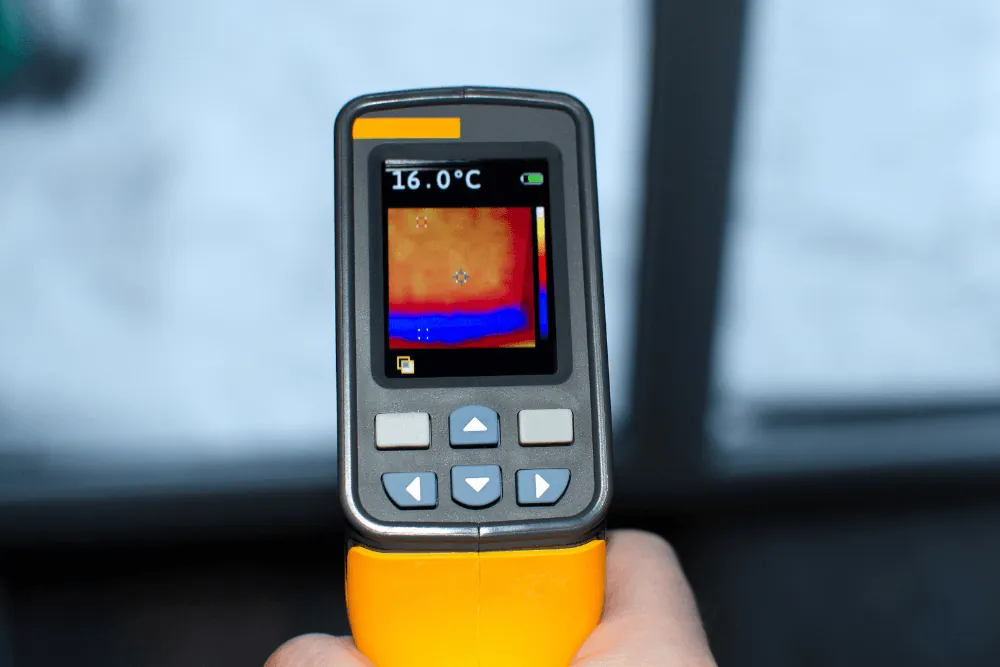
Electrical Thermography in Dubai: Thermal Imaging Inspection of Panels, Switchgear and Electrical Equipment
Electrical thermography is the use of an infrared camera to find overheating in live electrical equipment. A loose lug, a corroded busbar joint, an overloaded breaker or a failing fuse resists the current passing through it, and that resistance turns into heat long before anything trips, smokes or burns. A thermal imaging inspection shows the heat as a picture, so a technician can see which connection in a board is running hotter than its neighbours, measure by how much, and say how urgent the repair is. The equipment stays in service while it is scanned, and the report tells you what to fix, in what order.
Circuit Dubai carries out thermal imaging inspections across Dubai for villas, apartment buildings, offices, hotels, warehouses, factories and plant rooms. We scan distribution boards, main panels, switchgear, busbars, motors, transformers, UPS systems and generators, record each defect with a thermal and a normal photograph, and rank it by severity. You may know the service as electrical thermography, an infrared inspection, an IR scan or a thermographic survey.
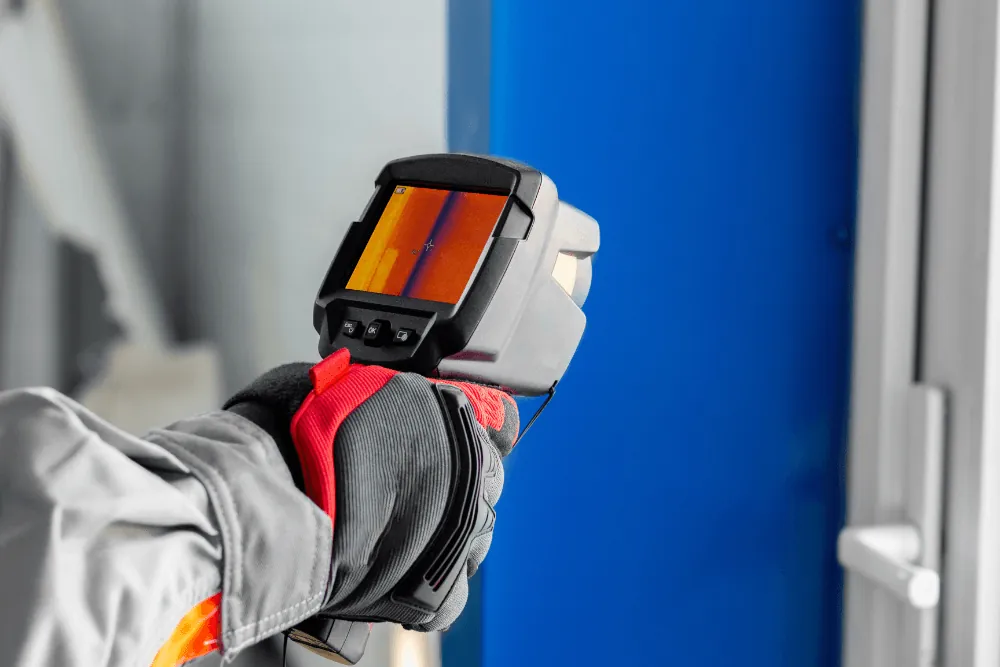
What a thermal imaging inspection with us includes
A scan of every board and item in scope, with the equipment running under its normal load, so faults that only heat up under current show themselves.
A thermal image and a normal photo of each defect, side by side, with the component marked, so anyone can find it again.
Measured temperatures, including the rise above similar components and above the surroundings, with the load current and the ambient temperature recorded.
A severity rating for each finding, so you know what needs attention now, what can wait for planned maintenance and what only needs watching.
Repair advice, and the repair if you want it, such as re-torquing, cleaning, replacing a breaker or correcting an overloaded circuit.
A re-scan after the repair, to show the fault is gone and leave you with a clean record.
The numbers at a glance
Typical answer for Dubai
Before you book a thermal imaging inspection, find out which boards and machines matter most and when they carry the most load. A scan at a quiet time can miss a fault that appears at peak demand, and in Dubai that usually means a hot day with every air conditioner running. The sections below explain how thermography works, what it can and cannot see, and how to read the report you receive.
Electrical thermography and its other names: what is being searched for
The service goes by many names, and they all describe the same inspection. This table matches what people search for to what it is.
| If you searched | What it is |
|---|---|
| Electrical thermography, thermography electrical, thermography in electrical, electrical infrared thermography | The use of infrared imaging to find heat faults in electrical equipment |
| Thermography test electrical, thermography test for electrical panels, thermographic testing of electrical equipment, thermography electrical equipment | The same inspection, described as a test of the equipment |
| Electrical thermal imaging, thermal imaging electrical testing, thermographic imaging electrical, electrical thermographic imaging | The same inspection, named after the picture the camera produces |
| Electrical thermography inspection, thermographic inspection of electrical installations, infrared inspection of electrical equipment, electrical infrared inspection | A formal inspection with a written report |
| Thermographic survey electrical systems, electrical thermographic survey, thermographic scan electrical, infrared scanning electrical equipment, IR scan electrical, IR testing electrical | A survey of a whole site, a set of boards or a plant, scanned in a planned order |
| Electrical panel thermography, electrical panel thermography inspection, electrical panel thermal imaging, thermography for electrical panels, thermal imaging for electrical panels | A scan of distribution boards and panels specifically |
| Thermographic equipment, thermal imaging camera for electrical inspections, best thermal imaging camera for electrical inspections | The camera and its accessories. See the equipment section below |
Thermography is the technique and the thermal imaging camera is the tool. A thermographer is the person who uses it and interprets the images. The words infrared and thermal are used for the same thing in this context.
How a thermal camera finds an electrical fault
Every conductor has some resistance, and current flowing through resistance produces heat. The heat produced rises with the square of the current, so doubling the current makes a bad connection about four times hotter. A sound joint has very low resistance and stays close to the temperature of the cable either side. A loose, dirty or corroded joint has more resistance, so it runs hotter than it should for the same current. A thermal camera picks up the infrared energy that surfaces give off and turns it into an image in which each colour stands for a temperature, so the hot joint stands out against its neighbours.
What causes a hot spot
| Cause | What happens | Where it shows up |
|---|---|---|
| Loose connection | Poor contact raises resistance at the joint | Breaker terminals, lugs, busbar joints, fuse holders, contactors |
| Corrosion or dirt | A film on the contact surface raises resistance | Outdoor and coastal equipment, humid plant rooms |
| Overload | The circuit carries more current than it is built for | Cables, breakers, small boards fed by large loads |
| Unbalanced load | One phase carries far more than the others | One phase of a three-phase board, one cable of a parallel set |
| Failing component | A breaker, fuse or contactor wears out internally | The device body or one pole |
| Harmonics and poor power quality | Extra current heats neutrals, transformers and capacitors | Neutral bars, transformer windings, capacitor banks |
| Friction or misalignment | A bearing, belt or coupling works harder than it should | Motors, pumps, fans |
| Cooling failure | Blocked vents, failed fans or dust trap heat | Panels, drives, UPS, transformers |
What a thermal camera cannot see
The camera shows surface temperature. It does not see through a closed panel door, a metal cover or glass, so the equipment has to be open or fitted with an infrared window before it can be scanned. It measures the outside of a component, and a joint buried inside a block of insulation may be hotter than the surface suggests. Shiny metal reflects heat from its surroundings, so a bright copper bar can read cooler than it is, or can show a warm reflection that is not a fault. The thermographer corrects for this by setting the right emissivity and by checking suspicious readings from another angle. A thermal scan also says nothing about insulation breakdown that has not yet produced heat, which is what insulation and earth resistance testing measures. The two checks cover different faults.
Thermography, inspection and testing together
| Check | When it is done | What it finds |
|---|---|---|
| Thermal imaging inspection | Live, under load | Heat from loose joints, overloads and failing parts |
| Electrical inspection and testing | Usually de-energised, circuit by circuit | Wiring condition, protection, earthing, and test readings against limits |
| Insulation and earth resistance testing | De-energised | Insulation breakdown and the quality of the earth path |
| PAT testing | De-energised, item by item | The safety of plug-in appliances |
A thermal scan is a good complement to the other checks, and see our electrical inspection and certificate service, which can include it. It is not a substitute for them, and a clean thermal report does not mean the wiring has been tested.
What we scan: electrical panels, switchgear and equipment
The usual target is the electrical panel, because that is where current is concentrated and where connections are made and remade. Panel thermography covers main distribution boards, sub-boards, final distribution boards in apartments and villas, motor control centres and switchgear. A thermographic inspection of electrical installations extends to the equipment those panels feed.
Electrical panel thermography
An electrical panel thermography inspection looks at each incoming and outgoing breaker, every terminal, the busbars, the neutral and earth bars, the contactors, the fuse holders and the cable ends. The thermographer opens the cover, or views the panel through an infrared window if one is installed, and scans each section from a set distance. Any component that is hotter than its neighbours carrying a similar load is recorded. A small villa board has a dozen or so breakers, and a main panel in a building has many more terminals than that.
A hot terminal on one phase while the other two are cool is the classic result, and it usually means a loose lug. A breaker that runs hotter than the same type of breaker beside it on a similar load is another. A neutral bar that runs hot in a building full of electronics points to harmonic current. Each of these is only visible with load on the circuit.
Equipment we scan
| Equipment | What we look for |
|---|---|
| Main and sub distribution boards, switchgear | Hot terminals and busbar joints, hot breakers, uneven phases |
| Final distribution boards in villas and apartments | Loose breaker terminals, overloaded circuits, neutral overheating |
| Motor control centres, starters and drives | Hot contactors, overload relays and terminations, blocked cooling |
| Motors, pumps and fans | Hot bearings, windings and couplings |
| Transformers, dry type | Hot windings and terminals, uneven temperature across the coils |
| UPS, inverters and battery banks | Hot connections, hot cells or strings, failed cooling fans |
| Generators and automatic transfer switches | Hot alternator terminals, contactor contacts and cable ends |
| Capacitor banks and power factor correction | Hot capacitors and contactors, failed units |
| Cable terminations and joints | Hot lugs and cable ends |
| Solar DC combiners, strings and inverters | Hot connectors, hot modules, inverter terminals |
| Isolators on rooftops and in plant rooms | Hot contacts and terminals under load |
If your main concern is one of these systems, see our UPS and inverter installation service for backup power, our commercial solar service for PV arrays, and our generator installation and servicing page for standby sets. The thermal scan is a regular part of maintaining all three.
Infrared inspection of electrical equipment outdoors
Outdoor equipment such as rooftop isolators, external boards, pole-mounted gear and PV arrays needs extra care. Sun on a metal enclosure heats the surface and can mask or imitate a fault, and wind cools a hot joint. We scan outdoor items early in the morning, late in the day or under cloud, when the sun's effect is small, and we note the weather in the report.
What decides a good thermographic scan: load, ambient, emissivity and access
A thermal image is easy to take and easy to misread. The same picture can show a serious fault or a harmless reflection, depending on the conditions when it was taken. These are the things we control.
Load on the equipment
A fault only heats up when current flows through it, and the heat rises with the square of the current. A joint that looks fine at 20 percent load can be dangerously hot at 80 percent. For that reason, a scan is done with the equipment carrying as much of its normal load as possible. A figure of at least 40 percent of rated load is often quoted as a minimum, with higher being better. We measure the current on each circuit with a clamp meter at the time of the scan and put it in the report, so the severity can be judged against it and the same board can be scanned again under similar load.
In Dubai the best time for a scan is usually in the hot months, when air conditioning drives the load up. A building scanned on a cool, quiet weekend may show nothing because nothing is loaded. We agree the timing with you, and where the load is seasonal we say what we could not test.
Ambient temperature
Ambient temperature matters because a component at 80°C in a 45°C plant room has risen 35°C above its surroundings, while the same component in a 20°C room has risen 60°C. Readings are compared both with similar components on the same load and with the ambient temperature, and the ambient is recorded in the report. Hot plant rooms and roof spaces are normal here, and a reading that looks alarming in absolute terms may be normal for the place.
Emissivity and reflections
Emissivity is how well a surface gives off infrared radiation. Painted and insulated surfaces have high emissivity and read accurately. Bare, polished metal has low emissivity and reads too cool. The thermographer sets the camera for the surface being scanned and, where it matters, applies a patch of electrical tape or paint to give a reliable reading on a shiny part. Reflections from nearby hot equipment, lights or the sun are checked by changing the viewing angle.
Distance and focus
A camera measures the average temperature of everything in each pixel, and a small hot joint seen from far away can be averaged with the cool cable around it. That makes a real fault look milder than it is. We scan from close enough that the component fills enough pixels, use a lens suited to the distance and keep the image in focus, because an out-of-focus image under-reads.
Access and safety
Most boards must be opened to be scanned, and opening an energised panel is a hazard, so it is done by an authorised person who follows a safe work procedure, wears the right protective equipment and keeps within the board's arc flash limits. We cover this in the safety section below.
How we run an electrical thermographic survey, step by step
A thermographic survey is a planned job, not a walk round with a camera. The order below keeps it safe, keeps the readings meaningful and gives you a report you can act on.
1. Agree the scope and the timing
We start with a list of what is to be scanned: the main panel, the sub-boards, the motor control centre, the UPS, the generator, the rooftop isolators. For each item we ask what it feeds, when it carries its heaviest load and whether it can be opened while live. A walk-through or a set of photos is enough for a small site. For a building or plant we ask for the single-line diagram or the board schedule, so the survey follows the real layout and nothing is missed.
The timing is agreed at the same time. A board that feeds air conditioning should be scanned when the cooling is running. A workshop board should be scanned during a working shift. If a board cannot be loaded at the time of the visit, we say so in the report instead of reporting it clean.
2. Prepare the equipment and the site
Before opening any panel, we confirm who is authorised to open it, what protective equipment and procedure apply and what the board's arc flash labelling says, if it has any. Doors and covers are opened only by an authorised person. The area in front of the board is cleared and marked, and a second person stays outside the working zone. Where the building has a permit system or a facility manager, we work to it.
We also note the conditions that affect the readings: ambient temperature, any air movement, direct sun on outdoor equipment, and nearby heat sources that could reflect into the picture.
3. Scan under load
With covers open and the equipment running, the thermographer scans each board section by section, from a distance that keeps every terminal in sharp focus. The scan starts with a quick pass over the whole board, to see the overall pattern of heat, followed by a closer look at anything that stands out. Each phase of a three-phase device is compared with the other two, and each breaker is compared with its neighbours on a similar load.
A clamp meter records the current on each phase of the circuits scanned, so the thermal result can be read against the load at that moment. We also record the make and rating of any component that shows a fault.
4. Record the findings
For each defect we take a thermal image and a normal photograph of the same view, with the component named or numbered. We note the temperature of the hot point, the temperature of a comparable healthy component, the ambient temperature, the load current and the emissivity setting. This is what lets someone else repeat the scan later and compare like with like.
5. Report and rank
The report lists each finding with its images, its measurements, a severity rating and the action we recommend. We explain the severity bands in the next section. We give you the report in a form that you can pass to an insurer, a facility manager or a contractor.
6. Repair and re-scan
A defect found by a scan is often a quick repair. A loose lug is re-torqued to the maker's setting, a dirty or corroded joint is cleaned and remade, an overloaded circuit is rebalanced or reinforced, and a failing breaker or contactor is replaced. Where the repair needs a shutdown, we agree a time with you. After the repair, the same part is scanned again under load, and the before and after images go in the report. That closes the finding, and it shows the fix worked.
Reading the results: how hot is too hot
A thermal image shows a temperature, and the temperature on its own does not say whether a part is healthy. A breaker at 60°C may be perfectly normal on a heavily loaded circuit in a hot plant room, and a terminal at 45°C may be a problem if its neighbours are at 30°C. Thermographers judge by comparison.
The two comparisons
- Against similar components under similar load. The three phases of one breaker, or the same breaker on two equal circuits. This is the most useful comparison, because it cancels out the ambient temperature and most of the load effect. The difference is written ΔT, read as delta T.
- Against ambient. The temperature rise of the component above the air around it. This is useful when there is no similar component to compare with, such as a single isolator or a lone transformer.
Severity bands
Several industry schemes classify the temperature difference into bands. One widely used set, in the style of the NETA acceptance and maintenance specifications, looks like this.
| Band | Rise above a similar component under similar load | Rise above ambient | Usual meaning |
|---|---|---|---|
| Possible deficiency | 1 to 3°C | 1 to 10°C | Note it, and check it again at the next survey |
| Probable deficiency | 4 to 15°C | 11 to 20°C | Repair at the next planned opportunity |
| Monitor until repaired | Not used | 21 to 40°C | Repair soon, and keep watching it until it is done |
| Major discrepancy | Above 15°C | Above 40°C | Repair as soon as it is safe to do so |
Some plants use their own bands, or ones taken from an insurer or a maker. The report should say which scheme was used, so the severity rating means the same thing from one survey to the next.
What also counts
Temperature difference is not the only measure. We also consider:
- The absolute temperature against the insulation rating. Cable insulation and component bodies have maximum operating temperatures. A reading near or above those limits is a problem whatever the ΔT.
- The load at the time. A moderate ΔT at 30 percent load is likely to be a serious one at full load, because the heat rises with the square of the current.
- The type and importance of the part. A hot terminal on a critical feed, such as a data room or a lift, gets earlier attention than the same reading on a spare circuit.
- The pattern. One hot joint on one phase is a loose connection. All three phases hot together points to overload, and a hot neutral points to harmonics or an unbalanced load.
What a clean scan means
A scan with no findings means that, at the time of the scan and at the load present, no connection or component in scope was hotter than it should be. It does not mean the equipment cannot fail. It does not cover anything that was not scanned or not loaded, and it says nothing about insulation condition, protection settings or the quality of the earth path. We say this in the report.
Common findings and what fixes them
These are the faults a thermal scan finds in electrical equipment, and what we do about each.
| What the image shows | Likely cause | Usual fix |
|---|---|---|
| One terminal hot on one phase, the others cool | Loose lug or screw | Isolate, re-torque to the maker's value, check the conductor and lug for damage, re-scan |
| A hot terminal with discoloured insulation or a heat-marked lug | Long-running poor contact | Cut back and re-terminate the conductor, replace the lug or the terminal if it is pitted |
| One breaker hotter than identical breakers beside it | Worn contacts inside the breaker, or a loose connection | Check the connection first, replace the breaker if it is the device |
| All three phases hot on a cable or a breaker | Overload | Measure the load, redistribute it, or increase the size of the cable and protection |
| One phase hotter along its whole length | Phase imbalance | Rebalance single-phase loads across the three phases |
| Neutral bar hotter than the phases | Harmonic currents from electronic loads, or a loose neutral | Measure harmonics, check the neutral connection, review the neutral size |
| A fuse and its holder hot | Poor contact between the fuse and the clips | Clean or replace the holder, replace the fuse |
| A contactor with one hot pole | Pitted contacts or a loose power terminal | Replace the contactor or its contacts, re-torque the terminals |
| A busbar joint hot | Loose or oxidised bolted joint | Isolate, clean the faces, remake the joint to the correct torque, check for damage |
| A motor bearing hotter than the other end | Poor lubrication, wear or misalignment | Lubricate, check alignment, replace the bearing if it is worn |
| A transformer with a hot spot on one side | Loose connection or an uneven load | Check the connections and the load, review cooling |
| A hot, warm or cool band on a cable run | Overload, or a poor termination at one end | Measure the load, inspect both terminations |
After a repair we scan again. A joint that was cleaned and re-torqued should come back to the temperature of its neighbours, and if it does not, there is damage that the first repair did not reach.
Why re-torquing is not enough on its own
Tightening a hot connection may bring the temperature down at once and hide the real cause. Aluminium conductors creep, copper work-hardens and a lug that has overheated may have lost its spring or pitted its face. Where the lug, the conductor or the terminal shows heat damage, we replace the part instead of only tightening it.
Motors, transformers, UPS, generators and solar equipment
The same principle applies to every piece of electrical equipment, but each has its own pattern of heat and its own things to check.
Motors, pumps and drives
A scan of a motor looks at the terminal box, the casing, the bearing ends and the coupling, and at the starter or drive that feeds it. Hot terminals in the box point to a loose connection. A bearing end much hotter than the other points to lubrication or wear. An unusually warm casing may mean overload, a blocked cooling fan or a winding fault, and further tests will say which. For a drive, the scan checks the heatsink and the cooling fans, and the terminals at both sides.
Transformers
For dry-type transformers, the scan covers the winding surfaces, the terminals, the tap links and the cooling. A uniform warmth is normal under load. A hot spot on one coil, a hot terminal or a difference between phases is worth investigating. Oil-filled transformers are scanned from the outside, and the cooling fins, radiators and bushings show how the oil is circulating and whether a bushing connection is hot.
UPS systems, inverters and battery banks
A UPS carries a load that never stops, so a loose connection inside it can run hot for a long time before anyone notices. We scan the input and output terminals, the battery terminals, the bypass switch and the cooling fans. In a battery bank, a cell or a link that is hotter than the rest is a sign of a poor connection or a failing cell, and it is much easier to see on a scan than by looking at the string. See our UPS and inverter installation service for how these systems are installed and maintained, and our battery storage installation service for home and commercial batteries.
Generators and transfer switches
A generator is run only now and then, so its connections are tested rarely. The best scan is done while the set is running on load, or during a planned load test. We scan the alternator terminals, the circuit breaker, the cable ends and the transfer switch contacts. A generator that has not run under load for a long time can show a bad connection the moment it does. See our generator installation and servicing page for how the sets are serviced.
Capacitor banks and power factor correction
Capacitors and their contactors work hard and fail with heat. A scan shows a capacitor running hotter than its neighbours, a contactor with a hot pole and a bank where one stage is not working at all.
Solar PV and DC equipment
On a rooftop array, a thermal camera shows modules with a hot cell or a hot junction box, connectors that have a poor contact and a string that is carrying less current than it should. The same camera finds hot terminals in combiner boxes and inverters. Solar equipment is best scanned in strong, steady sunlight, with the array producing, so the conditions are the opposite of those for most outdoor electrical equipment. See our solar panel installation service and our commercial solar service for the systems we install, A PV array scan is scoped separately from a panel scan.
Cables, joints and terminations
A scan of cable ends, glands and joints shows poor crimps and loose lugs, and it shows cables running hot because of overload. Underground cables and cables inside walls cannot be scanned along their length, but their terminations at each end can, and a hot end often gives the first sign of trouble.
Safety: opening live equipment, arc flash and infrared windows
Scanning a live board is safe when it is done properly and dangerous when it is not. The camera itself is harmless, and the risk is in opening the equipment and standing in front of it.
What the risk is
An arc flash is an explosive release of energy when a fault passes through air. It can happen when a cover is removed, a tool slips or a loose part touches a conductor. It produces intense heat, light and pressure, and it injures the people standing in front of the board. The risk depends on the fault current available, the time the protection takes to clear it and the distance of the person from the equipment.
How we reduce it
- Only authorised people open live equipment, and they do it under a safe work procedure that the site agrees.
- Protective equipment suited to the board is worn, chosen against the arc flash label or an assessment where there is one.
- The thermographer scans from outside the working zone where the layout allows, using the camera's lens and distance and not leaning into the panel.
- Covers are opened and refitted by the authorised person, not by the thermographer reaching in, and a board is closed again before anyone else is allowed near.
- A second person watches the work, and the area around the board is kept clear.
- We do not touch or probe anything during a scan. The camera measures from a distance.
Infrared windows
An infrared window, sometimes called an IR window or viewing port, is a panel fitted into a switchgear door that is transparent to infrared. It lets the camera see inside a closed, energised board without opening it. A window can reduce the exposure to an arc flash and make regular scans quicker. It has to be suitable for the equipment and installed by a competent person, and the board maker's approval matters. Not every board has one, and the thermographer should say whether a window changes the readings, because a window cuts some of the infrared and the camera has to be set to allow for it.
Stop and keep clear of a panel that has a burning smell, a buzzing or crackling sound, discoloured or melted parts, or visible smoke or sparks. Do not open it or try to scan it. Isolate the supply if it is safe to do so, call the emergency number and contact us for an emergency electrician. A hot panel that is showing signs of damage is no longer a candidate for a survey, and it needs an immediate response.
Heat and humidity in Dubai
Plant rooms and roof spaces in Dubai are hot, and the crew in front of the board is working in heat while wearing protective clothing. We plan the work with breaks and drinking water, and we keep the time in protective clothing as short as the job allows.
Thermographic equipment: the thermal imaging camera for electrical inspections
People often ask which is the best thermal imaging camera for electrical inspections. There is no single best one, because the right camera depends on what is being scanned, from how far and by whom. What can be said is which specifications matter, and which ones are marketing. This section is for anyone choosing thermographic equipment, and for anyone judging a thermographer by the camera that turns up.
What to look for in a thermal imaging camera for electrical work
| Feature | Why it matters for electrical inspections | What to look for |
|---|---|---|
| Detector resolution | Decides how many pixels fall on a small terminal, and so how accurately a small hot spot is measured | Higher resolution helps for boards and switchgear scanned from a distance. Common detector sizes range from 160 by 120 up to 640 by 480 pixels |
| Thermal sensitivity (NETD) | The smallest temperature difference the camera can show. Matters for finding small ΔT | A lower figure is better. Compare the figures the makers publish |
| Accuracy | The error on a temperature reading | Read the maker's stated accuracy, and the conditions it applies to |
| Lens and field of view | Decides how close you have to stand and how much of a board you see at once | A standard lens for panels, and a telephoto lens for substations and rooftop isolators, where the thermographer cannot stand close |
| Focus | An out-of-focus image under-reads small hot spots | Manual or good autofocus, and a sharp view of small details |
| Temperature range | A camera that tops out too low cannot measure a very hot fault | Check it covers the temperatures in your plant |
| Radiometric images | Lets each pixel be measured and the emissivity changed afterwards in software | Fully radiometric files rather than pictures with a single spot reading |
| Emissivity and reflected temperature settings | Needed to correct readings on shiny or painted surfaces | Adjustable settings and a way to record them |
| Software and reporting | The images have to go into a report that people can use | Report tools, and the ability to compare images over time |
| Calibration | A camera that has drifted gives wrong temperatures | A calibration certificate with a date, and a regular recalibration |
| Build and safety | Used in plant rooms and near live equipment | Rugged build, and a lens and screen suited to bright and dusty places |
Makers and models
Several makers sell cameras for electrical and maintenance work, including FLIR, Fluke, Testo and Hikmicro, and others. Their ranges run from small phone attachments to high-resolution handheld units. We do not rank them here, and we quote no prices because those change. The model matters less than the specifications in the table above, and more than that, the person using it. A good camera in the wrong hands produces confusing images, and a basic camera in the hands of a trained thermographer who sets the emissivity, measures the load and compares like with like produces a report that is useful.
The best camera for a given job
| Job | A sensible choice |
|---|---|
| A villa main board and a few sub-boards, scanned from close up | A camera with moderate resolution, a standard lens and radiometric images |
| A building with many boards and risers | Higher resolution, so each terminal is measured accurately, and software for batch reports |
| Switchgear and substations, where you cannot stand close | High resolution, with a telephoto lens |
| Rooftop isolators and solar arrays | A camera with a wide temperature range, a good lens and the ability to cope with bright light |
| A site team that wants to check boards in between surveys | A simpler camera, and training in what the images mean and what they do not |
Thermal imaging, a multimeter and a clamp meter
A thermal camera does not replace the instruments an electrician carries. It finds the hot spot, and a clamp meter measures the current in it, a multimeter or a voltage tester tells you the supply is isolated before anyone touches it, and an insulation tester checks the conductor and its insulation afterwards. A scan without a current measurement is a picture, and a repair without a re-scan is a guess. If you are building a kit for in-house use, the camera should come with a clamp meter and training in what the images mean.
Thermography on a phone attachment
Low-cost phone thermal cameras can show that a cable or a breaker is warm. Their resolution is low, so a small terminal is averaged with its cooler surroundings and the temperature reads too low. For a record that an insurer or a facility manager will rely on, use a proper radiometric camera and a trained operator.
How often to scan, and who needs it
There is no UAE rule we can point to that sets a scan interval for electrical thermography, and we do not invent one. What follows is the usual practice.
| Situation | Typical approach |
|---|---|
| Commercial buildings, hotels, malls, data rooms, factories and plants | A scan once a year is a common starting point, with the heavy-load boards scanned at peak summer load. Insurers or standards sometimes ask for this. |
| Critical systems, such as UPS, main switchgear and generators | More often, according to how critical the system is and what the last scan showed |
| Equipment with a defect found | Re-scan after the repair, and again at the next interval |
| Handover of a new building or fit-out | A scan under load at handover, so loose connections from installation show up early |
| After an incident, a trip or a burning smell | A scan once the cause is isolated, to find any damage that remains |
| Before and after major load changes | A scan after adding a large load such as a chiller, an EV charger bank or a solar system |
| Villas and small premises | Not usually needed every year. Worth doing when breakers trip or run warm, when a large load is added, or when the board has not been checked for years |
Who benefits most
- Facility managers and building owners, who want to find loose connections before they cause an outage and to have a record for the insurer.
- Hotels, malls and hospitals, where an unplanned shutdown is costly and the supply is loaded around the clock.
- Factories and warehouses, with motors, drives, compressors and large boards that run for long hours.
- Data rooms and server rooms, where the UPS, the distribution and the cooling are scanned together.
- Villa and building owners with large loads, such as several air conditioners, an EV charger or a battery system on one board. See our EV charger installation service and our three-phase and load upgrade service if a board is near its limit.
- Landlords and buyers, who want a check on the main board before a purchase or a renewal.
A scan at handover
A building or fit-out that has just been wired can have loose terminations from the installation. A scan at handover, under load, finds them while they can still be put right under warranty, and it gives the new owner a baseline for later scans.
What a thermal imaging inspection costs in Dubai
We quote each thermal imaging inspection after we know what is being scanned. The site visit costs AED 50, and the quote follows it. These are the things that set the price.
| What affects the price | Why |
|---|---|
| The number of boards and items | Each board takes time to open, scan and record |
| The size and complexity of the equipment | A main switchboard with hundreds of terminals takes longer than a villa board |
| Access and permits | A building with a permit system, shutdown windows or restricted access adds time |
| Timing | Scans at night, at weekends or at peak load may cost more |
| The report | A full report with thermal and normal images for every item takes longer than a short summary |
| Travel | The location and the number of sites |
| Repair work | Re-torquing, replacing parts and re-scanning are separate from the survey |
| Equipment hire or special lenses | For substations and large plant |
Ways to keep the cost sensible
- Send a list or a photo of each board so the quote is accurate.
- Combine the scan with other checks, such as an electrical inspection or insulation and earth resistance testing, because the access, the permits and the shutdowns are shared.
- Scan the boards that matter most first, and the rest at the next visit.
- Fix findings in the same visit where the parts are on hand, so you do not pay for a second trip.
What a good report includes, and how to choose a thermographer
The report
A thermography report is only as useful as its detail. A good one has:
- The site, the date, the time, the weather and the ambient temperature
- The camera model, its serial number and its calibration date
- The load on each circuit at the time, with the method of measuring it
- For each finding: a thermal image and a normal photo of the same view, the component, the temperature, the reference temperature, the ΔT, the emissivity used and the severity
- The scheme used to rate severity, stated clearly
- A recommended action and a time frame for each finding
- A list of what was scanned and what was not, with the reason
- After repair, the re-scan images
- The thermographer's name, qualification and signature
Questions to ask a thermographer
- 1What qualification do you hold, and who issued it? Schemes in use include training and certification to levels such as Level I and Level II, and standards such as ISO 18436-7 for thermography personnel.
- 2Which camera will you use, and when was it last calibrated?
- 3How will you measure the load, and what minimum load will you scan at?
- 4Which severity scheme do you use, and can I see a sample report?
- 5Who opens the panels, and what is your procedure for working near live equipment?
- 6Do you re-scan after repair?
- 7What will you not be able to see, and how will the report say so?
Thermography near me
A search for thermal imaging near me or electrical thermography near me is really a search for a thermographer who can come to the site, work safely on live boards and write a useful report. We cover all of Dubai. Our office is at Office 1271, Oasis Mall, Al Quoz 1, Dubai, UAE, and we work across the city and the surrounding areas.
Thermal imaging inspection with Circuit Dubai
- A scan under load, not a cursory look at a cold board, with the current recorded on each circuit.
- A report with thermal and normal images for each defect, with the measurements and the severity scheme set out, so it holds up with an insurer or a facility manager.
- Repair and re-scan from the same team, so a hot joint is fixed and proved fixed.
- Safe working on live equipment, with authorised people, protective equipment and a plan agreed with the site.
- A plan around your business, with scans timed for peak load and with the least disruption.
We work across all of Dubai. Our office is in Al Quoz.
If you are also planning an electrical inspection, insulation and earth resistance testing, PAT testing or an energy audit, we can plan it with the scan.
Phone: +971 55 407 7427
Thermal imaging inspection questions we hear from Dubai property owners and managers
What is electrical thermography?
It is the use of an infrared camera to find heat in live electrical equipment. A hot joint, a hot breaker or an overloaded cable shows up as a bright area in the image before it fails.
What is the difference between thermography and thermal imaging?
Thermography is the technique and thermal imaging is the picture the camera produces. In electrical work, the two names are used for the same inspection.
Do you scan panels while they are live?
Yes. A fault only heats up when current flows, so the equipment has to be loaded. An authorised person opens the panel under a safe work procedure, or the board is viewed through an infrared window.
Can you see inside a closed panel?
No. The camera shows surface temperature and cannot see through a metal door or a cover. The panel has to be opened, or fitted with an infrared window that is suitable for the board.
How much load does the equipment need?
The more load, the more a fault shows. A minimum of around 40 percent of the rated load is often quoted. We record the current at the time of the scan.
What temperature is too hot?
There is no single figure. We compare similar components under the same load, and compare each with the ambient temperature, and then rate the difference. Bands often used are a few degrees for a possible issue, and over 15°C above a similar component for a major one.
Does Dubai's heat affect the results?
Yes. A high ambient temperature raises every reading, so we judge by the difference against similar parts and against ambient, and not by the absolute number. We also scan outdoor equipment away from strong sun.
What does an electrical thermography report include?
Thermal and normal images of each defect, measured temperatures, the load, the ambient temperature, the severity rating and the recommended action. A re-scan after repair is added.
How often should we scan?
For commercial and industrial sites, once a year is a common starting point, with more frequent scans for critical equipment. There is no Dubai rule we can name that sets the interval.
Do you scan villas?
Yes, though it is not usually needed every year. It is worth doing when breakers trip or run warm, when a large load is added or when the board has not been looked at for a long time.
How much does a thermal imaging inspection cost?
It depends on the number of boards, the size of the equipment, access and the report. A site visit costs AED 50, and the price follows it. Send a list or photos and we give a fixed quote.
Do you repair the faults you find?
Yes. We re-torque, clean and remake connections, replace breakers and contactors, and rebalance loads. We scan the part again afterwards. A shutdown is arranged with you where the repair needs one.
Is a thermal scan the same as an electrical inspection?
No. A scan finds heat in live equipment. An electrical inspection tests the wiring, protection and earthing, usually with the supply off. They complement each other.
Can thermography find insulation faults or a bad earth?
Not directly. A thermal scan finds faults that produce heat. Insulation breakdown and a poor earth path are measured with an insulation tester and an earth resistance tester.
What camera do you use?
We choose the camera for the job, and we record its details in the report.
Who is qualified to do a thermographic scan?
Look for a trained thermographer, with a recognised certification and experience of working near live electrical equipment. Our technicians are experienced electricians who work near live equipment, and the report names the one who did the scan.
What do I need to send for a quote?
The type and number of boards or equipment, the site and area, when the load is highest and what the report is for. Photos of the boards help.
Ready to book a thermal imaging inspection?
Send the site, a list of the boards and equipment, and what the report is for. We reply instantly on chat with a fixed price, the time the visit will take and anything we need from you, so you know the job before anyone arrives.