Fire Alarm and Smoke Detector Installation in Dubai: Hassantuk, Smoke and CO Alarms, Panels and Wiring
Fire alarm installation means choosing the right detectors for each room, placing them where smoke or heat will reach them, wiring them to a panel or to each other, and testing the system until the alarm sounds and the right people hear it. A detector on a ceiling is the small part. The system type, the cable, the power, the panel and the approvals decide whether it works in a fire, and whether Dubai Civil Defence accepts it.
Circuit Dubai installs smoke alarms, heat detectors, carbon monoxide alarms and fire alarm panels for villas, apartments, shops, offices, warehouses and building sites across Dubai. We are electricians first, so we start with the building, the supply and the cable route, and only then choose the detectors and the panel.
What fire alarm and smoke detector installation with us includes
A walk-through first, covering the rooms, the ceilings, the cooking and heating areas, the existing wiring and the place for a panel.
The right detector for each room, smoke, heat or carbon monoxide, chosen to avoid false alarms from kitchens, steam and incense.
Detectors placed and fixed to the maker's rules, on ceilings where the rules say so, clear of walls, beams and light fittings.
Wiring and power done to a standard, with fire-rated cable where the system needs it, supervised circuits and a battery that keeps the alarm working in a cut.
A panel set up and tested, with zones or addresses named so the alarm tells you where the fire is.
A handover, with the test record, the device list, the battery dates and the number to call if the system faults.
The numbers at a glance
Typical answer for Dubai
Before you book fire alarm installation, walk through the building with a phone and photograph every ceiling, the kitchen, the plant room, the stair and the electrical board. Count the floors and the bedrooms, and note any existing alarm, panel or sounder and whether it still works. Tell us if the building is a villa, a flat, a shop or a workplace, because the rules differ. That is enough for us to say what is realistic and to give a first price. The sections below explain the rules in Dubai, the detector types, where each one goes and how it is wired, so you can judge a quote before you accept it.
Fire alarm and smoke detector installation terms: what people search for and what each means
People search for this work by the service, by the device, by the wiring and by the place, and some of the wording comes from other countries. The first table matches the service searches to what they mean here. The later sections cover the detector, wiring and brand searches.
| If you searched | What it means |
|---|---|
| Fire alarm installation, fire alarm system installation, fire alarm installation services, fire alarm fitting, alarm fitting, alarm installation, installation alarm | Planning, fitting, wiring and testing a fire alarm. This page describes our service. A general alarm search can also mean an intruder alarm, which is a different system. See the intruder alarm row below |
| Smoke alarm installation, new smoke alarm installation, smoke alarm system installation, home smoke alarm installation, home smoke detector installation, install new smoke detector, installing new smoke detectors, smoke detector fitting | Putting new alarms into a home or business, or adding to what is there. The planning, siting and mains alarm sections cover it |
| Smoke and heat detector installation | A smoke detector for the rooms where smoke is the first sign and a heat detector for kitchens and garages. See the detector section |
| Smoke alarm connection, fire alarm smoke detector connection, fire smoke detector connection, fire smoke detector wiring | Joining a detector to its power supply, to the other alarms or to a panel. See the mains alarm and panel sections |
| Fire alarm installation near me, fire alarm system installation near me, smoke alarm installation near me, smoke detector installation near me | We are at Oasis Mall, Al Quoz 1, and visit across Dubai. See the cost and choosing section |
| Fire detection and alarm system installation | The full system: detectors, call points, sounders, a panel, cable and power. Detection finds the fire and the alarm tells people |
| Connection of fire alarm, connection of fire alarm system | Wiring the detectors and sounders to a panel, or connecting a panel to a monitoring service. See the wiring section |
| Fire alarm assembly | Putting the parts of a system together, or fitting a detector to its base. We follow the maker's assembly instructions for each product |
| Replacing a fire alarm | Taking out an old alarm or panel and fitting a new one. Check that the new detectors suit the old wiring. See the replacement section |
| Automated alarm system | An alarm that raises itself and signals others without a person pressing anything. A smoke detector on a panel that calls a monitoring centre is this. See the Hassantuk section |
| Home fire alarm installation, home fire alarm system installation, domestic fire alarm installation | A system for a villa, townhouse or apartment. In Dubai a villa system is tied to the Hassantuk rule |
| Commercial fire alarm installation, commercial fire alarm system installation, fire alarm installation commercial, industrial fire alarm installation | A system for a shop, office, warehouse or factory. Larger buildings need a panel, call points, sounders and Civil Defence approval of the design. See the rules section |
| Commercial fire alarm systems installation near me | A commercial fire alarm fitter who will visit. See the cost and choosing section |
| Fire alarm and sprinkler system contractor, fire alarm sprinkler system installation | One contractor for both systems, or a fire alarm panel that watches the sprinklers. See the commercial section |
| Intruder alarm installers, intruder alarm installers near me | Fitters of burglar alarms. That is a security system and not a fire system. See our access control and intercom service and our CCTV installation service for the security side |
| Fire alarm electrician, smoke alarm electricians | An electrician who fits fire alarms. We are electricians first |
Fire alarm rules in Dubai: Civil Defence, approved equipment and the standards behind them
Fire alarm rules in Dubai are set by Dubai Civil Defence and the UAE's fire safety authorities, and they change. We are electricians and not lawyers, so confirm what applies to your building with Dubai Civil Defence, the building's fire consultant or the Hassantuk service. The table gives the published points we work from, with the year of each report.
What the rules say
| Subject | What the source says |
|---|---|
| Emergency numbers | The UAE government's fire safety page lists 999 for police, 997 for Civil Defence, 998 for ambulance and 991 for the electricity authority |
| Villa and townhouse owners | Owners of residential houses must install fire detection devices and subscribe to the Civil Defence eSystem, under a cabinet resolution of September 2020. The government page says existing owners had three years to comply, and that licensing authorities must confirm the detectors and the subscription before a completion certificate |
| Apartment and commercial buildings | The Hassantuk service, launched in 2018, monitors fire and smoke alarms in commercial buildings and residential apartments. A 2024 news report says apartment complexes already have mandatory fire detection |
| Wireless alarms | A 2023 report says wireless detection and alarm systems in Dubai must be evaluated by the Emirates Safety Laboratory and then registered with Dubai Civil Defence |
| Fire-resistant cable | The same report says fire-resistant cables sampled from project sites are tested by the Emirates Safety Laboratory, and a failed cable must be re-tested and re-registered before it is sold to Dubai projects |
| Design standards | A 2007 Civil Defence circular, reported at the time, said designs must follow NFPA, British Standards, European Standards or equivalent Gulf standards, and that fire-related equipment must be approved by Dubai Civil Defence or no building certificate is issued |
The 2007 circular is old and the rules have been revised since, so it shows the principle and not the current text. The standards it names are the US National Fire Protection Association codes (NFPA), the British Standards (BS) and the European Standards (EN). We name them on this page when we give an example, and the building's fire consultant decides which edition applies.
Who may install
A battery alarm screwed to a ceiling is a different job from a panel with a Civil Defence connection. For anything connected to Civil Defence, or for a commercial design, the system must use approved equipment and an approved contractor. A report from January 2024 names three approved Hassantuk installers and says an installer must apply to Dubai Civil Defence and have its equipment tested by the Emirates Safety Laboratory to join the list. Ask any installer which approvals they hold and for the numbers.
Buildings, landlords and tenants
In a villa, the owner or landlord is responsible for the system under the Hassantuk rule. A tenant should not remove, cover or disable an alarm. A report from January 2024 says anyone who damages or disables the alarm, tenants included, faces a fine of Dh1,000 under a 2020 cabinet decision. In an apartment, the corridors, the lobby and the plant rooms belong to the building, and the building's fire system is managed by the management. A tenant should ask before touching any alarm in a shared area.
Hassantuk: the Civil Defence connected fire alarm for villas and townhouses
Hassantuk is the UAE's connected fire alarm service. A system in the building sends alerts over a secure network to a command room, where staff check the alarm and send a response team. For a villa or townhouse in Dubai, a Hassantuk system is the fire alarm the rule requires. The details below come from news reports and the government's fire safety page, and they date from 2024, so check the current terms with Civil Defence or the Hassantuk service before you buy.
| Question | What the sources say |
|---|---|
| Who needs it | Owners of villas and townhouses. The deadline for existing homes was 1 January 2024, and new homes need it before the completion certificate |
| What is in the system | A fire alarm panel, a wireless heat detector and up to nine smoke detectors, depending on the size of the property, as reported in Dubai in January 2024 |
| How it is fitted | Wireless detectors, so no new wiring. An installer's director was quoted as saying the fitting takes 10 to 15 minutes after an initial survey |
| What it connects to | A command room that verifies the alert and sends a response team, and gives firefighters the property's location |
| Cost, as reported | A one-off Dh1,800 to Dh2,200 in Dubai according to Dubai Civil Defence figures in the January 2024 report, and a Ministry of Interior plan from Dh233 a month for 24 months with Dh1,000 upfront. A separate report gives just over Dh237 a month for 24 months, or a one-time payment of Dh5,903, with the final quote depending on the size of the home |
| Contract | A report says the national subscription is payable to e& with a minimum 10-year commitment |
| Approved installers | The January 2024 report named Naffco, Firex and Ateis, and said installers apply to Dubai Civil Defence and have their equipment tested by the Emirates Safety Laboratory |
| Penalties | A warning first, then a Dh1,000 fine for not installing. A Dh200 fine if three verification calls from the command centre go unanswered |
| Help for low-income households | Government programmes pay for installation for some households, including villa owners in partnerships with the Community Development Authority |
| Hotline | The national report lists 800 222 20 |
The prices in this table are from news reports, they differ between reports, and the Dubai figure and the national figure are not the same. Ask the Hassantuk service for the current quote for your villa.
What an electrician adds to a Hassantuk system
A wireless Hassantuk panel needs mains power, a socket or a spur close to where the panel goes, and a signal that reaches the network. That is electrical work. We can check the circuit, fit the spur, add a surge device and make good the wall before the panel installer arrives. We do not tamper with a Hassantuk panel, and we tell owners not to cover or unplug one, because disabling it is an offence under the report quoted above.
Smoke alarms as well as Hassantuk
A Hassantuk system has a fixed number of detectors. A villa can have rooms or floors the panel does not cover, and a battery alarm or an interconnected mains alarm in each bedroom adds to it. The planning section says how to decide.
Planning a fire alarm system: which type, how many detectors and what the building needs
Planning decides whether the system works for the building. The same detector on the same ceiling can be a good choice in one building and a nuisance in another. We plan from the building type, the layout and what must happen when the alarm sounds.
The system types
| Type | How it works | Suits | Watch for |
|---|---|---|---|
| Standalone smoke alarm | A battery alarm that sounds on its own | A room or a flat where nothing else is needed | It warns only the people within hearing, and the battery must be replaced |
| Interconnected mains smoke alarms | Mains-powered alarms with a battery backup, linked so that all sound together | A villa or flat with rooms on more than one floor | A mains alarm needs a qualified installer, and the maker sets how many alarms may be linked |
| Conventional panel | Detectors on zone circuits to a panel, which shows the zone in alarm | A small shop, office or workshop | The panel shows the zone and not the detector, and more zones mean more cable |
| Addressable panel | Each detector has an address on a loop, and the panel shows which one operated | A larger building, a hotel, an office block or a building with more than a few floors | More programming and a higher equipment cost, with less cable in a large building |
| Wireless fire alarm | Detectors that talk to the panel by radio | A building where cable cannot be run, and Hassantuk villas | Needs batteries in each device and a signal test, and in Dubai the system must be evaluated and registered |
| Connected Hassantuk system | A wireless panel linked to the Civil Defence command room | Villas and townhouses | See the Hassantuk section |
A conventional system shows the zone and not the device, with each zone on its own radial circuit. An addressable system identifies the exact device on a loop and checks the devices continuously. Conventional panels suit small buildings where exact location is not critical, and addressable panels suit offices, hotels and larger sites. We follow that split, and the building's consultant has the last word on a large building.
What decides the type
Four things decide it: the size of the building, whether cable can be run, whether Civil Defence approval or a Hassantuk connection is needed, and who will maintain the system. A small shop with a handful of rooms suits a conventional panel. A multi-floor office suits an addressable panel with the devices named by floor and room, so that an alarm tells the security desk which room to check. A villa suits a Hassantuk panel and mains or battery alarms where the panel does not reach.
How many detectors?
The number depends on the layout and on the standard that applies. The placement section gives the spacing figures that NFPA 72 uses, and the maker's manual gives the figures for each product. In a home, the aim is a detector in each bedroom and in the hallway or landing outside the bedrooms, with a heat detector in the kitchen where a smoke detector would give false alarms. We count the rooms and give you a detector list you can cut or extend before you agree.
Smoke, heat and carbon monoxide detectors: what each type senses and where it fits
Each detector type senses something different. A smoke detector reacts to particles in the air, a heat detector reacts to temperature, and a carbon monoxide detector reacts to gas. Picking the wrong type is the main cause of both missed fires and false alarms, so this section comes before the siting and wiring.
Smoke detectors: photoelectric, ionisation and multi-sensor
A photoelectric smoke detector shines light inside a chamber and raises the alarm when smoke scatters it onto a sensor. It responds well to smouldering fires, such as a cable that is overheating or a sofa that is catching slowly. An ionisation detector uses a tiny radioactive source and responds faster to fast, flaming fires with very small particles. A multi-sensor detector combines optical smoke sensing with heat sensing, or with more than one smoke measurement, and the panel decides from both.
NFPA, the US fire code body, advises homes to have both photoelectric and ionisation sensing, or dual-sensor alarms. We fit photoelectric or multi-sensor detectors as the default in Dubai homes, because a photoelectric alarm is less prone to nuisance alarms from cooking, and we use ionisation only where a panel maker's range requires it. A photoelectric smoke detector connection to a panel is the same job as any other, but the detector must belong to the panel's compatible range.
| Detector | What it senses | Fits | Avoid |
|---|---|---|---|
| Photoelectric smoke | Visible smoke particles scattering light | Bedrooms, living rooms, corridors, offices | Kitchens, bathrooms, dusty plant rooms |
| Ionisation smoke | Very small particles from fast fires | A site where the panel maker supplies only this type | Kitchens and any room near cooking |
| Multi-sensor (smoke and heat) | Smoke and temperature together | Rooms where false alarms are a problem | A room with extreme heat or dust |
| Fixed temperature heat | A set temperature | Kitchens, garages, boiler rooms | Rooms where early warning of smoke is the aim |
| Rate-of-rise heat | A fast temperature climb | Kitchens, plant rooms with stable temperature | Rooms where temperature swings in normal use |
| Carbon monoxide | The gas from incomplete burning | Near gas appliances, in garages joined to the house | A room that has only electric appliances, unless the design asks for it |
Heat detectors
A heat detector does not sense smoke at all. It reacts when the air reaches a set temperature, or when the temperature climbs quickly. That makes it slower than a smoke detector, so it protects the property rather than warning early. It belongs in places where a smoke detector would give false alarms every day: a kitchen, a garage, a boiler room, a laundry.
The temperature rating matters more in Dubai than in a cooler country. A roof void or an unconditioned garage can run hot in summer, and a heat detector set too low would trip without any fire. The maker's datasheet lists the rating, and we choose one that sits above the highest temperature the room reaches in normal use. A ceiling mounted heat detector is fitted the same way as a smoke detector, on a base, on the ceiling, clear of the wall.
Electric, battery and sealed-battery alarms
When people search for a smoke detector electric or an electric carbon monoxide detector, they mean a mains-powered one. The choices are:
| Power | How it works | Good for | Watch for |
|---|---|---|---|
| Battery alarm | Replaceable battery inside | Quick cover in a rented flat, a single room | A flat battery stops it, and a removed battery is never reported |
| Sealed battery alarm | A battery that is built in and lasts for the life of the alarm, as the maker states | A room with no mains point | The whole alarm is replaced when the battery ends |
| Mains alarm with backup | Powered from the mains, with a battery that takes over in a cut | Villas and flats where a fixed system is wanted | Needs an installer for the wiring and a dedicated circuit |
| Panel-powered detector | Powered from the panel loop | Commercial systems and Hassantuk | The panel, its power supply and its battery must be sound |
Where to put smoke detectors: ceiling, wall, bedroom, basement, sloped and suspended ceilings
Siting is where installations go wrong. A good detector in a bad position can miss a fire or sound every time someone makes toast. The spacing numbers below come from NFPA 72 (the US code) and from the UK's BS 5839-6 for homes. They are the published rules of those standards, shown here as examples of how placement works, and they are not the rule for Dubai. The building's fire consultant or Dubai Civil Defence sets the standard for your building.
| If you searched | Where to read about it |
|---|---|
| Ceiling smoke alarms, smoke alarm on ceiling, ceiling mount smoke detector, smoke alarm mounting | The ceiling or wall subsection |
| Wall mount smoke alarm, smoke alarms on walls, mount smoke detector on wall, mounting smoke alarm on wall, mounting smoke detector on wall, smoke detector from wall | The same subsection, which gives the distances from walls |
| Smoke alarm in bedroom, bedroom smoke detector, bedroom smoke detectors, smoke alarm in room | The bedroom subsection |
| Smoke detector in basement | The basement subsection |
| Smoke detector on sloped ceiling | The sloped ceiling subsection |
| Smoke detector suspended ceiling, smoke detector drop ceiling | The suspended ceiling subsection |
| Smoke detector vertical installation | The ceiling or wall subsection: a detector is fitted only in the position its datasheet allows |
Smoke detector coverage area and spacing
A smoke detector covers a circle of ceiling, and the circle is smaller than people expect. NFPA 72 sets a listed spacing of 30 feet (9.1 metres) between smoke detectors on a smooth, flat ceiling, which puts every point on the ceiling within about 21 feet (6.4 metres) of a detector. BS 5839-6 for homes sets a maximum horizontal distance of 7.5 metres from any point in a room to a smoke detector. Both assume a flat ceiling with no obstacles, so a tall room, a beam, an L-shaped room or a partition changes the count. Each detector's datasheet also states its own coverage area, and the datasheet limit wins when it is stricter.
The practical answer for a villa is a detector in each bedroom, on each landing and in each hallway that leads from the bedrooms, and a heat detector in the kitchen. For a shop or office we count the floor area and the partitions and draw the detectors on a plan before we quote.
Smoke alarm on the ceiling or on the wall
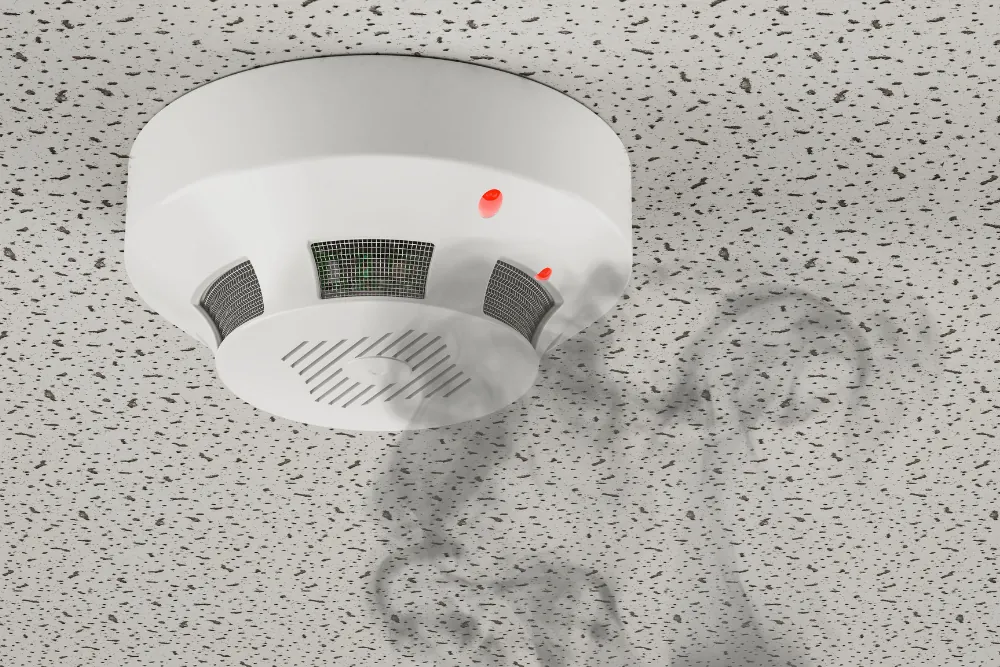
Smoke rises and spreads along the ceiling, so the ceiling is the first choice. A ceiling smoke alarm should sit flat on the ceiling, away from corners and from the edges of the ceiling, where a pocket of still air can form. NFPA advises a ceiling-mounted detector at least 4 inches (100 millimetres) from any wall, and BS 5839-6 advises at least 300 millimetres from walls and light fittings.
When a ceiling cannot take the detector, a wall mount is allowed by the standards, if the top of the detector is between 4 and 12 inches (100 to 300 millimetres) below the ceiling in NFPA 72. A wall mounted smoke detector placed lower than that can miss smoke that collects higher up. That is the rule to ask any installer about. Some detectors are made for the ceiling only, and fitting such a detector sideways on a wall, or turning it vertical in a shaft or on a column, changes how smoke reaches the sensor. We only mount a detector in the positions its datasheet allows. A surface mounted smoke detector sits on the ceiling with its base screwed on, and wiring runs in conduit above it or in a flush box. On a concrete soffit, we run surface conduit and mount the detector on a surface base.
Smoke alarm in a bedroom and other rooms
A smoke alarm in a bedroom matters most, because a sleeping person does not smell smoke. NFPA advises a smoke alarm inside each bedroom, outside each sleeping area and on each level. BS 5839-6 grades home coverage from escape routes only up to every room, and puts a heat detector in the kitchen. We follow the stricter reading for a home: every bedroom, every landing, the main living room and the hallway.
A smoke alarm in a room is wasted if it is blocked, so we do not mount one directly over a bed fan, an air outlet or a window opening where air moves fast and pushes smoke away. We also avoid the area right next to a shower door and a cooker. The alarm should hear the room, and the room should hear the alarm. In a villa with more than one floor, interconnected alarms (see the next section) are what let a fire in the kitchen wake someone in a bedroom upstairs.
Smoke detector in a basement
A smoke detector in a basement or lower level goes at the bottom of the stairs, and a second detector goes at the top of the stairs. A basement is where electrical panels, laundries and storage can sit, and a fire there can build before anyone upstairs notices. A basement smoke detector, like any other, must stay clear of damp, steam and the dust of a plant room. Where a basement has a laundry or a boiler, a heat detector may be the better choice.
Smoke detector on a sloped ceiling
A sloped or pitched ceiling has a high point where smoke collects. NFPA 72 puts the first detector within 3 feet (0.9 metres) of the peak, measured horizontally, and then spaces further detectors by the maker's rules. A smoke detector on a sloped ceiling that is not at the peak can miss smoke that is trapped above it. The same logic applies to double-height spaces, such as a villa's entrance hall, where we place a detector at the top, not on the wall at the middle height.
Smoke detector in a suspended ceiling or drop ceiling
A Dubai villa or office can have a suspended ceiling, or a gypsum false ceiling, below the structural slab. A smoke detector on a suspended or drop ceiling is fitted to the tile or board, with the base fixed so that the tile cannot sag and with the cable laid above on a support. A detector installed in the void above a suspended ceiling is a design decision, not an installer's guess, because the void can hold cables and can be a hot or dusty place, and the building's fire consultant decides whether detection is needed there.
Siting mistakes we correct
- Placing a detector in a kitchen, a bathroom or next to a shower, where steam and cooking fumes trigger it.
- Mounting a detector near an air-conditioning outlet or a fan, where moving air pushes smoke away.
- Mounting a detector in the corner where the wall meets the ceiling, which is the place where smoke is slowest to arrive.
- Painting over a detector or leaving the builder's dust cap on.
- Fixing a detector to a loose board that moves with the air.
Mains smoke alarms: wiring, interconnection and replacing old alarms
A mains smoke alarm, also called a hard wired smoke alarm or hard wired smoke detector, is powered from the building's electrics, with a battery that takes over when the supply is cut. In a villa or flat that wants a fixed system without a panel, interconnected mains alarms are the standard answer. They need an electrician, because the work is on a live supply and the cable must go back to a source that is not switched off by accident.
| If you searched | Where to read about it |
|---|---|
| Hard wiring smoke alarms, hard wiring smoke detectors, smoke alarm wiring, wiring a smoke detector, smoke alarm wiring circuit, wiring a smoke detector circuit, smoke detector wiring connection | How a mains alarm is wired |
| Adding smoke detectors to existing circuit | The subsection on adding to an existing circuit |
| Replacing a hard wired smoke detector, replacing a wired smoke detector, replacing mains smoke alarm, replacing old smoke detectors | The subsection on replacing alarms |
How a mains alarm is wired
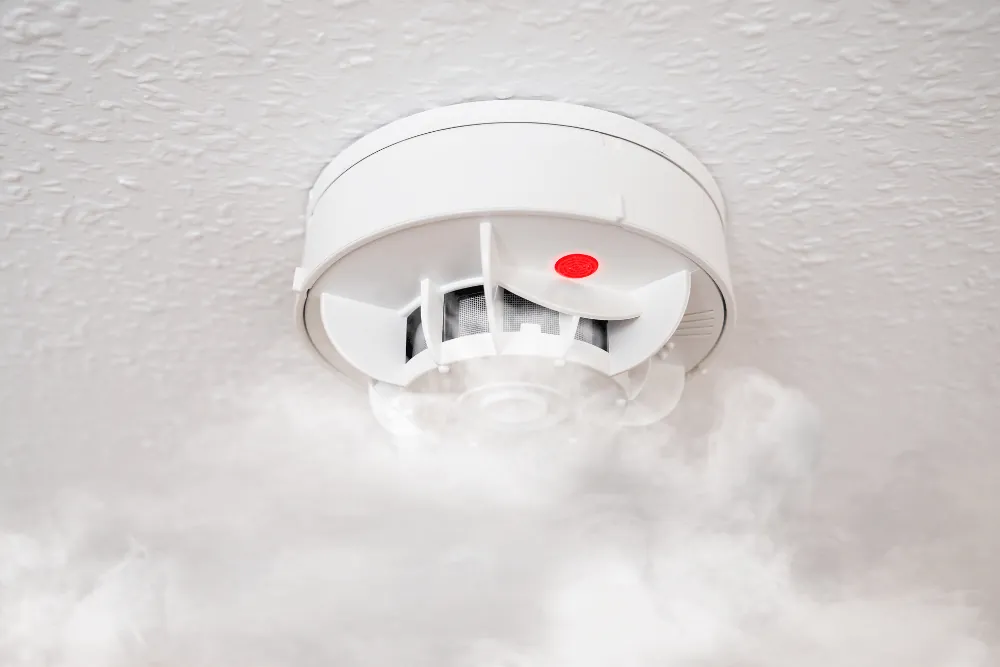
A mains alarm base has three terminals: live, neutral and an interconnect terminal, with an earth for the cable. The interconnect wire is the extra core that carries a signal from the alarm that has detected smoke to every other alarm in the group, so they all sound. Wiring a smoke detector in this way means a three-core and earth cable, run from the first alarm to the next, with the live and neutral taken from a protected supply. Some makers allow the interconnect over radio instead of cable, which suits a building where the ceiling cannot be opened.
The circuit rules matter more than the wiring. A mains alarm should be on a supply that nobody can switch off by turning off a light or a socket, and the maker's instructions say how many alarms can be linked on one circuit. UK practice puts the alarms on a lighting circuit or on a dedicated circuit, protected, and on a supply that does not feed equipment that trips the breaker. We choose the source after we look at the board. Every wiring search comes down to the same three questions: where does the supply come from, how is the interconnect carried, and how is it protected.
| Question | What we decide |
|---|---|
| Where does the supply come from? | A protected circuit that is not switched by a light switch |
| How do the alarms link? | A three-core cable with an interconnect core, or a radio link where the maker allows it |
| How many alarms on one circuit? | The maker's limit for that model |
| What happens in a power cut? | The backup battery keeps the alarm working, and a low-battery chirp tells you to change it |
| Can different brands link? | Only if the maker says so. Alarms of different brands do not interconnect |
Stop and keep clear of the supply to a mains alarm or a fire alarm panel until the circuit is isolated at the board and proved dead with a tester. A battery can keep an alarm live after the mains is off, and the mains terminals of a panel stay live while the panel looks idle. Message us on WhatsApp or another electrician, and do not work on it yourself.
Adding smoke detectors to an existing circuit
Adding smoke detectors to an existing circuit is possible only if the circuit can carry them. On a mains alarm group, it means checking the maker's maximum number of linked alarms, the cable's interconnect core and whether the existing alarms are of the same range. On a conventional panel, it means checking how many detectors the zone supports and that the end-of-line device sits after the new detector. On an addressable panel, the new detector needs its own address on the loop and a programming change at the panel. Send us a photo of the existing alarm and its model number, and we can tell you whether it can be extended or replaced.
Replacing hard wired smoke alarms and old smoke detectors
Swapping a hard wired alarm for a new one is a job that looks simple and is not. The new alarm must match the old base or the whole base must be changed, the cable must be sound, and the alarms in the group must still be able to link. A mix of old and new brands may sound alone. A detector that has passed its rated life, which the maker prints on the unit, should be replaced even if it still seems to work. We check the cable, fit the new base, test every alarm in the group and record the dates. Replacing smoke detectors and replacing smoke alarms follow the same steps:
- 1Isolate the circuit and prove it dead.
- 2Take down the old alarm and read its model and manufacture date.
- 3Check the cable and its connections, and replace any that are brittle or burnt.
- 4Fit the new base and head, wire the interconnect and fit the backup battery.
- 5Restore the supply and test each alarm and the link.
- 6Write the installation date on each alarm and in the handover list.
Replacing a fire alarm panel or a whole system is a larger job, and the new devices must suit the existing wiring. An older panel may use detectors that are no longer made, so we check the part numbers before we quote.
Red lights, chirps and other signs on a detector
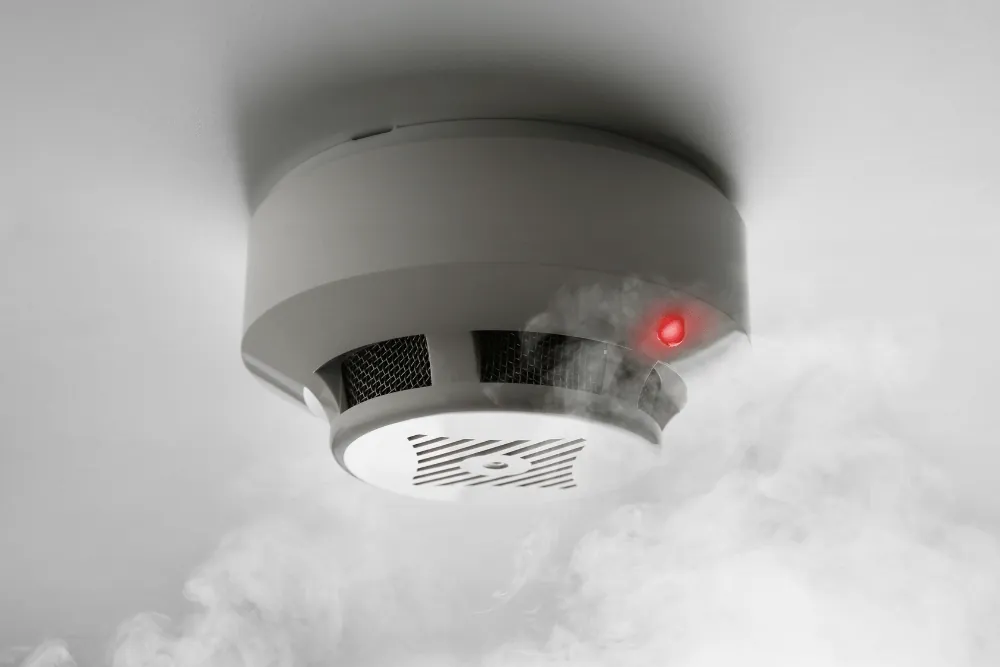
Searching for smoke detector red light meanings? The red light on a detector is its indicator. What a slow flash, a fast flash or a steady light means depends on the model, so check the manual. A short chirp every minute or so on a mains alarm points to a low or missing backup battery, and the manual for the model gives the exact meaning. We cannot place the search "reds smoke alarms". If it is the name of a brand or a model, send us a photo of the alarm and its label, and we will tell you whether we can fit or replace it.
Carbon monoxide alarms: where to place them, how to install them and when to replace them
Carbon monoxide is a gas with no smell, colour or taste, made when fuel burns without enough air. A smoke alarm does not sense it, and a CO alarm does not sense smoke, so a home with gas appliances, a generator or a garage joined to the house needs its own CO alarms. People search for this work as carbon monoxide alarm installation, carbon monoxide detector installation, CO alarm installation and CO detector install, and the job is the same in each case.
| If you searched | Where to read about it |
|---|---|
| Placing carbon monoxide detector, ceiling mounted carbon monoxide detector, ceiling mounted co detector | The placement subsection |
| Carbon monoxide detector wiring, electric carbon monoxide detector | The electric CO detector subsection |
| Replacing carbon monoxide alarm, replacing carbon monoxide detector | The replacement subsection |
| Duct mounted carbon monoxide detector, duct mounted co detector | The duct mounted subsection |
Where carbon monoxide comes from in a Dubai home
The sources are gas cookers and hobs, gas water heaters, gas boilers and heaters, generators, charcoal grills used indoors or on a covered terrace, and cars left running in a garage that shares a wall or a door with the house. An electric oven, an electric kettle or an air-conditioner does not make CO. If the house has no fuel-burning appliance and no attached garage, a CO alarm is not needed for those reasons, and we say so in the quote.
Placing a carbon monoxide detector
The maker's instructions decide the position, and they differ between models. As an example, UK guidance for homes puts a CO alarm in the same room as the appliance, between 1 and 3 metres from it measured sideways, and in a bedroom near the bed, at about the height of a sleeping person's head. NFPA advises CO alarms outside each sleeping area and on each level of the home. Carbon monoxide mixes with the air in a room, so a ceiling mount carbon monoxide detector, a ceiling mounted carbon monoxide alarm and a wall mount carbon monoxide detector can all be correct, depending on the model. If the maker allows a ceiling mounted CO detector, we mount it at least as far from the wall as the instructions say. If it is a wall model, we fit it high on the wall, above the level of doors and windows, and away from corners.
We do not fit a CO alarm directly above a cooker or a water heater, where a burst of normal combustion gas can set it off for no reason, or inside a cupboard, where the gas cannot reach it.
Electric CO detectors and wiring
A mains-powered or electric carbon monoxide detector is wired much like a mains smoke alarm: a protected supply, a battery backup and, for linked models, an interconnect. Carbon monoxide detector wiring follows the instructions for the model, because the same terminals do not always mean the same thing. A battery CO alarm needs no wiring at all. A combined smoke and CO alarm exists for rooms where only one unit fits, though one sensor can fail before the other, so we confirm the maker's life for both.
Replacing a carbon monoxide alarm
A CO sensor wears out. Alarms carry a date or a "replace by" mark, so replacing a carbon monoxide alarm or a carbon monoxide detector is routine. We replace the whole unit, check that the position still suits the appliances, test it with the test button and write the replacement date on the unit. An end-of-life warning beep is a reason to replace the alarm, and not a reason to remove its battery.
Duct mounted carbon monoxide detectors
A duct mounted CO detector senses gas in the air moving through a duct. It belongs to the ventilation design of a car park or a plant area, where it can start the extract fans. It is not a substitute for room alarms in a home. If a design calls for one, we install it to the maker's instructions and connect its output to the ventilation controls or the panel, with the airflow and the access for testing checked first.
Duct, beam and linear heat detectors, sounders, strobes and call points
Some buildings need more than a smoke detector on a ceiling. A warehouse has a roof too high for point detectors to react in time, a duct carries smoke to places no detector can see, and a conveyor or cable tray needs detection along its length. A fire alarm also needs the means to tell people, and a way for a person to raise it by hand.
Duct smoke detector installation
A duct smoke detector, also called a duct mounted smoke detector, sits on or beside an air duct, with a sampling tube across the duct that draws a sample of the air going past. It does not replace room detectors. Its job is to detect smoke in the air stream and stop the air handler, so the fan does not spread smoke around the building. A duct smoke detector installation, including duct smoke detector sampling tube installation, has a few rules that are specific to the device:
- Choose the tube for the duct. The sampling tube must reach across the width of the duct, and the maker sells different tube lengths for different duct widths.
- Face the holes into the airflow. The tube has holes on the upstream side, and a tube fitted the wrong way round samples nothing.
- Seal the duct entry. A leaking duct entry weakens the sample and the air handler's performance.
- Check the airflow speed. The detector is rated for a range of air speeds, and the duct must stay inside it.
- Leave room for access. The housing needs a clear space to open, clean and test, and a remote test and indicator can be added where the housing is out of reach.
Duct smoke detector wiring is a normal detector circuit to the panel plus a control output to the air handler's stop circuit. The stop circuit belongs to the air-conditioning system, so the connection is made with the AC contractor present. We also do the AC electrical connection, which is useful here.
Beam smoke detector installation
A beam detector projects a narrow beam of light across a space and sounds an alarm when smoke weakens it. One detector covers a long run of ceiling, so it suits a warehouse, an atrium, a sports hall or a showroom with a high roof. In a fire alarm beam detector installation, the details that decide success are:
- A stable mounting surface. A beam fixed to a wall that moves with temperature or wind drifts out of alignment.
- A clear line. A crane, a sign, a hanging light or a stack of goods in the beam path will cause a fault or a false alarm.
- Alignment. Each detector is aligned with a test procedure at commissioning, and checked again at service.
- Distance and height. The maker's datasheet gives the range of the model and the height below the ceiling at which it is mounted.
Linear heat detector installation
A linear heat detector is a heat-sensing cable that runs along the length of what it protects, such as a cable tray, a conveyor, a tunnel, a fuel line or a goods rack. It reacts to heat at any point along its length. Linear heat detector installation is a cable job as much as a detector job: the cable is clipped along the route, its ends are terminated in a module that connects to the panel, and the route is chosen to put it where heat will build up. We check the cable's temperature rating and its fixing method against the maker's instructions.
Sounders, strobes and call points
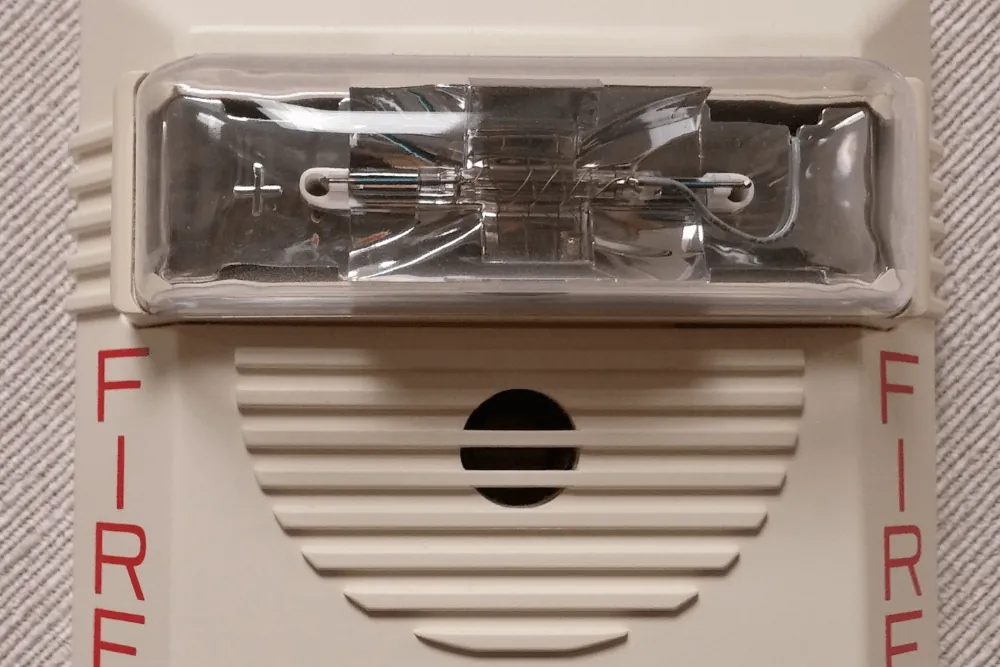
An alarm that nobody hears is not an alarm. A sounder, a bell or a horn provides the sound, and a strobe provides the flashing light for people who cannot hear it or are in a noisy room. Fire alarm sounder wiring is a separate circuit from the detector circuit, monitored by the panel so that a cut or a short shows as a fault. A ceiling mounted fire alarm strobe is fitted like a ceiling detector, but its light has to be seen, so the position and the light's rating are set by the design and not by the nearest free ceiling space.
A manual call point, also called a pull station or break glass unit, lets a person raise the alarm by hand. Fire alarm pull station installation follows a few simple rules: one near each exit, on the exit route and at a height that a person can reach, which standards set at roughly 1.1 to 1.4 metres depending on the standard, and visible from the way people leave. A call point on a conventional circuit carries a small resistor that tells the panel it has been pressed.
| Device | What it does | Fitting rule we follow |
|---|---|---|
| Sounder or bell | Makes the alarm sound | On its own monitored circuit, loud enough to wake a sleeper where the design needs that |
| Strobe | Flashes to warn people who cannot hear | Visible from the whole space it serves |
| Ceiling mounted fire alarm strobe | The same, on the ceiling | Rated for the area it covers |
| Manual call point | Raises the alarm by hand | At each exit, on the route out |
| Duct detector | Senses smoke in ductwork and stops the air handler | Sampling tube across the duct, wired to the air handler's stop circuit |
Fire alarm panels and wiring: conventional, addressable, wireless and smart systems
The panel is the brain of a system with detectors, sounders and call points. It supplies power, watches every circuit, shows what happened and where, and sends signals out. The work is connecting the devices to the panel correctly, and the table at the end of this section matches the wiring searches to the parts below.
Conventional fire alarm wiring
In a conventional system, detectors on a zone are wired in parallel on a pair of wires that runs from the panel to the first detector, on to the next and back along the zone. Conventional fire alarm wiring puts a resistor or an end-of-line device at the last detector, so the panel can tell the difference between a healthy circuit, a broken wire and a short. When a detector goes into alarm, the current on the zone changes, and the panel lights the zone. It does not say which detector operated.
Smoke detector wiring connection and fire alarm smoke detector wiring on a conventional zone follow the base of the detector: two terminals for the zone, a terminal for a remote indicator on some bases, and the polarity marked. Wiring a smoke detector in reverse stops it from working. Detectors and bases are made to work with specific panels. System Sensor is one maker of conventional detectors, and system sensor smoke detector wiring follows the datasheet of the model and the panel's compatibility list. A detector from another maker or series is not a substitute unless that list says so.
Addressable fire alarm system installation
An addressable fire alarm system installation connects the devices in a loop. The cable leaves the panel, passes through every device and comes back to the panel, so that a break in one place leaves every device still fed from the other end. Each device has an address, set by a switch or by programming, and the panel names the device that operated. Isolators on the loop confine a short circuit to one section of it.
An addressable system costs more in equipment and in programming, and it uses less cable in a big building. It is the choice when "where is the fire" has to be answered in seconds, in a building with more than one floor, a corridor of rooms or a hotel. The installer's task is to wire the loop to the maker's instructions, set the addresses, programme the panel with the device names and write the cause-and-effect plan, which says what each input should switch on. We record it in the handover.
Cable, containment and fixings
Fire alarm cable is not ordinary building wire. The circuits that must keep working in a fire, such as the sounder circuits and the loop, use fire-resistant cable, and the cable is fixed with clips and supports that will not melt and drop it. Screened cable is earthed at the panel end only, so the screen does not carry loops of current. Fire alarm cable is kept away from mains cables, or run in its own containment, to prevent interference and damage. The emirate tests fire-resistant cables sold to Dubai projects at the Emirates Safety Laboratory, according to a 2023 report, so ask for the product's registration. Our work on containment is part of our conduit, trunking and cable tray service.
Power supply, battery and the panel's place
A fire alarm panel needs a supply that nobody can switch off by accident: its own fused spur, marked as the fire alarm supply, with a standby battery that keeps the system alive during a cut. Standards set the standby time. The UK's BS 5839-1 asks for 24 hours of standby plus 30 minutes of alarm, and NFPA 72 asks for 24 hours plus 5 minutes, as published examples. Surge devices at the supply protect the panel's electronics, which is part of our surge protection work.
The main fire alarm panel goes where people responding to the alarm will find it: near the main entrance, at eye height, on a wall where it can be read and where nobody stores anything in front of it. In a villa that has a Hassantuk panel, the panel's place is set with the Hassantuk installer.
Zones, labels and the zone chart
The system is only as useful as its labels. We name each zone or address by floor and room, put a zone chart next to the panel and keep a copy in the handover pack, so a person who sees "Zone 4" or "First floor, bedroom 2" knows where to go. A system with unlabelled zones forces a search across the building during a fire, and we do not hand one over.
Wireless and smart fire alarms: Nest, Z-Wave and radio systems
Not every building can take new cable. A finished villa with solid ceilings, a listed or rented flat, or a building where the landlord refuses chasing can still have a working alarm, if the devices talk by radio. The choice is between a fire alarm system made of approved wireless devices, and a consumer smart alarm that is designed for the home and has no approval for the building's fire system.
Wireless fire alarm system installation
In a wireless fire alarm system, each detector, call point and sounder has its own battery and a radio link to the panel. Wireless fire alarm system installation has no loop cable to run, which saves the ceiling and the mess, but it has its own work: a radio survey to find where the signal is weak, a battery plan, and a check after fitting that every device reports to the panel. Thick concrete walls, metal ceilings and lift shafts can block the signal, and we place the devices and the panel accordingly.
In Dubai, wireless detection and alarm systems must be evaluated by the Emirates Safety Laboratory and registered with Dubai Civil Defence, according to a 2023 report. A wireless system we fit has to come from that registered list, and we ask the supplier for the registration first. The Hassantuk villa system is a wireless system of this kind.
Google Nest smoke alarm installation
A search for Nest smoke alarm installation, Nest smoke detector installation, Nest fire alarm installation or Google Nest smoke alarm wired installation is about the Nest Protect, a consumer smoke and CO alarm that sends alerts to a phone. It is made in battery and wired versions, and the wired version connects to the building's supply through a backplate. The version sold in one country is not always the version sold in another, and the mains in the UAE is 230 volts, so the first check is the model number: whether it is a wired model at all, and what voltage the box says. For wiring Nest smoke detector models, the instruction sheet for that model applies, which shows the backplate terminals, and we do not guess a wiring diagram from a different model.
Two limits apply. A Nest alarm is a consumer product and does not replace a Hassantuk system or a Civil Defence approved system, and it needs the home's Wi-Fi to send alerts to a phone. We install it as an extra in a bedroom or a landing, and we set up the app and the Wi-Fi with the owner. The home network side is part of our TV, data and network cabling work.
Z-Wave alarm system and smart home links
Z-Wave is a low-power radio standard used by smart home devices, and a Z-Wave alarm system is a set of Z-Wave sensors, including smoke and CO detectors, reporting to a hub that can send a phone alert or switch lights and a siren. It is a convenience layer for the home. It does not make the devices an approved fire alarm, and the siren and the phone alert depend on the hub's power and the home network. A smart home can read a smoke alarm's output and respond: unlock a door, turn on lights, shut down an air handler, if the alarm has a contact or a link to do that. For that side of the job, see our smart home installation page and our smart lock, doorbell and intercom page.
| Question | Wireless fire alarm | Consumer smart alarm |
|---|---|---|
| Built for | A building's fire system | A home, as an extra |
| Approval in Dubai | Evaluation by the Emirates Safety Laboratory and registration with Civil Defence, as reported in 2023 | Not a Civil Defence system |
| Power | Battery in each device, panel on mains with a battery | Battery or mains, depending on the model |
| Alerts | To the panel and, for Hassantuk, to the command room | To a phone through Wi-Fi and the maker's cloud |
| Good for | Villas, finished buildings, shops | A bedroom, a landing, a tenant's flat |
Terms for panels
| If you searched | What it means |
|---|---|
| Advanced fire alarm panel | A high-specification panel. Advanced is also the name of a UK maker of fire panels. If you mean that brand, tell us the model |
| Main fire alarm panel | The control panel of a building, or the main one where there are repeaters |
| Notifier fire alarm contractors | Notifier is a panel brand. We tell you whether we work on it. |
| Fire alarm assembly, smoke detector assembly | Fitting the head onto its base and the base onto the ceiling. The maker's instructions cover the twist-lock and any dust cap |
| Alarm panel wiring, fire alarm panel wiring, fire panel wiring, fire alarm wiring, alarm wiring, wiring fire alarm system | Connecting detectors, sounders and call points to a panel. The conventional and addressable subsections and the cable subsection cover it |
| Smoke detector installation set action | We cannot place this phrase. If you mean the action a panel or a smart system takes when a detector operates, that is the cause-and-effect programming described above |
Commercial, industrial and sprinkler-linked fire alarm installation: shops, offices, warehouses and sites
A commercial building does not choose its fire alarm. The fire consultant designs it, Dubai Civil Defence approves it, and the contractor installs it, tests it and gets it witnessed. Our part is the electrical and low-current work: the panel, the devices, the cable, the power and the commissioning.
What a commercial job involves
- The drawings. A fire consultant's design gives the device positions, the zones and the cause-and-effect plan. We build to it, and we tell the consultant if the building does not match the drawing.
- The panel and its repeaters. The main fire alarm panel sits where responders arrive, and repeater panels can show the status at a second point.
- Detection suited to each space. Point detectors in rooms, duct detectors in air handlers, beam detectors in high spaces, heat detectors in kitchens and plant rooms, and linear heat cable on trays.
- Alarm devices. Sounders and strobes in every area, and call points at every exit.
- Interfaces. The panel can stop air handlers, release door magnets, bring lifts to the ground floor and start pressurisation fans, if the design asks for it. Each interface needs the other contractor to agree the connection.
- Approval and handover. Tests witnessed by the authority, and drawings, device lists and test records handed over.
Fire alarm and sprinkler system installation
A fire alarm and sprinkler system contractor does two jobs that meet at the panel. The sprinkler contractor builds the pipework, the pumps and the tank. The fire alarm contractor monitors the sprinkler's switches so that the panel shows a flow, a closed valve or a pump fault. Sprinkler monitoring uses waterflow switches, which show that water is moving, and tamper or supervisory switches, which show that a valve has been closed. The same pattern applies here: each switch is wired to a panel input and labelled, so that the panel names the fault.
If you searched for an alarm gong installation, the gong is the bell that rings when sprinkler water flows. A water motor gong is mounted on the outside wall near the sprinkler riser and rung by the flowing water, and an electric bell can be wired to the flow switch for an indoor alarm. The water side belongs to the sprinkler contractor. We wire the electric side, and we connect the flow switch and the valve switches to the panel.
Industrial buildings and warehouses
A warehouse, a factory or a workshop differs from an office in three ways: height, dust and heat. A high roof can delay a point detector, the standard and the datasheet set the height limit for each type, and beam or aspirating detection may be the better design. Dust can foul an optical chamber, so heat detection or a sealed device may be chosen. A hot roof needs a high-rating heat detector. Industrial fire alarm installation therefore starts with a survey of the roof and the activity, not with a catalogue. Where machinery has its own suppression or shutdown, the panel is wired to receive its signals. For the cabling routes in such a building, see our conduit, trunking and cable tray work, and for the supply side, our motor and lift wiring and lightning protection.
Building sites and temporary alarms
A site under construction has its own fire risks: hot work, stored materials and temporary power. A temporary alarm for a site is set by the principal contractor's safety plan, and a wireless system suits it, since it can be moved as the building rises.
Fire alarm installation cost, smoke alarm prices and how to choose an installer
Fire alarm prices depend on the building, so a figure without a survey is a guess. The cost comes from five things, and the same five things are what you should compare between quotes.
| What changes the price | Why |
|---|---|
| Number and type of devices | Each detector, sounder and call point is a unit cost plus labour, and special detectors cost more |
| System type | A battery alarm costs less than interconnected mains alarms, which cost less than a conventional panel, which costs less than an addressable one |
| Cable route | Opening concrete or a high ceiling takes longer than an open ceiling, and fire-resistant cable costs more than ordinary cable |
| Ceiling and access | A suspended ceiling, a double-height space or a roof that needs scaffold adds time |
| Programming and approvals | An addressable panel is programmed, and a commercial system is tested and approved before use |
The site visit costs AED 50, and the quote follows it. The Hassantuk figures in the earlier section show the range reported for a villa, and they are separate from a quote for extra alarms.
If you searched for a price
| If you searched | What it means |
|---|---|
| Smoke alarms prices | The price of the alarms alone. A battery alarm and a mains alarm with a backup battery are different products at different prices |
| Smoke alarm fitting cost, smoke alarm installation cost, smoke alarm installers cost, smoke detector installation cost, cost to install a smoke detector | The labour and the parts for fitting. The number of alarms, the ceiling type and the wiring decide it |
| Fire alarm installation cost, fire alarm system installation cost, cost of fire alarm system and installation | The whole system: panel, devices, cable, power, programming and testing. A survey is needed first |
| Free smoke detectors, smoke alarms free, smoke detectors for free | Some places run free schemes. We sell and fit alarms, and we do not give them away. In 2024, news reports said that government programmes in the UAE pay for some households to install a Hassantuk system, so ask Civil Defence if that may apply to you |
| Fire brigade to fit smoke alarms, fire department smoke alarms, fire service smoke alarm fitting, smoke alarm fitted by fire service, smoke alarms fitted by fire brigade | In the UK, fire and rescue services can fit free alarms for some households after a home safety visit. That is a UK service. For a Dubai home, start with Dubai Civil Defence and the Hassantuk service |
Choosing an installer
People search for installers in different ways, and the table below matches the words to what to ask.
| If you searched | What it means |
|---|---|
| Alarm installation companies, alarm installation near me, approved alarm installers, smoke alarm companies, smoke alarm installation companies, smoke detector installation company, smoke detector installation companies near me, fire and smoke alarm installers, smoke alarm fitting near me | A company that fits alarms. Ask for its approvals |
| Fire alarm installation company, fire alarm installation company near me, fire alarm installation companies near me, fire alarm system installation companies, fire alarm system installation companies near me, fire alarm contractors, fire alarm contractors near me, fire alarm system contractors, fire alarm system companies near me, fire alarm experts, fire alarm fitters near me | A contractor for a panel system. Ask who designs, approves and tests it |
Whatever the words, put these questions to anyone who quotes:
| Question | A good answer |
|---|---|
| Which approvals do you hold, and what are the numbers? | Specific numbers you can check with the authority. A vague claim is not an answer |
| Is the equipment on the approved list? | The make and model of each device, and its registration where Dubai asks for it |
| Who designs the system? | A named person, with a drawing, for anything beyond a few alarms |
| What cable will you use? | Fire-resistant cable for the circuits that must survive a fire, with fixings that survive too |
| What do I receive at handover? | A device list, a zone chart, a test record and battery dates |
| Who services it afterwards? | A named contact and a service interval |
We are in Oasis Mall in Al Quoz and visit homes and businesses across Dubai. NICEIC is a UK scheme that registers electricians and issues certificates in the UK. We do not issue NICEIC certificates, because it is not a Dubai scheme, so a search for a NICEIC fire alarm certificate or a NICEIC smoke alarm certificate in Dubai is better answered by asking for the Dubai approvals above. We also keep intruder alarm installation separate, which is covered in our access control and CCTV pages. The search "ravel fire alarm system installation" is a name we cannot place. If it is a brand, send us the model and the site.
Testing, servicing and false alarms: keeping a fire alarm working
A fire alarm that has not been tested is a guess. We test every device before handover, and the system should be tested again on a schedule.
What we test at handover
- 1Every detector is tested with smoke or heat from a test device, and the panel must show the right zone or address.
- 2Every call point is operated, and the panel must show it.
- 3Every sounder and strobe is checked for the sound level and that it can be seen.
- 4Every circuit is tested for a fault by lifting a wire, and the panel must show a fault.
- 5The power is tested by switching off the mains and checking that the battery keeps the panel running, then restoring it.
- 6Any link to Hassantuk, a lift, an air handler or a sprinkler is checked with the other contractor.
- 7The record lists each device, its location, the result and the date.
Servicing smoke detectors
Smoke detector servicing covers the cleaning of the head, a sensitivity check where the panel allows it, a battery check, and replacement of a detector that has passed its rated life. A home alarm is tested with its own test button on the schedule the maker gives. A commercial panel has a log book, and the tests, faults and visits are recorded in it.
Why false alarms happen in Dubai
- Cooking and steam near a smoke detector. Move the detector or change it to heat.
- Bakhoor and incense smoke. Burning incense makes smoke, and a photoelectric alarm reads it as smoke. Keep it away from the alarm, or ventilate.
- Dust. A sandstorm, a building site next door or fit-out work in the flat can fill a detector. Detectors covered during building work must be uncovered afterwards, and the cover must be reported to the person who manages the system.
- Humidity and condensation in a bathroom or a cold room.
- Insects in the sensing chamber.
- A failing battery, which gives a chirp and, in an old alarm, a false alarm.
When the system shows a fault
A fault light is the panel saying that something is wrong with the system itself: a broken cable, a dead battery, a missing detector, a lost mains supply. Do not silence a fault and forget it. Write down what the panel shows and message us on WhatsApp. Do not open a panel or move a cable, because the system is then not protecting you. If there is a fire, leave, call 997 and do not wait to see if it goes out.
Fire alarm and smoke detector installation with Circuit Dubai
- Electricians first, so the supply, the cable and the protection are right before any detector goes on a ceiling.
- A walk-through before a quote, so the rooms, the ceilings and the system type are settled first.
- The right detector for each room, with heat detection in kitchens and photoelectric detection in bedrooms and hallways.
- Wiring to a standard, with fire-resistant cable where the system needs it, labelled zones and a battery that is tested.
- A fixed quote after photos or a visit, with what is included and what is extra written out.
We work across all of Dubai. Our office is in Al Quoz.
If you are also planning CCTV installation, access control and intercom, a UPS or an electrical inspection, we can plan it with the fire alarm and smoke detector installation.
Phone: +971 55 407 7427
Fire alarm and smoke detector installation questions we hear from Dubai homeowners and managers
How much does fire alarm installation cost?
It depends on the number of devices, the system type, the cable route and the ceilings. A site visit costs AED 50, and the price follows it. We give a fixed quote after photos or a visit.
Do I have to install a fire alarm in my Dubai villa?
Under a cabinet resolution of September 2020, villa and townhouse owners must install fire detection devices and subscribe to the Civil Defence eSystem, and a news report in 2024 gave 1 January 2024 as the deadline for existing homes. Check the current position with Dubai Civil Defence or the Hassantuk service.
What is Hassantuk?
It is the UAE's connected fire alarm service. A wireless panel and detectors in the building send an alert to a command room, which verifies it and sends a response team. See the Hassantuk section for what was reported on cost and installers.
What is the difference between a conventional and an addressable fire alarm?
A conventional panel shows which zone is in alarm. An addressable panel shows which device operated. Conventional suits a small building, and addressable suits a large one.
Where should I put a smoke alarm in a bedroom?
On the ceiling, flat and clear of the wall, with a smoke alarm in each bedroom and on each landing. NFPA 72 and BS 5839-6 give distances from walls of 100 and 300 millimetres, and the maker's sheet applies to the model.
Can I put a smoke detector on a wall?
Yes, if the maker allows it. NFPA 72 puts the top of a wall-mounted detector 100 to 300 millimetres below the ceiling. A ceiling-only detector must not be turned on its side.
Where do I put a smoke detector in a kitchen?
Not in the kitchen. Use a heat detector there, and put a smoke detector in the hallway or the room next to it.
Can I replace a hard wired smoke alarm myself?
The new alarm must match the base and the interconnect, and the work is on a live supply. We isolate and test the circuit, fit the new alarm and test the link. A like-for-like head swap on an existing base follows the maker's instructions for that model, and any change to the base or the wiring is a job for an electrician.
Do I need a carbon monoxide alarm?
If you have a gas appliance, a generator or a garage joined to the house, yes. A smoke alarm does not sense carbon monoxide. A house with only electric appliances and no attached garage does not need one for those reasons.
How long do smoke and CO alarms last?
The maker prints the life on the unit and on the box. Replace the whole alarm at that date. We write the date on each alarm at handover.
Can I add a detector to my existing circuit?
Only if the circuit can carry it. It depends on the maker's limit for linked alarms, or on the panel's zone or loop capacity. Send a photo and the model number.
Does a Nest or Z-Wave alarm replace Hassantuk?
No. A consumer smart alarm is an extra and is not a Civil Defence connected system. Check the Hassantuk rule for your home.
Can you fit a wireless fire alarm?
Yes, where the devices are on the approved list for Dubai. A radio survey comes first, because concrete and metal can block the signal.
Why does my alarm go off when I cook or burn bakhoor?
A smoke detector reads cooking fumes and incense as smoke. Move it, change it to a heat detector in the kitchen or ventilate the room.
What do I do when the alarm chirps?
A chirp is a warning of a low battery or an end-of-life alarm. Check the date on the alarm, replace the battery or the alarm as the maker says and do not remove the battery and leave it.
Do you issue a NICEIC certificate?
No. NICEIC is a UK scheme. We give a test record and a handover pack. Ask any installer for their Dubai approvals, and we will give you ours.
Can you install a fire alarm in a commercial building, a warehouse or a site?
Yes. We work to the fire consultant's design and the authority's approval, and we test and hand over. A commercial job starts with a survey and the drawings.
Ready to book fire alarm installation?
Send photos of each ceiling, the kitchen and the electrical board, tell us how many floors and bedrooms there are and whether it is a villa, a flat or a workplace, and say which alarms or panel you already have. We reply instantly on chat with a view on what will work and a fixed price, so you know what you are buying before anyone drills a hole.