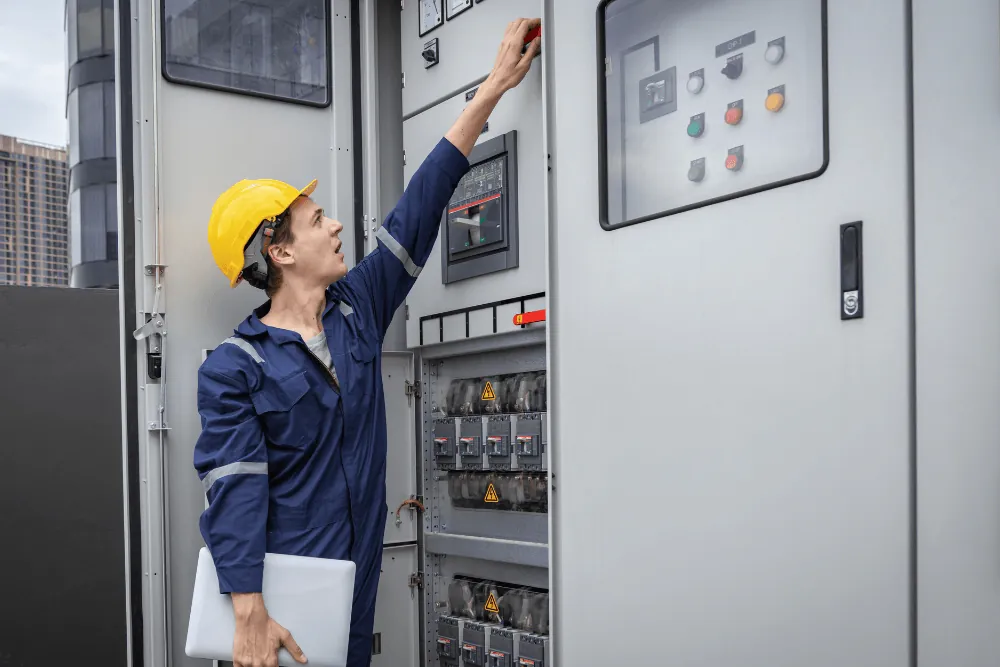
Transformer and Substation Maintenance in Dubai: Installation, Testing, Repair and Servicing of 11kV, Distribution and Dry Type Transformers
A transformer is the part of a building's electrical system that is easy to forget until it fails. It sits in a substation room or on a pad, it hums, and for years it needs nothing. Then a connection works loose, the oil takes up moisture, dust blocks the cooling or an insulation fault grows, and a whole building or plant loses power. Maintenance is the work that finds those faults while they are still small.
Circuit Dubai maintains, tests, installs and repairs transformers and the substation equipment around them for buildings, factories, warehouses and plants across Dubai: oil-filled distribution transformers, dry type and cast resin transformers, the low voltage panels and switchgear beside them, current transformers and phase converters. We are electricians who work to the maker's manual and the test results, and we say plainly which work is ours and which belongs to the supply authority, the transformer maker or a repair workshop.
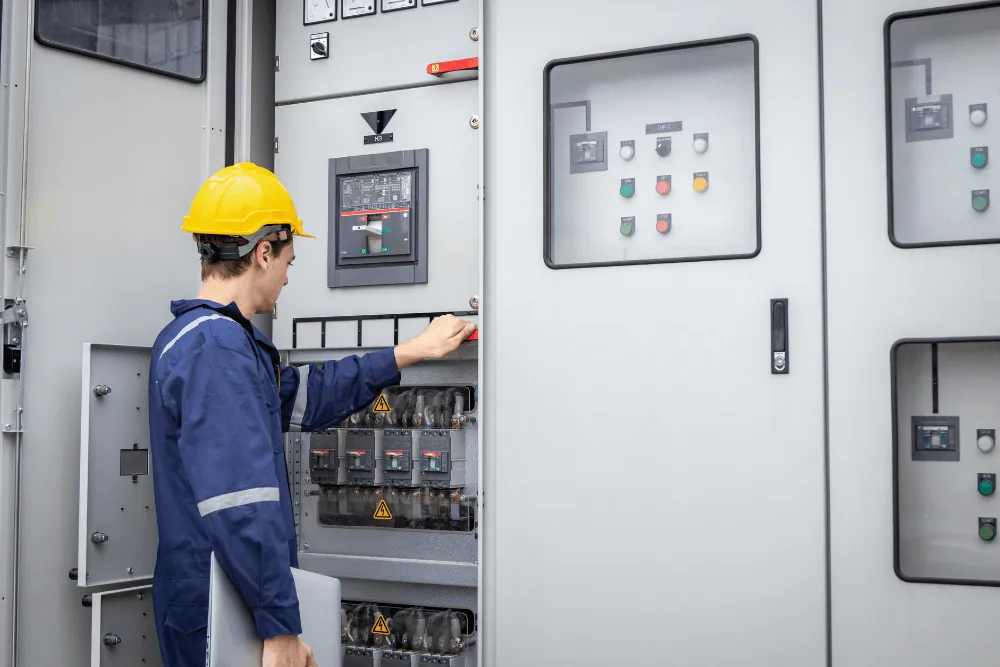
What transformer and substation work with us includes
The nameplate and history first, with the rating, voltage, type, age and last test results recorded before anyone starts.
Inspection and cleaning to a schedule, covering connections, bushings, oil level, breather, cooling and the room itself.
Tests that give a number, including insulation resistance, polarisation index, turns ratio and winding resistance, written down so the next test can be compared.
Oil and gas checks for oil-filled units, with samples sent to a laboratory and the results read as a trend.
Installation and hook up of new and replacement transformers, with the placement, earthing, cabling and pre-energisation checks recorded.
A clear boundary on repair and on the supply authority's equipment, so you know what we do, what a workshop does and what only the authority may touch.
The numbers at a glance
Typical answer for Dubai
Before you book transformer or substation work, photograph the nameplate of each transformer, the room or the pad it stands on, and the low voltage panel it feeds. Write down its rating in kVA, its voltage, whether it is oil-filled, dry type or cast resin, and its age. Note when it was last serviced or tested and whether there is a report. Say what has happened: a hum that has changed, a hot smell, an oil leak, a trip, a warning light or nothing at all. Tell us whether the building owner, a tenant or the supply authority owns it, and when the power can be switched off, because the work needs an outage. The sections below explain the work so you can judge any quote before you accept it.
Transformer and substation terms: what people search for and what each means
The searches for this subject range from a request for a service to a question from a physics lesson, a product name or a part of an electronic circuit. The tables below match each wording to the work or say that it is something else, so you land on the part of this page that fits.
Maintenance, testing and repair terms
| If you searched | What it means |
|---|---|
| Transformer maintenance, electrical transformer maintenance, transformer maintenance service, transformer servicing, transformer inspection | The routine work of inspecting, cleaning, tightening and testing a transformer. See the maintenance programme section |
| Transformer maintenance and service, transformer maintenance & service inc, transformer maintenance and service inc | The same work. The last two read like a company name, and we are not connected to any firm of that name |
| Transformer maintenance tests, transformer testing and maintenance | The measurements that show a transformer's condition. See the testing section |
| Ir test for transformer, ir test in transformer, ir test transformer | IR means insulation resistance, the test that measures the insulation between windings and to earth. See the testing section |
| Polarisation index of transformer, polarisation index test of transformer | A ten-minute insulation test that compares readings at one minute and ten minutes. See the testing section |
| Preventive maintenance of transformer, preventive maintenance for transformer, preventive maintenance of power transformer, periodic maintenance of transformer, types of transformer maintenance | Scheduled maintenance carried out before a fault. See the maintenance programme section |
| Predictive maintenance of transformer | Measuring a transformer regularly and acting on the trend. See the maintenance programme section |
| Operation and maintenance of transformer, power transformer operation and maintenance | Running a transformer and looking after it. See the maintenance programme section |
| Distribution transformer maintenance, power transformer maintenance, hv transformer maintenance, high voltage transformer maintenance, 11kv transformer maintenance | Maintenance by transformer type and voltage. See the maintenance programme and the oil sections |
| Dry type transformer maintenance, maintenance of dry type transformer, cast resin transformer maintenance | Maintenance of a transformer with no oil. See the dry type section |
| Maintenance of transformer oil, transformer silica gel maintenance, transformer oltc maintenance | The oil, the breather and the tap changer of an oil-filled transformer. See the oil section |
| Transformer repair, electrical transformer repair, power transformer repair, high voltage transformer repair | Repairing a faulty transformer. See the repair section |
| Transformer repair near me, transformer repair companies near me | A local firm that repairs transformers. Our office is in Al Quoz, and the repair section says which repairs go to a workshop |
Installation and mounting terms
| If you searched | What it means |
|---|---|
| Transformer installation, new transformer installation, electrical transformer installation | Setting and connecting a new transformer. See the installation section |
| Installation of power transformer, power transformer installation, distribution transformer installation | Installation by transformer type. See the installation section |
| 25 kva transformer installation, 75 kva transformer installation, 500 kva transformer installation | Installation of a transformer of that rating. See the installation section for what changes with size |
| Dry transformer installation, indoor transformer installation, outdoor transformer installation | Installation by location and type. See the installation section |
| Pad mounted transformer installation, pole mounted transformer installation, ring transformer installation | Installation by mounting. A ring transformer can mean a ring-core (toroidal) transformer or a transformer on a ring main unit, and we cannot tell which from the words alone. See the installation section |
| Transformer mounting, transformer placement, trapeze mounted transformer, transformer hook up | Where a transformer goes, how it is fixed and how it is connected. See the installation section |
| Eaton pole mounted transformers | Pole mounted transformers are a product line of a manufacturer, Eaton. We do not sell Eaton products. The installation section covers the mounting itself |
Construction, substation and current transformer terms
| If you searched | What it means |
|---|---|
| Work of transformer, working of a transformer, construction and working of transformer | How a transformer works and what it is made of. See the how a transformer works section |
| Construction of electrical substation, electric power substations engineering | What a substation is made of and how it is laid out. See the how a transformer works section |
| Electrical substation maintenance, substation maintenance, substations maintenance, operation and maintenance of substation, preventive maintenance of substation | Looking after the whole substation and not only the transformer. See the substation section |
| Substation maintenance companies | Firms that service substations. See the substation section for what to ask |
| Substation maintainer | A job title used in utilities. We do not list jobs |
| Current transformer maintenance, installing current transformers | A current transformer, or CT, is a measuring device and not a power transformer. See the substation section |
Converters, power supplies and other searches
| If you searched | What it means |
|---|---|
| 1ph to 3ph converter, converter 1 phase to 3, monophase to triphase converter, 3ph converter, phase 3 power converter, phase 3 to phase 1 converter | A phase converter that makes three-phase power from single-phase, or the reverse. See the phase converter section |
| Pfc converter, pfc power supply, pfc boost converter, pfc circuit in smps, pfc smps power supply, pfc switching power supply | PFC here means power factor correction inside an electronic power supply, which is a circuit in a device and not building equipment. See the power supply section, and see our power factor correction page for the building side |
| Uninterruptible power supply installation, uninterruptible power supply repair | A UPS. See the power supply section and our UPS and inverter installation page |
| Cctv power supply wiring | The power for cameras. See the power supply section and our CCTV installation page |
| Starlink power supply replacement | The power supply of a Starlink dish or router, which is a consumer device. See the power supply section |
Planning transformer work: who owns what and what to decide first
A transformer job goes wrong when nobody is sure whose equipment it is, when it can be switched off or what condition it is in. The questions below are settled before anything is touched.
Whose transformer is it
| Case | What it means |
|---|---|
| Supply authority equipment | A substation or transformer that belongs to the supply authority is operated and maintained by the authority, and we do not work on it |
| Private equipment | A transformer, switchgear or substation that belongs to the building owner or the plant is the owner's to maintain, through a competent contractor |
| Shared building | In a tower or a mall, the building management, the landlord and tenants can each own part of the chain from the substation to the meter |
In some buildings the 11 kV and 400 V equipment in the substation room is the authority's, and in others it is private. The DEWA site lists mandatory requirements for contractors enlisted for private 11 kV substation works, and the scope in that document is equipment shifting and cable laying. Whether maintenance on private 11 kV equipment needs DEWA approval is a point to settle with DEWA before work.
The questions that decide the work
| Question | Why it decides the work |
|---|---|
| What does the nameplate say? | The kVA, voltage, vector group, impedance and cooling decide the tests and the settings |
| Oil-filled, dry type or cast resin? | Each has its own maintenance and its own risks |
| How old is it and what is its history? | Age and past faults decide how often to test |
| What is its load? | A transformer that runs hot or near its rating needs a closer look |
| Where does it stand? | Heat, dust, damp and ventilation decide the cleaning and the cooling checks |
| When can it be switched off? | Tests and cleaning need an outage, and a critical load needs a planned window |
| What backup is there? | A generator or a second transformer sets how long the outage can last |
Who does what on a transformer job
| Item | Who does it |
|---|---|
| Supply authority transformers and the network up to the point of supply | The supply authority |
| Isolation of the high voltage side where it is the authority's | The authority, on request |
| Inspection, cleaning, tightening, testing and reporting on private equipment | Us, where it is within the voltage and scope we work on |
| Oil sampling | Us, with the samples analysed by a laboratory |
| Rewinding, rebuilding and major repair | A transformer repair workshop |
| Shifting heavy equipment and laying high voltage cable in a private substation | A contractor approved for that work |
| Design of the substation and sizing of the transformer | A consultancy. See our electrical design services page |
Rules and safety for transformers and substations in Dubai
Transformer work sits under the supply authority's regulations, the manufacturer's manual and the safe working rules for high voltage. We are electricians and not lawyers, so confirm what applies to your premises with the authority and your consultant.
What applies and where it comes from
| Subject | What applies |
|---|---|
| Wiring regulations | DEWA publishes Regulations for Electrical Installations. This page does not repeat DEWA's clause numbers, and we work to the edition in force for your site. |
| Substation room layout | An independent exam-prep guide for the Dubai electrical licence exam gives figures such as a clear room height of 3.0 m, clearances of 1.0 m around a transformer, outward-opening fire-rated doors, ventilation with fire dampers and an oil containment pit that holds 110 per cent of the oil. It attributes them to DEWA regulations and building codes, and says it is not official. Treat them as questions to check. |
| Private substation contractors | DEWA publishes mandatory requirements for contractors enlisted for private 11 kV substation works, with named staff roles, equipment, third-party certificates and a six-month renewal cycle. Its stated scope is equipment shifting and cable laying. |
| Maker's manual | Each transformer has a manual that states the checks, the intervals and the safety steps. We work to it |
| Isolation and earthing | High voltage work starts with isolation, locking off, proving dead and applying earths, under a permit to work. |
| Authorised persons | Work on high voltage equipment is done by persons the site has authorised in writing for that voltage. |
What the work needs on the day
A planned outage, a permit to work, a named person in charge, test equipment with a valid calibration, a clean and dry work area and a copy of the maker's manual and the last test report. We agree these in writing before the visit. If an item is missing, we say so and move the date and do not work around it.
Stop and keep clear of a transformer that is smoking, sparking, leaking oil, making a loud or changing noise, or too hot to stand near, and of any room where there is a smell of burning or an oil spill. Keep people out, leave the door open for ventilation and call the supply authority or the electrician responsible for the equipment. Do not open a panel, a bushing cover or a tank, and do not touch an oil spill, which may be hot and can burn.
How a transformer works and how an electrical substation is built
You do not need to design a transformer to look after one, but you do need to know what is inside it, because every maintenance task is aimed at one of its parts. This section explains the working of a transformer, what it is made of and how the equipment around it makes up a substation.
How a transformer works
The working of a transformer rests on one effect. An alternating current in one winding, the primary, makes a magnetic field in the iron core that rises, falls and reverses with the current. That changing field cuts through a second winding, the secondary, and induces a voltage in it. The two voltages are in the same ratio as the number of turns in each winding: a secondary with one twenty-seventh of the primary's turns gives one twenty-seventh of its voltage.
This only happens with alternating current. On direct current the field does not change, no voltage appears in the secondary, and the primary, limited only by the resistance of its wire, would overheat. That is why a transformer is never connected to a DC supply.
The power that goes in is, apart from losses, the power that comes out, so a higher voltage means a lower current. The table shows the full load current of three ratings, worked out from the rating in kVA. The 11 kV and 400 V values are the distribution levels we expect in Dubai, so confirm them for your site. The currents ignore losses and are nominal figures to size cables and breakers, not what a meter will show on the day.
| Rating | Current on the 11 kV side | Current on the 400 V side |
|---|---|---|
| 25 kVA | about 1.3 A | about 36 A |
| 75 kVA | about 3.9 A | about 108 A |
| 500 kVA | about 26 A | about 722 A |
The sum is kVA multiplied by 1,000 and divided by the square root of 3 times the line voltage. The 400 V side of a 500 kVA unit carries more than twenty-seven times the current of its 11 kV side, which is why the low voltage cables, busbars and breakers are heavy and why loose connections on that side heat up quickly.
The same sum shows how much current a short circuit can push through. A fault at the secondary terminals is limited by the transformer's impedance, a figure on the nameplate shown as a percentage. At an illustrative impedance of 5 per cent, a 500 kVA unit would feed a fault of about 722 divided by 0.05, which is 14,400 A, or 14.4 kA, if the supply behind it is strong. The breakers on the low voltage panel must be rated for the real figure.
Two kinds of loss turn into heat. The core loss is present whenever the transformer is energised, even with no load. The winding loss rises with the square of the load current. Both heat the unit, which is why the cooling, the oil level and the room temperature appear in every maintenance routine.
What a transformer is made of
| Part | What it does | What maintenance looks at |
|---|---|---|
| Core | Laminated steel that carries the magnetic field | Noise, hot spots and loose clamping that make a hum change |
| Windings | Copper or aluminium coils for the high voltage and low voltage sides | Insulation resistance, winding resistance, turns ratio and signs of heat |
| Insulation and cooling | Oil and paper in an oil-filled unit, epoxy resin in a cast resin unit, air with solid insulation in a dry type | Oil quality and moisture, resin cracks, dust and discolouration |
| Tank and radiators | Hold the oil and shed heat | Leaks, rust, dents and blocked fins |
| Conservator and breather | Give the oil room to expand and dry the air that enters, using silica gel | Oil level and the colour and condition of the silica gel |
| Bushings | Carry the connections through the tank wall | Cracks, dirt, tracking marks and loose terminals |
| Tap changer | Moves the turns ratio in steps to adjust the voltage, either off-circuit or on load (OLTC) | Position, operation counts, contact wear and the oil in its own compartment |
| Protective devices | Temperature gauges, a gas relay (Buchholz relay) on units with a conservator, a pressure relief device | Whether they operate and whether the trip wiring still works |
| Nameplate | States rating, voltages, impedance, vector group and weight | Photographed on the first visit and kept with the records |
The vector group on the nameplate, for example Dyn11, tells how the windings are connected and the phase shift between the sides. It matters when two transformers are paralleled and when a replacement is bought, because a different group will not run beside the old one. Dyn11 here is an example only; read the plate on yours.
Construction of an electrical substation
The construction of an electrical substation is the work of fitting a room or a yard with the equipment that receives power at a higher voltage, steps it down and distributes it. Electric power substations engineering is a field of its own, covering design, protection settings, earthing studies and the equipment itself. For a building or a plant in Dubai, the substation is made of a small set of parts.
| Part | What it does |
|---|---|
| Incoming high voltage switchgear | Receives the 11 kV supply, for example a ring main unit with switches and a fuse or breaker feeding the transformer |
| Transformer or transformers | Step 11 kV down to 400 V |
| Low voltage main panel | Receives 400 V, protects and splits it to the building's boards and large loads |
| Protection relays and trip supply | Detect faults and open the breakers, powered from a battery that works when the mains is off |
| Earthing system | Ties the metalwork, the neutral and the earth electrodes together. See our earthing and grounding page |
| Cables and trenches | Carry the high voltage in, and the low voltage out |
| Room or enclosure | Gives space, ventilation, fire separation and containment of any oil |
| Metering | Current and voltage transformers feed the meters and the relays |
The order of the work is design and approval, civil work for the room, setting the high voltage switchgear and the transformer, cabling, earthing, the low voltage panel, then testing and commissioning, and only after that is the substation energised. Each stage is signed off before the next begins.
| Stage | Who normally does it |
|---|---|
| Design and load calculation | A consultancy or the design team. See our electrical design services page |
| Approval of the drawings | The supply authority, through the registered consultancy |
| Room, trenches, doors and ventilation | The main contractor |
| Setting heavy equipment and laying high voltage cable | A contractor approved for private 11 kV substation works |
| Transformer installation, low voltage panel, earthing and testing | The electrical contractor, which can be us within the scope we agree |
| Energisation of the supply connection | The supply authority |
We do not build the room and we do not lay the 11 kV cable unless the approvals are in place. We join the project where the electrical contractor's work starts: the transformer set and hook up, the low voltage side, the earthing, the pre-energisation tests and the maintenance after handover.
Transformer installation: types, mounting, placement and hook up
A transformer installation is more than lowering a box onto a plinth. The type, the mounting, the room, the cabling and the checks before energisation each decide whether it will run for decades or fail in its first year.
Distribution and power transformers
A distribution transformer is the last step down to the voltage a building uses. A power transformer is the term used for larger units in the supply network, handling bulk transfer between voltage levels, and the border between the two is not fixed. Buildings and plants such as those we work on have distribution transformers, so a search for power transformer installation or installation of power transformer can describe the same steps on a bigger scale, with more civil work, bigger cranes and a longer commissioning.
Oil-filled, dry type and cast resin
| Type | How it is insulated and cooled | Where it suits | The main care |
|---|---|---|---|
| Oil-filled | Oil and paper insulation, the oil carries heat to the tank and radiators | Outdoors or in a purpose-built room with an oil pit | Oil tests, silica gel, leaks, tap changer |
| Dry type | Air and solid insulation on the windings | Indoors in a clean, dry room | Dust cleaning and checks for heat marks |
| Cast resin | Windings cast in epoxy resin, a form of dry type | Indoors, including inside buildings where oil is a fire concern | Cleaning, connections and checks of the resin for cracks |
A dry transformer installation avoids the oil, the pit and the oil tests, which is why dry and cast resin units are chosen for rooms inside a building. They are also more sensitive to dust and damp, so the room matters more.
Mounting types compared
| Mounting | What it is | Points to check |
|---|---|---|
| Pole mounted | A small transformer carried on an overhead pole, part of an overhead network | Pole strength, line clearances and who owns the pole. We do not work on the authority's poles |
| Pad mounted | A sealed outdoor unit on a concrete pad, fed by underground cable | Pad level, cable entry, locks and access for a crane |
| Indoor on a plinth | A unit on the floor of a substation room | Floor loading, door size for moving it in, ventilation and, for oil, a containment pit |
| Outdoor on a plinth | A unit in a fenced yard | Fencing, drainage, shade and sun load, distance from buildings |
| Trapeze mounted | A unit slung from a steel frame fixed to the structure above | The frame, the anchors and the slab must carry the weight, so an engineer checks them |
| Vault | A room built to hold the transformer, on an outer wall with vents to the outside | Ventilation, smoke detection linked to the air handling, and nothing above that can leak onto it |
A US design guide for utility and military sites gives some limits for these mountings: a single wood pole cannot carry a unit above 300 kVA, a single pole with a unit above 100 kVA needs a structural review, and pad mounted units are for outdoor use up to 2,500 kVA with primary voltage up to 15 kV. Use them as a sense of scale only, because those are American rules and not DEWA's.
Searches for Eaton pole mounted transformers are searches for a manufacturer's product range. We do not sell Eaton products. If you already own one, or any other make, we can service the equipment on your side of the connection. A ring transformer in the wording of some searches may mean a ring-core transformer, a type with a doughnut-shaped core used in electronics and audio, or a transformer fed from a ring main unit. We cannot tell which from the words, so tell us what you have.
Transformer installation by size: 25, 75 and 500 kVA
The steps are the same at each size. What changes is the weight, the way it is lifted, the cable and the protection.
| Rating | What changes |
|---|---|
| 25 kVA transformer installation | A small unit that two people with a lifting aid may place. It feeds a small load such as a pump house or a farm building. The cables are modest, about 36 A on the 400 V side, and the work is more about correct protection and earthing than about weight |
| 75 kVA transformer installation | A heavier unit that needs a hoist or a pallet truck, about 108 A on the 400 V side. It suits a small building or one wing of a larger site |
| 500 kVA transformer installation | A unit weighing in the order of a tonne or more, so the route, floor loading and crane are planned. About 722 A on the 400 V side means large cables or busbars, a proper low voltage breaker and a room built for it |
The weights above are an order of magnitude, not a figure for any make. Read the real weight from the nameplate and the data sheet before booking the lift.
Placement and room needs
Transformer placement is settled before the unit is ordered. The points to settle are the route in and out, since a unit that cannot be removed cannot be replaced; the floor and plinth loading; space round the unit to work and to let heat escape; ventilation or air handling to carry the heat away; distance from other equipment and from combustible material; and, for oil-filled units, a containment pit for any leaked oil.
The independent exam-prep guide mentioned in the rules section gives figures for clear height, clearances, door size and oil pit volume. Check them against DEWA's published regulations and your consultant's drawings and do not use them as a substitute.
Transformer hook up and pre-energisation checks
The transformer hook up joins four things: the incoming high voltage cable, the outgoing low voltage cable or busbar, the earthing and the protection wiring. The sequence we follow on a new transformer installation is:
- 1Check the unit on delivery against the order: nameplate, damage, oil level or resin condition, and the delivery test certificate from the maker.
- 2Set it on its plinth, level and fixed, on anti-vibration pads where the room needs them, with the access and clearances agreed.
- 3Connect the earthing of the tank or frame and the neutral, as the design shows.
- 4Make the connections, with the high voltage terminations by a person approved for that work, and the low voltage connections torqued with a wrench and marked.
- 5Fit and check the protective devices, temperature gauges, gas relay and trip wiring, and fill the breather's silica gel.
- 6Test before energising, with insulation resistance on each winding to earth and between windings, turns ratio and vector group, and winding resistance on each tap, compared with the maker's test certificate. See the testing section.
- 7Set the tap to the position the design gives, and check the covers, labels, locks and signs.
- 8Energise with the supply authority's agreement, first with no load, listening and watching the gauges, then loading in steps.
Skipping the pre-energisation tests is the mistake we guard against on a new unit. A winding damaged in transport shows up on a ten-minute test, and after energising it shows up as a failure.
What we do on an installation
For a new transformer installation we plan the placement and the route with you and the consultant, arrange the lifting, set and connect the unit in the scope we agree, carry out the pre-energisation tests, and leave a record with the readings. High voltage cable work and the final energisation sit with the approved contractor and the authority.
Substation maintenance: the whole room, not only the transformer
Substation maintenance covers every part of the room that carries or controls the power. A transformer in perfect condition is no use if the low voltage panel beside it has a loose busbar joint, the trip battery is dead or the earthing is corroded. This section explains what a visit looks at and how to choose a firm to do it.
What a substation maintenance visit covers
| Area | What is done |
|---|---|
| The room | Cleaning, checking for water, vermin and dust, looking at ventilation, signs, extinguishers, lighting and the oil pit |
| Low voltage panel | De-energise, clean, check and retorque busbar and cable joints, test the breakers, check metering and labels |
| Transformer | The checks and tests in the maintenance programme section |
| Protection and trip supply | Check the relays' settings against the record and the battery that powers them. |
| Earthing | Visual check and a measurement of resistance. See our insulation and earth resistance testing page |
| Cables and terminations | Visual check for heat marks, damage and loose lugs. See our cable termination and jointing page |
| High voltage switchgear | Visual checks only, unless the work is within the approval we hold. |
| Records | A report with photos, readings and anything that needs action |
Preventive maintenance of a substation is the scheduled version of this visit. It is booked ahead, planned around an outage and written up so that the next visit compares with it. The substations maintenance that fails is the kind done as a quick look when something goes wrong, with no record of what was normal before.
Operation and maintenance of a substation
Operation and maintenance of a substation is the term for running a substation day to day and looking after it for a fixed period, under a contract. The contract should say who does the switching, who responds to a fault and in what time, how often the planned visits are, what reports you get and who pays for parts. Operating high voltage switchgear needs authorised persons, so ask for the names and their authorisation, and do not accept a general promise.
Choosing substation maintenance companies
Substation maintenance companies vary in the work they take on, in their testing equipment and in who stands behind the work. When comparing them, ask each firm:
- Which voltage levels and which equipment it is authorised to work on, in writing, and whether it holds the approvals the authority needs for private 11 kV equipment.
- What test equipment it brings, and when it was last calibrated.
- Whether the reports include the actual readings, with the temperature and the method, or only a pass mark.
- Who does the work on site and who supervises.
- What happens at a fault outside normal hours.
- Whether it sends oil samples to an independent laboratory.
A substation maintainer is a job title, used by utility companies, for the technician who looks after substations. We do not recruit for it, and this page is for customers who need the work done.
Current transformers: maintenance and installing
A current transformer, or CT, is a measuring device and a close relative of the power transformer. It is a small transformer that gives a secondary current in a fixed ratio to the current in the main conductor, so that meters and protection relays can read a few amps instead of hundreds. A 1000:5 CT carrying 800 A gives 4 A on its secondary, since 800 divided by 200 is 4. The standard secondary is 5 A or 1 A.
The rule that matters above the others is that a CT's secondary must never be left open while current flows in the primary. With no load on the secondary, the voltage across it rises to a level that can destroy the CT's insulation and endanger anyone touching the terminals. A CT is shorted with a shorting block before any wire is moved.
The checks for current transformer maintenance are the following:
| Check | Why |
|---|---|
| Visual inspection | Cracks, heat marks, loose terminals and dirt |
| Secondary connections tight and not open | A loose secondary can become an open circuit |
| Ratio and polarity test | A wrong ratio or reversed polarity makes meters and relays read or act wrongly |
| Burden | The total load on the secondary, meter, relay and wiring, must not exceed the CT's rating or the reading becomes inaccurate |
| Insulation resistance | Checks the CT's insulation to earth |
| Class | A protection CT, marked for example 5P10, is built to keep accuracy at fault currents. A metering CT is accurate at normal load but saturates in a fault |
When installing current transformers, the checks are on the ratio chosen for the load, the class for the job, the polarity marking, the burden of the circuit, the secondary earthing as the design states and the shorting links. Fitting a CT with the primary arrow pointing the wrong way is a mistake that survives for years, because the load still runs, only the meter or the relay reads wrongly.
Current transformers on the authority's metering equipment belong to the authority. We do not touch them.
Transformer maintenance programme: preventive, periodic and predictive
A transformer maintenance programme turns "look at it when it breaks" into a schedule of checks, tests and records. The aim is to catch a loose joint, a wet breather or a rising gas level while the repair is still a small job and the outage can be planned.
Three kinds of transformer maintenance
| Kind | What it means | Example |
|---|---|---|
| Corrective | Repair after something fails | Replacing a burnt low voltage connection after a trip |
| Preventive, also called periodic maintenance of a transformer | Scheduled work done whether or not anything looks wrong | Cleaning, retorquing, checking the oil level and the silica gel every set interval |
| Predictive | Measurements taken at intervals, with action triggered by the trend | Dissolved gas readings that climb from one sample to the next, or a thermal image that shows one phase hotter than the others |
Preventive maintenance for a transformer and predictive maintenance of a transformer are used together. The schedule sets when to look, and the readings decide whether anything needs doing beyond the schedule. Corrective work is what the other two aim to shrink.
A maintenance schedule
There is no single interval that fits every transformer, and the maker's manual comes first. The table gives examples from two outside sources: an insurer's property risk guideline for transformers, and an industry article on electrical preventive maintenance that refers to NFPA 70B and IEEE 3002.8. Both are American documents, so use them as a starting point and set your own with the maker's manual and the site's risk. The interval depends on the work and is set on your quote.
| Task | Example interval from those sources |
|---|---|
| Visual inspection of an oil-filled unit of 1,000 kVA or more | Twice a week, by site staff |
| Visual inspection of a smaller oil-filled unit or another type | Weekly, by site staff |
| Thermographic survey of transformer, cables and switchgear | Yearly in the insurer's guideline, every 6 months in the industry article |
| Retorque of bolted connections | Every 2 years in the insurer's guideline |
| Cleaning a dry type unit | Every 2 years in a clean, dry area, and more often in a dusty one |
| Routine oil tests: dielectric strength, acidity, interfacial tension | Every 2 years up to 1,000 kVA, yearly above that |
| Full oil analysis including dissolved gases and moisture | Yearly in the industry article |
| Electrical tests on the transformer | Every 3 to 5 years in the industry article |
| Draw-out breaker testing | Every 3 years in the industry article |
The two sources disagree on thermography because they are written for different risks. A site with a critical load, an old unit or a hot, dusty room chooses the shorter interval. A new unit in a clean room can follow the longer one. After a transformer has been moved, repaired or has tripped on a fault, the insurer's guideline asks for power factor and turns ratio tests before it is energised again.
What a routine visit includes
A routine visit has a fixed order, and the first step is always safety. The steps below apply to the whole substation, with the transformer-specific points in the later sections.
- 1Agree the outage and the permit with the site, and read the last report and any open actions.
- 2Isolate: de-energise, open the incoming supply, lock off, apply earths where the procedure requires them, and prove that there is no voltage before touching anything.
- 3Clean the unit, the room and the bushings, taking care with the method for a dry type unit.
- 4Inspect for leaks, rust, cracks, heat marks, loose parts, oil level, silica gel and the state of gauges and labels.
- 5Tighten the bolted connections with a torque wrench to the maker's value, and mark them. A mark alone does not show that a joint is tight, so we use the wrench.
- 6Test as the schedule says. See the testing section.
- 7Restore: remove earths and locks, close covers, record the as-left state and re-energise with the site's agreement.
- 8Image the joints under load after the unit is back in service, so the thermal image shows real current. See our thermal imaging inspection page.
- 9Report with readings, photos, the temperature at which they were taken and a list of actions ranked by urgency.
Records and trends
A single reading says little. The same reading taken the same way every visit says a lot. The insurer's guideline asks for test results to be corrected to 20 degrees Celsius and trended, with the same method each time, and the industry article suggests keeping them in a maintenance log. We keep your readings in one report format, with the instrument, the test voltage and the temperature noted, so that a rise or a fall is clear at the next visit.
Thermal images follow the same rule. The industry article ranks a temperature rise over the reference of more than 100 °F as critical, 50 to 100 °F as serious and 20 to 50 °F as moderate. Converted, these are about 56 °C, 28 to 56 °C and 11 to 28 °C. Use them as an example scale, because the right action depends on the load at the time and on the part.
Oil-filled transformer maintenance: oil, silica gel and the tap changer
An oil-filled transformer lives or dies by its oil. The oil insulates the windings and carries heat away, and it also carries information: what it holds dissolved shows what has been happening inside.
What goes in the oil test
The maintenance of transformer oil is a set of laboratory tests on a sample drawn from the unit, with the results trended over the years.
| Test | What it shows |
|---|---|
| Dielectric strength (breakdown voltage) | How much voltage the oil withstands before it breaks down. Moisture and dirt lower it |
| Acidity | Ageing of the oil. Acids attack the paper insulation |
| Interfacial tension | A measure of dissolved ageing products, which lowers as the oil ages |
| Moisture (Karl Fischer) | Water in the oil, which speeds the ageing of the paper and lowers the dielectric strength |
| Power factor of the oil | Losses in the oil, which rise with contamination |
| Colour | A simple check that darkens as the oil ages |
| Dissolved gas analysis (DGA) | Gases made by faults inside the unit |
The first three, in the insurer's guideline, are routine tests; the others make up a full analysis. DGA is the test that reads faults inside the unit. Acetylene points to arcing. Ethylene points to a hot spot. Hydrogen points to partial discharge. Carbon monoxide points to paper being broken down by heat. A laboratory reads the pattern with a method such as the Duval Triangle or the Rogers Ratio. DGA has no single set of pass or fail limits, so what counts is the rate of change from one sample to the next.
A trained person takes the sample from the drain valve into a clean, sealed container, with no air bubbles and with the transformer's details and the temperature recorded. A bad sample gives a bad answer, so we do not leave this to a general site worker.
Silica gel and the breather
An oil-filled unit with a conservator breathes. As the oil heats and cools, it expands and contracts and air moves in and out through the breather. The silica gel in the breather takes the moisture out of the air before it reaches the oil. Silica gel maintenance of a transformer is the checking and replacement of that gel.
The gel is checked on every visit: its colour, whether it is damp or caked, and the oil seal at the bottom of the breather. Gel that has taken up its limit of moisture is replaced. Gel can be saturated inside the container while the colour at the glass has not changed, and no single interval suits every unit, so the visit looks at the whole container and not only the glass.
A breather that no longer dries the air lets moisture into the oil. Moisture lowers its dielectric strength, speeds the breakdown of the cellulose insulation, raises the risk of partial discharge and can corrode the tank. Silica gel is the cheapest part of the unit and a wet breather is one of its simplest faults to prevent.
Tap changer maintenance
A transformer oltc maintenance task depends on the type. An off-circuit tap changer is set with the transformer de-energised, and needs to be moved through its range from time to time so the contacts do not seize. An on-load tap changer (OLTC) changes tap while the unit carries load, has its own oil compartment and its contacts wear with each operation. Its service is set by the maker, by the count of operations and by the time since the last overhaul.
We record the tap position and the operation counter, check the oil level and any gauge on the compartment, and look at the control and indication. Opening and overhauling the OLTC itself is specialist work, done by the maker's engineer or an approved specialist.
Leaks, relief devices and bushings
- Leaks at gaskets, valves and radiators are cleaned and logged, the oil level is topped up with the correct oil, and the source is fixed. A leak that keeps returning is reported, not wiped.
- Pressure relief and gas devices are checked for operation and for the wiring to the trip. The insurer's guideline asks for relief devices to be checked.
- Bushings are cleaned and examined for cracks and tracking marks, and their terminals are tightened.
- The yard or room is kept free of combustibles and vegetation, with the oil pit clear.
Treating, filtering or drying the oil is a specialist service done with equipment brought to site.
Dry type and cast resin transformer maintenance
A dry type transformer has no oil to test, so its maintenance is about cleanliness, connections, heat and the condition of the winding surface. The advice from the transformer's maker on cleaning and inspection comes first, and the points below are general ones to be checked against the manual of your unit.
Cleaning
Dust on the windings of a dry type unit holds heat in and, when it is damp, can carry current across the insulation surface. The insurer's guideline asks for dry type cleaning every 2 years in a clean, dry area and more often otherwise, using a vacuum cleaner and compressed air at no more than 25 psi, which is 1.7 bar. Vacuum first, so that the dust is lifted out and not blown deeper into the ducts between the windings.
Connections, heat and the room
- Connections: retorque bolted joints and examine them for discolouration. A purple or brown mark on a copper lug means it ran hot.
- Temperature sensors and alarms: a dry type unit has sensors in the windings that trip or alarm at set temperatures. Test that the alarm and trip circuits work.
- Cooling fans: if the unit has forced-air cooling, check that the fans run and that the filters, if fitted, are clean.
- Ventilation: check that nothing blocks the air inlets and that the room does not trap heat. A dry type unit should be away from air conditioning intakes, since a damp or dusty air stream settles on the windings.
- Damp: a room with condensation, a leaking pipe above or standing water shortens a dry type unit's life.
Cast resin units
Maintenance of a cast resin transformer follows the dry type routine, with attention to the resin: look for cracks, white or discoloured patches, surface tracking and signs of damp. Do not scrape or chip the resin. A crack that opens during the visit is photographed and reported, since a damaged winding can fail without warning.
What we do not do on a dry type unit
We do not open the windings, repair resin or rewind. A winding fault in a dry type unit is a workshop job or a replacement, as the repair section explains.
Transformer testing: insulation resistance, polarisation index, turns ratio and winding resistance
Transformer maintenance tests give numbers that can be compared with the maker's factory test report and with the last visit. Transformer testing and maintenance therefore go together: the test says what to fix and the next test says whether the fix worked.
The tests and what each one shows
| Test | What it shows | Notes |
|---|---|---|
| Insulation resistance (IR) | Condition of the insulation between windings and to earth | Quick, done on each visit that includes testing |
| Polarisation index (PI) | The ratio of the 10-minute reading to the 1-minute reading, showing moisture or contamination in the insulation | A low value points to dampness or dirt. It can mislead on oil and paper insulation |
| Turns ratio | Whether the ratio of the windings is as the nameplate says | Detects shorted turns and tap faults |
| Winding resistance | Resistance of each winding, on each tap | Detects poor connections, broken strands and tap changer contact problems |
| Magnetising current | Current drawn at low voltage with the other side open | Compares the three phases for core or winding faults |
| Power factor (tan delta) | Losses in the insulation | Needs specialist equipment. |
| Frequency response (SFRA) | The unit's electrical fingerprint, compared with an earlier one | Detects movement of windings after a fault or transport. Needs specialist equipment |
| Dissolved gas and oil tests | Internal faults and oil condition | Oil-filled only. See the oil section |
| Thermal imaging | Hot connections and uneven heating | Done under load |
An engineering portal's guide to on-site diagnostic measurements gives example acceptance figures: turns ratio within 0.5 per cent of the nameplate; winding resistance within about 1 per cent of the factory report once corrected to 75 °C, measured with four wires on every tap, with a difference between phases of 2 to 3 per cent at most; magnetising current on the outer phases within 5 per cent of each other; winding power factor of about 0.5 per cent, with a value above 1 per cent called questionable. It also says the turns ratio is measured before winding resistance, and that winding resistance should not be measured before a frequency response test, because the direct current can magnetise the core and change the result. Treat all of these as examples. The maker's figures win.
IR test for a transformer
An IR test, also written ir test for transformer or ir test in transformer, applies a direct voltage to the insulation and reads the resistance. The steps are:
- 1De-energise, isolate and prove dead, then discharge the windings.
- 2Disconnect cables and busbars from the terminals, and clean the bushings.
- 3Short together all the terminals of each winding.
- 4Connect the tester between one winding and the earthed tank or frame, and then between the windings, as the maker's method states.
- 5Apply the test voltage the maker or the standard calls for, and record the reading at 1 minute.
- 6Record the temperature, since insulation resistance falls as the unit warms, by roughly half for every 10 °C rise as a rule of thumb. Correct the reading to 20 °C so that it compares with others.
- 7Discharge the winding again before the leads come off.
An engineering portal's guide to on-site tests gives at least 500 megohms at 20 °C as an example for a transformer rated at 69 kV or less, and a higher figure above that voltage. The factory report and your own previous readings are better benchmarks than any single number.
Polarisation index test
The polarisation index of a transformer is the 10-minute insulation resistance divided by the 1-minute resistance. Clean, dry insulation keeps charging over the ten minutes, so the resistance keeps rising and the ratio is high. Damp or dirty insulation leaks, so the reading levels off and the ratio is low. The polarisation index test of a transformer is useful as a trend over time. For oil and paper insulation the ratio can be misread, and other moisture methods are preferred.
Testing before energising
After a transformer has been moved, repaired or has tripped on a fault, the insurer's guideline calls for power factor and turns ratio tests before it goes back on supply. We apply the same rule to any unit that has been disturbed: the tests come first and the switch follows.
Transformer repair, replacement and what it costs
A faulty transformer is repaired, rewound, refurbished or replaced, depending on what failed, how old it is and how long the site can wait. We give you the choice in the order that follows from the test results, not in the order that is best for us.
Faults and first response
| Sign | What it may mean | First step |
|---|---|---|
| Hotter than before, or a hot smell | Overload, blocked cooling, a loose connection | Reduce load if safe, and call for inspection and thermal imaging |
| Noise has changed | Loose core clamping, overload or harmonics | Record the sound, check the load and the clamping |
| Oil leak | Failed gasket, valve or tank | Isolate if the leak is large, and report |
| Oil level low or gauge alarm | Leak or heat | Inspect and refill only with the correct oil |
| Tripping on protection | A fault inside the unit or on the load side | Do not re-energise until tested |
| Gas relay alarm | Gas collecting from an internal fault | Take a gas and oil sample and test |
| Smoke or burning smell | Serious internal or connection fault | Stop and keep clear. Call the emergency number and the responsible electrician |
What can be repaired on site
Cleaning, retorquing, replacing a gasket, a gauge, a breather, silica gel, a bushing in some designs, a fan, a sensor, a trip wire or a low voltage connection can be done on site. Electrical transformer repair at the winding level cannot be done on site, and neither can work on the core.
What goes to a workshop
Rewinding, repair of a failed winding, replacement of a core, processing of oil on a large scale and the repair of a high voltage transformer all go to a transformer repair workshop. High voltage transformer repair, like electrical transformer repair and power transformer repair, means the unit is lifted out, taken to the workshop, tested, repaired, tested again and returned. We manage that process: we remove the unit with the approved contractor, agree the workshop's scope and the test report, and set the unit back with the tests described above.
Repair or replace
| Factor | Points towards repair | Points towards replacement |
|---|---|---|
| Test results | A localised fault with a good record on the rest | Signs of widespread insulation ageing, gas patterns that point to the winding |
| Age | A younger unit that has failed from a cause that is now fixed | An old unit, with a record of rising gas or moisture |
| Cost | The repair costs well below a new unit | The repair approaches the price of a new one |
| Time | A workshop can return it within the outage the site can bear | A new unit's lead time is shorter, or a spare is available |
| Load | The size still suits the site | The site has outgrown it. See our three-phase and load upgrade page |
A temporary arrangement, such as a generator or a hired unit, can bridge the gap. See our generator installation and servicing page.
Transformer repair companies near me
A search for transformer repair near me and transformer repair companies near me gives a list of workshops, and the list does not say what each can handle. Ask each one the voltage and size range it repairs, whether it tests to a recognised standard before the unit leaves, what warranty it gives, how long a repair takes, and whether it will show you the test report. Our office is in Al Quoz. We take the site side of the job and work with a workshop for the repair itself.
What it costs
Prices depend on the unit and the site, so we quote after we see the nameplate and the room. The site visit costs AED 50, and the quote follows it.
| Job | What moves the price |
|---|---|
| Inspection, cleaning and tightening | Number of units, access and outage time |
| Testing | Which tests, how many units, and whether specialist equipment is needed |
| Oil sampling and analysis | Number of samples and the tests chosen |
| Silica gel and minor parts | The part and the make |
| Installation | Size, lifting, cabling, room works and tests |
| Repair | The fault, the size, the workshop's quote and transport |
| Replacement | Rating, type, the maker's price and lead time |
Phase converters: 1ph to 3ph, 3ph converters and the reverse
A phase converter makes three-phase power from a single-phase supply, so that a three-phase machine can run where only single-phase is available. Searches for a 1ph to 3ph converter, converter 1 phase to 3, monophase to triphase converter, 3ph converter or phase 3 power converter all describe this. This section explains the types, the sizing rules and the question to ask before buying one.
When a phase converter is the answer
Dubai's supply is 230 V single-phase or 400 V three-phase at 50 Hz, so confirm which you have. A converter is for a premises with single-phase power and one or two three-phase machines, such as imported workshop equipment, a pump or a compressor. If the premises can have a three-phase supply connected, that removes the converter, its losses and its maintenance. See our three-phase and load upgrade page. A converter cannot create power the supply does not have: a 32 A single-phase circuit at 230 V carries about 7.4 kVA, and the converter, the motor and its starting current all have to fit inside that.
Phase converters compared
| Type | How it works | Points to note |
|---|---|---|
| Rotary | A motor-generator set makes the third phase | Bulky, needs maintenance. In an industry guide, unbalance is 2 to 5 per cent and the idler is sized at 1.5 to 2 times the largest motor |
| Static | A capacitor circuit supplies a temporary phase shift to start the motor | Output drops once the motor runs. An industry guide gives about two thirds of the nameplate horsepower on a star-wound motor and about one third on a delta-wound one, with 5 to 10 per cent voltage unbalance |
| Digital or electronic | Power electronics under a microprocessor make a three-phase output | Low harmonics and an unbalance under 2 per cent in that guide. Costs more |
| Variable frequency drive (VFD) | A rectifier and inverter make a three-phase output of adjustable frequency | Controls the speed of one motor. On a single-phase input a drive is derated to about half of its three-phase current rating, so a 10 HP drive delivers about 5 HP |
The sizing figures here come from American converter guides and are written in horsepower, so use them as a guide to the method and ask the maker for the Dubai figures. A high-torque load needs a converter two to three times the largest motor's rating, and a welder needs a rotary type. Older rotary and static units can cause voltage unbalance and harmonics, and a supplier may need the authority's approval to connect a converter.
Phase 3 to phase 1
A search for a phase 3 to phase 1 converter has an easier answer. A single-phase 230 V supply is taken from one phase and the neutral of a three-phase 400 V supply, with no converter needed. If a single-phase load needs a different voltage, a small transformer does it. The point to plan is the balance: spread single-phase loads across the three phases so that no phase carries far more than another.
What we do on a phase converter job
We check what the machine needs from its nameplate, measure the supply, compare the options for the load, install the converter or the drive with its own protection and isolator, and test the output. If the answer is a three-phase connection, we say so and plan it. We do not build converters.
Power supplies: PFC circuits, UPS, CCTV and satellite dish adapters
The searches in this group are about power supplies and not transformers. This section sorts them out.
PFC in a power supply is not a PFC panel
A search for pfc converter, pfc power supply, pfc boost converter, pfc circuit in smps, pfc smps power supply or pfc switching power supply is about power factor correction inside an electronic power supply. A switch-mode power supply (SMPS) without correction draws current in short spikes. An active PFC stage fixes this. It sits between the bridge rectifier and the large capacitor, and a boost converter shapes the input current into a sine wave in step with the voltage. A power electronics maker's design article puts the power factor of a supply without correction as low as 0.4, and 0.95 or higher with it. Standard IEC/EN 61000-3-2 limits the harmonic current of equipment drawing up to 16 A per phase, which is why such circuits are built in.
That circuit is a part of a device, designed by the manufacturer and repaired at component level by an electronics workshop. We do not design or repair it. A power factor correction panel at the main board is a different thing: capacitors that cancel the reactive load of motors and transformers for the whole building. See our power factor correction page.
UPS installation and repair
An uninterruptible power supply installation protects equipment that cannot lose power for a second, such as servers, medical equipment, alarm panels and CCTV recorders. The job covers the load list, the rating and runtime needed, battery type and room, the input and output circuits, a bypass, earthing and a test. See our UPS and inverter installation page.
For uninterruptible power supply repair we check the circuits on either side, the battery and its connections, the bypass and the earthing, which are the electrician's side. Faults inside the unit's electronics go to the maker's service agent.
CCTV power supply wiring
A camera system needs a clean power supply. The wiring is either a power adapter at each camera, a central low voltage supply with its own fuses, or power over Ethernet from a switch. On long low voltage runs the voltage drops with cable length, so the cable size has to suit the run. A central supply on a UPS keeps the recorder and cameras running through a short outage. See our CCTV installation page.
Starlink power supply replacement
The power supply of a Starlink dish or router is a consumer device that comes with the kit, and replacement comes from the company that supplied it. We do not sell or repair it. If the supply keeps failing, we can test the socket, the circuit and the protection feeding it, and fit a surge protected outlet. See our surge protection page.
Transformer and substation maintenance with Circuit Dubai
- Electricians who test and record, with every reading written down so the next visit can be compared.
- A clear boundary, with what we do, what a workshop does and what only the authority may do set out in writing before work starts.
- Planned outages, with a permit, a named person in charge and a restore plan agreed in advance.
- Honest advice on repair or replacement, based on the test results and not on what is easiest to sell.
- One contact for the whole site, from the transformer to the low voltage panel and the earthing.
We work across all of Dubai. Our office is in Al Quoz.
If you are also planning a power factor correction panel, a thermal imaging inspection, an electrical inspection, an energy audit, a generator installation and servicing job or a UPS and inverter installation, we can plan the outage once and do the work in one visit, so the site is switched off only as often as it must be.
Phone: +971 55 407 7427
Transformer and substation questions we hear from Dubai customers
What is transformer maintenance, and why do it?
It is the scheduled cleaning, tightening, testing and recording that keeps a transformer and the substation around it running. It finds a loose joint, a wet breather or a rising gas level while the repair is small and the outage can be planned. See the maintenance programme section above.
How often should a transformer be serviced?
The maker's manual sets it. The examples in the schedule section, from an insurer's guideline and an industry article, range from a weekly visual check by site staff to a thermal survey once or twice a year and electrical tests every 3 to 5 years. A hot, dusty room or an old unit calls for shorter intervals.
What tests do you carry out?
Insulation resistance, polarisation index, turns ratio and winding resistance, with thermal imaging under load and oil sampling for oil-filled units. Power factor and frequency response tests need specialist equipment.
How long will the power be off?
It depends on the number of units, the tests and whether anything is found. We agree the outage window with you in writing, with the order of work and a restore plan, before we start.
Can you maintain a transformer that belongs to DEWA?
No. The authority's substations and transformers are maintained by the authority. We work on private equipment on the customer's side.
Do you work on 11 kV equipment?
Work on high voltage equipment needs persons authorised for it, and private 11 kV substation works have their own approval route with the authority.
Do you service oil-filled and dry type transformers?
Yes, both, plus cast resin units. The checks differ: oil, silica gel and the tap changer for oil-filled units, and cleaning, heat and winding surface for dry ones. See the oil-filled and dry type sections.
What is silica gel in a transformer, and when is it changed?
It is the drying agent in the breather of an oil-filled unit that keeps moisture out of the oil as it breathes. We check its colour and condition on every visit and change it when it has taken up its limit. The colour alone does not tell the whole story, so we look at the container as a whole.
What is an IR test, and what is a polarisation index?
An IR test measures the resistance of the insulation between windings and to earth. The polarisation index divides the 10-minute reading by the 1-minute reading, and shows moisture or dirt in the insulation. See the testing section.
How much does transformer maintenance cost?
It depends on the number of units, the tests and the access. A site visit costs AED 50, and the price follows it. We quote after seeing the nameplate, the room and the last report, and show each part of the job on its own line.
Can you install a 25, 75 or 500 kVA transformer?
Yes, within the scope we agree. The steps are the same at each size, but the lifting, the cable and the protection change. High voltage cabling and the final energisation sit with the approved contractor and the authority. See the installation section.
Should I repair or replace my transformer?
It depends on what failed, the unit's age and test record, the cost of repair against a new unit and the outage the site can bear. We give you the test results and the options. The repair section sets out the factors.
Can you install a phase converter to run a three-phase machine on single-phase?
Yes, after we check the machine's nameplate and your supply. If your premises can take a three-phase connection, that is the better answer, and we say so. See the phase converter section.
Is a PFC converter or PFC power supply something you repair?
No. Those terms refer to power factor correction inside an electronic power supply, which a manufacturer designs and an electronics workshop repairs. We install power factor correction panels for buildings, which is a different job.
Can you install a UPS or wire the power for CCTV?
Yes. We size the UPS, install the battery and circuits, and wire the camera power supply with protection. Faults inside a UPS's electronics go to the maker's service agent.
What is a current transformer, and can I open its secondary?
A current transformer gives a small current in a fixed ratio to the main current, for meters and relays. Never open its secondary circuit while current flows in the primary, because the voltage rises to a dangerous level. Short the secondary first with a shorting block.
Can you replace a Starlink power supply?
No. It is a consumer device, replaced through the supplier of the kit. We can test and protect the circuit that feeds it. See the power supplies section.
Ready to book transformer or substation maintenance?
Send the photo of the transformer's nameplate, the room or the pad it stands on and the low voltage panel it feeds. Tell us the rating, the voltage, whether it is oil-filled, dry type or cast resin, when it was last serviced and what you have noticed. Say whether you want maintenance, testing, installation, repair, a phase converter or advice. We reply instantly on chat with a view on what the unit needs, what each part involves and a quote, so you know what you are buying before any work starts.