
Motor Wiring, Drives, Rewinding and Industrial Electrical Work in Dubai: Motors, Lifts, Cranes and Roller Doors
An electric motor is the part of a building that does the heavy work: it moves water, air, goods, doors and people. The wiring that feeds it, the starter or drive that controls it, the protection that guards it and the tests that show its health decide whether it runs for years or burns out in a season. Motor work is electrical work with a mechanical load on the end of it, and it is easy to get wrong when the nameplate is not read.
Circuit Dubai wires, tests, repairs and maintains electric motors and the controls around them for villas, apartment buildings, factories, workshops, warehouses, farms and plant rooms across Dubai. That covers motor wiring, starters, drives, motor insulation tests, rewinding through a workshop, control panels and PLC faults, crane and hoist electrics, the power supply to a lift and roller door motors. We are electricians first, so the cable, the protection, the starter and the motor are checked as one circuit.
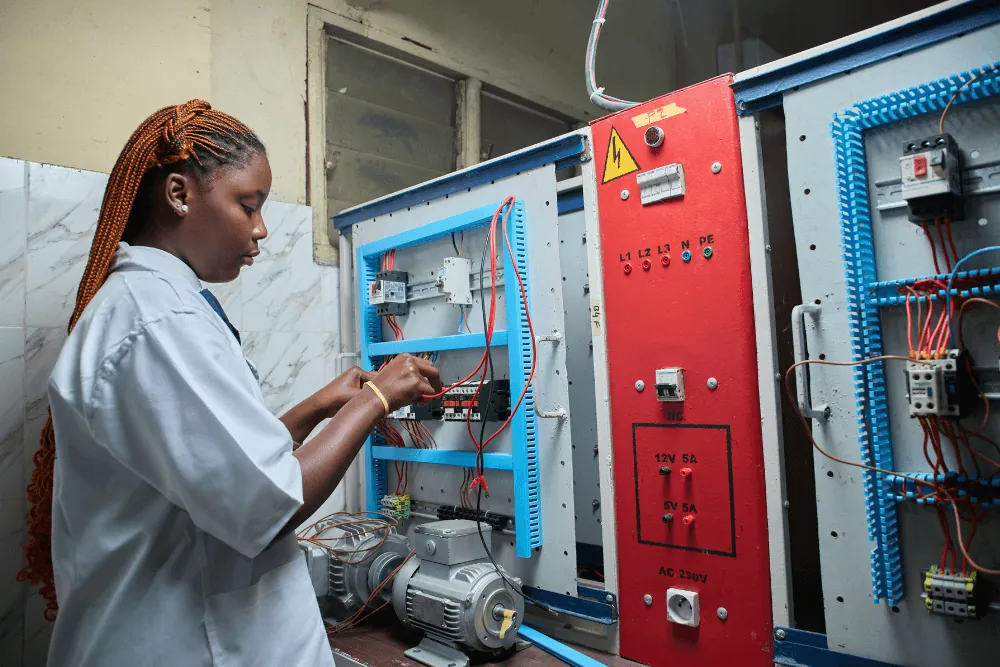
What motor and industrial work with us includes
The nameplate first, read and written down before anything is connected, because it gives the voltage, the current, the speed and the connection.
Motor wiring done to the plate, with the right cable, the right terminal links, the earth and the direction of rotation checked.
Starters and drives set up and protected, with overloads, fuses or breakers sized to the motor and not guessed.
Tests that give a number, including insulation resistance, winding resistance and current on each phase, written down so the next test can be compared.
Fault finding on motors, drives and control panels, from a motor that trips on start to a PLC input that will not change.
A clear boundary on lifts, cranes and rewinding, so you know what we do and what the lift company, the examiner or the rewind workshop does.
The numbers at a glance
Typical answer for Dubai
Before you book motor or industrial work, photograph the motor's nameplate, the terminal box with its cover off if you can do that safely, and the starter or drive that controls it. Write down what the motor drives, how long it runs each day and what happens when it fails, whether it trips, hums, runs hot, smells burnt or does not start. Note the supply, which is single-phase or three-phase, and whether the motor has been rewound or moved before. Tell us if the machine is under a warranty or a maintenance contract that restricts who may work on it. That gives us enough to say what is likely wrong and what the first visit will find. The sections below explain the work so you can judge any quote before you accept it.
Motor and industrial terms: what people search for and what each means
People search for motor work by the machine, the part or the fault. The three tables below match the wording to the work and point to the section with the detail. Some search terms are model names, informal names or phrases that mean something else, and the tables say so.
Motor wiring and current terms
| If you searched | What it means |
|---|---|
| Motor wiring | Connecting a motor to its supply, its starter and its earth. See the motor wiring section |
| 60ktyz motor wiring | 60KTYZ is a model name for a small 220 V, 14 W permanent magnet synchronous gear motor. It is an appliance-size part, and the wiring of the one you hold comes from its label. See the small motors section |
| Stepper motor wiring | Connecting a stepper motor to its driver. See the small motors section |
| Water motor wiring, water motor connection, water motor starter connection | A water motor means a water pump and its motor, and these searches are for connecting one to the supply and a starter. See the motor wiring section, and see our pump and pool equipment wiring page for the pump side |
| Draw electric motor | Either the current an electric motor draws, or a request to draw a motor diagram. We explain the current a motor draws and the connection diagram of a terminal box. See the current draw section |
| Electric motor draw, electric motor current draw | The current a motor takes from the supply at start, at no load and at full load. See the current draw section |
| Bathroom vent motor replacement | Replacing the motor of a bathroom extractor fan. See the small motors section |
Testing, repair and rewinding terms
| If you searched | What it means |
|---|---|
| Motor resistance test | Measuring the resistance of the windings, and the insulation to earth. See the testing section |
| Polarisation index test of motor | A ten-minute insulation test that compares readings at one minute and ten minutes. See the testing section |
| Predictive maintenance of motors | Measuring a motor regularly so a fault is found before it stops the machine. See the maintenance section |
| Generator rewinding, generator rewinding near me, generator stator rewinding service, generator winding repair | Replacing or repairing the windings of a generator or alternator. See the rewinding section, and see our generator installation and servicing page for the set around it |
| Inverter drive repair | Repairing the variable speed drive that controls a motor. See the starters and drives section. The word inverter is also used for solar and backup inverters, which are a different product |
Industrial, crane, lift and door terms
| If you searched | What it means |
|---|---|
| PLC electrician | An electrician who works on the control panel and the PLC that runs a machine. See the control panel section |
| Crane electrical maintenance | Servicing the power, controls, brakes and limits of a crane or hoist. See the crane and lift section |
| Roll up door motor installation, roller door motor installation | A motor on a roll-up or roller door. See the crane and lift section for industrial doors |
| Garage motor installation | A motor for a garage door. Our gate and garage motor installation page covers this in full, and the crane and lift section here covers industrial doors |
Planning motor work: what to decide before anything is connected
A motor job goes wrong when the motor, the supply, the starter and the load are chosen separately. The plan below asks the same questions every time, because the answers decide the cable, the protection and the starter.
The questions that decide the job
| Question | Why it decides the work |
|---|---|
| What does the nameplate say? | The voltage, the current, the speed, the connection and the insulation class set the supply, the cable and the protection |
| Single-phase or three-phase? | The two use different motors, starters and cable |
| How does the load behave? | A pump, a fan, a conveyor, a crane and a compressor start and run differently |
| How many starts a day? | Frequent starts heat a motor and wear a contactor |
| Does the speed need to change? | A fixed-speed motor takes a starter, and a variable load takes a drive |
| Where does it sit? | Heat, dust, water and salt air set the enclosure and the cable |
| What does a stop cost? | A pump that serves a building needs a faster repair plan than a fan in a store |
Who does what on a machine or a lift
A motor sits inside a machine, and a machine has its own maker, its own control and its own warranty. The line between our work and the maker's is drawn before the job starts.
| Item | Who does it |
|---|---|
| Supply cable from the board to the machine's isolator | Us |
| Isolator, motor protection and earth | Us |
| Motor wiring, starter and drive wiring | Us |
| The machine's own control panel, PLC program and safety system | The machine maker or the system integrator, and we work on the panel's wiring and faults where the maker allows |
| A lift's machine, controller and shaft | The lift company |
| Examination and certification of a crane, hoist or lift | An approved examiner |
| Rewinding a motor or a generator | A rewind workshop |
For lifts, UK electricians describe the same boundary: the building's installation stops at the lift's isolator or controller, and the lift company takes over from there.
Planning the supply
A motor's supply is sized from its current and its starting current, and a cable that is too small for a long run drops voltage and starves the motor. A motor of any size also needs a way to isolate it close to the machine, a protection device and an earth. If the machine is new and adds a large load, see our three-phase and load upgrade page, because the main supply may need to grow before the motor goes on. For a board that needs more ways, see our DB box and distribution board page.
Rules and standards for motors, lifts and industrial equipment in Dubai
Motor work sits under the wiring rules, the standards for the machine and, for lifting equipment, the authority's rules on examination. We are electricians and not lawyers, so confirm what applies to your premises with your consultant, the building management or the authority.
What applies and where it comes from
| Subject | What applies |
|---|---|
| Wiring regulations | DEWA publishes Regulations for Electrical Installations. This page does not repeat DEWA's clause numbers. Where we give a figure, it comes from a motor maker, a standard or a maintenance guide, and we check the DEWA requirement for your premises before work starts. |
| Motor nameplates and ratings | The IEC 60034 series covers rotating electrical machines, and the nameplate states the rating the motor was built and tested to. The standard ambient for a motor rating is 40 degrees Celsius, so a motor in a hot plant room can need a lower load or better cooling. |
| Machine electrical equipment | IEC and EN 60204-1 covers the electrical equipment of machines, and an electricians' forum on lift supplies names it for lifts. A machine maker builds to it, and we wire the supply to the machine's isolator. |
| Maker's manual | The motor, the starter and the drive each have a manual that states the wiring, the settings and the safety steps. We work to it |
| Isolation and lock-off | Work on a motor starts with isolation at the supply and a lock or tag, and proving dead with a tested meter. Stored energy in a drive or a loaded crane remains after the supply is off |
| Cranes, hoists and lifts | Dubai Municipality publishes a technical guideline on examination and certification of cranes, hoists, lifts and other lifting equipment. This page does not cite its clauses. An approved examiner certifies the equipment and not us. |
| Lifts | A lift is a machine with its own maker, controller and safety gear, and it is installed, serviced and inspected under its own rules. We do not install or service lifts. We can provide the electrical supply and the machine room lighting and sockets, under the lift company's requirements. |
| Permission | Plant, large motors and changes to a building's supply may need approval from the landlord, the building management or the supply authority. |
Why the nameplate is the first document
The nameplate is the one document that stays with the motor. It gives the voltage and the connection, the current at full load, the speed, the power in kilowatts or horsepower, the insulation class, the service factor and the enclosure rating. A motor wired to the wrong voltage or the wrong connection overheats within minutes, and one protected for the wrong current either trips for nothing or burns out without tripping. The data worth recording is the maker, model, serial number, power, enclosure, speeds, voltage, full-load current, power factor, efficiency, service factor and insulation class. We photograph the plate and write the figures on the job sheet. If a plate is missing, we measure and ask the maker.
Motor wiring: single-phase and three-phase motors, terminal boxes and water motor connections
Motor wiring is the job of getting power to a motor in the right way: the right voltage, the right terminal links, the right direction of rotation, a cable that carries the current and protection that stops the motor before it burns. The wiring is short work when the plate has been read and long work when it has not.
Single-phase motors
A single-phase motor runs from one live and one neutral. It needs a second winding to start, and a home motor uses a capacitor to give that winding a phase shift. The terminal box shows the main winding, the start or auxiliary winding and the capacitor. A pump, a compressor, a fan and a garage machine are single-phase loads. Our pump and pool equipment wiring page explains the capacitor-start and capacitor-run types for pumps, and the same wiring applies to other machines that use them.
| Fault | Likely cause | Fix |
|---|---|---|
| Hums and does not turn | A failed capacitor, a seized load or a broken start winding | Test the capacitor, turn the shaft by hand, test the windings |
| Runs and then trips | An overload, a bad capacitor or a worn bearing | Measure the current against the plate and check the shaft |
| Turns the wrong way | Start winding leads reversed | Swap the start winding leads as the plate shows |
Three-phase motors and the terminal box
A three-phase motor takes three live conductors and starts without a capacitor, because the three phases make a rotating field. Its terminal box has six terminals where the motor can be connected either way, marked U1, V1, W1 and U2, V2, W2. How the six terminals are linked decides whether the windings are connected in star or in delta.
How the terminal box connects star and delta
The six leads let a motor be connected in star or in delta, and the link bars and the connection are read from the nameplate or the maker's diagram. A nameplate that reads 400 V star and 230 V delta, for example, tells you that on a 400 V supply the windings are linked in star. A motor that is linked in delta on a 400 V supply when its plate asks for star gets more voltage than its windings were made for and overheats quickly.
| Connection | What the links do | When it is used |
|---|---|---|
| Star | Joins the three winding ends U2, V2 and W2 together, and the supply goes to U1, V1 and W1 | A motor whose plate asks for star on the supply voltage, or the starting step of a star-delta starter |
| Delta | Links the end of each winding to the start of the next, and the supply goes to the three link points | A motor whose plate asks for delta on the supply voltage, or the running step of a star-delta starter |
The links are the copper bars supplied in the terminal box, and they are fitted flat and tight, with the nuts to the maker's torque. A loose link heats up and burns the terminal.
Direction of rotation
A three-phase motor reverses when any two of its three supply conductors are swapped. We make the swap at the supply side of the starter, which is simpler and safer than changing leads inside a star-delta arrangement. We check the direction with the load uncoupled where the machine allows, because a pump or a fan run backwards for a minute can lose its pressure or damage its seal, and a machine with a one-way gearbox can be damaged.
Cable, protection and earth
| Item | What we do |
|---|---|
| Cable size | From the plate current, the length of the run and the way the cable is laid, with the voltage drop checked at start |
| Isolator | A lockable isolator within sight of the motor |
| Overload protection | A thermal or electronic overload set to the plate current, which stops a motor that is overloaded |
| Short circuit protection | A fuse or breaker rated for the motor's starting current |
| Earth | A conductor from the motor frame to the supply earth. See our earthing and grounding page |
| Gland and box | A gland that suits the cable, a terminal box lid that closes and a rating that suits the place |
| Thermistors | Connected to the starter where the motor has them |
See our MCB and RCCB breakers page for what each device does, and our cable termination and jointing page for lugs and joints on larger cables.
Stop and keep clear of a motor that smells burnt, smokes or sparks, a terminal box that is too hot to touch, a drive that was switched off a moment ago, a machine that can start without warning and any load held up by a crane or a hoist. Isolate at the supply if you can do so from the board, keep people away and call an electrician. A drive keeps its charge after the supply is off, and a motor can turn on its own if the load drives it.
Water motor wiring, connection and starter connection
In everyday use, a water motor means a water pump with its motor. Water motor wiring, water motor connection and water motor starter connection are the same job: bring the supply to a starter, connect the starter to the motor and add the controls that start and stop it. A direct-on-line starter has a contactor and an overload, a start button, a stop button and the motor leads. A tank-fill pump can also have a float switch in the control circuit so that the pump stops when the tank is full and starts when it is low. A single-phase water motor has its capacitor and its start winding, as above. For borehole, submersible and booster pumps, see our pump and pool equipment wiring page, which covers the control boxes, pressure switches and floats in detail.
Electric motor current draw: how much a motor takes from the supply
Electric motor current draw, electric motor draw and draw electric motor all ask the same thing, which is how many amps a motor takes. The answer changes with the moment: starting, running with no load and running at full load all draw different currents.
The three currents of a motor
| Moment | What the current does |
|---|---|
| Starting | A direct-on-line start takes a large current for a moment while the rotor accelerates. It is a multiple of the running current, and a star-delta starter, a soft starter or a drive reduces it. |
| No load | A small current, mostly the current that magnetises the motor, with a poor power factor |
| Full load | The current on the nameplate at the rated voltage and the rated power |
Working out the current from the plate
The plate gives the full-load current, and it is the figure to use. If the plate is missing, the current can be estimated from the power, the voltage, the power factor and the efficiency. For a three-phase motor, the line current is the output power divided by the square root of three, the line voltage, the power factor and the efficiency. A worked example for a 7.5 kW motor on 400 V with a power factor of 0.85 and an efficiency of 0.90 gives a current of about 14 A. This is an estimate for a motor with no plate, and a motor's real plate figure takes priority over it. A motor on the same 400 V supply but with a lower power factor takes more current for the same power.
| For a three-phase motor | Formula |
|---|---|
| Current from output power | I = P / (1.732 × V × PF × efficiency), with P in watts |
| Input power from measurements | kW = V × I × PF × 1.732 / 1000, from the average line voltage, average current and average power factor |
| Load as a percentage | I measured divided by I on the plate, corrected for the supply voltage, multiplied by 100 |
The load figure is corrected for voltage with the ratio of the supply voltage to the plate voltage, because a low supply raises the current drawn for the same power. These formulas follow a United States Department of Energy guide to motor loading.
Measuring current with a clamp meter
We measure the current on each of the three phases while the motor runs under its normal load, with a clamp meter, and compare it with the plate. Three readings show more than one.
- Each phase against the plate. A current above the plate means an overload, a low supply voltage or a mechanical fault. A current far below it means the motor is lightly loaded.
- Balance between the phases. The unbalance should not exceed 10 per cent, a limit given in a test equipment maker's maintenance guide, and it is calculated as the largest difference from the average divided by the average. A larger unbalance heats a motor and points to a supply fault, a loose connection or a winding fault.
- A phase with no current. One phase at zero is single phasing, and the motor runs hot on the other two.
- Voltage can mislead. A ghost voltage from induced current can show on a phase that is dead, so the current reading is the one to trust.
Load, efficiency and power factor
Motors are designed to run between 50 and 100 per cent of their rated load, with peak efficiency near 75 per cent. Efficiency drops sharply below about 50 per cent load, and power factor falls off sooner than efficiency as the load drops. Current falls roughly in line with load down to about 50 per cent, and below that the current is not a good measure of load. A motor that runs for long periods below half load is oversized for its job, and a drive, a two-speed motor or a smaller motor can cost less to run. Every motor that runs more than 1,000 hours a year is worth surveying. See our power factor correction and energy audit pages if the power factor or the running cost of your motors is the concern.
What a high or low current tells you
| Reading | What it can mean |
|---|---|
| Above the plate on all phases | An overloaded machine, a low supply voltage, a jammed or worn load, or a wrong connection |
| Above the plate on one phase | A winding fault, a bad connection or an unbalanced supply |
| Far below the plate | A lightly loaded motor, a broken coupling, a pump running dry or an empty fan |
| Rising over weeks | Wear in the bearings or the machine, a dirty filter or a fouled impeller |
| Hunting up and down | A load that varies, a loose belt or a drive setting |
Starters, soft starters and variable speed drives: wiring and inverter drive repair
A motor needs something between the supply and its terminals to start it, stop it and protect it. The choice of starter depends on the load, the size of the motor and how gently the load must start.
Starting methods compared
| Method | How it works | Suits |
|---|---|---|
| Direct on line | The contactor connects the motor to the full supply | Small motors and loads that can take the starting current and torque |
| Star-delta | The motor starts in star at a reduced voltage, then switches to delta | Larger motors that start without a heavy load, where the supply cannot take a direct start |
| Soft starter | Electronics raise the voltage in a ramp | Pumps, fans and conveyors that need a gentle start and stop |
| Variable speed drive | A drive changes the voltage and the frequency to set the speed | A load that needs speed control, or a gentle start and energy saving |
In one example, the motor starts in star with about 58 per cent of line voltage on each winding and about a third of the starting torque of a direct start, and the starter switches to delta at about 75 to 80 per cent of full speed. A star-delta start into a heavy load can fail to reach speed in star, and the switch to delta then draws a high current. The open transition between star and delta can also cause brief voltage transients that wear the contacts of a poorly built starter.
Wiring a drive
A variable speed drive takes the supply at its input terminals and sends a variable voltage and frequency to the motor from its output terminals. The maker's manual states the cable type, the maximum motor cable length, the earth connections and whether a screened motor cable is needed to control electrical noise. The supply never goes to the output terminals, and a drive with the supply on its output terminals is destroyed. The drive also has a control side, with start and stop terminals, a speed reference and relay outputs, and the control wiring is kept away from the power cables. We set the motor data in the drive from the plate, so that the drive protects the motor correctly.
Inverter drive repair
An inverter drive repair is the repair of the variable speed drive that controls a motor, and the word inverter here is a drive and not the solar or backup inverter that has its own page. See our UPS and inverter installation page if your search was for a battery or solar inverter.
These are the causes of drive failure that an electrical engineering publication lists.
| Cause | What happens |
|---|---|
| Dust and heat | Blocked vents overheat the drive, and 10 to 40 degrees Celsius is the operating range given for the drive described |
| Humidity and conductive dust | Corrode and short the circuit boards |
| Loose power connections | Heat and arcing damage the terminals and boards |
| Aged DC bus capacitors | The capacitors in the DC bus age faster than other parts, and heat shortens their life |
| Overcurrent | Fast acceleration or a poor connection trips the drive |
| High DC bus voltage | Supply spikes, or a load that drives the motor faster than the drive, make the bus trip |
Drive repair starts with the fault code and the conditions at the time of the trip. We read the code against the maker's manual, check the supply, the motor and its cable and test for a short before the drive is powered again. A drive that trips on overcurrent or overvoltage can have its problem outside it, and replacing the drive without fixing that repeats the fault. Where the drive itself has failed, a repair can mean fans, capacitors or boards, or a replacement unit, and the choice depends on the age and the parts. After the supply is switched off, a drive holds charge in its capacitors for a time that the maker's manual states, and no one opens one before that time has passed.
A plant room in Dubai in summer can run above the range a drive is rated for, and an enclosure with no cooling and a clogged filter shortens the life of a drive. We look at the room, the filters and the fans as part of a drive repair.
Small motors: stepper motors, 60KTYZ gear motors and bathroom vent motors
Not every motor is a three-phase machine in a plant room. Small motors turn up in machines, displays, fans and appliances, and each has its own wiring. This section covers the three that people search for.
Stepper motor wiring
A stepper motor moves in fixed steps and is run by a driver, a small electronic unit that takes a pulse for each step. Stepper motor wiring is the connection of the motor's coil leads to the driver's output terminals. The motor can have four, six or eight leads.
| Leads | How a bipolar driver is connected |
|---|---|
| Four | One coil to each of the driver's two output pairs. Swapping the two wires of one coil reverses the direction, and pairing wires from different coils makes the motor erratic or stops it |
| Six | The half-coil connection uses each coil's centre tap and one end, and performs at the motor's rating. The full-coil connection uses the two outer ends of each coil in series, which doubles the resistance and quadruples the inductance and lowers the top speed |
| Eight | Half-coil, series or parallel, and parallel halves the resistance |
A maker's application note on bipolar drivers says that a five-lead unipolar stepper cannot be run from a bipolar driver. The coil pairs of an unmarked motor are found by testing continuity between the leads, because two leads on the same coil have a low resistance between them and leads on different coils show none. The driver's current limit is set to the motor's rated current for each phase, and the motor is not connected or disconnected while the driver is powered, because that can damage the driver. We wire the supply, the driver and the controller as part of a machine or a panel, and we do not design the machine's motion control.
60KTYZ motor wiring
The 60KTYZ is a small permanent magnet synchronous gear motor. Retail listings give it as 220 V AC, 14 W, 50 to 60 Hz, in speeds such as 10 revolutions a minute, for slow, continuous turning. Those listings do not show the wiring, the number of leads or whether a capacitor is needed, so this page gives no colour codes. Wire the motor to the label or the data sheet of the one in your hand, and send us a photo of the label and the leads if you want us to do it.
Two points apply to a motor like this on a Dubai supply. A label of 220 V on a 230 V supply means the motor runs a little above its rated voltage, and the label or the maker states the tolerance. And a motor that is built into a machine takes its power from the machine's own board through a fused spur or a plug, a switch and a fuse, and not from a bare lead pushed into a socket.
Bathroom vent motor replacement
A bathroom extractor fan has a small motor driving an impeller, a single-phase motor on the lighting circuit or a fan circuit. A fan that hums, turns slowly or stops can have a failed motor, a dirty impeller, a seized bearing or a failed capacitor. A bathroom vent motor replacement is practical where the maker sells the motor. Where it does not, the whole fan unit is replaced. We switch off at the board and prove it dead, because a bathroom is a wet area. Before a replacement we check that the duct is clear and the outlet is not blocked, because a fan that cannot move air overheats. See our ceiling fan installation page for the fan side of a room, and our electrical inspection page if a bathroom circuit worries you.
Motor testing: winding resistance, insulation resistance and the polarisation index
A motor test gives a number that can be compared, with the same motor next year or with a motor of the same make. A motor that looks fine and turns freely can have an insulation fault that shows only on a test.
The tests and what each shows
| Test | What it measures | What it shows |
|---|---|---|
| Winding resistance | The resistance of each winding, with a low-resistance ohmmeter | A short between turns, an open winding or an unbalance between the phases |
| Insulation resistance | The resistance from the winding to the frame, with an insulation tester | Moisture, dirt, age and damage to the insulation |
| Polarisation index | The ratio of the insulation resistance at ten minutes to the reading at one minute | Whether the insulation is dry and sound or contaminated |
| Current on each phase | Running current on each leg | Overload, unbalance and a supply fault |
| Temperature | The surface temperature of the frame and the bearings | A hot bearing, a hot winding and blocked cooling |
The motor resistance test
A motor resistance test compares the resistance of the three windings, and they should match each other closely. A winding that is lower than the others points to a shorted turn, and a winding that is higher points to a poor connection. The meter has to measure low values, and the leads are connected firmly because the figures are small. The resistance changes with temperature, so readings are noted with the winding temperature. Insulation resistance and winding resistance are different tests with different instruments, and we carry out both when a motor is suspect. See our insulation and earth resistance testing page for the same testing on a building's wiring.
The polarisation index test of a motor
The polarisation index test of a motor applies the test voltage for ten minutes and compares the reading at ten minutes with the reading at one minute. Insulation that is dry and clean keeps improving as the test runs, so the ten-minute reading rises. Wet or dirty insulation leaks and the reading stays flat. The IEEE 43 standard covers insulation resistance testing of rotating machines, and the minimum polarisation index depends on the insulation class, with the table of minimum values in the standard. We read the minimum for your motor from the standard and do not give one number here.
These conditions make the test meaningless.
- A very high one-minute reading. Above 5,000 megohms the leakage is so small that humidity or the connections distort it, and the index is not useful.
- A tester that runs out of range. If the instrument over-ranges before ten minutes, no index can be calculated, and a higher test voltage extends the range. A reading of infinity is not a measurement, and it means only that the value is beyond the instrument.
- An insulation with very little capacitance. Equipment of this kind can show a flat index even when it is sound.
How we test a motor
- 1Isolate, lock off and prove dead.
- 2Disconnect the motor from the starter or drive. An insulation tester applies a high voltage, and it must never be applied through a drive or an electronic starter, which it can destroy.
- 3Disconnect and earth external equipment, such as cables, capacitors and surge arresters, when a machine is tested.
- 4Measure winding resistance and compare the three.
- 5Measure insulation resistance to the frame, at the voltage that suits the motor, and note the temperature.
- 6Run the polarisation index test where the motor and its size call for it.
- 7Run the insulation test before any higher-voltage test, because a stress test can damage insulation that a lower test would have caught.
- 8Record the readings with the date, the temperature and the instrument.
A rule of thumb from a test equipment maker's maintenance guide is that every 10 degrees Celsius above a motor's design temperature halves the life of its winding insulation. It is the reason the running temperature and the cooling are part of the test. See our thermal imaging inspection page for the temperature survey.
Motor and generator rewinding: stator rewinding service and winding repair
Rewinding replaces the copper windings of a motor or a generator that have burned, shorted or aged. It is workshop work, with an oven, a winding machine and a varnish process, and it is done on the machine's stator and its rotor where needed. Generator rewinding, generator rewinding near me, generator stator rewinding service and generator winding repair are searches for that workshop work.
Is the winding really the fault?
A generator or a motor that stops producing or turning is not always a winding fault. Testing comes before any decision to rewind.
| Machine | Faults that look like a bad winding | What we test first |
|---|---|---|
| Motor | A tripped overload, a seized bearing, a failed capacitor, a loose terminal | Winding resistance, insulation resistance and current, as in the testing section |
| Generator or alternator | No voltage, low voltage, unstable voltage | The voltage regulator, the exciter, the rotating diodes, the brushes if fitted and then the stator windings |
| Machine behind a drive | A drive trip that is blamed on the motor | The drive and the cable before the motor |
A brushless alternator has several windings and parts that can fail, so testing in order saves the cost of a rewind that was not needed. See our generator installation and servicing page for the generator set, its controls and its servicing.
What damages a winding
- Heat, from overload, poor cooling, a dirty motor or a high ambient temperature. Each 10 degrees Celsius above the design temperature halves the life of the insulation, by a rule of thumb.
- Moisture and contamination, which lower the insulation resistance until the winding tracks to the frame.
- Voltage spikes, from the supply or from a drive. See our surge protection page for protection on the supply side.
- Vibration and loose wedges, which let a coil move until its insulation wears through. A US motor repair shop names loose or trapped wedges and coil vibration among the causes of ground faults.
- A failed bearing, which lets the rotor rub the stator.
- Single phasing, where a motor loses one phase and the other two windings overheat.
What a rewind involves
A US motor repair shop describes the steps of a stator rewind, and its sequence is an example of good practice. The figures vary with the machine.
- 1Record the winding data, which means the connection, the coil groups, the wire size and the turns, before the old winding is touched.
- 2Test the core, because a core damaged by heat or by a winding burn-out does not hold a new winding well.
- 3Burn out the old winding. The shop's burn-out oven runs at about 650 degrees Fahrenheit, roughly 340 degrees Celsius, with water sprayers to guard against varnish flare-ups that can damage the iron.
- 4Clean the core and retest it, after a bake at roughly 250 to 285 degrees Fahrenheit, which is about 120 to 140 degrees Celsius.
- 5Fit slot insulation and wind and insert the new coils without nicking the insulation.
- 6Connect the coil groups, insulate the joints and tie the connections.
- 7Impregnate with varnish. Vacuum pressure impregnation warms the stator, puts it under vacuum and pressure, dips it in varnish and cures it for hours.
- 8Test the finished winding for resistance, insulation resistance and the polarisation index, and run the machine.
Rewind or replace
| Factor | What it means |
|---|---|
| Cost against a new machine | A rule of thumb from a test equipment maker's guide is that a repair costing more than half the price of a replacement is not worth doing. It is a guide and not a rule |
| Efficiency | A rewound motor loses efficiency, and a United States Department of Energy guide advises taking 2 percentage points off the efficiency of a motor under 40 horsepower and 1 point for a larger one |
| Parts and lead time | A new standard motor can be on the shelf, and a special motor or a large generator stator takes weeks to rewind |
| Downtime | A critical machine may need a spare more than a repair |
| Age and condition of the core | A core that has been damaged before does not rewind well |
| Special design | A motor made for a hazardous area or an inverter drive needs a rewinder who knows the design |
Who does the rewind
Our part is the testing before and after, the removal and refitting of the machine, the wiring and the commissioning. The rewind itself is done in our own workshop. We ask the workshop for its test results and keep them with the job. A rewound machine is run at no load and then under load, with the current and the temperature recorded, before it goes back to work.
PLC electrician and control panels: faults, wiring and panel work
A PLC, a programmable logic controller, is the small industrial computer that runs a machine's sequence. It reads inputs, such as buttons, sensors and limit switches, and switches outputs, such as contactors, valves and lamps. A PLC electrician is an electrician who works on that panel, its wiring and its field devices as well as its program.
What a PLC electrician does
| Job | What is involved |
|---|---|
| Fault finding | Finding why a machine stopped, from the PLC's status to the field device |
| Panel wiring | Wiring terminals, relays, contactors, power supplies and the PLC's input and output modules to a drawing |
| Replacing modules and devices | Swapping a failed input module, relay, sensor or power supply for the same part |
| Drawings and labels | Marking the wires and terminals and keeping the drawings up to date |
| Adding a device | Wiring a new sensor, button or motor starter into the panel and the program |
| Handover | Documenting what changed |
How a PLC fault is found
We follow an order that starts with the power, the wiring and the field devices, because those fail before the program does.
- 1Check the power. A 24 V DC supply should read between 21.6 and 26.4 V, which is the nominal voltage plus or minus 10 per cent. Below about 21 V, inputs drop out. A blown fuse means find the short before changing the fuse.
- 2Read the lights. The module status lights, the point lights and the network lights show the state of the system in a short scan.
- 3Compare each input point's light with the tag in the controller. A light that is on with a tag that is off points to a forced or mis-mapped tag, a light that is off with a tag that is on points to the same cause in reverse, and both off point to the field device, its supply or its wiring.
- 4Check the field device with the power isolated. A healthy sensor contact reads close to zero ohms, and a sensor can be out of alignment or its lens dirty.
- 5Diagnose outputs from the load back to the module. If the point light is on and the load does not move, the wiring, the fuse or the load is at fault.
- 6Look for forced inputs and outputs. A forced point can hide a real fault, and a force is a change that needs authority and a record.
- 7Ground screens at one end only, because grounding both ends creates loops that put noise on analog signals.
- 8Read live data without editing a running program.
What we do and do not do
We work on the power, wiring, devices and panel of the control system. The machine's program belongs to its maker or its integrator, and changing it can void a warranty or a safety approval. We do not claim to program every PLC, and we say which makes and which tasks we take on. The owner of a machine should hold a copy of its program and its drawings, because a failed processor with no backup can stop a plant for weeks.
Faults on control panels
| Symptom | Likely cause | Fix |
|---|---|---|
| The whole panel is dead | A tripped supply, a blown fuse or a failed power supply | Check the supply, the fuse and the 24 V output |
| One machine function does not work | A failed sensor, an open wire, a stuck relay or a blown output fuse | Trace from the PLC point to the device |
| Random stops | A loose terminal, a drifting sensor or a power supply that sags | Check the terminals and the voltage under load |
| A contactor chatters | A low control voltage or a worn coil | Measure the coil voltage and replace the coil or fix the supply |
| An input stays on | A stuck device, a short or a forced point | Check the device and the forces |
| A drive fault trips the machine | An overload, an overvoltage or a lost enable signal | Read the drive's fault code |
See our smart home installation page if your automation is in a home and not a plant. A home system uses a different kind of controller, and the work is covered there.
Cranes, hoists, lifts and roller doors: electrical work on lifting equipment and doors
Equipment that lifts a load or a person is held to a higher standard than a pump or a fan, because a fault can drop the load. This section says what we do on cranes, hoists, lifts and industrial doors, and what we leave to others.
Crane electrical maintenance
Crane electrical maintenance covers the power, the controls and the safety devices of an overhead crane or a hoist. A university's pre-use and monthly checklist for overhead cranes and hoists lists these electrical and control items.
| Item | What is checked |
|---|---|
| Limit devices | That the limit switches work, tested without a load on the hook |
| Pendant or radio control | That every control works and moves the crane in the direction marked, and that labels are present |
| Brakes | That hoist, bridge and trolley brakes hold, and that the hook does not drift when the control is released |
| Wiring | That nothing is loose, broken or damaged on the electrical system |
| Operating mechanisms | That nothing is out of adjustment or making unusual sounds |
| Labels and load rating | That the rated load is marked and legible, and warning labels are clean |
On that checklist, the pre-use check is a guide that needs no record and the monthly inspection is documented. We add the items an electrician checks on the electrical side: the condition of the festoon or conductor bars and the collectors, the contactors and their contacts, the overloads, the motor current against the plate, the brake coil and its supply, the emergency stop and the earth.
Examination and certification of a crane, hoist or lift are done by an approved examiner, and that is not our role. Dubai Municipality publishes a technical guideline on the subject, and this page does not cite it. We fix what the examiner finds on the electrical side and keep the records.
Lifts: what we do and where the lift company takes over
A lift has a machine, a controller, safety gear and a shaft, and the lift company installs, services and has them inspected. What the building provides is the electrical supply to the lift's isolator, and the light and socket circuits in the machine room and the shaft.
UK electricians describe the following practice for lift supplies, and it is an example. The supply ends at an isolator and the lift company takes over from there. A small lift can have a three-phase supply of 32 A, though the actual figure comes from the lift company's specification. One lift maker asked for a separate supply for the lift lighting. A lift that serves for evacuation needs a second, independent supply. A lift inspector inspects the installation before it enters service.
| Item | Who does it |
|---|---|
| Supply cable from the board to the lift isolator | Us, to the lift company's specification |
| Machine room lighting, sockets and ventilation | Us |
| Lift controller, drive, motor and safety circuit | The lift company |
| A second supply for an evacuation lift | Us or the electrical contractor, to the consultant's design |
| Inspection and certification | An approved examiner |
We do not install, repair or adjust a lift, and we do not enter a shaft. If a lift stops with people inside, call the lift company's emergency number and the building management. Do not open the doors by force.
Roller door motors in industrial buildings
Roll up door motor installation and roller door motor installation on a warehouse, a loading bay or a workshop use a larger motor than a villa door, and may need a three-phase one. The motor can be a tubular motor inside the barrel, or a motor at the end or side of the door driving it through a chain or gears. The door has limit switches at the top and bottom, a brake or a self-locking drive, a hand chain or a release for a power cut, and safety devices such as a bottom edge and photocells where vehicles or people pass.
| Item | What we do |
|---|---|
| Supply | A cable, an isolator and protection sized to the motor |
| Motor and control | Wire the motor, the control box, the push buttons and the limits to the maker's diagram |
| Safety | Fit and test the edge and the photocells, and check the stop on an obstruction |
| Override | Check that the hand chain or the release works |
| Test | Run the door through full travel and record the settings |
Our gate and garage motor installation page covers garage door motor installation, shutter motors and the safety checks in detail, and the same safety principles apply here. Garage motor installation for a villa belongs on that page, and industrial doors with large motors belong here.
Predictive maintenance of motors: what to measure and how often
Predictive maintenance of motors means measuring a motor regularly and acting on the trend before it fails. A motor that is measured at regular intervals leaves a record, and a change in the record is the warning. A motor that is only looked at when it stops gives no warning.
What we measure
A test equipment maker's maintenance guide lists four practices for motors, and they make a useful plan.
| Measurement | What it finds |
|---|---|
| Temperature, by infrared | Hot bearings, hot connections, phase unbalance, overheated windings and misalignment shown as a warm coupling |
| Vibration | Unbalance, misalignment, bearing wear and looseness, and it can catch them earlier than temperature does |
| Insulation resistance | Moisture, dirt, age and damage in the winding, and the trend is the point because readings change with temperature and humidity |
| Current and voltage | Current unbalance, single phasing and a supply fault |
That maker's figures for how often these problems occur are roller bearings in up to 60 per cent of machine failures, unbalance in up to 50 per cent and misalignment in up to 45 per cent, with overlap because one causes another. We measure temperature, current and insulation resistance. Vibration analysis needs its own instruments and training, and we say whether we do it or work with a specialist. See our thermal imaging inspection page for the camera survey.
How a plan is built
- 1List the motors by what they drive and what a stop costs.
- 2Record the plate data and take a baseline of current, temperature and insulation resistance while the motor is healthy.
- 3Set the interval from the maker's manual and the duty. A motor in a dusty, hot or wet place is measured more often than one in a clean room. We do not set an interval without knowing the duty.
- 4Measure and compare with the baseline and the previous reading.
- 5Act on the trend, with a lubrication, a realignment, a cleaning, a retighten or a replacement before the failure.
- 6Keep the record with the motor's plate and drawings.
Drives and panels in the plan
A drive asks for its own checks. A drive is kept clean, dry and within its temperature range, its power connections are checked with proper instruments, and the temperature of the drive and the capacitors is watched. A dusty or contaminated place needs cleaning more often than a clean one. A panel is checked for loose terminals, heat at the connections, dirty filters and fans that have stopped.
Motor and industrial work cost: what affects the price
The price of motor work depends on the size of the motor, the supply, the starter and the amount of fault finding, and a quote that gives one figure with no list cannot be compared with one that shows each part.
What goes into the price
| Factor | Why it changes the price |
|---|---|
| Motor size | A larger motor needs a bigger cable, starter and protection |
| Starter or drive | A direct-on-line starter, a star-delta starter, a soft starter and a drive differ in cost and set-up time |
| Cable length and route | A long run and an awkward route cost more cable and time |
| Isolators and enclosures | Lockable isolators and a box that suits the place |
| Fault finding | A fault that needs hours of tracing costs more than a part swap. We say when a fault is open-ended and quote the first visit |
| Testing | A resistance and insulation test costs less than a full report with a polarisation index |
| Rewinding | Set by the size, the type and the workshop's lead time, with transport each way |
| Parts | Contactors, overloads, capacitors, relays, sensors and drive parts |
| Access and shutdown | Work at height, in a plant room or in a shutdown window |
| Lifting equipment | Records and checks that an examiner or a client requires |
The site visit costs AED 50, and the quote follows it. A quote needs the nameplate, the symptom and a look at the site.
How we price
We give a fixed price for wiring and installation work after we have seen the plate, the route and the board. For fault finding, we quote the first visit and then the repair once the cause is known, so you are not asked to approve a job before anyone knows what it is. Parts and workshop charges appear on separate lines. If a repair costs more than a replacement would, we say so.
Motor and industrial electrical work with Circuit Dubai
- Electricians first, so the supply, the protection, the starter and the motor are checked as one circuit by one team.
- The nameplate read before anything is connected, and the readings written down after.
- Tests that give numbers, so a motor's health can be compared next year.
- A clear line on lifts, cranes and rewinding, with what we do and what an examiner, a lift company or a rewind workshop does set out in writing.
- Direct advice, including when a repair costs more than a replacement.
We work across all of Dubai. Our office is in Al Quoz.
If you are also planning a generator installation and servicing job, power factor correction, surge protection or a three-phase and load upgrade, we can plan the supply, the protection and the motor circuits together, so the board is opened once.
Phone: +971 55 407 7427
Motor and industrial electrical questions we hear from Dubai customers
How much does motor wiring cost?
It depends on the motor size, the supply, the cable length and route, the starter and the protection. A site visit costs AED 50, and the price follows it. We give a fixed price after we have seen the nameplate and the route, with the starter and the isolator on their own lines.
How do I know whether my three-phase motor is wired in star or delta?
The nameplate gives the voltage for each connection, and the link bars in the terminal box show which one is fitted. A plate that reads 400 V star on a 400 V supply asks for star. We check the plate against the links before the motor is powered.
Why does my motor run backwards?
On a three-phase motor, two of the supply conductors are in the wrong order. Swapping any two reverses it, and we make the swap at the supply side of the starter. On a single-phase motor, the start winding leads are reversed. Check the load before a motor runs backwards for long, because a pump or a fan can be damaged.
How many amps does an electric motor draw?
The nameplate gives the full-load current. A motor draws more at the moment of starting and less with no load, and the running current depends on the load. We measure the current on each phase with a clamp meter and compare it with the plate.
Why does my motor trip when it starts?
The starting current can be above what the breaker or overload allows, the supply voltage can sag under the start, a phase can be missing, the load can be jammed or a winding can be failing. We measure the current, the voltage at the motor and the insulation to find which.
Do you repair inverter drives?
We find the cause of a drive's fault, which can be outside the drive, and repair or replace the drive. A drive that trips on overcurrent or overvoltage repeats the trip if the cause stays. If you meant a solar or backup inverter, see our UPS and inverter installation page.
Do you rewind generators and motors?
The testing, removal, refitting and commissioning are ours, and the rewind is done in a workshop. We test first, because a generator that gives no voltage may have a fault in the regulator or the diodes and not in the winding.
What is a polarisation index test, and do I need one?
It compares an insulation reading at ten minutes with one at one minute, and it shows whether the insulation is clean and dry. It suits larger motors and generators where the insulation matters to the plant. A small motor is checked with the shorter insulation and winding resistance tests.
What does a PLC electrician do?
A PLC electrician finds faults in a machine's control panel, its inputs and outputs, its power supply and its field devices, and replaces what has failed. We start with the power and the wiring before the program.
Can you wire a 60KTYZ motor?
Yes, to the label or data sheet of the motor you hold. Retail listings do not show its wiring, so send a photo of the label and the leads. It is a 220 V motor, and the maker states the tolerance on a 230 V supply.
Can you wire a stepper motor?
We wire the supply, the driver and the motor leads in a machine or a panel to the driver's data sheet. We do not design motion control. The number of leads and the driver decide the connection.
Can you replace the motor in my bathroom extractor fan?
Yes. Where the maker sells the motor we fit it, and where it does not we replace the fan unit. We check the duct first.
Can you connect my water motor and starter?
Yes. We connect the supply, the starter, the overload, the stop and start controls and any float switch, and set the overload to the plate current. For pumps in a borehole or a pool, our pump and pool equipment wiring page covers the details.
Do you do crane electrical maintenance and certification?
We maintain the electrical and control side, with the limits, brakes, pendant, wiring, contactors and earth, and keep the records. Certification is done by an approved examiner.
Do you install or service lifts?
No. We provide the electrical supply to the lift's isolator and the machine room lighting and sockets, to the lift company's requirements. The lift company installs, services and inspects the lift.
Do you fit roller door motors in warehouses?
Yes, for the supply, the motor wiring, the control box, the limits and the safety devices on roll-up and roller doors. Villa garage doors are covered on our gate and garage motor installation page.
What is predictive maintenance for motors, and do mine need it?
It is measuring temperature, current, insulation and vibration regularly and acting on the trend. It suits motors that stop a plant or a building when they fail. A motor that is cheap to replace may not justify it. We help you choose which motors to include.
Ready to book motor or industrial work?
Send photos of the nameplate, the terminal box and the starter or drive, say what the motor drives and what is wrong, and tell us whether the supply is single-phase or three-phase. We reply instantly on chat with a view on what is likely wrong, what the first visit will check and a fixed price for the work that is clear, so you know what you are buying before anyone opens a panel.