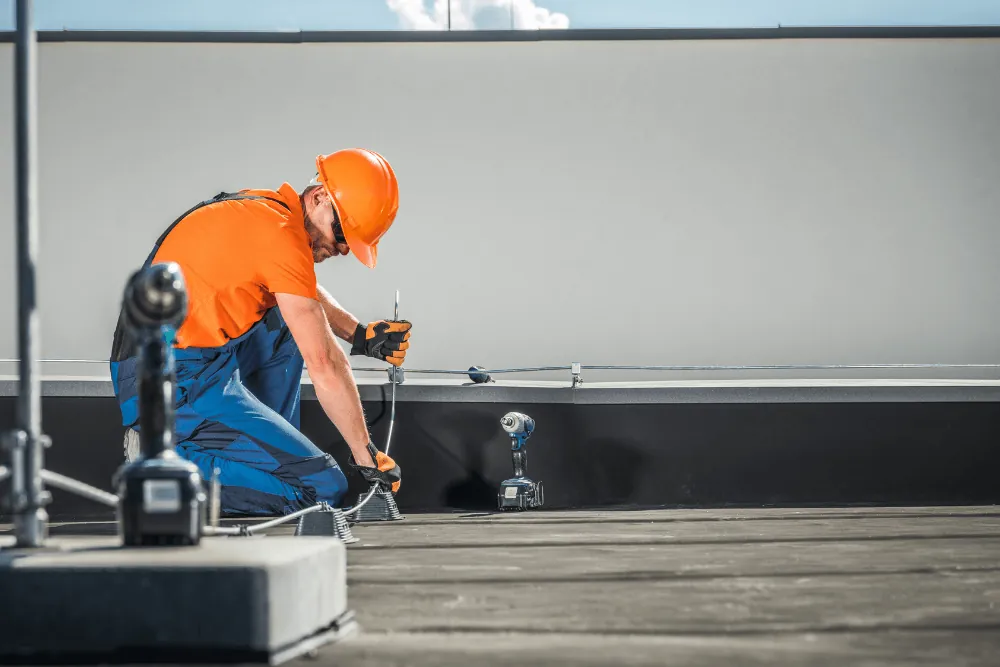
Lightning Protection Installation in Dubai: Lightning Rods, Down Conductors, Earthing and Surge Arresters
A lightning protection system gives a lightning strike a controlled route to the ground, so the current runs down a conductor you chose and not through your roof, your walls or your wiring. It has two halves. The outside half catches the strike with rods, poles or tape on the roof, carries it down conductors fixed to the walls and spreads it into the earth. The inside half deals with what the strike leaves behind: bonding that keeps metalwork at one voltage, and surge arresters that stop a voltage spike from travelling along the power, data and antenna cables into your equipment.
Circuit Dubai carries out lightning protection installation across Dubai for villas, apartment buildings, towers, warehouses, farms, solar plants and sites with masts or antennas. We start with a risk assessment, design the system, install the air terminals, conductors and earth termination, fit surge arresters at the main board and on incoming lines, and test the finished system. We also inspect and maintain systems that someone else installed.
What lightning protection with us includes
A risk assessment and a design, so the system matches the building, its height, its contents and how it is used, and you can see why each part is there.
Air terminals on the roof, whether lightning rods, poles, tape or an overhead wire, set out so the whole structure sits inside the protected zone.
Down conductors and test joints, run to the earth, fixed securely and kept clear of doors, windows and people.
An earth termination system, with earth electrodes or a ring, bonded to the building's main earth, and tested.
Surge arresters, at the main board, on sub-boards where needed and on antenna, CCTV and data lines.
Inspection, testing and a certificate, with the readings and a drawing of what was installed and where.
The numbers at a glance
Typical answer for Dubai
Before you book lightning protection, find out whether the building actually needs it, and what for. A tall tower, a farm with livestock and a villa in a built-up area face different risks, and the right answer for one is wrong for another. For many houses the cheaper and more useful first step is a surge arrester at the main board and a good earth. A risk assessment tells you which case you are in, and the sections below explain how the assessment works, what the parts are and how we install and test them.
Lightning protection terms: arrester, arrestor, conductor and rod
The trade uses several words for overlapping things, and they change from one country to another. The table below matches the names people search for to what they mean.
| If you searched | What it means |
|---|---|
| Lightning protection installation, lightning protection system installation, installing a lightning rod system | The whole job: a design, air terminals, conductors, earth termination, bonding and surge arresters |
| Lightning rod installation | Fitting the rod or air terminal on the roof, with its base and its connection to the down conductor |
| Lightning conductor installation | The British name for the same system, or for the conductor that runs from the roof to the earth |
| Lightning arrester installation, lightning arrestor installation | In many markets this means the air terminal on the roof. In power engineering an arrester is a surge device. We ask which you mean before quoting |
| Installation thunder arrestor | Another name for a lightning arrester. It usually means the roof-level air terminal |
| Surge arrester installation, house surge arrester | A device at the main board that diverts a voltage surge to earth. See the surge arrester section below |
| Lightning protector for house | A system for a home. For many houses this means a modest roof system, an earth and a surge arrester at the board |
| Lightning pole installation | A pole or mast that carries the air terminal above a roof, a plant area or open ground |
| Lightning mobile electric | We cannot place this phrase. If you mean protecting a mobile phone mast or mobile equipment, send us the details. If you mean using a phone during a storm, there is nothing to install, and the safety section below covers what to do |
So a lightning arrester installation can mean two different jobs, and the cost, the work and the standard that applies are different for each. A roof air terminal catches a strike. A surge arrester on a cable deals with the voltage that a nearby strike puts on the wiring. A good system includes both.
How lightning damages buildings, and what that means in Dubai
A strike can harm a building in four ways. Knowing which are likely for your site tells you what to protect.
| Effect | What happens | What protects against it |
|---|---|---|
| Direct strike | The current passes through the structure and can start a fire, crack masonry or injure people | Air terminals, down conductors and an earth termination system |
| Side flash | Current jumps from a conductor to nearby metal or a person | Separation distances and bonding |
| Surge on incoming lines | A strike near a power, telephone or antenna line puts a voltage spike on the cable | Surge arresters at the entry point and at sensitive equipment |
| Rise of earth potential | The ground around the strike point rises in voltage for a moment | Bonding and a well designed earth |
Lightning in Dubai
Dubai has fewer thunderstorm days than many tropical places, but storms do occur, and they can be intense when they arrive. That changes the maths of a risk assessment, which weighs how often a strike is likely against how bad the damage would be. A tower, a crane, an isolated farm building, a solar plant on open ground and a telecom mast stand out from their surroundings, and a strike on one of them costs a lot. A villa in a dense neighbourhood, surrounded by taller buildings, is less likely to be hit, and its owner may sensibly choose surge protection and a good earth over a full roof system. A risk assessment is the way to decide, and we do not recommend a full system by default.
What lightning does to electronics
Much of the damage lightning does to houses is to electronics and not fire: a burnt-out router, television, air conditioner board or inverter, because a strike near the property puts a surge on the cables. The strike does not have to hit your roof for this to happen. That is why surge arresters matter even where a roof system does not. See our surge protection service for how those are chosen and fitted.
Do you need a lightning protection system
The honest answer depends on the building and on who is asking. There are three separate reasons to have one.
The law or the authority requires it. Some buildings and uses fall under rules that call for lightning protection. We are not aware of a rule that names an ordinary villa, but tall buildings and certain uses may be covered by the UAE fire and life safety rules or by DEWA or Civil Defence requirements for the project.
A risk assessment says you need it. The assessment compares the likely number of strikes with the harm each could do, and shows whether a system is needed and at what protection level.
A client, insurer or standard asks for it. Some contracts and insurers name a standard, and some ask for a certificate.
The risk assessment
A risk assessment in the style of IEC 62305-2 looks at the size and height of the building, its surroundings, the soil, the services that enter it, the people inside and what a failure would cost. The result is a decision, and where a system is needed, a protection level from I to IV. Level I is the most stringent.
Standards behind the search terms
| If you searched | What it is | What it means in Dubai |
|---|---|---|
| IEC 62305, BS EN 62305 | The international and European standard for protection against lightning, in several parts covering risk, the external system, surge protection and structures | The most widely used reference. Many projects name it |
| UL96A lightning protection, UL 96A lightning protection | A United States standard for the installation of lightning protection systems, used with UL certification marks | Not a Dubai standard. We follow it only if a project specifies it |
| NFPA 780 | A United States installation standard that covers the same ground as UL 96A | The same. A reference where named |
| ESE lightning arrester | An early streamer emission terminal, which claims a larger protected area than a plain rod | Covered in the rod section below. It is not recognised in every standard |
| DEWA and Civil Defence requirements | The local rules that apply to a project | These decide what is acceptable on your project |
We state the standard in the design and the certificate, so everyone knows what the system was built to and tested against.
The parts of a lightning protection system
A complete system is made of five parts, and a weakness in any one limits the others.
| Part | What it does | What can go wrong |
|---|---|---|
| Air terminals | Catch the strike at a chosen point on the roof or the structure | Too few, in the wrong place or too short to protect the roof edges |
| Down conductors | Carry the current from the roof to the ground | Too small, damaged, loose or run close to windows and people |
| Earth termination system | Spreads the current into the ground | High resistance, corroded joints or a poor connection to the main earth |
| Bonding | Ties the lightning system to the building's metalwork and the main earth | Missing or loose connections, giving sparks and side flashes |
| Surge arresters | Divert surges on power, data and antenna lines to earth | Wrong type, long leads or no connection to the earth bar |
The first three together are called the external system, and bonding with surge arresters make up the internal system. A rod with no proper earth, or an earth with no surge arresters, leaves the building only partly protected.
Lightning rods, poles and air terminals
The air terminal is the part that meets the strike. Several kinds exist, and the right choice depends on the roof and on what has to be covered.
Lightning rod installation
A lightning rod, also called an air rod or Franklin rod, is a pointed metal rod fixed to the roof or a pole. Lightning rod installation means choosing the number, height and position of the rods so every part of the roof, including the edges, the corners and rooftop equipment, falls inside the zone they protect. Designers use geometric methods for this. The rolling sphere method, for example, rolls an imaginary sphere over the building and places a rod wherever the sphere would touch it, and the sphere's radius depends on the protection level. A rod is connected by a conductor to a down conductor, and each connection is made with a proper clamp. Installing a lightning rod system also means checking that the roof can carry the load of the base and the wind on the rod.
Lightning rod mounting base
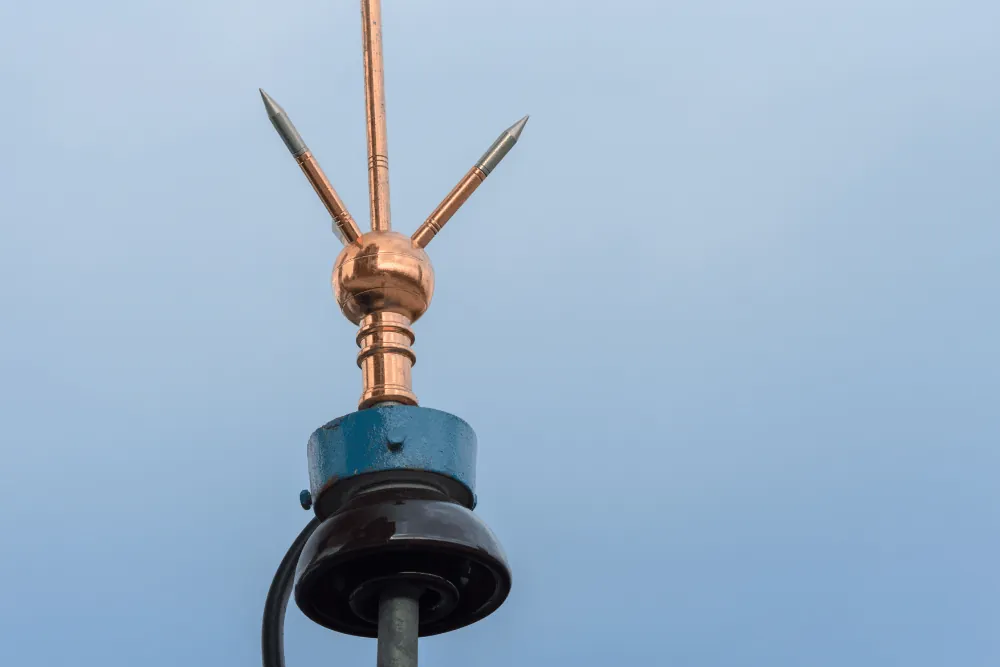
The rod stands on a base, and the base suits the roof.
| Roof or location | Common base | Notes |
|---|---|---|
| Flat concrete roof | Weighted base, tripod or a base bolted to the slab | Bolting needs waterproofing. A weighted base avoids drilling but needs weight calculated for wind |
| Parapet or edge | A bracket fixed to the parapet wall | Gives height at the roof edge, where strikes often land |
| Pitched or tiled roof | A fixing to the ridge or a rafter | Needs a flashing so the roof stays watertight |
| Chimney, vent or tower | A clamp or strap base | Often used on an existing structure |
| Metal roof | A base that joins the rod to the metal sheet where the design allows | The roof itself can act as part of the system if suitable |
A lightning rod mounting base must be secure, corrosion-resistant and sealed where it passes through a waterproofing layer. A loose rod on a windy roof is a hazard in itself.
Lightning pole installation
A lightning pole, or mast, lifts the air terminal above the structure. It is used for a tall area of roof, a cluster of rooftop plant, a tank, a car park or an open site. A pole needs a footing, a connection to a down conductor and a check on its stability in wind. Some poles stand free of the building, with their own earth, so that the strike current stays outside the structure. That is a design choice, and we make it after the risk assessment.
Strike pads and strike plates
Strike pad lightning protection installation is a phrase we cannot place with confidence. It may mean a strike plate or a strike termination device, a flat metal part where the strike is meant to land, or a pad on the roof where a conductor ends. If you mean that, we install flat strike plates, bonded to the system, on roofs where a rod is not wanted. If you mean something else, send us a photo or a datasheet and we will say whether we can do it.
Catenary lightning protection system
A catenary system is a wire stretched between two masts, or between a mast and a building, with the wire acting as the air terminal. The area beneath it is protected. It is used where there is a lot of ground or roof to protect and no single high point, such as solar fields, storage yards, car parks or long roofs. A catenary lightning protection system needs masts, tensioning, footings and careful spacing, and its design is more specialised than a rod on a roof.
ESE lightning arrester installation
An early streamer emission, or ESE, terminal is a rod with a device at its tip that makers say starts a streamer earlier than a plain rod, giving a larger protected radius. ESE lightning arrester installation is common in some countries and is covered by a few national standards. It is not covered by IEC 62305 or by NFPA 780, and the claims for it are disputed. We design with conventional air terminals by default, and we install an ESE terminal where a project specifies it and the authority accepts it.
Lightning tape, conductors and down conductors
The conductors join the air terminals to each other and to the earth. They carry the full strike current, so their material, size, route and fixings all matter. Most of the visible work on a roof and wall is conductor.
Lightning tape installation and lightning copper tape installation
Flat metal tape is the usual conductor on a roof and down a wall, because it lies flat, bends round corners and is easy to fix. Lightning tape installation covers laying the tape along the roof edge, ridge or parapet, and fixing it at regular intervals with clips suited to the surface. Lightning copper tape installation, also searched for as lightning protection copper tape installation, uses copper or tinned copper tape, which resists corrosion and carries current well. Joints are made with proper clamps or by welding or brazing, never twisted and taped. A tape that lifts in the wind or has a loose joint is a weak point, so fixings are spaced and checked for the surface.
Conductor materials
| Material | Strengths | Limits |
|---|---|---|
| Copper | Excellent conductivity and corrosion resistance | Costs more, and can corrode aluminium and galvanised steel if the two touch |
| Tinned copper | The tin coating protects the copper in harsh air | Slightly higher cost |
| Aluminium | Light and cheap | Corrodes if buried or fixed to masonry, lime or wet concrete, so it suits only some positions |
| Galvanised steel | Strong and cheap | The coating wears faster in salty or damp air, so it suits inland, dry sites better than the coast |
| Stainless steel | Resists corrosion | Higher resistance, and costs more |
Standards set a minimum cross-section for each material, and copper tape or round conductor is often around 50 mm² for the main conductors. Mixing metals where they touch causes corrosion, so we keep the materials separate or use a bimetallic connector.
Lightning conductor installation
In British usage a lightning conductor is the whole conductor path, from the rod to the earth. Lightning conductor installation covers the roof network, the connection to the down conductors and the routing so that the path from every air terminal to the earth is short and direct. Bends are kept gentle, because a sharp bend in a conductor makes a strike current more likely to jump to something nearby.
Lightning protection down conductor installation
The down conductors run from the roof to the ground, and lightning protection down conductor installation covers their number, position and fixing.
- Number and spacing: at least two down conductors on most buildings, spaced evenly round the outside, with the maximum distance between them set by the protection level. Typical values run from about 10 m for the highest levels to about 20 m for the lowest.
- Position: on the outside of the building, away from doors, windows and places people stand. Corners are favoured.
- Fixing: held to the wall at regular intervals with clips that suit the surface, with a cover or guard where it is within reach.
- Test joints: each down conductor has a joint near the base that can be opened to measure the earth, and closed again after.
- Natural parts: where the building has steel columns or reinforcement that are electrically continuous, they can serve as down conductors if the design allows it.
A cost to install a lightning protection system, and a lightning conductor installation cost, depends heavily on the length of conductor and the number of down conductors, which is why a survey comes before a price. The cost section covers this.
Lightning arrester and surge arrester installation
Surge arresters are the inside half of lightning protection, and for many buildings the most useful half. A surge arrester sits in the wiring, and when a voltage spike arrives it diverts the excess current to earth almost instantly, so the spike does not pass on to the equipment. This section covers the kinds, where they go and how they are connected.
Surge arrester installation and house surge arrester
Surge arrester installation for a home means a device in the main distribution board, between the live conductors and the earth bar. A house surge arrester, sometimes sold as a whole-house surge protector, protects every circuit downstream from a surge coming in on the supply. Sensitive equipment such as a router, a television or a computer may also have its own plug-in protector. Surge arresters are graded by type.
| Type | Where it goes | What it handles |
|---|---|---|
| Type 1 | At the main board or service entrance, where a building has an external lightning system or an overhead supply | Partial lightning current, in the heaviest duty class |
| Type 2 | At the main board or sub-boards | The surges that reach a board from nearby strikes and switching |
| Type 3 | Close to the equipment, in a socket or a plug-in unit | Small residual surges, as a last layer |
The type, the voltage rating and the earthing system have to match. See our surge protection service for the choice of device and our DB box and distribution board service for the board it goes in.
Surge arrester connection and connection of lightning arrester
Surge arrester connection is as important as the device, because a poor connection makes a good arrester useless. The steps are:
Isolate the supply and prove it dead before touching the board.
Mount the arrester in the board, next to the incoming supply where possible.
Connect the live and neutral side, with the backup fuse or breaker the maker specifies in front of it.
Connect the earth side to the main earth bar with the shortest, straightest lead possible. Long or looped leads add voltage during a surge and cut the protection. A total lead length of about half a metre is often quoted as a target.
Check the status indicator, record the make and rating, and label the board.
The connection of a lightning arrester to the earth follows the same principle for a roof air terminal: a short, direct and well clamped path.
Lightning arrester installation for home and for building
Lightning arrester installation for home usually means a surge arrester at the main board, and a roof system where the risk assessment calls for one. Lightning arrester installation for building adds more: a roof system designed to the protection level, down conductors, an earth termination and surge arresters at the main board and at each sub-board that serves sensitive equipment. In a larger building we also protect the fire alarm, the building management system, the lifts and the data room, because a surge in any of them can shut the building down.
Pole mounted lightning arrester
A pole mounted lightning arrester is normally a medium-voltage surge arrester fixed to a pole, a transformer or a cable termination, to protect the equipment from surges on an overhead line. It is utility-grade equipment and most often belongs to the supply authority's network. If you have a private overhead line, a transformer or a pole-mounted switchgear in your plot, we can advise and coordinate the work with the authority.
Antenna lightning arrestor installation and PolyPhaser
An antenna cable runs from the roof into the building, and a strike near the antenna sends a surge down the cable to the receiver. Antenna lightning arrestor installation puts a surge protector on the cable where it enters the building, and bonds it to the earth. The same applies to CCTV, Wi-Fi and satellite cables. PolyPhaser is a maker of radio-frequency surge protectors for coaxial cable, and PolyPhaser lightning arrestor installation is the fitting of one of its units. The protector is mounted at the entry point, on a bonded panel or earth bar, with a short, thick earth connection to the building's earth, because the earth connection is what makes it work. The right model depends on the frequency, the connector and the power the cable carries. Please send the antenna and cable details with your enquiry.
How we install a lightning protection system, step by step
A lightning system is built in an order. Skipping to the roof work before the design is settled is how a system ends up with gaps.
1. Risk assessment and survey
We look at the building, the roof, any rooftop equipment, the incoming services and the ground. We note the height, the nearby structures, the soil and what is inside the building. The risk assessment follows, with the protection level it recommends. If the assessment says no system is needed, we say so and recommend surge protection and earthing instead. The visit costs AED 50.
2. Design and drawing
The design shows the air terminal positions, the conductor routes, the down conductors, the earth electrodes and the surge arrester positions, with the materials and the standard. The drawing is checked with the architect or consultant where there is one, because the roof and the facade are visible and the rod positions often affect the look of the building. Approval comes before work starts.
3. Air terminals and bases
The bases go in first, sealed where they pass through the roof, then the rods or poles. Rooftop equipment such as air conditioners, antennas, solar panels and water tanks is covered by the air terminals or bonded to the system, depending on the design.
4. Conductors and down conductors
The roof conductor is laid and fixed, joints are made and the down conductors are run to the ground. Each joint is made with a suitable clamp, brazing or welding, and checked for tightness.
5. Earth termination and bonding
The earth electrodes or ring are installed, the test joints are fitted and the lightning system is bonded to the building's main earth and to the large metal parts. See our earthing and grounding service for the electrode and the connection, which are the same work as for any other earth.
6. Surge arresters
The surge arresters are fitted at the main board, at sub-boards that need them and on antenna and data cables. Each is connected with short leads and its backup protection. Our surge protection service covers the device choice.
7. Test, certify and hand over
We test the continuity of the conductors, measure the earth resistance, check the bonding and the surge arrester indicators, and compile the drawing, the readings and the certificate. We tell you what to inspect and when.
Earth termination, bonding and the lightning counter
Earth termination
The earth termination system is where the strike current goes into the ground, and its job is to spread the current without creating a dangerous voltage on the surface. It is built from a ring electrode round the building, vertical rods, a foundation earth, or a mix. Lightning standards ask for a low-impedance system, and a resistance of 10 ohms or less is often quoted as a target. The earth is normally joined to the building's main earth, so there is one earth system and not several that could differ in voltage. In sandy or dry ground a plain rod may not reach a low reading, and chemical earthing or a longer ring is the answer.
Bonding
Bonding joins the lightning system to the building's metalwork and to the incoming metal services, such as water and gas pipes, so that no two parts can be at different voltages if a strike occurs. Rooftop equipment such as air-conditioning units and solar frames must be either bonded to the lightning system or kept at a safe separation distance from it, depending on the design. Our solar panel installation service covers the roof side of an array.
Lightning counter installation and lightning strike counter installation
A lightning counter records how many strikes pass through the system. Lightning counter installation fits the counter on a down conductor, usually just above the test joint, so the strike current passes through it, and the counter registers a count. Lightning strike counter installation is the same job under another name. A counter does not protect anything. It tells you when the system took a strike, and that tells you when to inspect it afterwards and gives you a record for the insurer. A building with a counter can see whether a mark or a failure on a given date matches a strike.
Inspection, testing and maintenance
A lightning protection system that was good on the day it was installed can be damaged by roof works, corrosion, a new air conditioner or a loose clamp. It has to be inspected to stay reliable.
Lightning protection system inspection
A lightning protection system inspection is a check by someone who knows the design. A visual inspection looks at the air terminals, the conductors, the fixings, the joints, the down conductors, the surge arresters and the bonding, for damage, corrosion, loose parts and changes to the building. A full inspection adds measurements.
Lightning protection system testing
Lightning protection system testing measures the things that cannot be seen:
| Test | What it tells you |
|---|---|
| Continuity of the conductors | That the path from the air terminal to the earth is unbroken |
| Earth resistance | That the earth termination still meets the design |
| Bonding resistance | That the bonds to metalwork and services are sound |
| Surge arrester condition | That the arresters have not reached the end of their life, by indicator or test |
| Lightning counter reading | How many strikes have occurred since the last inspection |
Our insulation and earth resistance testing service covers the earth measurement method, and see our electrical inspection service for the wider check of the building's installation.
How often
Standards suggest a visual inspection every one or two years and a complete inspection with measurements every two to four years, with the shorter intervals for the higher protection levels. Buildings with explosive or very sensitive contents, and sites that are exposed, are inspected more often, and an inspection is also due after a strike or after major roof works.
Lightning protection system maintenance
Lightning protection system maintenance puts right what the inspection finds. That means re-fixing loose tape, replacing corroded clamps and conductors, re-making a bad joint, replacing a spent surge arrester, improving a poor earth and updating the drawing when the building changes. Where equipment has been added on the roof, we check it is inside the protected zone or bonded to it.
Lightning protection for villas, buildings, farms, solar plants and masts
The same parts go into every system, but how they are arranged, and how much of it is needed, depends on the property.
| Property | What usually matters | Typical approach |
|---|---|---|
| Villa | Surge damage to electronics is the common loss. A direct strike is less likely in a built-up area | A risk assessment, a surge arrester at the main board and a sound earth, and a roof system where the assessment or the owner calls for it |
| Apartment building or tower | Height, many occupants, lifts, fire alarm and data systems | A roof system designed to the protection level, down conductors, earth termination and surge arresters at each board |
| Warehouse or factory | Large flat roofs, rooftop plant, stored goods and machinery | Roof air terminals or a mesh, down conductors, bonding of the metal structure and surge arresters on the plant |
| Farm or isolated building | An exposed site, often with people and animals inside | Rods or poles on the highest points, earthing in difficult soil, and a check of the incoming power line |
| Solar plant | A large area of metal on open ground or a roof | Air terminals or a catenary system, bonding of frames, earth ring and DC and AC surge arresters |
| Telecom mast, antenna or CCTV | A tall metal structure with cables running down it | Earthing at the base, bonding and surge arresters on every cable at the entry point |
| Tank, crane or yard | A tall, isolated metal object | A pole or bonding to a proper earth, depending on its use |
Solar panels and rooftop equipment
Solar panels add metal and cabling to a roof, and they do not need lightning protection in themselves, but the roof does need a plan that includes them. The design decides whether panels sit inside the zone of air terminals, whether frames are bonded to the lightning system, and whether surge arresters go on the DC and AC sides. See our solar panel installation service and our commercial solar service, and our UPS and inverter installation service for the equipment that a surge can reach.
Generators, batteries and EV chargers
A generator, a battery bank or an EV charger sits on a cable that can carry a surge, and each should have surge protection at its supply. See our generator installation and servicing page, our battery storage installation service and our EV charger installation service for the equipment itself.
During and after a storm: safety and what to check
Lightning protection protects the building. It does not make the roof or the outside of the building a safe place to be in a storm.
Safety during a storm
- Stay indoors and away from windows, and keep off the roof and out of open ground during a storm.
- Keep away from down conductors and metal poles, as they carry the strike current to the earth and can throw a spark.
- Do not work on a roof, a mast or an outdoor board when a storm is near, and do not use a roof ladder.
- Unplug sensitive equipment if a storm is close, or rely on surge arresters, because a strike can put a voltage on any cable.
A mobile phone does not attract lightning. The risk to a person is being outdoors, or touching wired equipment, and the risk to a phone is a surge through its charger. If you have a phone charging at a wall socket during a nearby strike, unplug it, or use a socket with surge protection.
Stop and keep clear of the roof, a down conductor or any equipment that was hit by a strike, and of anything that smells of burning, is scorched or is making a noise. Do not touch damaged conductors or fittings, do not go onto the roof, and do not switch equipment back on if you see burn marks. Isolate the supply at the main breaker if it is safe to reach, call 997 if there is a fire, and message us on WhatsApp for an emergency electrician.
After a strike
- 1Check for fire and smoke, including in the roof space and behind walls.
- 2Look at the main board for tripped breakers, burn marks and the status of the surge arrester.
- 3Look at the roof system from the ground for displaced rods, loose tape and scorch marks.
- 4Check the lightning counter, if you have one, to see how many strikes were recorded.
- 5Test sensitive equipment before relying on it, such as the router, the alarm and the air conditioners, because damage is not always visible.
- 6Book an inspection and test, because a system that has taken a strike may have damaged joints or earth connections that look fine.
What lightning protection costs, and how to choose a contractor
Cost to install a lightning protection system
We quote each job after a survey. The site visit costs AED 50, and the quote follows it. If you searched for cost to install lightning protection system, lightning rod installation cost, lightning arrester installation cost or lightning conductor installation cost, these are the things that set the price.
| What affects the price | Why |
|---|---|
| Size and height of the building | A larger roof needs more conductor, more air terminals and more down conductors |
| Protection level | A higher level needs closer spacing and more parts |
| Number and type of air terminals | Rods, poles, catenary wires and ESE terminals cost differently |
| Roof type and access | Pitched tile roofs, tall buildings and tight access take longer and may need lifting equipment |
| Conductor material | Copper tape costs more than aluminium or galvanised steel |
| Earthing | Poor or rocky ground may need a ring, extra rods or chemical earthing |
| Surge arresters | The number of boards and incoming lines |
| Rooftop equipment | Each item that needs bonding or covering adds work |
| Design, drawing and certification | A full design and a tested certificate take time |
| Repairs to an existing system | Replacing corroded parts and re-testing |
Ways to keep the cost sensible
- Start with the risk assessment, because it can show that a full roof system is not needed.
- Fit surge arresters first if electronics are the main loss, as they cost less than a full system.
- Send roof photos and plans, so the survey is quick and the quote is close.
- Combine the work with earthing, solar or an inspection, so access and scaffolding are shared.
- Use the right metal for the site, because galvanised steel on the coast costs more over its life.
Choosing a lightning protection contractor
If you searched for lightning protection contractors, lightning protection system contractors, lightning protection system installation near me or lightning rod installation companies near me, you want a firm that can design, install and test, and that will still be around to inspect. Questions to ask:
- 1Who carries out the risk assessment, and may I see the result?
- 2Which standard do you design and test to, and which protection level is it?
- 3Who produces the drawing, and who signs the certificate?
- 4Which materials do you use, and how do you stop different metals corroding where they touch?
- 5How do you treat the earth, and what reading will you give me?
- 6Do you fit surge arresters, or only the roof system?
- 7Do you inspect and maintain the system afterwards, and how often?
We cover all of Dubai. Our office is at Office 1271, Oasis Mall, Al Quoz 1, Dubai, UAE.
The paperwork
You should receive a drawing of the system, the risk assessment, the materials list, the test readings for continuity, earth and bonding, a certificate and an inspection schedule. The drawing matters most, because the next person to work on your roof needs to know where the conductors run.
Lightning protection with Circuit Dubai
- A risk assessment first, so you pay for the protection your building needs, and we tell you when a full roof system is not one of them.
- Roof, earth and surge protection from one team, so the three parts are designed together and do not leave gaps between them.
- Materials chosen for Dubai's heat, dust and salty air, with joints made properly and checked.
- Tested before we hand over, with continuity, earth and bonding readings in a certificate and a drawing.
- Inspection and maintenance afterwards, so the system still works the day it is needed.
We work across all of Dubai. Our office is in Al Quoz.
If you are also planning earthing work, surge protection, a solar installation or an electrical inspection, we can plan it with the lightning protection.
Phone: +971 55 407 7427
Lightning protection questions we hear from Dubai property owners and managers
What is lightning protection?
It is a system that gives a lightning strike a safe route to the ground, with air terminals on the roof, down conductors, an earth termination and surge arresters on the cables.
Does my villa need lightning protection?
Not always. A risk assessment decides it. For many villas, a surge arrester at the main board and a sound earth give the most useful protection, and a roof system is added where the risk or the owner calls for it.
What is the difference between a lightning arrester and a surge arrester?
The term lightning arrester is used for both the air terminal on the roof and, in some places, for a surge device on a cable. A surge arrester is the device in the wiring that diverts a voltage spike to earth. A good system has both.
How much does lightning protection cost?
It depends on the size and height of the building, the protection level, the materials and the earth. A site visit costs AED 50, and the price follows it. We give a fixed quote after a survey.
How many lightning rods does a building need?
It depends on the roof's size and shape, the protection level and the rooftop equipment. The design places the rods so that every part of the roof is covered, and it is not a fixed number.
Where are lightning rods installed?
On the highest points and the edges and corners of the roof, on poles above rooftop plant, and on masts for open areas. The design decides the position.
Do you install lightning copper tape?
Yes, copper and tinned copper tape on roofs and down walls, with proper clamps and fixings. We choose the material for the roof and the climate.
What standard do you follow?
We design and test to IEC 62305 unless the project names another, and we state it on the drawing and the certificate.
Is an ESE lightning arrester accepted?
ESE terminals are covered by some national standards but not by IEC 62305 or NFPA 780. We install one where the project specifies it and the authority accepts it.
How often should a lightning protection system be inspected?
Standards suggest a visual inspection every one to two years and a full test every two to four years, depending on the protection level, plus an inspection after a strike or roof works.
What is a lightning counter?
A device on a down conductor that counts strikes. It protects nothing, but it tells you when the system took a strike and when to inspect it.
Can lightning protection be added to an existing building?
Yes. We survey the roof, route the conductors on the outside where they can be fixed and add the earth and the surge arresters. The design works around what is already on the roof.
Will lightning protection protect my electronics?
Only with surge arresters. A roof system handles the strike, and surge arresters handle the voltage that reaches the cables.
Do solar panels need lightning protection?
The roof needs a plan that includes them. The panels may sit inside the zone of the air terminals, with frames bonded and surge arresters on the DC and AC sides.
Can you protect antennas and CCTV cameras?
Yes. We fit surge arresters on the antenna, camera and data cables at the entry point, bonded to the earth.
Do you test the earth?
Yes. We measure the earth resistance and the continuity and bonding of the system, and put the readings in the certificate.
What do I need to send for a quote?
The building type and height, photos of the roof and the main board, any rooftop equipment, and what the system is for.
Ready to book lightning protection?
Send the building, photos of the roof and the main board, and what the system is for. We reply instantly on chat with a survey date and a fixed price after the survey, so you know the job before anyone is on your roof.