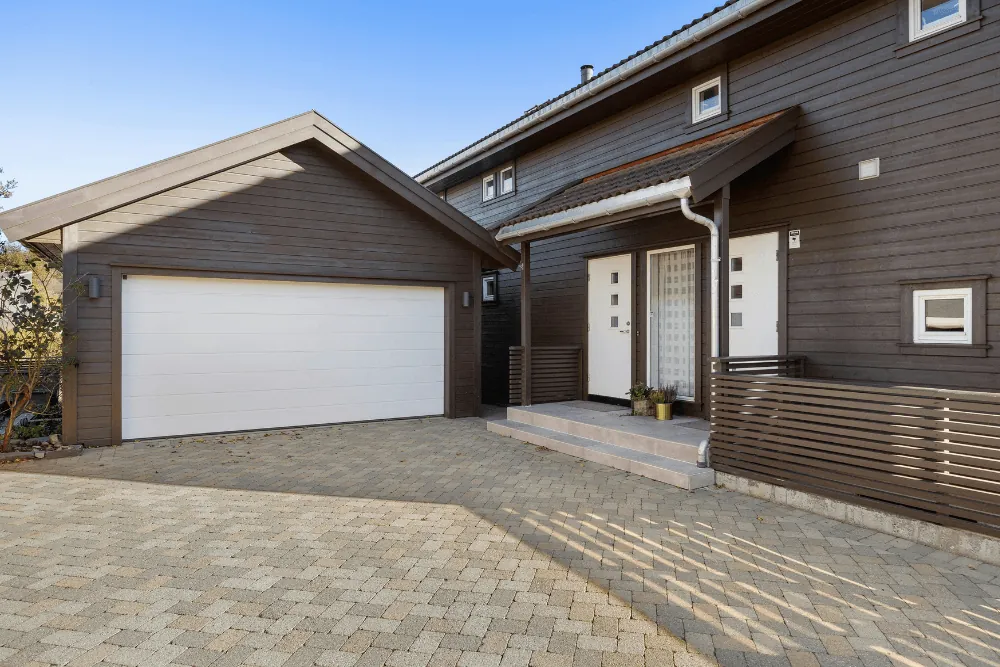
Gate and Garage Motor Installation in Dubai: Automatic Gates, Sliding and Swing Gate Openers, Boom Barriers and Garage Door Openers
A gate or garage door motor does one job again and again every day, in heat, dust and humidity, with people and cars close by. The motor, the way it is fixed to the gate, the safety devices and the power supply all have to be right, or the gate wears out early, stops working or becomes a hazard. Automatic gate installation is mechanical work, electrical work and safety work in one job.
Circuit Dubai installs and repairs sliding gate motors, swing gate openers, underground gate motors, boom barriers, garage door openers, roller shutter motors and the controls that go with them for villas, apartment buildings, farms, offices, warehouses and car parks across Dubai. We are electricians first, so the supply, the cable, the protection and the control wiring are done by the same team that fits the motor. Where we fit a make that you already own, we work to the maker's manual.
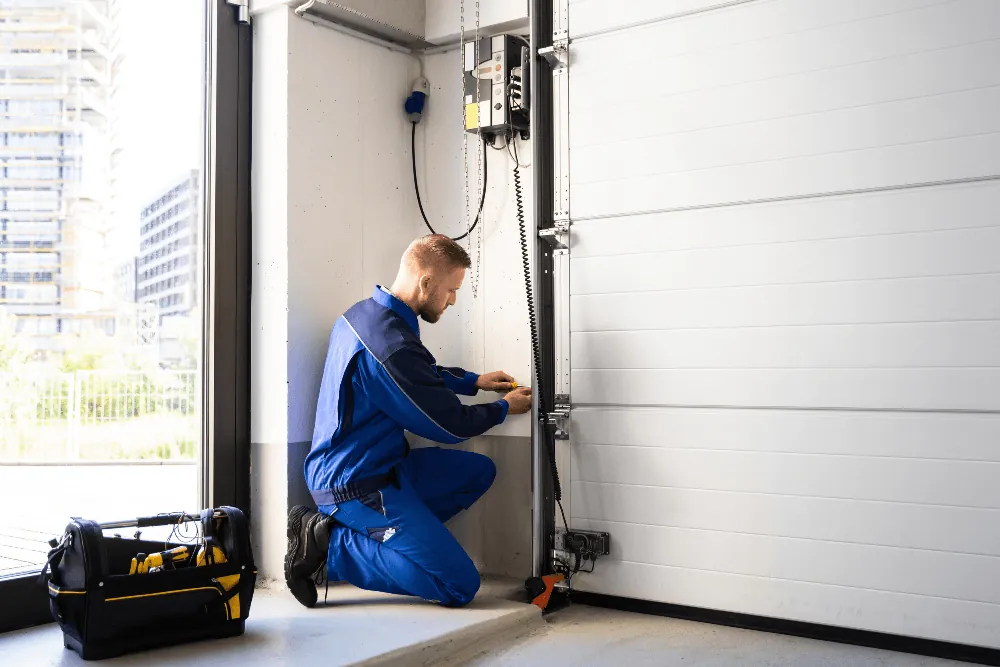
What gate and garage motor installation with us includes
A site check first, covering the gate or door, its weight and width, the posts and track, the ground, the nearest board and where people and cars pass.
The right motor for the job, chosen for the weight, width and number of openings a day, and not for the lowest price.
Mechanical set-up, with the rack, the foundation plate, the arms, the brackets and the limits fitted square and set so the gate or door moves without strain.
Safety devices fitted and tested, including photocells, safety edges, force settings and a manual release that you have seen work.
Supply, cable and controls, with a protected circuit, conduit for the cables, remotes, keypads, an intercom link and a smart controller where you want one.
A handover, with remotes programmed, the release shown to you, the settings written down and the test result recorded.
The numbers at a glance
Typical answer for Dubai
Before you book a gate or garage motor, measure the opening width and the height of the gate or door, and photograph the gate closed, open and from the side, with the posts and the ground in view. Note the material, which can be steel, aluminium, wood or a mix, and find out roughly what the finished leaf weighs. If a motor is already there, photograph its nameplate. Say whether cars, people or both pass through, how many openings a day you expect and whether the gate is shared with neighbours. Ask your community management whether an automatic gate or a change to the garage door needs approval. That gives us enough to say which motor type fits and what the first price will be. The sections below explain the choices so you can judge any quote before you accept it.
Gate and garage motor terms: what people search for and what each means
People search for this work by the gate they have, the motor they want or the fault they see. The three tables below match the wording to the work and point to the section with the detail. Some search terms are brand or model names, and some are for a different product, and the tables say so.
Automatic gate and gate repair terms
| If you searched | What it means |
|---|---|
| Automatic gate installation, install automatic gate, automatic gate system installation, automatic gate installer near me, automatic gate installers near me, automation gates near me, automated gates near me | Fitting a motor, safety devices and controls to a gate so that it opens and closes on a command. Our office is in Al Quoz and we work across Dubai. See the planning section |
| Automatic gate companies near me, automatic gate company, automatic gate contractors, automated gate company near me, automatic gate systems installers near me, electric gate company, electric gate company near me, electric gate contractors | Companies that supply and fit gate automation. See the planning section for what to ask any company, and the Why us section for ours |
| Electric gate installation, electric gate installers near me, electric gate opener installers, electric gate openers near me, electric driveway gates near me | The same work, named by the electric motor. See the planning section |
| Motorized gate installation, motorized gate installation near me, motor gate installation, remote gate installation, remote control gate installation, remote gates for homes | Gates that open from a remote control. See the controls section |
| Automatic gate motor installation, electric gate motor installation, gate motor installation near me, installation gate motors, gate motor installers near me | Fitting the motor that drives the gate. See the sliding gate and swing gate sections |
| Automatic gate opener installation, install gate opener, automatic gate opener installers near me, installing automatic gate opener, home gate opener, gate opener installers near me | Fitting the opener that moves a gate leaf. See the swing gate section |
| Automatic driveway gate installers near me, electric opening gates driveway, electric sliding driveway gates | Gates across a villa driveway. See the sliding gate and swing gate sections |
| Automatic gate and fence, fence automatic gate | A gate set into a fence line, where the posts and the fence panels have to carry the motor or the gate. See the planning section |
| Automatic gate opener for wooden gate, automatic wood gate opener, automatic wooden gate opener, electric sliding wooden gates | A motor for a timber gate. Wood changes the weight and the way a gate hangs. See the swing gate section |
| Sliding gate motor installation, sliding gate motor fitting, sliding gate opener installation, slide gate opener installation, install sliding gate, automatic sliding gate installation, automatic sliding gate opener installation, installing sliding gate opener, sliding gate opener installation near me | A motor that pulls a gate along a track or on rollers. See the sliding gate section |
| Swing gate motor installation, automatic swing gate installation, automatic swing gate opener installation, dual swing gate opener installation | A motor that swings a gate leaf on its hinges, with one leaf or two. See the swing gate section |
| Underground gate motor installation, in ground gate opener | A motor in a box under the gate post that turns the leaf from below. See the swing gate section |
| Beninca sliding gate motor installation, centurion swing gate motor installation, faac in ground gate opener, e8 swing gate opener | Brand and model names. We install to the maker's manual and do not claim to be a dealer of any make. See the swing gate section for the E8 |
| Boom gate installation, automatic boom gate, automatic boom barrier gate, electronic boom gate, barrier gate installation, gate barrier installation, gate barrier system installation, parking gate installation, loop detector for boom barrier | A rising arm that stops and releases vehicles at an entrance. See the boom barrier section |
| Smart sliding gate opener, smart home gate opener, wifi gate opener, apple homekit gate opener, gate opener homekit, homekit gate opener, home automation gate control | A gate that you open from a phone or a home system. See the controls section |
| Automatic gate repair, repair automatic gate, automatic gate repair near me, automatic gate repair companies near me, automatic gate opener repair near me, repair gate opener, automatic gate motor repairs, automatic gate chain repair, automatic gate system repair | Fixing a gate motor, chain, control board or safety device. See the repair section |
| Electric gate repair, electric gate repairs, electric gate repair near me, electric gate repair company near me, electric gate motor repairs near me, home electric gate repair, electric gate technician, electric gate technician near me | The same repair work, named by the electric gate. See the repair section |
| Driveway gate repair, driveway gate repair near me, motorized gate repair, motor gate repairs near me, sliding gate motor repairs, remote control gate repair, gate automation repair, gate automation repairs near me, automated gate repair services, automated gate repair services near me, automatic gate repair near me | Repair of driveway, sliding and remote-controlled gates. See the repair section |
| Automatic gate servicing, electric gate service, electric gate servicing near me, automatic gate maintenance, electric gate maintenance, electric gate maintenance near me, automatic gate opener maintenance | Regular checks, lubrication and safety tests. See the maintenance part of the repair section |
| A automatic gate & repair | A search phrase with a word missing. It asks for an automatic gate and its repair, and both are covered in the sections above and below |
Cost terms
| If you searched | What it means |
|---|---|
| Automatic gate installation cost, cost of automatic gate installation, cost of installing automatic gates, automated gate cost, automatic driveway gates cost, cost of electric gates, electric gate installation cost, electric gate motor installation cost, sliding gates cost, gate motor installation prices, automatic barrier gate price | What decides the price of a gate, a motor or a barrier. See the cost section. A price without a site check is a guess |
| Garage door opener installation cost, garage door opener installation cost near me, garage door opener and installation cost, garage door opener installation price, garage door opener price with installation, price for garage door opener, automatic garage door opener installation cost, garage opener installation cost, garage opener installation price | What decides the price of a garage door opener and its fitting. See the cost section |
Garage door opener and other motor terms
| If you searched | What it means |
|---|---|
| Garage door opener installation, garage door opener installation near me, garage opener installation, garage opener installation near me, garage door motor installation, garage door motor installation near me, electric garage door opener installation, automatic garage door opener installation, automatic garage opener installation, automatic garage door opener and installation, garage door opener and installation, garage opener and installation, install new garage door opener, garage door opener installment | Fitting a motor to a garage door. See the garage door opener section and the fitting section. The last phrase is a spelling of installation |
| Garage door opener installers near me, garage opener installers near me, garage door opener companies, garage opener company | Companies and people who fit garage door openers. Our office is in Al Quoz and we work across Dubai |
| Fitting automatic garage door opener, fitting electric garage door opener, mounting a garage door opener | Putting the opener on the door and the ceiling or wall. See the fitting section |
| Side mounted garage door opener, side mounted garage opener, garage door opener mounted on side, shaft mounted garage door opener | An opener that sits beside the door and turns the shaft. See the garage door opener section |
| Garage opener mount, garage opener mounting bracket, garage door opener mounting bracket, garage door opener hanging bracket, garage door brace for opener | The brackets that hold the opener and strengthen the door. See the garage door opener section |
| Changing garage door opener, changing out garage door opener, replacing a garage door opener, replacing garage door opener, replacing garage opener, replacing garage door motor, replacing a garage door opener motor | Taking out an old opener and fitting a new one. See the fitting section |
| Add garage door opener, add remote control to garage door opener, add remote to garage door opener | Putting a motor on a door that is lifted by hand, or adding a handset to an opener that you have. See the fitting section |
| Garage door opener service, garage opener service | Servicing an opener. See the maintenance part of the repair section |
| Roller shutter motor installation, shutter motor installation, rolling shutter motor fitting, roll up garage door motor installation | A tubular or side motor on a roller shutter or a roll-up door. See the roller shutter section |
| Motorised blinds installation, motorized blinds installation cost, motorised curtain installation, motorized curtain installation, curtain motor installation, homekit motorized blinds, best motorized blinds | Motors for blinds and curtains. These belong to smart home work, and the roller shutter section says what we do and where to go for the rest |
Planning an automatic gate or garage door: what to decide before a motor is chosen
The motor is the last decision, not the first. The gate or door, the ground, the posts, the supply and the people who use the opening decide which motor fits. A motor chosen first and a gate bent to suit it is how a job goes wrong.
Start with the gate or door you have
| Question | Why it decides the motor |
|---|---|
| How heavy is the finished gate or door? | Every operator has a weight limit, and the weight must include pickets, mesh, boards, locks and hinges. A leaf that was weighed bare will be heavier on the day |
| How wide is the opening? | A long swing leaf puts a bigger load on the hinge and the arm, and a long sliding gate needs a long run-back |
| What is it made of? | Steel, aluminium and wood differ in weight and in the way they hang. A solid panel also catches the wind |
| Does it move freely by hand? | A gate that binds, rubs or drops on its hinges will wear out any motor |
| Who uses it? | Cars only, cars and people, or a shared entrance, because pedestrians change the safety devices |
| How many openings a day? | A villa gate and a car park entrance are not the same duty |
Choose the gate type
| Type | Suits | Main limit |
|---|---|---|
| Sliding gate | A driveway with room beside the opening, or a gate that must clear a slope or a steep apron | Needs a run-back as long as the opening, plus space for the motor and posts |
| Swing gate, single leaf | A narrow opening with a good post on the hinge side | A long or heavy leaf needs a stronger post and arm |
| Swing gate, dual leaf | A wide opening, where two shorter leaves put less load on each hinge | Needs room for both leaves to swing, and the leaves must be timed together |
| Underground gate motor | A gate where an arm above ground is unwanted | Needs a box in the ground with drainage, and the leaf has to suit the operator |
| Boom barrier | A car park or a gated entrance where the aim is to stop and release vehicles | Controls vehicles and does not keep out people on foot |
Plan the power and the cable first
A gate motor needs a supply, a control cable to each device and a safe place for the control box. Cables for the motor and the safety devices run in conduit under the ground, and conduit has to be in before the foundation or the paving is laid. A cable dug into the ground without conduit is a repair that waits to happen. Running the conduit at the same time as the foundation is part of the same trench, and adding it afterwards means breaking paving. We plan the route with you at the site check. If a new circuit is needed, see our DB box and distribution board page for what the board must hold.
A gate that stands open when the power fails is a security problem, and a gate that stays shut is a problem for a car that is trying to get in or out. Battery backup is a choice that depends on the operator, so ask about it when you choose the motor.
Gates in fences and boundary walls
An automatic gate and fence is a gate set into a fence line, and the fence panels, the posts and the wall are part of the job. A post that carries a swing gate takes the weight of the leaf and the push of the arm every time the gate moves. A thin fence post or a block pillar with no steel in it can crack or lean. We look at the posts at the site check and tell you if a post has to be rebuilt or replaced before a motor goes on. A fence that is itself light, such as a mesh panel, may need a stronger frame around the gate. A gate that opens across a path, a pavement or a neighbour's drive needs the swing or the slide to stay inside your own land.
What to ask any gate company
When you compare quotes from an automatic gate company or an electric gate company, ask each one the same questions.
- 1What is the weight limit of the motor, and what does my gate weigh?
- 2Which safety devices are included, and where will they go? A quote with no safety devices is lower because it leaves them out.
- 3How will the power and the cables be run? Conduit, the circuit and the protection should be on the quote.
- 4What happens in a power cut? A manual release, a battery or both.
- 5Who is responsible after handover? Ask for a written test result and the settings.
- 6What does the quote leave out? Check whether the posts, the foundation, the paving repair and the intercom are in the price, because a quote can leave them out.
Be careful of a quote that names no motor, a price with no site visit, a motor chosen without asking the weight and a company that will not say how the safety devices are set.
Rules and standards for automatic gates and garage door openers in Dubai
An automatic gate can crush, shear and trap, so it falls under safety rules for machines as well as electrical rules. We are electricians and not lawyers, so confirm what applies to your building with your community management, your consultant or the authority.
What applies and where it comes from
| Subject | What applies |
|---|---|
| Wiring regulations | DEWA publishes Regulations for Electrical Installations. This page does not repeat DEWA's clause numbers. Where we give a figure, it comes from a maker's manual, a standard or a work-safety guide, and we check the DEWA requirement for your property before work starts. |
| Safety of power-operated gates | The European standards EN 12453, which sets the safety requirements, and EN 12445, which sets the test methods, are the reference standards for powered gates and doors. UK work-safety guidance points to them and describes the hazards. Whether the standards are a contract requirement in your project depends on your consultant or your community. |
| Hazards to design out | Crushing at the hinge, shearing between a sliding leaf and a fixed part, trapping at the closing edge and drawing in at the drive gear. UK guidance asks for gaps at hinges to be avoided or guarded and for the back of a sliding gate to be fenced |
| Two kinds of protection | Preventing contact with sensors, and limiting the force if contact happens. UK guidance treats photocells as helpful but not high-integrity safety devices, because rain, leaves and snow can trip them and a person can step over the beam |
| Force testing | UK guidance asks that force limits be checked with a force-measuring instrument along the lines of EN 12445 and that the results be written down. A gate that merely feels gentle has not been tested |
| Supply and protection | A dedicated circuit with a residual current device, a means of isolating the motor and an earth connection. A maker's manual for one in-ground operator asks for a 30 mA differential switch and a switch that opens all poles with a contact gap of at least 3 mm. Follow the manual for your motor |
| Cable protection | UK guidance asks that wiring be protected against damage and water, because a short circuit can disable the safety function. See our conduit, trunking and cable tray page for the route |
| Community rules | Master developers and owners' associations set rules for changes to gates, boundary walls and garage doors. Ask before you order a motor. |
| Roads and public land | A gate or barrier must not swing or slide over a public road or a neighbour's land. |
| Owner's duty | UK guidance puts the duty to keep a gate safe on the owner, landlord or managing agent. In Dubai, treat it as yours as the owner or manager of the gate, with regular checks and repair when a safety device fails. |
| Maker's manual | The maker states the installation steps, the weight limit and the safety checks. We install to the manual and keep to its test steps |
Why the standards matter at a villa gate
A villa gate may not be covered by a legal duty to test it, but the hazards are the same as at a factory gate, and a child, a pet or a delivery person is as easily hurt. The requirements above are the reason we fit more than one safety device and test them, and the reason we tell you if a gate cannot be made safe with the motor you chose. A gate that has been tested and has its settings written down is also easier to repair and to service later.
Sliding gate motor installation: rack, pinion, track and limits
A sliding gate moves sideways along a line, so it needs the space beside the opening and a firm base to run on. It suits a driveway that is flat or sloping, a gate that would hit a car if it swung and an entrance where the leaf must not cross the pavement. Sliding gate motor installation is the work of fixing a motor beside the gate, driving the gate by a toothed rack and setting where it stops.
How a sliding gate motor drives the gate
The motor sits on a plate or pad beside the closed position. A gear on the motor, the pinion, meshes with a toothed strip, the rack, that is bolted along the bottom of the gate. When the pinion turns, the gate moves. Two limit switches or magnetic sensors tell the control board where the open and closed positions are. Guide rollers on a post keep the gate upright, and the gate runs either on a track with wheels or as a cantilever with a counterbalance that carries it without a track.
| Part | What it does | What goes wrong |
|---|---|---|
| Foundation plate or pad | Holds the motor level and still | A pad that settles tilts the motor and the pinion wears one side |
| Rack | Carries the drive along the gate | A rack that is too tight to the pinion wears fast, and one that is too loose jumps |
| Pinion | Turns the rack | Wear shows as a rough movement and a gate that stalls |
| Track or cantilever carriage | Carries the weight | Sand, grit and a bent track bind the gate |
| Guide rollers | Keep the gate upright | A worn roller lets the gate sway and rub |
| Limit switches | Stop the gate at open and closed | A moved switch makes the gate hit the stop or stop short |
| Control board | Reads the commands and the safety devices | Water and heat damage a board that sits in a poor enclosure |
The steps of fitting a sliding gate motor
The order is the same for a Beninca, a Centurion or any other make, and only the fixing details change. We follow the manual of the motor that is on your gate.
- 1Check the space. The run-back for a track gate is about the width of the opening plus an allowance for the motor and posts. A cantilever gate also needs a counterbalance, which an American installation guide gives as about 30% to 50% of the opening width as an example.
- 2Set the conduit and the pad. Conduit for the power and the control cable goes in before the concrete is poured, and the motor pad is poured level beside the closed position.
- 3Fit the track or the carriage and the posts. The track is straight and level along its whole length, and the guide post is plumb.
- 4Hang the gate and slide it by hand to check that it moves without binding before any motor is fitted.
- 5Fix the motor to its plate with the pinion square to the gate.
- 6Fit the rack along the bottom rail of the gate. An example figure is 1 to 2 mm of clearance between the rack teeth and the pinion, and we set the clearance to the maker's figure. The rack is fitted a section at a time so that the joins keep the same pitch.
- 7Wire the motor, the board and the earth. The supply, the control cable and the safety devices are connected as the wiring diagram shows, and the motor body is earthed.
- 8Set the limits and the force. The gate is run slowly to each end, the stops are set and the force is set so that the gate stops on an obstacle. See the safety section.
- 9Fit and test the safety devices. Photocells, edges and any loop are checked as the safety section describes.
- 10Teach the remotes and show the release.
Gates that are not ready for a motor
A gate that binds, hangs out of line or sits on a track full of sand will wear out any motor. We tell you if the gate needs a new track, a new wheel or a straightened frame first. A heavy gate that has been moved by hand for years may feel fine and still load a motor beyond its limit.
Sliding gates in Dubai conditions
Sand and dust get into a track groove and the teeth of a rack, and heat makes steel expand along a long gate, so the clearances that were right in winter can change. Salt air near the coast attacks unprotected steel and board enclosures. We choose a motor rated for outdoor use and a control enclosure that keeps out water and dust, and we put cleaning and lubrication on the service list.
Swing gate openers and in-ground gate motors: dual leaves, arms and pillars
A swing gate turns on hinges, so the opener works against the weight of the leaf as it swings and against any wind that pushes on it. Swing gate motor installation depends more on the posts and the hinges than a sliding gate does, and a good opener on a poor post will not hold.
Single leaf and dual leaf
A single leaf suits a narrow opening, and a dual leaf suits a wide one. Two shorter leaves put less load on each hinge than one long one, and each has its own opener. A wide opening is easier on the hinges with two leaves, where there is room for them to swing. Weigh the finished gate, because a listed weight can leave out pickets, mesh and hardware. Dual swing gate opener installation needs the two leaves timed so that one starts a moment before the other and the leaves meet cleanly when they close.
Articulated and linear arms compared
| Arm | How it works | Suits | Watch for |
|---|---|---|---|
| Articulated arm | A jointed arm that folds as the gate opens | Heavier or wider leaves, and posts that are not perfectly square | Needs room beside the post for the arm to fold |
| Linear arm | A screw or ram that pushes the leaf in a straight line | Narrow posts and tight spaces | More sensitive to a post that is out of plumb |
| Underground motor | A motor in a box under the hinge that turns the leaf | A gate where no arm should show | Needs a box with drainage and a leaf that suits the motor |
Where the hinge sits and why it matters
An opener has to overcome a turning force, not just the weight of the leaf. The further the weight sits from the hinge, the larger the force, so a wide leaf loads the opener harder than a narrow one of the same weight. A leaf that has dropped on its hinges loads the opener further, so one of the first checks is whether the gate swings freely by hand. Hinges go on the centre line of the post and not on its face, so that the gate swings in a flat plane, and the posts are plumb in both directions. Concrete needs time to cure before the gate is hung, and about seven days is one example. A swing arc of 90 to 110 degrees is the range in the examples above, and the opener's stroke and mounting point have to fit that arc.
Posts, pillars and wooden gates
The post carries the weight of the leaf and the push of the opener, and a post that is light or has no steel in it can lean or crack. A concrete footing sized for the leaf, a steel or reinforced post and a bracket bolted through and not screwed into a render are the basics. A block pillar with a mounting bracket must be strong enough for the load, and we tell you if one has to be rebuilt.
A wooden gate adds its own problems. A wooden leaf is heavy, and it can twist or drop on its hinges, which loads the opener. An automatic gate opener for a wooden gate, whether you call it an automatic wood gate opener or an automatic wooden gate opener, needs a strong frame, good hinges and a stop on the ground. A solid wooden leaf also catches the wind, and UK guidance names wind on close-boarded hinged gates as a concern. A diagonal brace can stiffen a leaf that flexes, and wind that makes a gate stop and reverse near the open position is a reason to check the leaf before the opener. Electric sliding wooden gates need a rack fixed to a frame that is strong enough to take it, and the weight has to be within the motor's limit.
In-ground and underground gate motors
An underground gate motor sits in a box set in the ground at the hinge, and it turns the leaf from below, so nothing shows above ground except a small cover. The limits in one maker's manual for an in-ground operator, the FAAC 770, are an example, and a different make has its own. That manual gives a leaf of up to 500 kg, up to 2.5 m long and an opening of up to 110 degrees, and it asks for a strong rigid leaf with mechanical stops.
| Item | Example from that manual |
|---|---|
| Foundation box | Set in a hole in concrete, with a bed of quick-setting concrete where the ground is soft |
| Drainage | A second tube leads rain water from the box to a drain |
| Supply | 230 V at 50 Hz, with the operator drawing about 1.7 A |
| Cable route | A 35 mm tube from the box to the control unit for the operator cable, and low-voltage accessory cables kept apart from the 230 V cable |
| Protection | A differential switch at 30 mA and an all-pole switch at the supply |
| Release | A key release that frees the leaf for hand operation |
| Lubrication | The pivot and the ball are greased at fitting and on service |
This is why an in ground gate opener, including a FAAC in ground gate opener, starts with a site check. The box needs drainage in the right place, and a driveway that floods or ground that stays wet can fill a box that has no outlet. A box that stays full of water corrodes and seizes the pivot. We look at the ground and the nearest drain before we quote an underground gate motor installation.
Model names: Centurion, FAAC and E8
Centurion and FAAC are makers, and an automatic swing gate opener can be one of their models. We install the motor you have chosen to its manual, and we do not claim to be an authorised dealer of any make. E8 swing gate opener is a model name that we could not match to a single maker. If you have an E8, send a photo of the nameplate and we will say whether we can fit and set it.
Boom barriers and parking gates: barrier gate installation and loop detectors
A boom barrier is a horizontal arm that rises to let a vehicle through and lowers behind it. It controls cars at an entrance, a car park or a plant gate, and it is faster than a gate because the arm is light. It does not stop a person on foot, so a pedestrian gate or a turnstile is a separate item. Barrier gate installation and parking gate installation are the same job at different sizes.
What a barrier is made of
| Part | What it does |
|---|---|
| Housing | A steel cabinet on a concrete base that holds the motor, the springs and the control board |
| Boom | The arm, in aluminium or steel, with red and white marking or lights so that drivers see it |
| Balancing spring | Carries the weight of the boom so that the motor does not have to |
| Control board | Reads the commands, the loop and the photocells |
| Loop detector | Senses a vehicle over a loop of wire in the road |
| Photocells | Detect an object in the path of the boom |
| Access device | A card reader, a keypad, a remote or a ticket machine that sends the open command |
A UK installer guide gives 6 m as the longest automatic rising-arm boom and 4 m for a manual tilt barrier, with crash-rated and heavy-duty types longer. A maker's limit for a model is on its datasheet, and a longer opening needs a folding boom or a bigger operator. Automatic gate barrier installation also needs the boom's length checked against the lane, the height of the vehicles that pass and the speed at which the barrier must open.
Fitting a boom barrier
- 1Choose the position. The barrier stands beside the lane with room for the boom to rise, a clear view for the driver and a position set back so that a car waiting to enter does not block the road.
- 2Lay the foundation and the conduit. A foundation of about 600 by 600 by 800 mm deep is an example for one barrier post, and we follow the maker's drawing.
- 3Fix the housing level with the anchor bolts the maker specifies.
- 4Fit and balance the boom. The spring is set so that the boom stays where it is placed half way, and a boom that is not balanced strains the motor.
- 5Cut and lay the loop and fit the detector. The next part says how.
- 6Fit the photocells and any safety edge on the boom.
- 7Wire the supply and the controls on a protected circuit.
- 8Set and test the open and close times, the loop, the photocells and the manual release.
How a loop detector works
A loop detector is a coil of wire in a slot cut into the road, connected to a detector unit. A vehicle over the loop changes the coil's inductance, and the detector sends a signal. For a boom barrier, the loop is what stops the arm lowering onto a car that is under it. UK installer guidance describes loops as the way to prevent the barrier lowering onto a waiting vehicle, so we fit one on every vehicle barrier.
These figures come from a United States traffic loop guide and are examples. The maker of the detector sets the final figures.
| Item | Example figure |
|---|---|
| Slot | About 50 mm deep and 6 mm wide, cleaned and dried before the wire goes in |
| Wire | Cross-linked polyethylene insulation, 14 to 20 AWG. PVC and nylon-coated building wire absorb moisture and crack |
| Turns | Fewer turns for a long loop and more turns for a short one, set from the loop perimeter |
| Lead-in | Shielded and twisted, with the shield earthed at one end only |
| Detection height | About two thirds of the loop's shortest side |
| Two loops by a sliding gate | Wired in series with opposite winding, so the gate's movement does not trigger them |
| Two detectors | Set to different frequencies so that they do not disturb each other |
A loop that is poorly cut or laid is the first thing to suspect when a detector misbehaves, which is why we cut the slot, lay the wire and seal it with care. A loop that has been cut by resurfacing, or whose wire has moved because the ground has settled, shows as a barrier that no longer sees a car. See the repair section for fault finding.
Barriers, access control and parking
A barrier on its own opens for anything that triggers it. For a car park with permits or tickets, the card reader, the ticket machine or the number-plate camera sends the command. See our access control and intercom page for readers and keypads, and our CCTV installation page for a camera at the lane. An exit loop and an entry loop at a gate that passes cars both ways are separate loops.
Gate safety devices: photocells, safety edges, force limits and manual release
A gate is safe when it cannot trap someone and when a person who is trapped can be freed. The motor's own force setting helps, but it is the last defence and not the first. A well fitted gate has two or more independent safety measures.
Where photocells and safety edges go
A photocell is a pair of devices, a transmitter and a receiver, facing each other across the opening, and an object in the beam stops or reverses the gate. A UK installer guide gives mounting heights of 400 mm and 1,000 mm above the ground as an example for a pair of beams, and recommends screened cable and careful alignment. A second pair at another height catches a child or a low object that one beam misses. UK guidance warns that standard beams are not high-integrity devices, because rain, leaves and snow can trip them and a person can step over them. A beam at a given height does not protect the hinge side of a swing gate, which is why a gate also needs an edge or a force limit.
A safety edge is a strip along the leading and closing edges of the leaf that stops the gate when it is pressed. UK guidance puts edges on the leading edge and other edges that crush or knock, and it says edges that are correctly selected and fitted can measure forces lower than the maximums in EN 12453. An edge is connected by a flexible cable, and repeated flexing is a known cause of failure, so the cable is run in a chain or a protected loop.
| Device | What it protects against | Notes |
|---|---|---|
| Photocell pair | An object in the path of the gate | Needs a clean lens and a firm bracket, and can be tripped by rain or leaves |
| Safety edge | A person or object pressed by the moving leaf | Fitted on the leading and closing edges, and the cable has to survive flexing |
| Force limiting | A leaf that meets resistance | Set on the control board, and tested with an instrument |
| Slow speed near the end | A crush at the end of travel | A setting on boards that offer it |
| Fixed guard or fence | Shear at the back of a sliding gate | A mesh or panel that closes the gap |
| Warning light and sign | A person who does not know the gate is moving | A flashing lamp and a sign beside the opening |
Force limiting and testing
The control board can be set so that the motor stops or reverses when it meets resistance. A setting that is too low makes the gate stop for a gust of wind or a worn wheel, and one that is too high will push on a person. UK guidance asks for the forces to be measured with an instrument along the lines of EN 12445 and the results recorded, and we do that on gates where the owner or the consultant requires it. For a villa gate, we set the force to the lowest value that lets the gate move freely, test it with a safe obstacle and record the settings.
The manual release
A gate has to be able to open by hand when the power fails or someone is trapped. A sliding gate motor has a key or a lever release that frees the pinion, and an underground motor has a key release at the lock. The release is shown to you at handover, and a gate that has been released must be put back into drive and the power switched back on as the manual says. A gate that cannot be released is a gate that a fire engine or an ambulance cannot get through, so the release has to work and has to be known to the people who live there.
Test log
Each safety device is tested more than once at handover, at slow speed and at normal speed, and we write the results on a sheet that you keep. A UK installer guide suggests the user checks a gate visually each week and a competent engineer inspects it each year. We give you a short list of what to look at each week.
Remote controls, keypads and smart gate openers: wifi, HomeKit and home automation gate control
A gate motor needs a command to move, and the command can come from a handset in the car, a keypad on the post, an intercom, a loop in the road or a phone. The command device is separate from the safety devices, and a smart controller adds convenience without adding safety.
Ways to open a gate
| Command | How it works | Notes |
|---|---|---|
| Remote control | A handset sends a coded signal to a receiver in the control board | Remote control gate installation includes teaching each handset to the board, and one handset can be removed from the board if it is lost |
| Keypad or card reader | A code or a card sends the open command | Suits a shared entrance or visitors. See our access control and intercom page |
| Intercom | A visitor calls and someone at the house opens the gate | See our smart lock, doorbell and intercom page |
| Exit loop or sensor | A car leaving triggers the gate | Saves a handset and a button |
| Wall button | A button in the house or the garage | Wired to the control board, and a long run needs a screened cable |
| Phone | A wifi or cellular controller sends a pulse to the gate board | See the next part |
How a smart controller triggers a gate
Remote gates for homes can be opened from a phone. A smart controller does not replace the gate's board. It connects to the board's input for a push button, the same input a wall button uses, and sends a short closing contact when the phone says open. The usual wiring for a relay on a garage door opener, described in a smart relay maker's guide, is in parallel with the existing wall button, so both work. The terminals carry low voltage, for example 12 to 24 V, so we measure the terminals with a meter and check the maker's manual before we connect.
Two limits follow from that. A relay sends a pulse and does not know where the gate is, so a controller needs a position sensor, a magnetic reed switch or a tilt sensor on the gate, to show open or closed in an app. And the relay is a control device and not a safety device, so the gate's photocells, edges and force settings do the safety work whatever the phone says.
Wifi, HomeKit and home automation gate control
A wifi gate opener is a gate motor with a controller that joins your wifi, or a controller added to the board of a motor you already have. A smart home gate opener works the same way, and a smart sliding gate opener is the same controller on a sliding gate. Apple's Home app has an accessory type for garage doors, and third-party makers sell controllers that present a gate or a door to it, so an apple homekit gate opener, a gate opener homekit or a homekit gate opener is a controller that works with the Home app. We do not claim to be a dealer of any controller.
Home automation gate control links the gate to a scene, so that a gate opens when you arrive or a light comes on when the gate opens. That is smart home work, and we fit the wiring on the gate side. See our smart home installation page for the controls and the hub.
These points apply to any smart gate controller.
- The gate must work without it. A gate has to open on its remote and keypad when the wifi is down.
- Who has access? An app that opens the gate is a key. Anyone with the phone or the account can open it, so remove the access of anyone who leaves the household.
- Auto-close and the safety devices. A gate that closes itself on a timer relies on its photocells and edges every time.
- Power. The controller needs a supply of its own at the control box, and a power cut stops the wifi as well as the motor.
- Surges. A gate board on a long outdoor cable is exposed to surges, and a surge is a known reason for a board to fail. See our surge protection page.
Garage door openers: side-mounted, shaft-mounted and ceiling-mounted openers and their brackets
A garage door opener is a motor with a drive that lifts a sectional, up-and-over or roller door and a control that tells it when to stop. The way it is mounted depends on the door and the space, and the mounting hardware carries the load of the door every time it moves.
Types of garage door opener
| Type | How it works | Suits |
|---|---|---|
| Ceiling-mounted trolley opener | A motor head hung from the ceiling drives a carriage along a rail. An arm joins the carriage to the top of the door | A garage with headroom above the door and a ceiling that can carry the unit |
| Side-mounted or shaft-mounted opener | A motor beside the door turns the shaft or torsion bar that lifts the door | A garage with a low or obstructed ceiling, or where the ceiling is to be kept clear |
| Chain or belt drive | The drive that moves the carriage along the rail | A chain drive is louder than a belt drive. Either can be fitted to a ceiling opener |
| Roller door motor | A motor on the barrel of a roll-up door | See the roller shutter section |
Side-mounted and shaft-mounted openers
A side mounted garage door opener, also called a shaft mounted garage door opener or a jackshaft opener, sits on the wall beside the door and turns the torsion shaft that carries the door's springs. A supplier's guide gives these examples of what it suits and what it does not.
- Suits: a garage with a low ceiling or pipes, ducts and lights in the way, a garage with a very high ceiling, a garage where ceiling storage matters, a room above the garage where noise matters, and a door that has torsion springs.
- Does not suit: a door with extension springs, and a garage with no wall space beside the door. About 16 inches, roughly 400 mm, of side space is the figure one supplier gives to plan for.
- Compared with a ceiling opener: the side unit needs no ceiling space and has fewer moving parts, and one supplier's guide says it costs more up front.
The opener turns the shaft that holds the door's springs, so the springs and the cables must be sound, and we do not re-tension torsion springs as part of an opener job.
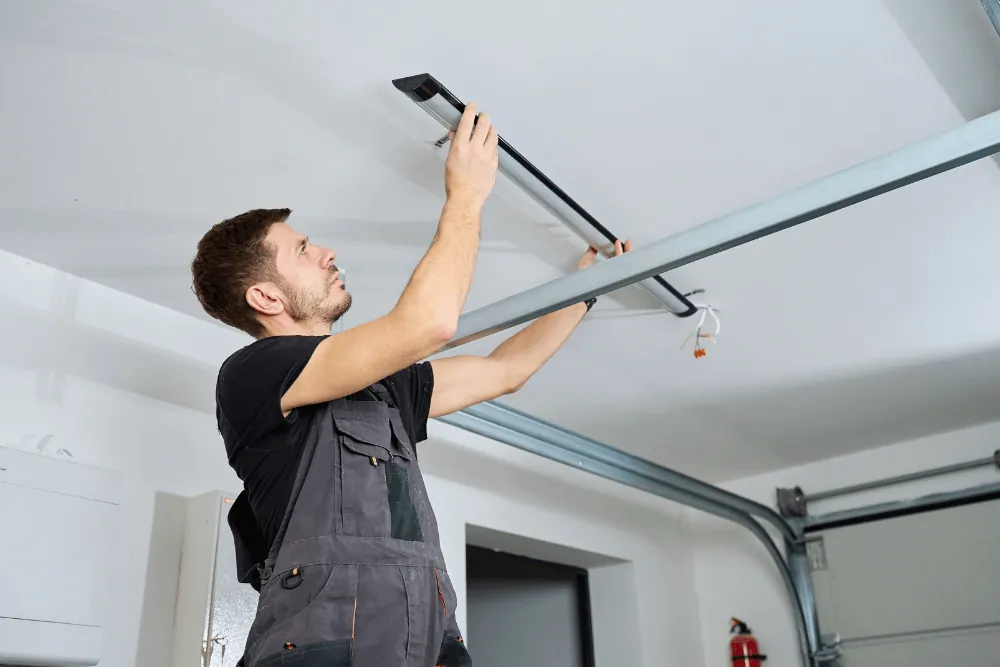
Mounting brackets, hanging brackets and door braces
| Part | What it does | What to check |
|---|---|---|
| Header bracket | Fixes the rail to the wall above the door | Fixed to a sound wall or beam, in line with the middle of the door |
| Hanging bracket | Hangs the motor head from the ceiling | Fixed to the structure with fixings suited to a concrete slab or a joist, and not into a false ceiling |
| Garage door opener mounting bracket or garage opener mounting bracket | The bracket that holds the opener to the wall, ceiling or frame | Square and tight, because a loose mount shakes the opener and wears it |
| Door bracket | Joins the arm to the top of the door | Fixed through the door's top section |
| Reinforcement bracket, the garage door brace for an opener | A strip that strengthens the top of a light door so that the arm does not tear it | Used where the door skin is thin |
A garage door opener hanging bracket and a garage opener mount carry the weight of the head and the pull of the door. Fixings that are right for a concrete slab are different from those for a timber joist, and a false ceiling cannot carry a motor. A light aluminium or insulated door can bend at the point where the arm pulls on it, which is why a brace goes across the top section. A door that is too light for the opener's force can also be damaged by a force setting that is too high.
Power, safety sensors and the wall button
The opener needs a socket near the head, and where there is none, we fit a socket or a fused spur from a circuit that can carry it, and not a long lead across the ceiling. See our socket outlet installation page. The wall button is wired to the opener and fixed at a height out of the reach of a child. A pair of safety sensors goes near the floor on each side of the door, and an object in the beam stops the door from closing, so a pet or a child in the doorway is detected. The opener also has a force setting so that the door reverses when it meets resistance, which is tested at handover, as the next section describes.
Fitting, replacing and adding to a garage door opener: step by step
Garage door opener installation is a job in which the door matters as much as the motor. Before any opener goes on, the door has to be balanced, the track straight and the springs sound.
Check the door first
Lift the door by hand to about half way and let go. A balanced door stays where it is left, and a door that rises or drops is out of balance.
Look at the springs, cables and rollers for wear and fraying.
Run the door up and down by hand and listen for rubbing at the track.
An opener on an unbalanced door works against the springs every time, and a motor that was chosen for a smooth door is overloaded by one that rubs. If the door needs work, we say so, and the work is done before the opener goes on.
Fitting a ceiling opener
Fitting an automatic garage door opener or an electric garage door opener on a ceiling rail follows these steps, which each maker's manual sets out in detail.
- 1Assemble the rail and the carriage as the manual shows.
- 2Mark the centre of the door and fit the header bracket above it.
- 3Hang the motor head from the ceiling with the hanging brackets, level and square to the rail.
- 4Fix the door bracket, with the brace if the door is light, and connect the arm.
- 5Run the cable to the wall button and the safety sensors, and connect the supply.
- 6Set the travel and the force. The door is run to the open and closed positions and the force is set to the lowest value that lets the door move freely.
- 7Fit and align the sensors.
- 8Test the reverse. A block of wood on the floor under the door should make the door stop and reverse as the manual describes.
- 9Teach the remotes and show the release cord or lever.
Replacing a garage door opener
Replacing a garage door opener, whether you call it changing garage door opener work, changing out garage door opener work or replacing garage opener work, starts with the same door check and then with what carries over.
| Item | Reuse or replace |
|---|---|
| Door, springs and cables | Check and repair first |
| Rail and brackets | Reuse if sound and if the new opener fits. A different make has its own rail and brackets unless the maker says otherwise |
| Wall button and sensors | Replace with the new opener's, because an old button may not suit the new board |
| Remote handsets | Replace with handsets that suit the new receiver. A handset has to match the receiver, so handsets do not carry across makes |
| Supply and socket | Check that the socket and the protection suit the new opener |
When a motor fails and the rest of the opener is sound, replacing a garage door opener motor or replacing garage door motor can be done on its own where the maker sells the head separately. Where the unit is old and parts are no longer sold, a new opener is the better choice. We tell you which applies after we see the model.
Adding an opener to a door that is lifted by hand
To add a garage door opener to a door that has none, the door has to be balanced and in good order, the wall above the door and the ceiling have to carry the brackets and a supply has to reach the head. A door that is heavy to lift or has no spring counterweight needs door work first. If the garage is in a villa with a slab ceiling, the hanging bracket takes anchors rated for concrete. A side-mounted unit is an option where there is no ceiling space.
Adding a remote to a garage door opener
To add a remote to a garage door opener, or to add a remote control to a garage door opener, the handset has to match the opener's receiver, which means the same maker and the same system. The receiver then learns the handset, with a button on the motor head on some models, as the manual describes. An opener with no receiver cannot learn a remote, and an old receiver may not accept a new handset. We tell you which applies from the model and its nameplate. A handset that is lost is removed from the receiver, so that it no longer opens the door.
Roller shutter motors, rolling shutters, motorised blinds and curtain motors
Shutters, roll-up doors, blinds and curtains look different, but a motor drives each of them in the same way: a tube or a track turned by an electric motor, with a limit at each end. This section says what we do and where the work belongs.
Roller shutter and roll-up door motors
A roller shutter is made of slats that wind onto a barrel above the opening. A shutter motor installation fits a tubular motor inside the barrel, or a motor at the end or the side that turns the barrel by a chain or gear. A roll up garage door motor installation is the same work on a larger door. A rolling shutter motor fitting needs the motor matched to the weight of the curtain and the size of the barrel, and a manual override for a power cut.
| Item | What to settle |
|---|---|
| Weight and size | The motor's torque has to suit the weight of the curtain and the barrel |
| Motor type | A tubular motor in the barrel, or a side or end motor with a chain or gear |
| Supply | Single-phase for small motors, and three-phase for large industrial doors |
| Limits | The up and down limits stop the curtain at the top and when it meets the sill |
| Control | A wall switch, a remote, a key switch or a smart controller |
| Override | A hand crank, a chain or a release for a power cut |
| Safety | A stop on an obstacle, and an edge on the bottom bar where the door can close on a person |
The limits are set so that the shutter stops at the top without jamming the curtain into the box and stops at the bottom without pushing on the sill. The method of setting differs by maker, so we follow the motor's sheet. A shutter that is not square in its guides or has rubbing slats will overload any motor.
Industrial and warehouse roller doors
A large roller door in a warehouse or a loading bay uses a bigger motor, which may be three-phase, with a brake, a hand chain and limit switches. The supply, the isolator and the protection come from the motor's data. See our motor and lift wiring page for the supply, the starter and the checks that apply to larger motors.
Motorised blinds, curtain motors and HomeKit blinds
A motorised blind has a motor in its tube, and a motorised curtain has a motor on its track. The motor needs power from a socket, a hidden supply or its own battery, and the control comes from a remote, a wall switch or a smart system. This is smart home work, and a blind or curtain also needs a supplier for the product itself.
- What we do: run the power or the control cable behind the wall and fit the motor and the wall switch where the product allows.
- What your blinds supplier does: measures and makes the blind, the fabric and the track.
- The best motorized blinds: the right blind depends on the window, the fabric, the width and where the power comes from. We do not rank brands, and we fit the product you have chosen.
- Homekit motorized blinds: the motor or its hub has to support Apple's Home app, and not every blind does. Check before you buy.
Motorised blinds installation, motorized blinds installation cost, motorised curtain installation, motorized curtain installation and curtain motor installation are quoted after we see the windows and the wall. See our smart home installation page for the controls, and send photos of the windows and the nearest socket.
Gate and garage opener cost: automatic gate installation cost and garage door opener price with installation
The price of a gate or garage opener depends on the motor, the gate or door, the posts, the cable and the safety devices, and a quote that gives one figure with no list cannot be compared with one that shows each part. The factors below answer the searches for the cost of automatic gate installation, the cost of installing automatic gates, the cost of electric gates and sliding gates cost.
What goes into the price of a gate motor
| Factor | Why it changes the price |
|---|---|
| Gate type | A sliding, swing, dual-leaf or underground installation needs different parts and different groundwork |
| Weight and width | A heavier or wider leaf needs a bigger motor |
| The gate itself | A new gate is a separate cost from the motor, and a quote that includes the gate, the track and the posts is higher than a motor-only quote |
| Motor make and duty | A motor made for heavy daily use costs more than one for a villa |
| Posts and foundations | Posts, pillars, footings and the motor pad |
| Groundwork | Trenching, conduit and making good the paving |
| Power | A new circuit, a protection device and the cable from the board |
| Safety devices | Photocells, edges, a second pair of beams and warning lights |
| Controls | Remotes, a keypad, an intercom link, a loop and a smart controller |
| Battery backup | An extra if you ask for it |
| Testing and handover | Force tests, the settings sheet and training |
An automatic gate installation cost, an electric gate installation cost, an electric gate motor installation cost and a price for gate motor installation all depend on these items. A boom barrier adds the foundation, the loop and the access device, and the figure for an automatic barrier gate price is set by the boom length and the duty.
What goes into the price of a garage door opener
| Factor | Why it changes the price |
|---|---|
| Door type and weight | A heavy sectional door needs a stronger opener |
| Opener type | A side-mounted unit can cost more than a ceiling unit, and the maker's range sets the rest |
| Brackets and brace | A hanging kit, a reinforcement bracket or a side-mount frame |
| Power | A socket at the head if there is none |
| Door work | A door that is out of balance or has worn parts needs work before an opener goes on |
| Controls | Extra handsets, a keypad and a smart controller |
| Removing the old opener | Taking out and disposing of the old unit |
Garage door opener installation cost, garage door opener and installation cost, garage door opener installation price, garage opener installation cost, garage opener installation price, price for garage door opener and automatic garage door opener installation cost all rest on these items. The site visit costs AED 50, and the quote follows it. We quote the opener and the fitting on separate lines, so you can see what each part costs.
How we price
We give a fixed price after a site check or photos, with the motor, the posts, the groundwork, the supply, the safety devices, the controls and the testing on separate lines. If a lower-rated motor does the work safely, we say so on the quote. A price that arrives before anyone has seen the gate is a guess, and we say so when you ask for a number by message.
Gate and garage opener repair, servicing and maintenance
A gate or opener that fails does so at a bad moment, with a car outside or the family inside. The faults in the tables below come from a short list of causes, and a regular service finds them first.
Finding the fault on a gate
| Symptom | Likely cause | Fix |
|---|---|---|
| Nothing happens | No power, a tripped breaker, a failed supply or a dead handset battery | Check the breaker and the supply, test with the wall button, change the battery |
| The gate runs but stops half way | An obstruction, a force setting that is too low, a binding wheel or a rack that is too tight | Clear the path, check the gate by hand, reset the force or the rack clearance |
| The gate reverses before it closes | A photocell lens that is dirty or misaligned, a safety edge fault or a loop | Clean and align, test the edge and its cable |
| The gate opens but will not close | A photocell beam is blocked or a safety input is open | Check each safety device in turn |
| The gate moves, then stops with a hum | A worn capacitor, a failing motor or a jam | Test the capacitor and the motor, and check the gate by hand |
| The motor runs but the gate does not move | The release is open, or the pinion is slipping or the chain is broken | Put the motor back in drive, and check the pinion and the rack or the chain |
| The handset works only close to the gate | A weak battery or a poor aerial on the receiver | Replace the battery and check the receiver |
| The board is dead after a storm or a surge | Surge damage | Replace the board and fit protection. See our surge protection page |
| A swing gate drifts or does not meet its partner | Timing, a dropped leaf or a worn hinge | Reset the leaf timing and check the hinges |
| The gate was hit by a vehicle | Bent frame, a damaged post or a broken arm | Check the structure before the motor |
An automatic gate chain repair on a chain-driven gate means checking the chain for stretch and broken links and the sprockets for wear, and replacing them together when they are worn.
Finding the fault on a garage opener
| Symptom | Likely cause | Fix |
|---|---|---|
| The motor hums and the door does not move | A broken spring, a seized roller or a failed capacitor | Check the door and its springs before the motor |
| The door starts to close and reverses | A sensor beam is blocked or misaligned, or the force or the travel is set wrongly | Clean and align the sensors, reset the travel |
| The wall button works and the handset does not | A flat battery or a lost handset code | Replace the battery and teach the handset again |
| The door opens part way | The travel setting or an obstruction | Reset the travel and check the track |
| The opener is noisy | A dry chain, a loose bracket or a worn roller | Lubricate, tighten the bracket and replace the roller |
| The light flashes and the opener does not move | The opener is showing a fault code | Read the code against the maker's manual |
Stop and keep clear of a gate or a door that has a person or a pet trapped, a garage door with a broken spring or a cable that has snapped, and any wiring that is cut, burnt or exposed. Do not reach into a moving gate. Switch off the supply at the board, use the release to free a person if you can do so without putting a hand in the path, and call for help. The spring and cable of a garage door hold stored tension and can injure a person who touches them.
What a service covers
| Check | What we do |
|---|---|
| Gate or door | Free movement by hand, hinges, wheels, track and rack or chain |
| Motor and drive | Mounting, backlash, noise and lubrication |
| Safety devices | Clean lenses, alignment, edge and cable condition, force and the reverse |
| Electrical | Supply, protection, the control board, connections and earth |
| Controls | Handsets, keypad, loop and the smart controller |
| Release | A test of the manual release |
| Record | A note of the settings and any parts that need replacing |
Repair or replace
A gate motor that is a decade old with a failing board may cost more to repair than a new motor, and a make that is no longer sold may have no parts. A repair is the better choice where the motor is sound and the fault is a board, a capacitor, a photocell or a wheel. We say which applies and give both prices.
Servicing and maintenance on a schedule
Automatic gate servicing, electric gate service, automatic gate maintenance, electric gate maintenance, automatic gate opener maintenance, garage door opener service and garage opener service are searches for the same job. A UK installer guide recommends a weekly visual check by the user and an annual inspection by a competent engineer. We offer a yearly visit and give you a short weekly checklist.
Gate and garage motor installation with Circuit Dubai
- Electricians first, so the supply, the protection, the cable and the control wiring are one job with one person responsible.
- The motor chosen for the gate, from its weight, width, posts and the number of openings a day.
- Safety devices fitted and tested, with the settings written down and the release shown to you.
- Repair as well as new work, on gates and openers that we did not fit.
- Direct advice, including when a gate needs new posts, a straighter track or a new door spring before a motor goes on.
We work across all of Dubai. Our office is in Al Quoz.
If you are also planning outdoor and garden lighting, CCTV installation, access control and intercom or smart home installation, we can plan one set of cable routes for the gate, the lights, the cameras and the controls, so the trench is dug once.
Phone: +971 55 407 7427
Gate and garage motor questions we hear from Dubai customers
How much does an automatic gate cost to install?
It depends on the gate type, the weight and width, the posts and groundwork, the supply and the safety devices. A new gate is a separate item from the motor. A site visit costs AED 50, and the price follows it. We give a fixed price after a site check, with each part on its own line.
Can you add a motor to the gate I already have?
Yes, if the gate is in good order, within the motor's weight limit and hung on posts that can take the load. We check the gate by hand, the posts and the track at the site check and tell you what has to be done first.
Should I choose a sliding or a swing gate?
A sliding gate suits a driveway with room beside the opening and a gate that would hit a car if it swung. A swing gate suits a narrow opening with a strong hinge post. A wide opening is easier on the hinges with two leaves. We tell you which fits after we see the entrance.
How heavy a gate can a motor move?
Each model has a weight limit, which you find on its datasheet, and the limit has to be compared with the weight of the finished gate with its pickets, mesh and locks. One in-ground operator's manual, for example, gives a leaf of up to 500 kg and 2.5 m, and other models differ.
Do you install underground gate motors?
Yes, where the ground allows a box with drainage and the leaf suits the operator. We look at the ground and the nearest drain before we quote.
What is a boom barrier loop, and do I need one?
A loop is a coil of wire in the road that senses a vehicle, and it stops the barrier lowering on a car that is under the arm. We fit one on a vehicle barrier.
Is the gate safe for children and pets?
A gate that has photocells, a safety edge or a tested force setting and a working release is safer than one with a motor alone, and none of these removes the need to keep children away from a moving gate. We set and test each device and give you the results.
What happens to the gate in a power cut?
A gate motor has a manual release, and some can fit a battery. The release has to work and has to be known to the people who live there. We show it at handover.
Can I open my gate from my phone?
Yes, with a wifi or cellular controller wired to the gate board. The controller sends the open command, and the gate's own safety devices still do the safety work. A position sensor tells the app whether the gate is open or closed.
Does it work with Apple HomeKit?
Controllers that appear in the Apple Home app are sold for gates and garage doors, and we can wire one to your gate board. Check that the model you choose supports the Home app before you buy.
Do you fit Beninca, Centurion or FAAC motors?
We install to the maker's manual and we do not claim to be a dealer of any make. Send the model and we will say whether we can fit and set it.
Can you fit a motor to a wooden gate?
Yes, if the frame is strong, the hinges are good and the weight is within the motor's limit. A wooden leaf can twist or drop on its hinges and catches the wind, and we check both before a motor goes on.
What is the difference between a side-mounted and a ceiling-mounted garage door opener?
A ceiling unit hangs from the ceiling and drives the door along a rail. A side-mounted unit sits beside the door and turns the shaft that carries the door's springs. A side-mounted opener suits a low or crowded ceiling and a door with torsion springs.
Can you replace my old garage door opener?
Yes. We check the door first, take out the old unit, fit the new opener and teach the remotes. A different make brings its own rail, wall button and handsets.
My garage door opener hums but the door does not move. What is wrong?
The spring, a roller and the opener's capacitor are the first things to check, and a broken spring is a job for a door technician before the motor. Do not touch the spring or the cables.
Do you fit motors on roller shutters and blinds?
We fit motors on roller shutters and roll-up doors, and we run the power and the control cable for motorised blinds and curtains as part of smart home work. Your blinds supplier supplies the blind itself.
Do I need permission for an automatic gate in my community?
Communities set their own rules on changes to gates, walls and garage doors, so ask your community management before you order. We do not know your community's rules and we will not guess them.
Ready to book a gate or garage motor?
Send photos of the gate or door closed and open, the posts, the ground and the nearest board, give the width and the material and photograph any motor that is already there. Tell us what is wrong if you need a repair. We reply instantly on chat with a view on which motor type fits, what needs doing first and a fixed price, so you know what you are buying before anyone cuts a trench.