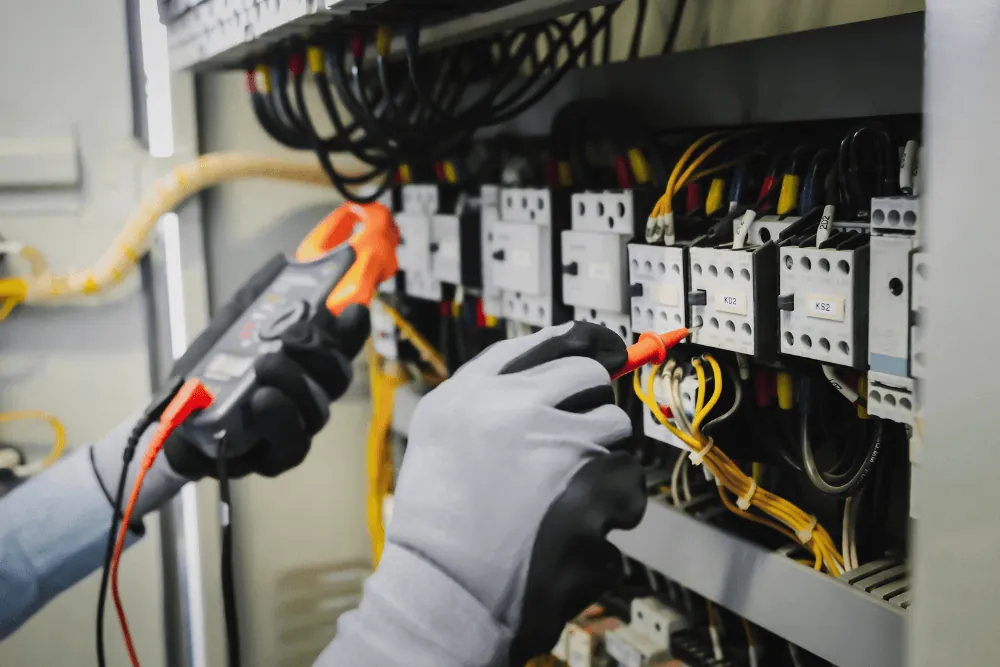
Power Factor Correction in Dubai: Capacitor Banks, Automatic Panels and Controllers, and Capacitor Wiring for Homes and Businesses
Power factor correction is the work of making a building draw less reactive power from the supply, which is done with capacitors, a controller to switch them and protection to keep them safe. For a factory, a mall, a hotel or a plant with big motors and chillers it can free capacity in the transformer and cables, and a proper study is worth doing. For a villa the sums are different, and we say so plainly on this page.
Circuit Dubai measures power factor, sizes and installs capacitor banks and automatic power factor correction panels, fits and sets controllers, and finds faults in existing banks. We also do the electrical side of capacitor work on air conditioners, fans, pumps and washing machines, because searches for a capacitor can turn out to be for those jobs, and the page covers them honestly.
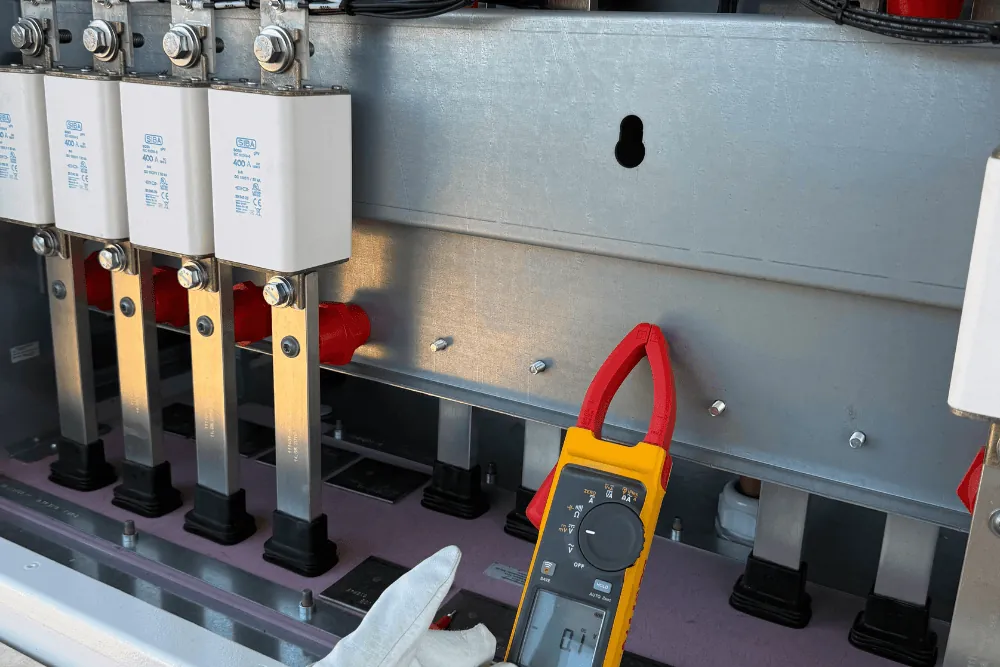
What power factor work with us includes
A reading first, from the bill, the meter or a logger fitted for a week, so the size of the bank rests on measurements and not on a guess.
A bank sized from numbers, with the kW, the starting and target power factor and the kvar worked out and shown.
Fixed capacitors, automatic panels and detuned banks installed to the design, with the protection, the controller and the current transformer set up and tested.
Harmonics checked before capacitors go in, because capacitors on a network with drives and UPS units can resonate.
Fault finding on existing banks, covering failed capacitors, worn contactors, controller settings and a bank that corrects the wrong way.
The electrical side of motor capacitors on air conditioners, ceiling fans, pumps and washing machines, and straight advice for homes on what power factor devices will and will not do.
The numbers at a glance
Typical answer for Dubai
Before you book power factor work, find the latest bill and look for a line that shows power factor, kVA, kVAr or a reactive energy charge. If there is none, say so. Photograph the main board and the name labels of the biggest motors, chillers and pumps. Write down the main breaker rating, whether the supply is single-phase or three-phase, and whether there are variable speed drives, UPS units or LED lighting banks, because they affect the design. If you are asking about a capacitor on an air conditioner, fan or pump, photograph the capacitor label and the unit's nameplate, and do not open the cover yourself. The sections below explain the work so you can judge any quote before you accept it.
Power factor terms: what people search for and what each means
The searches for this subject mix building equipment, home gadgets, electronics and small motor capacitors. The tables below match each wording to the work, or say that it is something else, so you land on the part of this page that fits.
Correction, panels and capacitor bank terms
| If you searched | What it means |
|---|---|
| Power factor correction, power factor and power factor correction, electrical power factor correction, power factor improvement, power factor and power factor improvement, power factor compensation, reactive power correction, power factor correction in power system, power factor improvement in power system | Adding capacitors, or other equipment, so a load draws less reactive power. See the what power factor is section |
| Increase power factor, for power factor, for power factor improvement, power factor use, use of power factor, use of power factor in electrical | Raising the power factor of a load, and why it matters. See the what power factor is section |
| Power factor reduction | Searchers use this for the opposite of correction. A low power factor is a reduction in how well a load uses current, and correction raises it again. See the what power factor is section |
| Automatic power factor, automatic power factor correction, automatic power factor improvement, automatic power factor correction system, automatic power factor correction unit, automatic power factor correction panels | A panel of capacitor steps that a controller switches on and off as the load changes. See the types section |
| Power factor correction panels, power factor panels, power factor correction system, power factor correction unit, power factor unit, power factor equipment, power factor correction equipment, power factor correction devices, power factor improvement devices, power factor module | The equipment itself. See the types section for fixed, automatic, detuned and dynamic kinds, and the home section for plug-in devices |
| Capacitor bank installation, capacitor banks for power factor correction, capacitor banks for power factor improvement, capacitor for power factor improvement, capacitor to improve power factor, improving power factor using capacitor, correcting power factor using capacitors, static capacitor power factor improvement | Fitting capacitors to correct power factor. See the sizing and installation sections |
| Power factor capacitor, power factor correction capacitor, pf correction capacitor, pfc capacitor, power correction capacitor, correction capacitor, capacitor and power factor, power factor in capacitor, reactive power for capacitor | The capacitor part of the equipment, and why a capacitor supplies reactive power. See the what power factor is section |
| Kvar power factor, 100 kvar power factor correction | The size of a bank is given in kvar. See the sizing section for the sum, and the example of a 100 kvar bank |
| 3 phase power factor correction, three phase power factor correction, 3 phase power factor capacitor, 3 phase power factor correction capacitors, power factor 3 phase, power factor in three phase | Correction on a three-phase supply, which is where banks are used. See the sizing section |
| Single phase power factor correction, single phase capacitor for power factor correction, single phase power factor capacitor, power factor for single phase, power factor of single phase | Correction on a single-phase supply, which suits only small loads. See the home section |
| Detuned power factor correction | A bank with a reactor in series to avoid resonance with harmonics. See the detuning section |
| Dynamic power factor correction, real time power factor correction system, svg power factor correction | Fast correction by electronic switching or a static var generator (SVG), for loads that change within a second. See the types section |
| Leading power factor correction, capacitive load power factor, inductor power factor | Leading and lagging power factor, caused by capacitors and by inductors. See the what power factor is section |
Controllers, brands and prices
| If you searched | What it means |
|---|---|
| Power factor controller, power factor correction meter, power factor correction controller, automatic power factor controller, digital power factor controller, apfc automatic power factor controller, apfc power factor, single phase power factor controller, power factor contactor | The relay that measures power factor and switches capacitor steps through contactors. A power factor correction meter is a display of the factor, either on the controller or on a separate power meter. See the types section |
| Circutor power factor controller, epcos power factor controller, entes power factor controller, frako power factor regulator, abb power factor controller, abb power factor controller rvt, power factor abb | Brand searches for a controller. These are makers of controllers and regulators. We are not their dealer and make no claim to be. The types and cost sections explain what a good controller must do |
| ABB power factor correction, eaton power factor correction, eaton power factor correction capacitors, ge power factor correction capacitors, schneider electric power factor correction, power factor correction schneider, power factor correction unit schneider, siemens power factor correction | Brand searches for banks and capacitors. We install the make the design calls for. See the cost section for what to compare |
| Power factor correction price, power factor correction unit price, power factor capacitor price, power factor correction capacitor price, automatic power factor controller price, power factor controller price | Price searches. See the cost section for what moves the price. We do not publish a list price here |
| Power factor correction manufacturers, power factor correction capacitor manufacturers, power factor controller manufacturers, best power factor controller | We are an installer and not a manufacturer. The cost section says what to ask when comparing makes |
Home, concept and electronics terms
| If you searched | What it means |
|---|---|
| Home power factor, power factor at home, power factor for home, home power factor correction, domestic power factor correction, domestic power factor correction unit, power factor correction for home use, home power factor correction devices, power factor controller for home, automatic power factor controller for home | A question about homes. See the home section, which says honestly what these devices do and do not do |
| Industrial power factor | Power factor in plants and factories, where correction pays back. See the planning section |
| DC power factor, output power factor, supply power factor, power factor limited, power factor circuits | Concept searches. DC has no reactive power in the sense used for AC. Output and supply power factor describe the two ends of a device. See the what power factor is section and the equipment section |
| Power factor correction circuit, power factor correction in smps, active power factor correction, active power factor correction using boost converter, passive power factor correction, passive power factor correction circuit, pfc power factor, pfc power factor correction | Circuits inside electronic power supplies, not building equipment. See the equipment section |
| Inverter power factor correction, solar inverter power factor correction, generator power factor correction, motor power factor correction, ac power factor correction | Power factor of an inverter, a generator, a motor and an air conditioner. See the equipment section |
Capacitor wiring searches that are not about power factor
| If you searched | What it means |
|---|---|
| AC capacitor connection, ac capacitor wiring, ac unit capacitor wiring, capacitor ac wiring, wiring a ac capacitor, ac capacitor wire connection, capacitor connection ac, capacitor connection in ac, capacitor for ac unit wiring, capacitor for ac wiring, capacitor wiring ac unit, hvac run capacitor wiring, capacitor wiring hvac, wiring run capacitor air conditioner, ac run capacitor wiring, ac start capacitor wiring | The run or start capacitor of an air conditioner's motor. This is a motor part and not a power factor bank. See the capacitor wiring section |
| Ac compressor capacitor connection, ac compressor capacitor wiring, ac compressor connection with capacitor, ac compressor wiring to capacitor, ac fan capacitor connection, ac fan capacitor wiring, ac motor capacitor connection, ac motor capacitor wiring, ac motor connection with capacitor, single phase ac motor capacitor connection, condenser capacitor wiring, condenser fan motor capacitor wiring, wiring condenser fan capacitor | The same, for the compressor, the condenser fan and single-phase motors. See the capacitor wiring section |
| Ac outdoor unit capacitor connection, outdoor unit capacitor wiring, split ac capacitor connection, capacitor connection in split ac, window ac capacitor wiring, lg window ac capacitor connection, lg ac capacitor wiring, lg outdoor capacitor wiring, trane ac capacitor wiring | The same, for a split, window or outdoor unit, and brand searches by name. We are not an agent for any air conditioner make. See the capacitor wiring section |
| Air compressor capacitor wiring, capacitor connection in water pump, single phase water pump capacitor connection, pedrollo water pump capacitor connection, washing machine motor capacitor connection, 4 wire capacitor for washing machine connection | Motor capacitors on compressors, pumps and washing machines. Pedrollo is a pump brand and we are not its agent. See the capacitor wiring section |
| Ceiling fan capacitor problem, ceiling fan capacitor replacement, kdk ceiling fan capacitor replacement, kdk fan capacitor replacement, panasonic ceiling fan capacitor replacement | Fan capacitors, including brand searches for KDK and Panasonic fans. See the capacitor wiring section |
| Cbb60 capacitor 30uf, cbb61 capacitor 300vac 2wire | Type codes of film capacitors for motors and fans. See the capacitor wiring section |
| Install capacitor for smart switch | A small capacitor used with a smart switch that has no neutral wire. See the capacitor wiring section |
| Ups capacitor replacement | Capacitors inside a UPS. See the capacitor wiring section |
| Capacitor work | Too general for us to say what is wanted. Tell us on WhatsApp whether it is a bank, an air conditioner, a fan or something else |
Planning power factor work: who needs it and what to decide first
Power factor correction pays when a building is billed in a way that rewards a better factor or when its transformer, cables or generator are short of capacity. It does nothing useful otherwise. The questions below are settled before a bank is sized.
Who it helps and who it does not
| Site | What correction does |
|---|---|
| Factory, workshop or plant with many motors | Frees capacity in the transformer and cables and cuts losses in the internal network. This is the standard case for a bank |
| Mall, hotel, hospital or office tower with chillers and lifts | Same, and the load changes through the day, so an automatic panel suits it |
| Site that is adding load to a full transformer or generator | Correction can release enough capacity to delay an upgrade. See our transformer and substation maintenance page and our three-phase and load upgrade page |
| Villa or apartment | The meter measures energy in kWh, and correction does not change the kWh used. See the home section |
| Site billed on a plain energy rate with no kVA or power factor line | A limited financial return, though the network benefits |
What DEWA says
DEWA's own power factor page, written for commercial and industrial customers, describes a power factor between 0.9 and 1.0 as ideal for efficient use of capacity. It says a better factor improves the efficiency of equipment such as motors, improves voltage, reduces losses in the internal network and frees capacity in transformers and feeders, and it advises these customers on automatic power factor correction equipment. The page is a campaign item from 2014, it describes a target range and not a rule, and the page mentions no charge. Whether your tariff carries a charge for a low factor is a point to check on your bill or with DEWA.
The questions that decide the work
| Question | Why it decides the work |
|---|---|
| What is the power factor now, and when? | It changes through the day, so one spot reading is not enough |
| What are the big loads? | Motors, chillers and compressors lower it, LED and electronic loads act differently |
| Is the load steady or fast-changing? | Steady loads suit fixed or slow automatic steps, fast ones may need dynamic switching |
| Are there drives, UPS units or other harmonic sources? | They decide whether the bank needs detuning reactors |
| What is the supply and where is the meter? | A bank goes at the main board or at a large motor, and the current transformer for the controller goes in a set place |
| Does the site have a generator? | A bank can cause trouble on a generator supply |
| Is there room, ventilation and an outage window? | A bank gives off heat and needs space, and the connection needs a shutdown |
Who does what
| Item | Who does it |
|---|---|
| Reading the bill, logging the load and sizing the bank | Us, or the design consultancy on a larger project. See our electrical design services page |
| Supply and installation of the bank, panel and controller | Us, within the scope we agree |
| Connection to the authority's network and any approval it needs | The authority, and the consultancy where one is appointed. |
| Harmonic study on a large or complex site | A power quality specialist, or us where we hold the instrument and the skill |
| AC, fan and pump capacitor replacement | Us for the electrical side, an air conditioner technician for the refrigeration side |
Rules and safety for power factor equipment in Dubai
Power factor equipment sits under the supply authority's wiring regulations and the maker's instructions, and capacitors carry stored energy even when the supply is off. We are electricians and not lawyers, so confirm what applies to your premises with the authority and your consultant.
What applies and where it comes from
| Subject | What applies |
|---|---|
| Target factor | DEWA's page describes 0.9 to 1.0 as the ideal range for commercial and industrial customers. It does not state a rule or a charge. |
| Wiring regulations | DEWA publishes Regulations for Electrical Installations. We do not quote clause numbers on this page, and we work to the edition in force for your site. |
| Other emirates | Abu Dhabi's utility states that industrial consumers there must keep the factor between 0.9 and unity under its wiring regulations. This is a different emirate and a different rule. It is mentioned only because people compare the two |
| Capacitor ratings | A capacitor is chosen for its voltage, kvar and the harmonics on the network. A bank with detuning reactors needs capacitors rated for a higher voltage than the system voltage |
| Discharge | A capacitor must be discharged and proven safe before anyone works on it. A controller delay does not replace a discharge device |
| Isolation | Work starts with isolation, locking off and proving dead, under a permit to work. |
What the work needs on the day
A planned outage for a bank connection, a permit to work, a named person in charge, instruments with a valid calibration, the single line diagram of the board and a clear idea of what is on each feeder. We agree these in writing before the visit. If an item is missing, we say so and move the date.
Stop and keep clear of a capacitor bank or capacitor that is bulging, leaking oil or fluid, smoking, humming loudly, hot to the touch, or in a panel that smells of burning. Do not open the panel, do not touch the capacitors and do not switch the bank back on. Capacitors hold a charge after the supply is off. Switch off the supply at the main breaker if it is safe to do so, keep people away and call the electrician responsible for the board. The same goes for an air conditioner, fan or pump whose capacitor has swollen or leaked.
What power factor is, and why a capacitor corrects it
You do not need an engineering degree to follow power factor, but some terms recur in every quote. This section explains them using the same words a bank's nameplate and a controller's screen use.
Real, reactive and apparent power
A motor, a transformer or any coil needs two kinds of current. One part does the work: it turns the shaft or heats the element. That is real power, in kW. The other part builds the magnetic field the motor needs and returns it again each cycle. That is reactive power, in kvar, and it does no work, but it still flows in the cables and loads the transformer. The two combine into apparent power, in kVA, which is what the cables, breakers and transformer must carry.
Power factor is real power divided by apparent power. A load drawing 80 kW from 100 kVA has a power factor of 0.8. Its current is higher than it needs to be, since the cables carry the full 100 kVA to deliver 80 kW. Raising the power factor to 0.95 brings the same 80 kW down to about 84 kVA, so the current falls by about a sixth. This is the benefit of correction: the same work done with less current, and spare capacity in the network behind it.
Why a capacitor corrects it
Motors, transformers and chokes are inductive loads. They make the current lag behind the voltage. A capacitor does the opposite: its current leads. Placed in parallel with the load, a capacitor supplies the reactive current the motor needs, so the supply no longer has to. This is why capacitors appear in every answer to correct power factor, and why the words capacitor and power factor appear together in searches such as capacitor and power factor, correcting power factor using capacitors and power factor in capacitor.
Leading and lagging
Inductive loads give a lagging power factor, and that is the problem a bank solves. A capacitive load gives a leading one. A bank that is too large for the load, or a bank left on when the load is light, can push the factor into the leading side, which causes its own trouble, such as a rise in voltage and trouble on a generator. A leading power factor correction is the term for bringing it back. A good automatic panel switches steps off as the load falls so it never over-corrects.
Single-phase, three-phase and DC
Power factor on single-phase and on three-phase supplies means the same thing. Banks are built for three-phase, where the loads are large. The factor for a single-phase circuit can be measured in the same way, and small capacitors serve single-phase motors, but correction on a single-phase home supply does not change the bill. Direct current has no reactive power in the sense used for AC, so the idea of a DC power factor applies only to the AC side of a rectifier or a converter. The factor of an electronic power supply is set by its input circuit, as the equipment section explains.
Do you need correction? Measuring first, and the honest answer for homes
How to find your power factor
There are three ways to find it. The first is the bill: a commercial or industrial bill may show kVA, kVAr or the power factor, and where it does the bill is the cheapest source. The second is the meter or a power analyser on the main incoming breaker, which shows the factor live. The third is a logger fitted for a week or more, so the reading covers the working day, the night and the weekend. A single reading at a quiet hour is a poor basis for a bank.
We read the bill and the main board first, then log the load where the answer needs it, and give you the factor with the kW, kVA and kvar at the busy and the quiet hours. The sizing section turns those numbers into a bank.
Power factor at home
A home meter measures energy in kilowatt hours, and a home bill follows the energy used. Power factor corrects the current, not the energy, so a device that raises a home's power factor leaves the kWh and the bill where they were. Two US home-energy writers looked at plug-in and panel-fitted devices and reached the same conclusion, and one of them measured no change in meter speed with a device fitted. Their examples are American and old, so check how a Dubai home bill is made up.
The searches for home power factor, home power factor correction devices and domestic power factor correction unit are for these gadgets. We do not sell plug-in savers or panel boxes that claim to cut a home bill, and we do not recommend them. A home that has an unusually large motor load, such as a big pump, a lift or a workshop, can have a measurable power factor problem at the main breaker, and the fix there is a properly sized capacitor, with the reading on the board to show it. The right first step for a home bill is an energy audit. See our energy audit page.
What a home can gain from correction is local: less current in the cable to one large motor, and no change in the kWh. If a salesperson quotes a saving of ten or twenty per cent from a home power factor correction, ask for a before and after reading on your own meter.
Sizing a capacitor bank: kvar, steps and a worked example
A bank is sized in kvar, the reactive power it supplies. The size comes from three numbers: the kW of the load, the power factor it has now and the power factor you want. A bank bought by guess is either too small to help or big enough to push the factor to the leading side.
The sum
The reactive power needed is the load in kW multiplied by the difference between two tangents:
kvar needed = kW × (tan φ1 - tan φ2)
Here φ1 is the angle of the present power factor and φ2 the angle of the target. The tangent for any power factor is the square root of (1 - PF²), divided by PF. For a three-phase bank, the nominal current of the capacitors is the kvar multiplied by 1,000 and divided by the square root of 3 times the line voltage.
A worked sizing example
The example below uses a plant load of 400 kW at 400 V three-phase, raised from a power factor of 0.75 to 0.95. The method is the standard one.
| Step | Working | Result |
|---|---|---|
| Tangent at 0.75 | √(1 - 0.5625) ÷ 0.75 | 0.882 |
| Tangent at 0.95 | √(1 - 0.9025) ÷ 0.95 | 0.329 |
| Reactive power to add | 400 × (0.882 - 0.329) | about 221 kvar |
| Line current before | 400 kW ÷ 0.75 = 533 kVA, then ÷ (√3 × 0.4 kV) | about 770 A |
| Line current after | 400 kW ÷ 0.95 = 421 kVA, then ÷ (√3 × 0.4 kV) | about 608 A |
| Nominal current of a 225 kvar bank | 225 ÷ (√3 × 0.4 kV) | about 325 A |
The correction cuts the line current by about 160 A, which is capacity returned to the transformer and the cables. The 221 kvar figure is a theoretical sum. The bank that is bought is rounded to a size and a step pattern that fit the site, such as 225 kvar. This example is an illustration, and your own load, voltage and targets replace the numbers.
A 100 kvar example
A 100 kvar power factor correction bank suits a load of around 180 kW at 0.75 that is to be raised to 0.95, since 180 × 0.553 is about 100 kvar. Its nominal current at 400 V is about 144 A. Split into four steps of 25 kvar, the controller can add or remove 25 kvar at a time, so the correction follows the load in four increments. The step sizes in this example are an illustration, and the real pattern depends on the load profile.
Why not aim for 1.0
A target of 1.0 leaves no margin. When the load drops, a bank sized for unity pushes the factor to the leading side, which raises the voltage and can upset a generator. A target of 0.95 leaves room. DEWA describes 0.9 to 1.0 as the ideal range, so a target inside it is a safe choice unless your tariff sets another.
Voltage rating and real kvar
A capacitor delivers kvar in proportion to the square of the voltage across it. A capacitor with a rating of 25 kvar at 525 V gives about 14.5 kvar at 400 V, since 25 × (400 ÷ 525)² is about 14.5. This matters with detuned banks, where capacitors are rated at a higher voltage than the network. The maker's data sheet states the effective kvar at the system voltage, and we size the bank on that figure and not on the label alone.
Steps and the controller
Smaller first steps give a finer match to the load but add contactors, fuses and parts to maintain. The load profile from the logger decides the pattern. If the load swings by a few kvar every minute, small steps and a sensible delay do better than a few large ones. If it changes slowly, fewer steps are enough.
Correction types: fixed, automatic, detuned and dynamic
There is more than one way to correct power factor. The right one depends on how the load behaves and what else is on the network.
Correction types compared
| Type | How it works | Best for | Watch for |
|---|---|---|---|
| Fixed capacitor | A capacitor connected all the time, for example at one motor, switched with it | A single motor that runs steady | A leading factor when the motor is off and the capacitor stays on, if it is not switched with the motor |
| Automatic bank (APFC panel) | A controller reads power factor and switches capacitor steps through contactors | Sites whose load changes through the day | Controller settings, contactor wear and harmonics |
| Detuned automatic bank | The same panel with a reactor in series with each capacitor | Networks with drives, UPS units and electronic loads | Capacitors of a higher voltage rating, and the reactor's heat |
| Dynamic bank | Steps switched by thyristors instead of contactors, so it reacts within a fraction of a second | Fast-changing loads such as cranes, welders and press lines | Higher cost and more complex equipment |
| Static var generator (SVG) | A power electronic unit that injects reactive current continuously, leading or lagging, with no steps | Sites with fast loads that also need smooth correction | Higher cost, and it is a different product from a capacitor bank |
A fixed capacitor, switched together with the motor it serves, is the simplest form of motor power factor correction. An automatic panel is the answer for a whole building or plant.
Where the correction goes
| Place | What it means | The trade-off |
|---|---|---|
| At the motor (individual) | A capacitor beside each large motor | Relieves the cable to that motor, but needs a capacitor for each |
| At a distribution board (group) | One bank serving a group of loads | A middle course for a big section of a site |
| At the main board (central) | One automatic bank at the incoming supply | Relieves the transformer and the supply side, and suits an automatic panel |
The controller
An automatic power factor controller, also called an APFC relay or a power factor regulator, reads the current and voltage, works out the power factor, compares it with the target and switches steps on or off. It does this through contactors, so the choice of controller and contactor decides how well a bank behaves. A digital power factor controller shows the factor, the steps and any alarm on a screen. What matters in a controller is:
- The target and the delay between switching. A short delay chases brief load changes and wears the contacts. A long one leaves a fast-changing load under-corrected.
- The current transformer. A controller needs one on the supply side of both the load and the bank. A wrong polarity or phase connection can make it add capacitance when it should remove it, so we check the connection at commissioning.
- Alarms for over-correction, under-correction, over-voltage, over-temperature and harmonics, where the model has them.
- A manual mode to test each step on its own.
Capacitor steps are switched by a power factor contactor, which is a capacitor-duty contactor built for the large inrush current when a capacitor is switched on. A standard contactor can suffer pitted contacts.
Single-phase controllers and home units
A single phase power factor controller exists for small single-phase installations, but it belongs with a motor or a small workshop. A home power factor controller or an automatic power factor controller for home use does not save a home bill, as the home section explains. We do not recommend one for a villa.
Harmonics and detuning: why a bank can fail on a network with drives
Capacitors and the network behind them form a resonant circuit. If the natural frequency of that circuit falls near a harmonic that loads put on the network, the voltage and the current can be amplified, and the capacitors take the damage.
What the problem looks like
Variable speed drives, UPS units, LED driver banks and other electronic loads produce harmonics, which are currents at multiples of 50 Hz, such as 250 Hz (the fifth) and 350 Hz (the seventh). A bank on such a network can resonate. The results can be blown fuses, capacitors that overheat, damage to contactors, reactors that run hot, nuisance tripping and extra distortion of the voltage. A bank that fails again and again on a site with drives is the sign.
Detuned reactors
A detuned reactor is an inductor placed in series with the capacitors. It moves the resonance of the circuit below the lowest harmonic that matters, so the harmonics can no longer excite it. The reactor is chosen so that the resonance sits below about 90 per cent of the dominant harmonic. With a dominant fifth harmonic at 250 Hz, that means resonance below 225 Hz.
A detuned bank is not a harmonic filter. It stops the bank from amplifying harmonics. It does not clean the network, and a tuned filter or an active filter is a separate piece of equipment designed around the harmonic it must remove.
Detuned reactor tunings
The tuning depends on the reactor's size as a fraction of the capacitor's impedance at 50 Hz. The resonant frequency is 50 divided by the square root of that fraction.
| Reactor | Resonant frequency | Chosen when |
|---|---|---|
| 5.67 per cent | about 210 Hz | The dominant harmonic is the fifth, at 250 Hz |
| 7 per cent | about 189 Hz | The fifth is dominant and a lower resonance is wanted |
| 14 per cent | about 134 Hz | A third harmonic at 150 Hz is present, since 134 Hz sits below 90 per cent of it |
A power management company's article lists 135, 190 and 210 Hz as available tunings on 400 and 415 V, 50 Hz networks, which match the three rows above to within a few hertz. The percentages come from the arithmetic and not from the maker's text, so confirm them against the data sheet of the reactor you buy.
Capacitor voltage and the effect on size
In a detuned bank the voltage across the capacitors is higher than the system voltage, so the capacitors must be rated for it. On a 400 or 415 V network, capacitor ratings of 480 V and 525 V are used. The effective kvar at the system voltage is then lower than the label, as the sizing section shows. We size on the effective figure.
Measure first
A capacitor bank sizing guide advises against a single harmonic limit as the rule for when reactors are needed, and recommends measuring the harmonic spectrum at the point of connection. We do the same where the site has drives, UPS units or a lot of electronic load. A site with no sources of harmonics can use a plain bank, but the decision belongs to the measurement and not to a habit.
Installing a capacitor bank: where it goes, the controller and the checks
A good installation depends on the detail: the connection point, the protection, the current transformer, the discharge and the ventilation.
The sequence
- 1Read the board and the single line diagram, and confirm where the main incoming supply, the load and the bank connect.
- 2Log the load and check the sizing against the readings.
- 3Prepare the connection: the breaker or fuse switch for the bank, cable sized above the nominal current as the maker's data states, and a place on the busbar.
- 4Fit the current transformer for the controller upstream of both load and bank, with the right ratio, polarity and phase, and with the secondary never left open.
- 5Install the panel with space and ventilation round the capacitors and the reactors, which give off heat.
- 6Check the discharge arrangement of the capacitors and the protection devices.
- 7Isolate, connect and torque the connections with a wrench, and mark them.
- 8Set the controller with the target factor, the delay and the step pattern, and check the alarms.
- 9Test each step by hand, reading the current and the factor, then run in automatic with the load on.
- 10Record before and after: the power factor, kW, kVA and kvar, with the dates and times, and leave the settings and the diagram with you.
Protection and cable sizing
Capacitors draw more than their nominal current when the voltage is high or when harmonics are present, so the cables and protection are sized above the nominal value, using a factor from the maker's data and the standard. The circuit breaker, fuses and contactors are rated for capacitor switching, and the cable terminations are torqued, since a loose connection on a capacitor step heats up quickly. See our MCB and RCCB breakers page and our cable termination and jointing page.
Discharge and safety
Capacitors can hold a hazardous voltage after the supply is off. The bank has discharge devices, and we check that they work. A controller's delay between switching is not a substitute for a discharge device. Before anyone opens the panel, the supply is isolated, locked off, proved dead and the capacitors are confirmed discharged. A bank that re-energises before the capacitors have discharged can see a damaging voltage, which is why the controller waits between steps.
Commissioning checks
| Check | Why |
|---|---|
| Current transformer ratio, polarity and phase | A wrong connection makes the controller add capacitance when it should remove it |
| Each step's current against its nameplate | Shows a failed capacitor or a wrong connection |
| Controller target, delay and step logic | Sets how the bank behaves |
| Power factor before and after at a representative load | Proves the result |
| Temperature of the panel after running under load | Shows poor ventilation or loose connections. See our thermal imaging inspection page |
| Alarms, trip and discharge | Proves the safety functions |
| Behaviour when the load is light | Confirms the bank steps off and does not push the factor leading |
Faults and maintenance of capacitor banks
A capacitor bank is built to sit without attention, which is why it is forgotten until the power factor on the bill drifts down. Capacitors lose capacity with age, heat and over-voltage, and a bank that has lost a third of its steps still looks fine from outside.
What a maintenance visit covers
- 1Read the controller first, with the power factor, the step status and any alarm history, before anything is switched.
- 2Isolate, lock off and prove dead, then confirm the capacitors are discharged.
- 3Inspect the capacitors for bulging cases, leaks, discolouration, loose terminals and burn marks.
- 4Clean the panel, the fan filters and the reactors' ventilation.
- 5Tighten the connections with a torque wrench, since a loose joint heats up under the inrush current.
- 6Check the contactors for pitting, welded contacts and worn coils.
- 7Measure each step's capacitance and compare it with the label, replacing any that has fallen away, and read the current per step with the bank running.
- 8Test the controller in manual and automatic, with the target, delay and alarms.
- 9Thermal image under load to find hot joints. See our thermal imaging inspection page. We suggest including the bank in your thermal imaging round. The maker's manual sets the other intervals.
- 10Report with the readings, photos and a list of actions.
Common faults and what causes them
| Symptom | Likely cause | What we check |
|---|---|---|
| Power factor still low although the bank is fitted | Failed steps, a wrong current transformer connection, a wrong target or load that has grown | Step currents, controller settings, CT polarity and the load |
| Factor goes leading at night or at light load | A bank larger than the light load needs, or a fixed capacitor that stays on | Step logic, minimum load and controller alarms |
| Fuses blowing or capacitors overheating, repeatedly | Resonance with harmonics, or over-voltage | Harmonic measurement and the need for detuning |
| A capacitor case that is swollen or leaking | Ageing, heat or over-voltage | Replace and find the cause. Stop and keep clear until the supply is off |
| Contactors that stick or burn | Wrong type of contactor or high inrush | Capacitor-duty contactors and pre-charge resistors |
| Controller keeps switching steps up and down | Delay too short or sensitivity set wrongly | Delay and sensitivity settings |
| Unexpected trips when the bank switches | Inrush current, or a protection setting that is too tight | Protection settings and switching sequence |
Replacing a failed bank or a step
When a bank has reached the end of its life, replacing the capacitors and contactors keeps the panel. When the load has changed, a new sizing is done first, and the replacement follows it. If the site has gained drives or UPS units since the bank was installed, a plain replacement may fail again, and the answer is a detuned bank. See the detuning section.
Power factor in generators, inverters, motors and electronic power supplies
Some of the searches that reach this page are about power factor in equipment, not in buildings. This section sorts them out.
Generators
A generator has a kVA rating and a kW rating, and the two are linked by the power factor the set is rated at. A set rated at 0.8 gives 400 kW from 500 kVA, for example. A load with a low power factor needs more kVA from the set for the same kW, so a low-factor site can overload a generator in current while still within its kW. A bank and a generator can clash, since a bank that is too large can raise the voltage and upset the voltage regulator. Some designs take the bank out of circuit when the site runs on the generator. See our generator installation and servicing page for sizing and for the changeover.
Inverters and solar
An inverter can be set to supply or absorb some reactive power, within its rating and the network operator's rules. A grid-tied solar inverter can therefore take part in power factor control, with the settings the authority requires. See our solar panel installation page and our commercial solar service page.
Motors
A motor's power factor falls when it runs lightly loaded, so an oversized motor on a small load has a low factor. A capacitor placed at a motor is sized at or below the motor's no-load reactive demand, so that it cannot raise the voltage when the motor is switched off while still spinning. For a site with a large number of motors, a central bank is the more practical form. A variable speed drive has a good input power factor but distorts the current, which brings back the harmonics issue.
Air conditioners
The run capacitor of an air conditioner motor makes that motor run. It is not sized to correct a building's factor. Some modern units have power factor correction built into their electronics. Correction for a building with many air conditioners is done at the board, as for any other load. See the capacitor wiring section for the run capacitor itself.
Power supplies: active and passive power factor correction
Electronic equipment has its own power factor correction built into its power supply. Without it, a switch-mode power supply draws current in short spikes, and the power factor can be as low as 0.4. With an active stage it reaches 0.95 or higher. A power supply maker's design article describes the active kind: a boost converter placed between the bridge rectifier and the large capacitor shapes the input current into a sine wave in step with the voltage. A passive stage is a network of an inductor and a capacitor at the input that smooths the current by simpler means, with a smaller improvement. The standard IEC/EN 61000-3-2 limits the harmonic current of equipment drawing up to 16 A per phase, which is why such circuits are built in.
The searches for power factor correction in SMPS, pfc power factor correction, active power factor correction using boost converter and passive power factor correction circuit are about these circuits. They are part of the device, designed by its maker, and repaired at component level by an electronics workshop. We do not design or repair them. Our work is the building's supply, as the sections above set out. See also our transformer and substation maintenance page, which covers the PFC converter in a power supply from the transformer's point of view.
Output and supply power factor
Output power factor is the factor of the load a device can feed. A UPS rated at 100 kVA with an output factor of 0.9 gives 90 kW, so the kW rating decides what it can carry. Supply power factor is the factor the device presents to its supply. For both, the maker's data sheet states the figure, and we size the UPS or the generator on the kW as well as the kVA. See our UPS and inverter installation page. A search for power factor limited does not name a standard term: it may mean a limit on the factor a device can supply, or it may be a company name, and we are not connected to any firm of that name.
Capacitor wiring for air conditioners, fans, pumps, washing machines and smart switches
Some of the searches that reach this page are for the small capacitor on a motor, not for power factor correction. The two are different jobs. This section explains the small capacitor and what we do about it. It is also a warning: a capacitor can hold a charge after the supply is off, and a person who opens an air conditioner or a pump without the training can be hurt.
What these capacitors do
A single-phase motor needs a second winding, fed through a capacitor, to produce a rotating field. The capacitor shifts the current in that winding. A run capacitor stays in circuit while the motor runs. A start capacitor gives extra torque to get a compressor or a pump moving and then drops out. A dual-run capacitor is one case with two capacitors inside, one for the compressor and one for the condenser fan, and it has three terminals. Capacitor work in this sense means replacing a failed one with the same value.
AC capacitor terminals
A dual-run capacitor on an air conditioner's outdoor unit has three terminals, marked as follows in HVAC guides:
| Terminal | Meaning | What is connected |
|---|---|---|
| C | Common, the shared connection for both motor circuits | As the unit's own wiring diagram shows |
| HERM | Hermetic, for the compressor motor | The compressor winding, which takes the larger microfarad value |
| FAN | The condenser fan motor | The fan motor winding, which takes the smaller value |
The label shows the two values and the voltage, for example 40 and 5 µF at 370 or 440 V AC, with a tolerance of about five per cent. A replacement matches the µF values exactly, and its voltage rating is equal to the original or higher, never lower. Wire colours are not the same on every make, so the connections are photographed and labelled before anything is removed. Wiring the compressor to the FAN terminal causes poor running, overheating and likely motor failure.
A measurement about 10 per cent or more below the rating is a reason to replace, and the label gives the tolerance. A top that bubbles or a case that leaks oil is a reason too, and ordinary rust on the can is not. A failed capacitor shows as a compressor that will not start, a fan that runs slowly, backward or hot, and high current. Searches for ac capacitor wiring, split ac capacitor connection, window ac capacitor wiring, hvac run capacitor wiring, lg ac capacitor wiring and trane ac capacitor wiring all describe this same job on different makes. The terminals follow the same pattern, and the unit's own wiring diagram decides the details. We are not an agent for LG, Trane or any air conditioner make.
What we do and what an AC technician does
We do the electrical side: isolating, discharging and proving dead, replacing a capacitor with a matching one, checking the supply, contactor and wiring, and measuring the current. Refrigerant, compressor and gas faults belong to an air conditioner technician. We do not advise anyone to replace an air conditioner capacitor themselves. See our AC electrical connection page for the circuit that feeds the unit.
Ceiling fan capacitors
A ceiling fan that starts slowly, hums, needs a push, or runs weakly on every speed may have a failed capacitor. The replacement has the same microfarad value and an equal or higher voltage rating, taken from the label, and the fan is isolated first. CBB61 is a type code for a metallised film capacitor used in fans. A two-wire capacitor is one capacitor, and a four-wire one is a pair in a single case, so its wires are matched to the fan's diagram. Searches for KDK fan capacitor replacement, KDK ceiling fan capacitor replacement and Panasonic ceiling fan capacitor replacement are brand searches, and we are not an agent for either. See our ceiling fan installation page.
Pumps, compressors and washing machines
Single-phase pump motors, small air compressors and washing machines use the same principle, each with a run capacitor. The value is on the capacitor label, and the wiring diagram is on the terminal box cover or on the machine. CBB60 is a type code for a film capacitor used on heavier motor duty, such as pumps and compressors, and a 30 µF part is one size in that range. The searches for pedrollo water pump capacitor connection, capacitor connection in water pump, single phase water pump capacitor connection, air compressor capacitor wiring, washing machine motor capacitor connection and 4 wire capacitor for washing machine connection are all for these. The right connection depends on the diagram of that machine, so we read it and do not guess. Pedrollo is a pump brand and we are not its agent. See our pump and pool equipment wiring page.
Capacitors for smart switches
Some smart switches work without a neutral wire. They draw their small operating current through the light itself. A low-power LED can flicker, buzz or glow faintly when off as a result. A bypass capacitor gives that current a path that avoids the lamp, and some switches have one built in. Others come with a separate one, to be fitted at the light fitting or at the switch as the maker states. One model needs at least 5 W of load to run reliably without a neutral. A writer on smart home equipment advises against no-neutral switches where a neutral can be run, since dimming, relay rating and energy metering are all weaker without it.
We fit the bypass where the maker requires it, and where a neutral can be added at the switch, we recommend it. A smart switch bypass is a small capacitor, and it is not a power factor device. See our smart switch installation page.
UPS capacitors
A UPS has capacitors in its DC and filter stages that age with heat. Replacing them is board-level repair done by the maker's service agent. We replace batteries, check the supply and the wiring, and test the UPS on load. See our UPS and inverter installation page.
Cost: what moves the price of power factor correction and what to ask
Prices for power factor equipment depend on the size, the type and the site, so we quote after we see the load and the board. The site visit costs AED 50, and the quote follows it. This section explains what the price is made of, so that you can compare quotes.
What moves the price
| Item | What moves the price |
|---|---|
| Bank size in kvar | More kvar means more capacitors, bigger cables and bigger breakers |
| Number of steps | More steps give finer control and add contactors, fuses and space |
| Detuning | Reactors add cost and heat, and capacitors rated for a higher voltage give less kvar per unit |
| Controller | A digital controller with more inputs, alarms and a harmonic readout costs more than a basic relay |
| Contactors | Capacitor-duty contactors cost more than ordinary ones |
| Dynamic switching or an SVG | Thyristor switching and static var generators cost more than contactor banks |
| Enclosure and ventilation | A larger cabinet, fans and filters for a hot room |
| Installation | The outage, the cabling to the main board, the current transformer and the commissioning |
| Measurement | A logging week and a harmonic study, if the site needs them |
| Capacitor wiring jobs | The part, the access and whether the unit needs to be taken apart |
What a quote should list
A quote for a bank is easier to compare when it names these items. Ask for each one:
| Item | Why it matters |
|---|---|
| The load, the present and target factor and the kvar worked out | Shows the size rests on a sum and not on a guess |
| Total kvar, effective kvar at your voltage, and the step pattern | Lets you compare banks of different ratings fairly |
| Whether the bank is detuned, with the reactor percentage and capacitor voltage | A plain bank on a network with drives can fail |
| The controller make and model, and its settings | Sets how the bank behaves |
| Contactor type | Capacitor-duty or not |
| Protection, cable sizes and the current transformer | Safety and performance |
| Discharge devices, ventilation and alarms | Safety |
| Measurements before and after | Proof of the result |
| Warranty and who services it | Who is responsible if a step fails |
| Exclusions | Civil work, supply approvals and outage costs |
Makes, manufacturers and a best controller
Capacitor banks, controllers and reactors come from a long list of makers, among them ABB, Schneider Electric, Siemens, Eaton, GE, Epcos, Circutor, Entes and Frako. We are not an authorised dealer for any of them and make no claim to be. The answer to the best power factor controller depends on the job. Compare the number of steps it can drive, its measurement of harmonics, its alarms, its manual mode, the number of current inputs and the support you can get in the UAE. A cheaper controller on a simple, steady load can be correct, and a better one on a site with drives pays for itself in fewer faults.
The same goes for power factor correction manufacturers, power factor correction capacitor manufacturers and power factor controller manufacturers. We are an installer. We help you pick from the makes that suit your site and specify the one that fits the design.
Whether it pays back
The saving depends on your tariff. Where the bill has a kVA, kVAr or power factor line, the saving is what that line costs, and we show it from your own bill before you buy. Where it has none, the return comes from capacity released in the transformer and cables and from lower losses in the internal network, which can delay a costly upgrade. See our transformer and substation maintenance page and our three-phase and load upgrade page. A bank that costs more than the capacity it releases is not worth fitting, and we say so.
Power factor correction with Circuit Dubai
- Electricians who measure first, with a reading from the bill, the meter or a logger, and the sum shown.
- Banks sized and detuned from numbers, with the harmonics checked where there are drives or UPS units.
- Honest advice, including when a bank will not pay and when a home device is not worth buying.
- Safe work on stored energy, with capacitors discharged and proved dead before anyone touches them.
- Before and after readings, so the result is on paper.
We work across all of Dubai. Our office is in Al Quoz.
If you are also planning an energy audit, a three-phase and load upgrade, a transformer and substation maintenance visit, a generator installation and servicing job, a solar panel installation or a UPS and inverter installation, we can read the load once and size the bank, the supply and the equipment together.
Phone: +971 55 407 7427
Power factor correction questions we hear from Dubai customers
What is power factor correction and how does it work?
It is the use of capacitors, switched by a controller, to supply the reactive current that motors and transformers need, so the supply carries less current for the same work. See the what power factor is section above.
How do I know if my building needs it?
Look at the bill for a power factor, kVA or kVAr line, and at the main breaker with an analyser or a logger. A factory or hotel with many motors and chillers and a low factor is a candidate. A site with a good factor or a plain energy bill gains little.
Will a home power factor device cut my DEWA bill?
A home bill follows the kilowatt hours used, and a device that raises the power factor does not change them. We do not recommend plug-in or panel-fitted home savers. Ask for a before and after reading on your own meter before believing any claim.
What does DEWA say about power factor?
DEWA's page for commercial and industrial customers describes a factor between 0.9 and 1.0 as ideal for efficient use of capacity, and advises automatic correction equipment. It describes a range and not a rule.
How is a capacitor bank sized?
From the load in kW, the present factor and the target, using kW multiplied by the difference of the two tangents. A 400 kW load raised from 0.75 to 0.95 needs about 221 kvar. The sizing section shows the working.
What is an automatic power factor controller?
A relay that reads the current and voltage, works out the power factor and switches capacitor steps on and off to hold a target. Its delay, its current transformer connection and its alarms decide how well the bank behaves.
What are detuned reactors, and do I need them?
A reactor in series with each capacitor, which keeps the bank from resonating with harmonics. You need them where there are drives, UPS units or a lot of electronic load. We measure first where it is not clear.
How much does power factor correction cost?
It depends on the kvar, the steps, the detuning, the controller and the installation. A site visit costs AED 50, and the price follows it. We quote after seeing the load and the board, and we list each part.
Which make is best, ABB, Schneider, Siemens or Eaton?
No make is best for every job. We are not a dealer for any of them. We compare the specification, the support and the price for your site.
Why does a capacitor bank fail?
Heat, over-voltage and harmonics shorten a capacitor's life, and contactors wear with switching. A bank that fails repeatedly on a site with drives is a sign of resonance. See the faults section.
Can a capacitor bank be used with a generator?
It can cause voltage and regulation problems if it is too large for the load, and some designs take the bank out of circuit on generator power. We check before connecting. See our generator installation and servicing page.
What is dynamic correction or an SVG?
A fast form of correction, using thyristor switching or a static var generator, for loads that change within a second, such as cranes and welders. It costs more than a contactor bank.
Is the PFC in a power supply the same thing?
No. That is a circuit inside an electronic power supply that shapes the current it draws. It is part of the device. We install correction for the building's supply.
Can you replace my air conditioner capacitor?
We do the electrical side, with the unit isolated, the capacitor discharged and a matching part fitted. Refrigerant and compressor faults go to an air conditioner technician. Please do not open the unit yourself.
My ceiling fan is slow and humming. Is it the capacitor?
A failed capacitor is one possible cause of that, and a worn motor is another. We test it and fit a capacitor with the same microfarad and voltage rating if it has failed. See our ceiling fan installation page.
Can you connect a pump or washing machine capacitor?
Yes, from the diagram on the machine or the pump's terminal box. We match the microfarad and voltage values and do not guess the wiring.
Do I need a capacitor for my smart switch?
Only where the switch has no neutral wire and the light is a low-power LED that flickers. The better fix is a neutral at the switch. See our smart switch installation page.
Ready to book power factor correction or capacitor work?
Send the latest bill or a photo of the meter, the main board and the labels of the biggest motors, chillers and pumps. Tell us the main breaker rating, whether the supply is single-phase or three-phase, and what you want: a power factor check, a bank, a controller, a capacitor replacement or advice. For a fan, pump or air conditioner capacitor, send a photo of the label. We reply instantly on chat with a view on what you need, what each part involves and a quote, so you know what you are buying before any work starts.