
Tesla Charger Installation in Dubai: Wall Connector Wiring, Load Checks and Home Charging
A Tesla spends most of its life parked at home, so Tesla charging at home is where almost all of its energy comes from. Charging your Tesla at home is simple when the electrical work behind it is right: a dedicated circuit, the correct cable and breaker, a sound earth, and a position that keeps the charger out of the worst of the Dubai sun. Tesla charging for home use fails in dull ways when it is wrong: a breaker that trips on the second hour, a socket that runs warm, a wall unit that slows down every afternoon.
Circuit Dubai does Tesla home charger installation across Dubai. Whether you call it Tesla charging installation, Tesla charger installation at home or charging installation for a Tesla, the job is the same. We fit the Tesla Wall Connector, or any other Type 2 wall box a Tesla owner prefers, on a circuit sized from your supply and your car. As your Tesla home charger installer, we check the board first, wire and mount the unit, connect it to your Wi-Fi and the Tesla app, and test it with your car before we leave. We are an independent electrical contractor and are not part of Tesla. Tesla and Wall Connector are trademarks of Tesla, Inc.
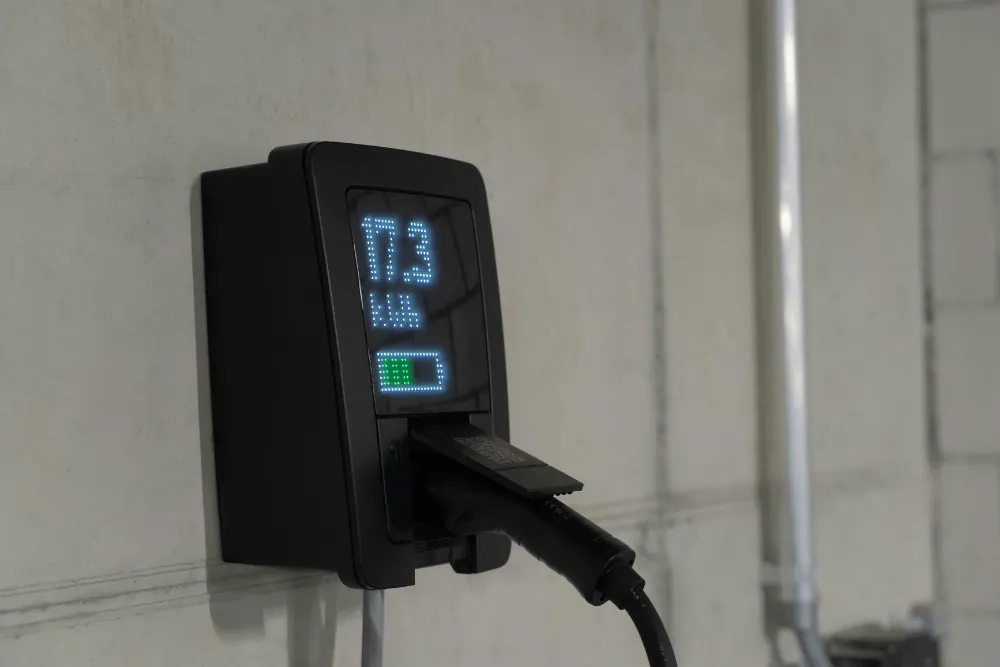
What Tesla charger installation with us includes
A load check of your main breaker, board and phases, so the charger does not become the load that trips your house.
A dedicated circuit from the board to the parking spot, with the cable, breaker and earth leakage protection sized to the Wall Connector or the charger you choose.
Wiring and mounting at the right height, in the shade where we can, with the cable entering the unit the way the maker specifies.
Wi-Fi, app and settings: the unit connected to your network, the charging current set, and a test charge with your car.
Surge protection and an isolator where the unit is outdoors or on a long run.
Handover: test readings, the settings, and a short walk through the app.
The numbers at a glance
Typical answer for a Tesla at home in Dubai
Before you order a Wall Connector, send us a photo of your board. If the board has no spare way, or the supply is already near its limit, it is cheaper to find out before the unit arrives. Tesla itself recommends installing the charger before the car is delivered, so the car can charge from the first night.
Tesla charging at home options: Wall Connector, Mobile Connector or another wall box
The finished job goes by many names: a Tesla home charging point, a Tesla charging station at home, a Tesla charging system for home, a Tesla car charger, a Tesla charging point installation. A few searches say Tesla battery charger installation, meaning the charger for the car's battery. Electrically they are all the same thing: a protected circuit and a wall unit, and a Tesla charger installed at home is judged by that circuit as much as by the unit. There are three ways to charge a Tesla at home, and they are not equal. Which one you choose sets the circuit we build.
| Option | Typical power | Fit |
|---|---|---|
| Tesla Wall Connector | Up to 22 kW from the unit; the car takes 7.4 kW single-phase or 11 kW three-phase | A fixed home charging station for Tesla owners, with the best app support |
| Tesla Mobile Connector | The portable cable that comes with the car, at a lower power from a socket | A backup and travel cable, not a home charger |
| Another Type 2 wall box | 7.4 kW, 11 kW or 22 kW | Households with a Tesla and a second make of car, or an owner who wants a different brand |
The Wall Connector
The Tesla Wall Connector is the charger most owners mean when they ask for Tesla charger installation. It is a hardwired wall unit with a 7.3 m cable, set up through the Tesla app, and sold for indoor or outdoor mounting. Tesla's UAE page gives its output as up to 22 kW and 32 A. A Tesla accepts only what its onboard charger allows: 7.4 kW from a 230 V single-phase supply, and 11 kW from a three-phase supply, so a Wall Connector on a villa's single-phase circuit charges at 7.4 kW however large its own rating is.
Tesla's UAE shop says a Wall Connector must be installed by a qualified electrician, and that installation and testing are not included in the price of the unit. Tesla also says that scheduling an installer can take up to two weeks. We cover what that means in the section on certified installers below.
The Mobile Connector
The Mobile Connector is the portable cable Tesla supplies for travel. Tesla describes it as a connector for use away from home, and recommends a Wall Connector for charging at home. In practice, many owners use the mobile cable on a household socket for the first weeks. That is workable for a short time, and it is a poor fit for the long run. A 13 A socket carrying a charging load for 8 to 12 hours heats the plug and the socket terminals, and Tesla's own installation manual lists adapters and extension sets as things not to use with the Wall Connector, which is a good rule for any charger. If you must use a socket while the wall unit is on order, send us a photo and we check the socket and its breaker.
A second brand of wall box
A Tesla charges on an ordinary Type 2 AC connector in the UAE, so any compliant Type 2 wall box works. Households with a Tesla and another car often prefer a socketed charger with a loose cable, which both cars can use. Owners who want fewer app accounts sometimes choose a wall box with its own app. The Wall Connector's advantage is that it is made by the car's maker, and its settings appear in the Tesla app. Its disadvantage is a fixed, tethered cable. We fit either, and we will say which suits your parking, because it affects where the unit goes. Our EV charger installation service covers the universal wall boxes in more detail.
The charging port on the car
A Tesla charging port at home is the same port the car uses at any AC station, in the left rear of the car, and a Tesla charging port for home use needs no change. A Tesla charging port installation is not an electrician's job, because the port is part of the car. What we install is the charger and its circuit. The Wall Connector's cable is 7.3 m, so the unit usually goes on the wall beside the bay, on the side the port is on. If you park nose-in on some days and tail-in on others, tell us. A unit mounted for one direction can leave the cable short in the other, and fixing that later means a second cable run.
Home EV charger installation for any electric car
Not every household has only a Tesla, and not every Tesla owner stays with one car. Electric charge at home, like electric vehicle charging at home, follows the same electrical rules whatever the badge on the car. Home EV charger installation, also called EV home charger installation or electric home charger installation, is a dedicated circuit, a protected wall unit and a load check. Car home charger installation and EV charging at home installation are the same work: a circuit sized to the unit, a sound earth, a position in the shade, and a test with the car.
In most UAE homes an electric car home charging station, car home charging point or electric home charging point is a Type 2 wall box. In a two-car household, electric vehicles charging at home can share one supply with load management, and an electric vehicle home charging point for a second make of car needs only the model and the car's AC limit. If you want to install an EV home charger and a Wall Connector together, we do both in one visit. Our EV charger installation service covers the wider range of wall boxes. When you look for an EV home charger installer, or for home EV charger installers near me, check that the quote names a load check. It is the clearest sign that the electrician is sizing the circuit and not just mounting a box. The same check applies if you are searching for home EV charger installation near me or EV home charger installation near me.
What the Tesla Wall Connector needs: requirements and specifications
Tesla publishes an installation manual for the Wall Connector, and an electrician working from it is working from the maker's own requirements. The figures below come from the manual for the Type 2 version, and from Tesla's UAE page. The current model is the Gen 3 Wall Connector, so a Tesla Gen 3 Wall Connector installation, or a Tesla Wall Connector Gen 3 installation, follows this manual. The figures are the starting point for every Tesla wall charger installation we do, and the answer to what the Tesla wall charger requirements are before an electrician has measured anything.
| Item | What the Wall Connector requires |
|---|---|
| Supply options | 230 V single-phase, 400 V three-phase (wye) or 230 V three-phase (delta) |
| Voltage tolerance | 230 V to neutral, plus or minus 10 per cent |
| Charging current | Set at commissioning from 6 A to 32 A |
| Own circuit | Each unit needs its own branch circuit and breaker |
| Built-in protection | Type A earth leakage protection plus a 6 mA DC fault detector |
| Earth | A proper earth conductor, or the unit will not charge after its earth test |
| Conductors | Copper, stranded 4 to 25 mm² |
| Terminal torque | 5.6 Nm |
| Enclosure | IP55, IK08 |
| Operating temperature | -30 °C to 50 °C |
| Cable | 7.3 m |
| Wi-Fi | 2.4 GHz, WPA2 network |
Two of those requirements matter more than they look.
Earth and neutral
The manual warns that wiring the neutral wrongly, or a supply that puts more than 264 V between a live conductor and earth, can damage the unit, and it tells the installer to check that the live-to-neutral voltage reads 230 V at the terminals before energising. We do that on every job, with a meter, and record the reading. The Wall Connector also runs an earth test before each session, and refuses to charge without a good earth path. A charger that will not start is sometimes an earthing problem in the villa and not a fault in the unit. Dubai's supply is a TN system, which the Wall Connector supports, and our earthing and grounding service covers the case where the villa's earth is poor.
The built-in protection
The Wall Connector detects AC leakage at 20 mA and DC leakage at 6 mA inside the unit. Because it detects DC leakage itself, a Type A earth leakage device of 30 mA at the board is enough, where a charger without that detection needs a more expensive Type B device. We still fit the device at the board, because the wiring rules require each charge point to have its own 30 mA protection, and the unit's built-in protection is a second layer. We check the Wall Connector's data sheet for the market version you have, and fit what it calls for.
Heat
The Wall Connector is rated for ambient temperatures up to 50 °C. Tesla's manual adds that output can begin to reduce around 35 °C ambient in rare cases. A west wall in direct sun in August can pass 50 °C at the surface, and a closed garage can sit above 40 °C. That is why we choose the position as carefully as the cable, and why the next sections cover the mounting.
The load check: will your villa carry a Tesla charger?
The load check comes before the order for the unit. A Tesla charging at 7.4 kW draws 32 A for hours, and in a Dubai summer evening that lands on top of the air conditioners. We look at five things.
The main breaker and the supply. The breaker rating, single-phase or three-phase, and the cable feeding the board.
The real demand. The villa's peak, which is in the evening in summer, estimated from the connected loads or logged with a clamp meter for a few days.
A spare way in the board. The Wall Connector needs its own breaker, and an older board may have none free.
The state of the board. A connection that is already warm with a small load gets much warmer with 32 A added.
The earth. A sound earth is a requirement of the Wall Connector, not an extra, so we test it at the board and at the parking spot.
Our DB box and distribution board service covers a full or worn board, and our three-phase and load upgrade service covers a supply that is too small. For example, a villa on a 100 A single-phase supply that already draws 70 A at its summer peak is taken to 102 A by a 32 A charger. The fix is a lower charging current set at commissioning (16 A is 3.7 kW and still adds about 25 km an hour to a Model 3 or Model Y), a load-sharing arrangement, or a larger supply.
Power sharing and dynamic load
The Wall Connector has a power-sharing feature. Up to six units can be linked wirelessly, with one leader and five followers, so that together they stay within a circuit's limit. For a household with two Teslas, two Wall Connectors can share one supply, so both charge overnight without a supply upgrade. Each unit still needs its own breaker, and each unit has a minimum of 6 A. Tesla also describes power management features that adapt the unit to the home's supply, including a setting based on the panel's rated limit. We say in the quote whether your villa needs any of this, because most single-car villas do not.
220 V, 230 V and what Dubai supplies
Searches for Tesla charging at home 220V usually come from guides written for other countries, and some older guides describe Tesla charging at home on 220 V. Dubai's supply is 230 V single-phase or 400 V three-phase at 50 Hz. The Wall Connector accepts 230 V to neutral with a tolerance of 10 per cent, which is 207 V to 253 V, so a normal Dubai supply sits well inside it. Where a villa's voltage sags below that under load, usually from a long thin cable, the charger slows or stops, and the remedy is a better circuit, not a different charger.
Fast charging at home
"Fast charging" means different things. Tesla Supercharging is DC charging at a public station, with equipment that is far larger than a home supply could feed. The fastest practical Tesla fast charging at home is an 11 kW three-phase Wall Connector, which adds up to about 70 km an hour in a Model 3 or Model Y. A 22 kW wall box adds nothing for a Tesla that accepts 11 kW. A true DC fast charger is a commercial installation with its own design, DEWA approval and a large supply, and it is priced after a site study. For a Tesla fast charger installation at a villa, the answer is nearly always the three-phase Wall Connector, if the villa has three-phase supply at the parking spot.
Wiring and mounting a Tesla wall charger
Installing a Tesla wall charger at home starts with one fact: the Wall Connector is hardwired. It has no plug, and the cable from the board enters a wirebox on the unit and is terminated on its terminals. To hardwire a Tesla charger, the wiring for a Tesla wall charger runs from its own breaker through conduit to the wirebox. Wiring a Tesla wall charger, and Tesla wall connector wiring in general, is an electrician's job, and a Tesla wall connector installation video, however clear, does not replace the maker's manual and a test meter. Tesla home charger wiring is also where the Tesla wall connector instructions matter most, so we work from them and leave a copy with you.
The circuit
| Charging | Breaker | Cable | Notes |
|---|---|---|---|
| 7.4 kW, single-phase | 32 A | 6 mm² for a short clipped run, 10 mm² for a long or buried run | The usual setup for a Model 3 or Model Y |
| 11 kW, three-phase | 16 A, three-pole | 4 mm², five-core | Needs three-phase supply at the parking spot |
| Lower current, 16 A single-phase | 20 A | 4 mm² | A compromise when the supply is tight |
In a Dubai garage above 40 °C, a 6 mm² cable's rating falls from about 47 A at 30 °C to about 37 A at 45 °C when clipped to a wall, and falls further when cables are bunched or run through insulation. When any of that applies, we step up to 10 mm². Over about 30 m we use 10 mm² to keep the voltage drop at the unit low. The Wall Connector's terminals take copper conductors of 4 to 25 mm². A smaller stranded conductor needs a ferrule, and the manual says not to use stranded wire under 4 mm² at the breaker without one.
Terminating the cable
The manual sets how the cable is prepared and fixed. We strip about 12 mm of insulation, tighten each terminal to 5.6 Nm with a torque driver, and secure the conductors to the service loop on the left of the wirebox so that no wire crosses a terminal screw. The conduit enters at the top, bottom or either side of the rear. The top and bottom entries take a 28 mm fitting, and outdoors the fitting must be watertight. The manual says not to use sealants or adhesives on the unit, since the screws have their own sealing washers. A loose terminal is the commonest cause of a hot Wall Connector, and a torque-checked terminal is the cure.
Height and position
For a Tesla wall mount charger installation, Tesla gives mounting heights. The recommended height is about 1.15 m. The minimum is 0.6 m outdoors and 0.45 m indoors, and the maximum is 1.52 m for both. The surface must be flat and vertical, and the manual warns that an uneven surface can cause a thermal failure. On concrete or masonry we use 6 mm wall plugs, and the unit weighs 6.8 kg with its wirebox, so the fixing matters. We stand the car in its bay first, and measure from the charging port to the wall, so that the 7.3 m cable reaches with some slack and does not drag across the floor.
Ceiling mounts and posts
Customers sometimes ask for a Tesla charger ceiling mount, usually because the wall is far from the bay or the cable would cross a walkway. The manual specifies wall mounting between 0.45 m and 1.52 m, and gives no ceiling option, so we do not mount the unit overhead. If the bay has no suitable wall, we use a post or a short wall return that puts the unit within the allowed height, and run the cable in conduit underground. A tidy solution for a freestanding bay is a pedestal, which adds cost for the foundation and the trench.
Outdoors, and the cover question
The Wall Connector is rated IP55 and IK08, which means it resists dust and water jets and can sit outdoors. Tesla offers it for indoor or outdoor mounting, so a Tesla wall connector outdoor installation, or any Tesla charger outdoor installation, is normal. In Dubai, outdoor installation has one extra problem, the sun. A unit in direct sun on a bare west wall heats beyond the 35 °C at which output can start to reduce. We mount it in the shade where there is any, and when there is none we fit a canopy that sits clear above and beyond the unit. A canopy or a Tesla wall connector outdoor cover should shade the unit and leave air moving around it. A tight box that traps heat does more harm than the sun. Near sprinklers or a pool, we keep the unit above splash height and on the dry side.
Wi-Fi, the Tesla app and commissioning
A Wall Connector works as a plain charger without Wi-Fi. Connecting it gives you settings in the Tesla app, firmware updates and remote diagnostics.
Join the unit's own network. Out of the box, the Wall Connector broadcasts a Wi-Fi network. Its name and password are on the label and the Quick Start Guide.
Choose your home network. The unit connects to a 2.4 GHz network with WPA2 security. It does not support open networks or 5 GHz.
Commission. The installer sets the charging current from 6 A to 32 A and confirms the earth assurance setting for a TN supply in the Tesla One app.
Test charge. We plug in your car and watch it charge, check the current against the setting, and check the connection for heat after some time. Setting up a Tesla wall charger takes about an hour once the circuit is in.
Wi-Fi can fail for a mundane reason: the router is on the other side of a thick wall. The manual advises against concrete, masonry and metal studs between the unit and the router. When the garage is a poor spot for Wi-Fi, we move the router's access point, add a mesh node, or set the unit up and leave it on its settings. Our smart switch installation service covers wider home automation if you want the charger tied into a smart home.
To connect a Tesla wall charger to the app, or to connect to the Tesla Wall Connector later, for example after changing your router, the same steps apply. If you need to connect to a Tesla wall charger that has lost its network, repeat steps 1 and 2. We leave the label's network details and a copy of the manual's instructions with you, and photograph the label for our records.
Tesla certified installers, approved electricians and DEWA
Owners search in several ways: a Tesla electrician near me, a Tesla-approved charger installer, a certified Tesla electrician, a Tesla electrical engineer, a Tesla wall charger installer, or simply find electrician Tesla. The words matter, because they do not all mean the same thing.
Where do you find an electrician for a Tesla? Some owners ask Tesla to find an electrician for them. Tesla's own site is the first place to look for a Tesla-approved wall charger installation or a Tesla certified EV charger installer, and any list of Tesla EV charger installers is Tesla's to keep. What you can check yourself is what any installer will do for the circuit and the car.
Tesla Certified Installer is Tesla's own programme. Tesla's UAE shop says the Wall Connector must be installed by a qualified electrician and points buyers to a Find an Electrician page. In some countries Tesla runs a Certified Installer programme with a lookup tool to find one. We wire to the maker's manual, and we ask you to confirm with Tesla how an independent installer affects the warranty.
DEWA's requirements are separate. DEWA's technical regulations for EV charging call for a certified installation contractor, and say to use contractors and consultants enrolled with DEWA, and to apply for the building's electricity no-objection certificate and an electricity connection through DEWA's usual procedures. A Tesla wall charger installation in Dubai therefore sits under both: the maker's installation rules, and DEWA's. For a Tesla EV charger installation or any Tesla electric car charger installation, the electrician must meet both.
The warranty on a Wall Connector for home use is 48 months from the invoice date, according to Tesla's UAE page. If that matters to you, ask Tesla in writing whether an installation by a given electrician affects it, before you pay anyone. A good installer will not mind you asking.
What to ask any electrician for a Tesla
- Do you have the Wall Connector's installation manual, and will you follow it?
- Can you show me a load calculation, not just a quote?
- Which earth leakage device will you fit, and why?
- What test readings will I get at the end?
- Are you enrolled with DEWA, and what do you submit?
Becoming a Tesla charger installer
Some visitors to this page are electricians who want to know how to become a Tesla charger installer. That route is set by Tesla, not by us, and goes through Tesla's own certification. If you are an electrician looking for work on EV charger installations, see our careers page.
Apartments, shared parking and company cars
Installing a Tesla charger at an apartment is possible, and the electrical work is rarely the hard part. Permission comes first: the building management, and in some buildings the owners' association, must agree in writing, and a tenant needs the landlord's consent too. Next is the bay, which must be one you can use every night. Then the cable route, which in a high-rise crosses shafts and fire-rated floors, and finally the meter: the simplest arrangement is a circuit from your own flat, so the energy lands on your own DEWA bill. When the bay is far away, a parking sub-board with sub-meters, or a managed charging service, may be the only practical way. We survey the route and the board and give you the options and the cost of each. Our EV charger installation service has the longer version for apartment buildings and compounds.
If a company provides the car, the charger is a separate question. Company electric car charging at home usually involves the fleet manager, and the points to settle are who owns the charger, who pays for the circuit, and what happens to the wall unit when the car changes or you move. A Wall Connector can be taken down and refitted elsewhere, but the circuit behind it stays with the property. We can quote the circuit and the unit separately for that reason, and give the fleet manager a drawing and test sheet.
What Tesla charger installation costs in Dubai, and what it costs to run
The cost of installing a Tesla charger has three parts: the unit, the installation, and anything extra the site needs. The unit is the Wall Connector, and Tesla sets its price. Tesla's UAE shop lists the Wall Connector at AED 2,300 at the time of writing. The installation, for a standard villa with the parking spot within about 15 m of the board and a spare way free, is typically AED 1,260 to 2,910 for the circuit, the isolator and the labour. The site visit costs AED 50, and the quote follows it.
| Job | Typical price (AED) |
|---|---|
| Circuit, isolator and installation only (you buy the Wall Connector), short run | 1,300 to 3,000 |
| Wall Connector installation, three-phase 11 kW circuit, short run | 1,800 to 3,500 |
| Longer run, trenching, post or pedestal | Quote after a site visit |
| Apartment, with building permission and a cable route | Quote after the building survey |
| Board or three-phase upgrade, if the load check finds one is needed | Quote after the load check |
| Second Wall Connector sharing the supply | Quote after the load check |
How much does a Tesla charger cost?
The answer depends on which price you mean, because one question covers three sums. The first is the unit. For the Tesla Wall Connector, which many owners call the Tesla wall charger, that is Tesla's price: the Tesla wall charger cost is whatever Tesla lists, and it can change, so check Tesla's UAE page on the day you order. A universal Type 2 wall box from another maker costs AED 1,650 to 3,105 for the hardware, depending on brand and features. The second sum is the installation, below. The third is the total: how much the Tesla home charger costs once it is on your wall is the unit price plus the installation, and the circuit is the part that changes from one villa to the next.
That total goes by many names. Whether the question is how much does the Tesla home charger cost, how much is the Tesla home charging station, how much is a home Tesla charging station, how much is an at home Tesla charger or how much is a home charging station for a Tesla, the answer is the same sum. So are the Tesla charger cost, the Tesla charger cost for home, the cost for a Tesla home charger, the home charger for Tesla cost, the Tesla EV charger cost, the Tesla home charging station cost and the cost of a Tesla charging station at home. For anyone who wants a number before the survey, the cost of a home charging station for a Tesla is the unit plus AED 1,260 to 2,910.
How much does Tesla charger installation cost?
Ask how much it costs to install a Tesla charger and the honest answer is a range until the site has been seen. For a standard villa, the cost of installing a Tesla charger at home is typically AED 1,260 to 2,910. The same figure covers a Tesla wall charger installation, a Tesla Wall Connector installation, and the cost to install a Tesla charging station at home, because the electrical work is the same whatever the unit is called. How much a Tesla charger installation costs in an apartment depends on the building, and we quote after the survey.
Quotes use other labels: the cost of Tesla charger installation, the cost for Tesla wall charger installation, the Tesla wall charger installation cost, the Tesla Wall Connector installation cost or price, the Tesla charging station installation cost, Tesla EV charger installation cost, Tesla car charger installation cost, Tesla charging installation cost or Tesla home charging installation price. They describe one job and one quote. People also ask how much to install a Tesla home charger or how much to install a Tesla wall charger, and the answer is the range above.
Three things move it. The distance from the board is the biggest, because cable and conduit are charged by the metre. The board is next: a spare way costs nothing, and a full board needs the upgrade first. The route is third: a cable that crosses a driveway, a pool or a slab needs trenching or core drilling, and a bay with no wall needs a post. Three-phase adds a three-pole breaker and a five-core cable. We quote from photos, so the Tesla charger installation price, the Tesla home charger install price and the total are agreed before anyone visits. The visit costs AED 50.
How much does a home EV charger cost for another make of car?
If a second car in the household is not a Tesla, the sums are the same. A wall box costs AED 1,650 to 3,105 and installing it costs the same AED 1,260 to 2,910 for a standard villa, so a home charging station for an electric car comes to roughly AED 2,910 to 6,015 in total. That answers how much a home EV charger costs, how much does a home charging station cost, how much does it cost for a home charging station and how much it costs to install a home EV charger. The electric car home charging station cost and the home charging station for electric cars cost are the same figure. Searches for home EV charger cost, home charger installation cost or home charging point cost mean the same thing: a unit plus a circuit. So do the cost of a home EV charger, the cost of installing a home EV charger, electric home charger cost and EV charging at home cost. A 7.4 kW AC wall box is what American guides call a level 2 charger, so the level 2 home charger cost is the same figure.
Does Tesla fast charger installation cost more?
A Tesla fast charger installation at home means one of two things. If you mean an 11 kW three-phase Wall Connector, it is a standard job and costs a little more than single-phase. If you mean DC fast charging like a Supercharger, that is a commercial project with its own design, DEWA approval and a large supply, and the Tesla fast charger installation cost is quoted after a study. It is out of proportion to a home.
What does it cost to charge a Tesla at home?
The cost of charging is energy times the tariff. Dubai's residential electricity is billed in slabs, and a home that already runs air conditioners adds the extra kWh at the top slab it reaches. With the fuel surcharge and VAT, AED 0.40 per kWh is a fair working figure. Tesla gives about 7 km per kWh for the Model 3 and Model Y and about 5 km per kWh for the Model S and Model X, and we add 10 per cent for losses in the charger and the battery.
| Car | Energy for 1,000 km | Home, AED 0.40 | DEWA public AC, AED 0.735 | DEWA public DC, AED 1.26 |
|---|---|---|---|---|
| Model 3 or Model Y (about 7 km per kWh) | About 157 kWh | AED 63 | AED 115 | AED 198 |
| Model S or Model X (about 5 km per kWh) | About 220 kWh | AED 88 | AED 162 | AED 277 |
So how much does charging a Tesla at home cost? About AED 6 per 100 km in a Model 3 or Model Y, and about AED 30 for a 75 kWh refill, as an example. For a Model S, how much Tesla charging at home costs is about AED 9 per 100 km. The sum is the same for any model: kilometres divided by the car's km per kWh, plus 10 per cent, times the tariff. That is the whole answer whether you are charging a Tesla 3 at home or a Tesla Model S at home. The Tesla Model 3 home charger cost and the Tesla Model 3 home charger installation work out as before: the unit plus the circuit.
If you meant public stations, the Tesla car charging stations cost and Tesla charging stations cost are higher. Tesla Superchargers set their own prices, shown on the car's screen, and DEWA's public AC and DC prices are in the table. A home charger saves most for an owner who would otherwise rely on public charging. The public figures are DEWA's prices for 2025, with VAT.
Charging a Tesla at home with a socket
Some owners charge a Tesla on a household socket and call it free. It costs the same per kWh as a wall unit, takes 8 to 12 hours to give the same energy, and heats the socket. The Tesla Mobile Connector is meant for travel. Using it on a dedicated, checked socket for a few weeks is your call, and a wall unit is the permanent answer. That is why Tesla home charging options start with the Wall Connector.
Tesla Powerwall, home battery and solar alongside the charger
Many Tesla owners ask about a Powerwall or solar panels in the same visit, so this section covers what a charger changes about them. We are an independent electrician. We are not Tesla's solar business, and we do not sell Tesla solar. If you searched for a Tesla solar company, Tesla solar installation or Tesla solar near me, we install solar panels and batteries from several makers, and we wire the charger to work with them.
Tesla Powerwall in the UAE
A search for a Tesla Power Wall, a Tesla Power Wall 3, a Tesla Power Wall 2 or a Tesla solar power wall nearly always means the Powerwall, Tesla's home battery. Tesla lists it on its UAE website as a battery that stores energy from solar or from the grid and can power a home during an outage, and says Powerwall 3 has an integrated solar inverter. A Powerwall 2 is a battery that pairs with a separate solar inverter, so a Tesla Powerwall inverter question depends on which generation you have.
The Tesla Power Wall cost and price vary with the unit, the inverter and the installation, and Tesla sets its own pricing, so check with Tesla for current availability. The cost of a Tesla home battery, the Tesla home battery price and the cost of a Tesla Powerwall and solar panels together follow from that. We do not quote Tesla's prices. For Tesla Power Wall installation,. A Tesla Powerwall system also needs a place to mount it, protected circuits for what it backs up, and DEWA's approval where it is connected to the grid. For a Tesla Power Wall alternative, our battery storage installation service covers batteries of other brands, sized to the circuits you want to keep running.
Tesla battery and solar panels together
Whether you call it Tesla battery and solar panels, solar panels with a Tesla battery, solar panels with a Tesla Powerwall, a Tesla solar battery backup, a Tesla solar power battery or Tesla solar battery storage, the design is the same: panels produce, the battery stores the surplus, and the house and the car use it. The Tesla battery for solar panels cost depends on the battery, the inverter and the panels. Tesla solar panels and a battery are priced by whoever supplies them, and a Tesla home solar system or Tesla solar power system installed by us uses panels and inverters from several makers. Our solar panels service covers the sizing and approvals.
Solar suits a Tesla owner in Dubai, because the car can charge in the daytime at the weekend when the panels are producing. A charger draws from the house, so while the panels produce they supply part of the charging. Tesla's Solar Roof tiles are a different product from standard panels. Questions about Tesla Solar Roof installation, Tesla Solar Roof wiring and Tesla solar panel costs for those tiles belong with the company that supplies the roof.
The charger and a home battery
A 7.4 kW car charger is a large load for a home battery. A battery of 10 to 15 kWh would supply that load for about two hours. For that reason most homes keep the car charger off the battery's backup circuit, and let it charge from the grid or from solar during the day. If you want to charge from a battery during an outage, the battery and its inverter must be sized for 7.4 kW of continuous load on top of the essentials, which is a larger and more expensive system than a battery for the lights, the fridge and the Wi-Fi. We say so in the design, before you buy.
Inverters and batteries sold under the Tesla name
Searches such as Tesla 5 kW inverter, Tesla 5kW hybrid solar inverter or Tesla inverter battery 200Ah price often lead to inverters and batteries sold under similar names by other companies. They are not Tesla's products. We install hybrid inverters and batteries of several makes, and we need the model and the nameplate to say what circuit it needs. Our UPS and inverter installation service covers the smaller backup systems.
How a Tesla charger installation runs, step by step
Installing a Tesla wall charger, setting up a Tesla wall charger and the installation of a Tesla wall connector all follow one order. It is the same whether you want to install a Tesla wall charger at home, install a wall connector for a Tesla in a rented villa, or are getting a Tesla charger installed at home. For anyone installing a Tesla charging station or just learning about installing a Tesla wall connector, this is what happens.
- 1Survey. From photos or a visit we see the board, the meter, the parking spot and the route between them, and ask which Tesla you have.
- 2Load check. We work out the demand and spare capacity, and say whether a lower current, power sharing or a supply upgrade is needed.
- 3Quote and drawing. A price listing the unit, circuit, cable length and board work, with the single-line drawing.
- 4Permission and approval. Building or community permission, and DEWA's requirements, are in place before work starts.
- 5Circuit. The breaker and earth leakage device, the cable in conduit, the isolator, and surge protection.
- 6Mount and wire. The Wall Connector at the chosen height, terminated to the maker's torque, with the live-to-neutral voltage measured before energising.
- 7Wi-Fi and settings. The unit joined to your network, the current set, the earth test checked.
- 8Test and charge. Earth and insulation tests, a trip test, and a charge test with your car.
- 9Handover. The settings, the test sheet, the manual and a short walk through the app.
A standard villa job is a half-day visit. An apartment, a long trenched run or a board upgrade takes longer and is scoped from the survey.
Tesla charger problems and repairs
Stop and switch off at the isolator if you smell burning, see a melted or brown mark on the cable or the unit, or the casing is too hot to hold. Running the charger again to see whether the fault returns can turn a loose terminal into a fire.
The unit will not charge the car
Check the car first: is it set to charge, is the port open, is a charge limit or schedule holding it off? Then the unit: is it lit, and what does its light show? The Wall Connector runs an earth test before charging, and refuses without a good earth path, so a unit that powers up and will not charge may be telling you the earth is poor. We test the earth at the unit and the board. If the unit has no light at all, the supply has gone, and we look at the breaker, the earth leakage device and the isolator.
The breaker or earth leakage device trips
The leak path can be water in the unit or the connector, a damaged cable, or a fault in the car. The Wall Connector's own protection also trips on a 6 mA DC leak and a 20 mA AC leak, and the fault clears only with user action, such as pressing the cable button or unplugging, and a fault that returns needs an electrician to look at the supply. A breaker that holds for an hour and then trips is warm: an undersized cable, a loose terminal, or a shared circuit. The remedy is a better circuit. A larger breaker on the same cable is dangerous and is not a remedy.
The app cannot connect to the unit
The commonest causes are a router on 5 GHz only, a password with a typo, or a thick wall between the unit and the router. The unit needs a 2.4 GHz WPA2 network. We move the access point or add a mesh node, and reconnect the unit.
Charging is slow in summer
A unit in the sun, a hot car battery and a sagging supply voltage all slow charging. Shade, a cooler wall, and a voltage reading at the unit while it charges tell us which. A car with a single-phase onboard charger charges at about 7.4 kW on any wall box, however many phases the box has.
As a rule, if a repair touches the supply cable, we replace the length and do not join it. A joint on a circuit that carries full current for hours is a weak point, and a new run costs less than another visit.
Tesla charger installation with Circuit Dubai
- A load check before a quote. Your main breaker, board and phases are read first, so the charger is not the thing that trips the house.
- The maker's manual followed. Torque, conduit entry, height and earth test done as Tesla specifies, with readings recorded.
- A circuit built for hours at full load. Cable, breaker and protection chosen for Dubai heat.
- One team for the board and the charger.
- Records you keep. The test sheet, the settings, the manual and a drawing of the circuit.
We work across all of Dubai. Our office is in Al Quoz, so if you are searching for Tesla charger installation near me, Tesla wall connector installation near me or Tesla wall charger installation near me and you are in one of those areas, we are close. The same goes for Tesla charging installation near me, Tesla home charger installation near me, or an electrician to install a Tesla charger near me.
If you are also planning solar panels, battery storage installation, a three-phase upgrade, surge protection or a DB box upgrade, we can scope them at the same visit and save a second call-out.
Phone: +971 55 407 7427
Tesla charger questions we hear from Dubai owners
How much does it cost to install a Tesla charger at home in Dubai?
For a standard villa, the circuit, isolator and labour are typically AED 1,260 to 2,910 plus the Wall Connector itself. A longer run, trenching or a board upgrade adds to that. We quote from photos.
How much does a Tesla Wall Connector cost?
Tesla sets the price of the unit. Tesla's UAE shop lists the unit at AED 2,300 at the time of writing. The installation is quoted separately, and so is any extra work.
How much does it cost to charge a Tesla at home?
About AED 6 per 100 km in a Model 3 or Model Y at about AED 0.40 per kWh, or about AED 63 per 1,000 km. A Model S or Model X uses more, about AED 88 per 1,000 km.
Do I need a Tesla-approved installer?
Tesla's UAE shop says installation must be done by a qualified electrician, and in some countries Tesla runs a Certified Installer programme. We are not part of Tesla, and we wire to the maker's manual. DEWA's regulations call for a certified contractor too, and Tesla's warranty is 48 months for residential use, so ask Tesla in writing how a given installer affects it.
How long does installation take?
A standard villa takes half a day. Tesla says the work usually takes a few hours but that finding and booking an installer can take up to two weeks, so order the circuit before the car arrives.
Can I install the Wall Connector myself from a video?
We do not advise it. The unit is hardwired to a circuit that carries 32 A for hours, and the manual calls for measuring the voltage at the terminals, torquing the terminals to 5.6 Nm and checking the earth. A video shows the steps and not the readings.
Can I charge my Tesla Model 3 from a normal socket?
For a short time on a dedicated socket in good condition, and never through an extension lead. It takes 8 to 12 hours, and the plug and socket run warm. A wall unit is the safer, faster answer.
Is 7.4 kW or 11 kW better for a Model Y?
7.4 kW is enough for most households, since an overnight charge adds far more than a day's driving. 11 kW needs a three-phase supply at the parking spot. Send us your model and your driving, and we say whether it earns its cost.
Can the Wall Connector go outdoors, or on a ceiling?
It can go outdoors, since it is rated IP55, and we shade it from the sun. It is made for wall mounting at 0.45 m to 1.52 m, and has no ceiling mount, so we use a wall, a post or a pedestal.
Can I charge a Tesla at an apartment?
Usually, with the building's written permission. The challenge is the cable route and the meter, not the electrical work. We survey it and give you the options.
Do you install Powerwall or Tesla solar?
We install home batteries and solar panels of several makes, and we can discuss Powerwall once you have confirmed its availability and installation with Tesla. We do not install Tesla Solar Roof. We are an independent contractor, not Tesla.
How do I get a Tesla charger installed at home?
Send us your model, a photo of the board and meter and the route to the parking spot. We do the load check, quote, get permission and approval in place, install the circuit and the Wall Connector, and test it with your car. Until the wall unit is in, charging my Tesla at home on a checked socket is fine for a short time, and the wall unit replaces it.
Can I use the same charger for another make of car?
The Wall Connector has a Type 2 handle for Type 2 cars, and Tesla describes it as compatible with most electric vehicles. If a second make has a different inlet, tell us the model before you buy.
Do you supply the charger as well?
Yes, a Wall Connector or another wall box, or we fit the one you have bought. If you have bought one, send us the model number and the car first and we confirm the circuit.
Ready for a Tesla charger that is wired properly?
Send your Tesla model, a photo of your distribution board and meter, and the route from the board to the parking spot. We reply instantly on chat with a price and a time, so you know what the job involves before anyone arrives.