
Sensor and Timer Installation in Dubai: Motion (PIR) Sensors, Photocells, Timer Switches and Hotel Key Card Energy Saver Switches
Some lights should not need a hand. The corridor light that comes on when someone walks in and goes off a minute after they leave. The garden lights that come on at dusk and go off at dawn whatever the season. The pool pump that runs for four hours a day and not a minute more. The hotel room where everything switches off when the guest takes the card out and goes. Each of these is a small control device between the supply and the load, and each fails in a predictable way when it is chosen or placed wrongly: a sensor that sees the air conditioner and not the person, a photocell that sees its own lamp, a timer that cannot carry the pump, a key card switch that cuts the fridge.
Circuit Dubai installs, replaces and repairs sensors and timers in villas, apartments, offices, car parks, shops, warehouses and hotels across Dubai. That covers wall and ceiling PIR motion sensors, photocell dusk-to-dawn controls, in-wall and plug-in timer switches, digital and countdown timers, and key card energy saver switches for hotel rooms and serviced apartments. People find this page by searching pir switch wiring, wiring a photocell, install photocell, timer switch installation, hotel key card switch and 3 way motion sensor switch installation. The sections below answer each, with the wiring, the settings and the places each device does and does not work.
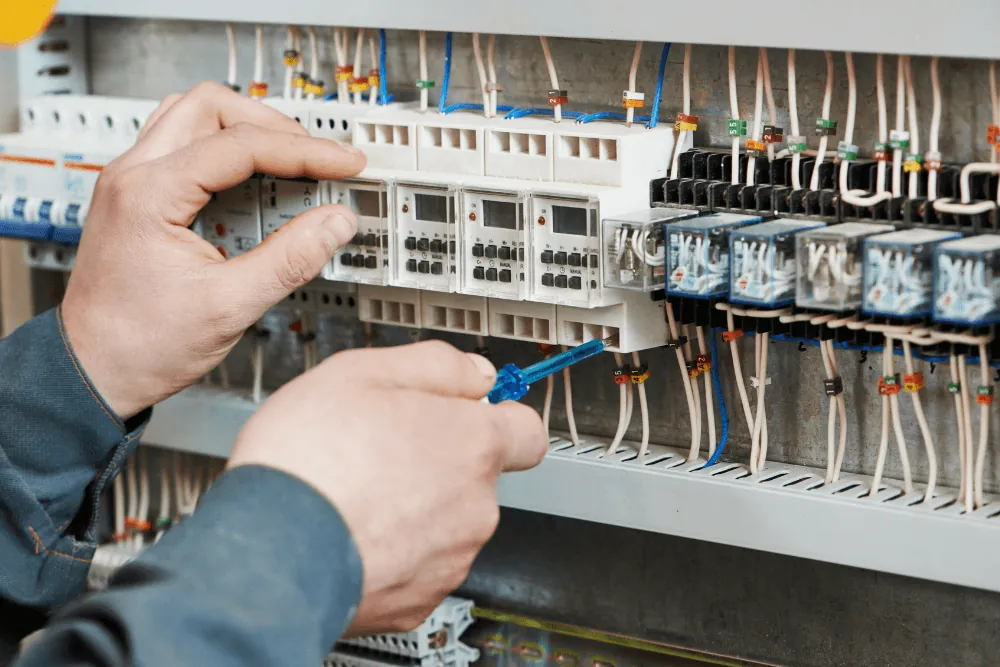
What a sensor or timer job with us includes
The load and the place checked first. We read what the device will switch, in watts and in lamp or appliance type, and look at where the sensor or photocell will sit.
The right device for the job. A PIR for rooms and corridors, a dual-technology sensor for a place where a PIR fails, a photocell for dusk-to-dawn, a timer for a set pattern, a key card switch for a hotel room.
A contactor where the load is large. A sensor, photocell or timer has a relay with a rating, and a heater, a pump or a group of lamps beyond it goes through a contactor.
Settings done on site. The time delay, the light level, the range and the schedule are set and tested in the place where the device works, not on a bench.
A manual override. Where it matters, such as a plant room or a stair, a switch lets the light stay on.
Any make you choose. We supply the device, or fit the one you bought. We work with any major brand, and we do not claim to be a dealer for any of them.
A clear price, with the device, any contactor and the labour on separate lines.
The numbers at a glance
Typical answer for Dubai
Before you book, work out what the device will switch and note where it will sit. For a motion sensor, stand where the sensor would be and think about who walks past it and which way. For a photocell, look at the sky from the spot and check that no lamp of its own, headlight or shadow reaches it. For a timer, note the appliance's watts from its plate. For a hotel, count the rooms and the loads in each: lights, sockets, air conditioner, fridge, safe. Those facts decide the device and the wiring.
Sensor and timer terms explained: PIR, photocell, timer and key card switch
Motion sensors
A motion sensor switches a load when it detects someone moving. Three kinds are in use.
| Sensor | How it detects | Where it works and where it fails |
|---|---|---|
| PIR (passive infrared) | Senses the change in infrared heat as a warm body crosses its zones | Best for rooms, corridors, stairs and toilets. It detects movement across its view better than movement straight toward it, and it can be fooled by heat sources and sunlight |
| Microwave or radar | Sends a low-power radio wave and senses the reflection | Sees through glass and thin partitions, so it detects movement in the next room. Suits car parks and plant rooms, and not a small room that has a thin wall |
| Dual technology | Needs both a PIR and a microwave detection before it switches on | Used where false triggers are costly, such as a warehouse or a window-facing corridor |
A sensor also has a time delay, which is how long the light stays on after the last movement, and a lux threshold, which is the daylight level above which it will not switch the light on. A good setting for a corridor is a delay of a minute or two. For a toilet with an extractor, a longer delay and an overrun timer on the fan.
Searches for pir switch wiring, pir sensor switch wiring, pir and switch wiring, wiring a pir sensor, wiring motion sensor and ceiling pir sensor wiring are about connecting these devices. The wiring sections set them out.
Photocells
A photocell is a light sensor that switches a load on when the light level falls and off when it rises. It is the device behind dusk-to-dawn lights. Inside is a light-sensitive element and a relay. The photocell's lux setting decides how dark it must be before it switches on. A delay stops it reacting to a passing headlight or a flash of lightning. Install photocell, installing photocell, installation of photocell, photocell installation and installing a photocell are the fitting of one. Photocell working, in the sense of how it works and how to tell if it is working, is covered in the photocell section.
Timer switches
A timer switch switches a load by the clock. The kinds are:
- Mechanical timers, with a dial and pegs or tabs that set the on and off times. They are hard-wearing and cost little, and cannot be set to the minute.
- Digital timers, with a display and programmes by day and time. They keep time with a battery or a capacitor during a power cut.
- Countdown timers, which switch on for a set time after you press a button, such as a bathroom fan or a booster pump.
- Astronomical timers, which compute sunrise and sunset for a location and switch the load at those times through the year. They suit garden, facade and signage lights.
- Plug-in timers, which go in a socket and hold a lamp or a small appliance.
Timer switch installation, install timer switch, timer switch wiring and wiring a digital timer switch are the in-wall types. The timer section sets out the wiring.
Hotel key card energy saver switches
A key card switch, also called a hotel card switch, an energy saver switch or a hotel key switch, is a switch beside the door of a hotel room that holds the room's power on only while a card or a key tag is in its slot. The guest puts the card in as they enter, the lights and sockets come on, and when they take the card out and leave, the room switches off after a short delay. It saves the energy of lights, television and air conditioning left on in an empty room. The key card section sets out how it is wired.
Choosing a sensor, photocell, timer or key card switch
Choose by the load
Every one of these devices has a switching rating, printed on its body or in the data sheet. The load must sit within it. A device rated for incandescent lamps carries a much smaller LED load, and some have a minimum LED load as well, for the same reason a dimmer does. Add up the lamps' watts. For a pump, a heater or a group of lamps larger than the device's rating, the device operates a contactor, and the contactor carries the load.
| Load | What suits |
|---|---|
| A few LED lamps | A sensor or timer rated for LED, with a minimum load that the lamps meet |
| A bank of lamps, a facade or a car park | A photocell or timer that operates a contactor |
| A water heater, a pump or an air conditioner | A timer or a sensor that operates a contactor, with the isolator as set out on our switch installation and replacement page |
| A fan or extractor | A sensor or timer made for it, with an overrun on the fan |
| A hotel room | A key card switch rated for the room's load, or one that operates a contactor |
Choose by the place
| Place | What suits and what to avoid |
|---|---|
| A bedroom, living room or office | A ceiling PIR in the centre, or a wall sensor facing the door. Avoid a place facing an air conditioner vent |
| A corridor or stairs | A wall or ceiling PIR with a delay of a minute or two, with the sensor watching along the length |
| A toilet or bathroom | A ceiling PIR in the room, with an overrun on the extractor. Keep it clear of the wet zone and use an IP-rated sensor |
| A car park | A weatherproof ceiling sensor or a microwave sensor, mounted at the height the maker states |
| A garden, a driveway or a facade | A weatherproof wall PIR for security, and a photocell for dusk-to-dawn |
| A warehouse | A high-bay sensor with a range for the mounting height, or a dual-technology sensor |
| A plant room | A timer or a sensor with a manual override, so the light stays on while work goes on |
Brands and ranges
We install the main ranges, including those of Legrand, Schneider, Hager, Steinel, Theben and others. We are not an authorised dealer for these makers. We fit what you choose, and when we supply the device we give the make and model on the quote. A device that carries no rating, no maker's name or unclear terminals is not fitted, whoever supplied it.
Planning a sensor or timer job: what to check and what to tell us
What to check before you book
The breaker. Find the breaker for the light or appliance and switch it off.
The load. The lamps' type and watts, or the appliance's plate.
The existing switch. A photo of it and its box. A sensor or timer that replaces a wall switch needs a neutral in most models, and the box is checked first.
The place. Photographs of where a sensor or photocell would sit and the area it must watch.
The pattern. When the light should be on: when someone is there, from dusk to dawn, between set times, or while a card is in the slot.
What to tell us
- The rooms or areas, and what each light or appliance is.
- The delay and the pattern you want, in plain words, such as "stays on for two minutes" or "off at midnight".
- Whether a manual override is needed.
- Any problem now: a light that stays on, a sensor that misses people, a lamp that glows when off.
Rules and safety
We isolate the breaker, prove the circuit dead with a tester that has been proved on a live source, and test again on the terminals. A sensor or a timer sits in a place that heat, damp and dust reach, so we choose a rating for the place: IP-rated and shaded where it is outdoors. We do not mount a sensor or a photocell where its own heat or light can reach it. We do not put an emergency light, a smoke alarm or a fire alarm panel behind a sensor, a timer or a key card switch. Those stay on their own circuits.
PIR sensor and motion sensor wiring: one-way, with a switch, on the ceiling and on a two-way circuit
A motion sensor is wired like a switch that closes itself. It has a live in, a load out and, in most models, a neutral, and the sensor does the switching.
Wiring a wall PIR switch
A PIR switch replaces a wall switch and carries the sensor in its plate. It is wired in the box in place of the old switch.
| Terminal | What goes to it |
|---|---|
| L or Line | The live supply into the sensor |
| N or Neutral | The neutral, which the sensor needs to power its electronics |
| Load or L out | The switched live to the lamp |
| Earth | The earth of the cable, to the box and to the sensor if it has a terminal |
The sensor needs a neutral in the box, the same as a smart switch does. Where the box has none, a sensor made for two wires takes its supply through the lamp and has a minimum load, and a low-power LED may glow or flicker. We check the box before we order, as the smart switch installation page explains for smart switches.
Wiring a separate PIR sensor
A surface-mounted or flood-light PIR has a terminal block with live, neutral and load. Wiring a pir sensor and wiring motion sensor describe this connection. The live from the supply goes to the sensor's live terminal, the sensor's load terminal goes to the lamp's live, and the neutral goes from the supply to the sensor and the lamp. The sensor is then in the live path to the lamp, and the lamp comes on only while the sensor is active. The load rating on the sensor's data sheet is the limit, and a bank of lamps beyond it goes through a contactor.
PIR and switch wiring: adding a manual control
A sensor on its own gives a light that you cannot keep on, which is a nuisance in a stair or a plant room. Two arrangements add a switch.
| Arrangement | What it does | How it is wired |
|---|---|---|
| A switch before the sensor | Turns the whole system off. With the switch off, the sensor has no supply and the light stays dark | The live goes through the switch to the sensor. It is a master isolator, and suits a light you want off at times |
| A switch across the sensor's load | Forces the light on. With the switch on, the light is on whether or not the sensor sees anyone | A second switch carries the live straight to the lamp, bypassing the sensor's load contact. It suits a stair or a work area |
| A sensor with its own override input | The sensor has a terminal for a push switch that holds the light on | The push switch is wired to that terminal as the maker's diagram shows |
PIR and switch wiring, pir sensor switch wiring and pir switch wiring are searches for these. We choose the arrangement from how the room is used and wire it from the diagram of the sensor in the box.
Ceiling PIR wiring
A ceiling PIR is a sensor that sits flush in the ceiling or is mounted on it, with a wide view all round. Ceiling pir sensor wiring uses the same live, neutral and load connections as the wall type, with the cable coming from the ceiling rose or a junction box. The sensor is placed in the centre of the room or above the place where people pass, at the height the maker states, and away from air conditioner vents, which move warm and cold air across its view and can switch it falsely.
A large room can need several sensors. We wire them as a master with slave sensors where the maker provides it, or we wire each sensor's output to the same contactor coil, so that any one of them can bring the lights on. The data sheet gives the coverage radius at the mounting height, and we plan the number of sensors from it and from the room's shape.
Motion sensor on a two-way circuit
A light that is switched from two places is a two-way circuit. A motion sensor can join it in one of three ways.
The sensor at the light. The sensor sits at the light or in the ceiling and the two wall switches become overrides or isolators. This is the most reliable.
A sensor switch made for a two-way circuit. Some models are wired to a two-way circuit with an ordinary two-way switch at the other end. They are sold for it, and the wiring diagram says so.
A pair of sensors. A master at one end and a companion at the other, from one maker.
3 way motion sensor switch installation is the American wording for this job. In American wiring a three-way circuit is a two-way circuit in the British sense, and a three-way motion sensor switch is a sensor made for it. A sensor made for a one-way circuit does not work on a two-way one, so we read the box and the sensor's label before we fit it.
Settings: sensitivity, delay and lux
| Setting | What it does | Where we set it |
|---|---|---|
| Time delay | How long the light stays on after the last movement | A minute or two for a corridor, longer for a toilet or an office, and a few seconds for a test |
| Sensitivity or range | How far and how small a movement the sensor detects | Reduced where the sensor can see a road, a window or a vent |
| Lux threshold | The daylight level above which the light does not switch on | Set to day for a stair that has windows, and to dark for a porch light |
| Test mode | A short delay for walking the room | Used when we set the range, and then switched off |
We walk the room in test mode and check the edges of the coverage, and then set the delay for the real use.
Why a PIR sensor misses people or switches on for nothing
- It sees across and not toward. A PIR detects movement across its view better than movement straight at it, so we place a corridor sensor to see along the walking path across its zones.
- Heat and sun. A heater, a lamp, a vent, a window with sun or a hot wall can look like movement. In summer, when the background is close to body temperature, a PIR sees people less clearly. We choose the place and a sensor suited to the heat.
- Glass and walls. A PIR does not see through glass, and a microwave sensor does, which is why a microwave sensor can switch on from a person walking in the next room.
- Pets and moving plants. A fan, a curtain in the breeze and a pet in the view all trigger a sensor. We adjust the aim and the sensitivity.
- The load. A low-power LED on a sensor with a minimum load can glow or flicker, as the dimmer installation page explains for dimmers.
Photocell installation and wiring: dusk-to-dawn controls, replacement and fault finding
A photocell makes outdoor and common-area lights follow the day without anyone remembering to switch them. It is a small device with a large effect on the bill and on how safe a building feels at night.
How a photocell works
A photocell has a light-sensitive element that changes its resistance with the light on it, and a circuit that reads it. When the light falls below the set level, a relay inside closes and the lamp circuit comes on. When daylight returns, the relay opens. A short delay stops the photocell from reacting to a passing headlight, a flash or a shadow. Photocell working is the search for how a photocell works and how to tell that it is.
Types of photocell
| Type | What it is |
|---|---|
| Switch-type photocell | A small sensor in a weatherproof housing, with three wires: live in, load out and neutral. It goes on a wall, a post or a fitting and controls one lamp or a small group |
| Twist-lock photocell | A sensor that plugs into a three-pin socket on a lamp head or a bracket and twists to lock. It is the type used on area and street lighting |
| Built-in photocell | A sensor on the lamp itself, in a dusk-to-dawn wall light or a bulkhead. Replacing it is replacing a part of the fitting |
| Photocell with a contactor | The photocell switches the coil of a contactor, and the contactor carries a bank of lamps, a facade or a car park |
Wiring a photocell
Wiring a photocell, photocell wiring and photocell switch wiring come down to the same connection as a sensor: the live to the photocell, the load wire to the lamp, and the neutral to both. For a bank of lamps, the photocell's load wire goes to the contactor's coil, the other side of the coil goes to the neutral, and the contactor's contacts carry the lamps. A hand-off-auto selector switch in the circuit lets an electrician or a manager force the lights on or off for maintenance. The photocell's data sheet gives its load rating, and a load above it goes through the contactor.
Installing a photocell: where it goes
Install photocell, installing a photocell, installing photocell, installation of photocell and photocell installation depend more on the position than on the wiring. A photocell must see the sky and must not see its own lamp.
- Face away from direct sun. In Dubai the midday sun is to the south, so a north-facing sensor avoids it, and a shield covers the low sun at the ends of the day.
- Keep clear of its own light. A lamp that shines on the photocell turns itself off, then on again, and flickers through the night. We mount the sensor where the lamp's light cannot reach it, or we use a shield.
- Keep clear of other light. A car park, a street lamp or a sign beside the sensor keeps it in permanent daylight.
- Keep clear of shade. A tree, a pillar or a canopy over the sensor makes it think it is dusk at midday.
- Fix it and seal it. The housing is fixed at the right way up, the cable enters through a gland and the box is IP-rated for outdoors. UAE dust coats the window of the sensor, so it is cleaned when it is serviced.
Installing a photocell sensor in a lamp or fitting
Install photocell sensor, installing a photocell sensor and installing photocell sensor are the fitting of the sensor itself, in a bracket, a lamp post, a wall box or the head of a luminaire. We choose the type to match, wire it to the maker's diagram, set the lux level and test it by covering the window with a dark cloth in daylight and checking that the lamp comes on after the delay.
Photocell sensor replacement
Photocells have a life, and a failed one gives one of three symptoms. The lights stay on all day, because the relay has welded or the sensor is covered. The lights never come on, because the sensor has failed or is shaded. Or the lights cycle on and off through the night, because the sensor sees its own lamp. Photocell sensor replacement is the swap of the sensor with one of the same type and rating. We check the cause first. A new photocell fails again if the lamp lights it, if it is wired to the wrong terminal, or if the load is above its rating.
| If you searched | What we do |
|---|---|
| photocell sensor replacement | Replace a failed photocell with one of the same type, check the lux setting, the aim and the load, and test it by covering the sensor in daylight |
| photocell working | Check whether a photocell is working by covering its window in daylight. The lamp should come on after its delay and go off again when the cover is removed. If it does not, we test the supply, the sensor and the relay |
Photocell and PIR together
A security light that comes on only at night and only when someone is there uses both. Some PIR sensors have a built-in lux setting that does this. Where they do not, the photocell goes in series with the sensor's supply, so the sensor is live only at night. A garden light can use a photocell for the low path lights and a PIR for the bright security lamp.
Timer switch installation and wiring: in-wall, digital, countdown and plug-in timers
A timer switches a load by the clock, and it is the simplest way to save energy on something that runs on a schedule.
Wiring an in-wall timer switch
Timer switch installation and install timer switch replace a wall switch with a timer in the same box. Timer switch wiring has the same terminals as a smart switch: live in, load out, neutral where the timer needs one, and earth. A digital timer runs a clock and a display, so it needs a neutral in most models. A mechanical dial timer can run without one. We check the box first.
Wiring a digital timer switch follows the maker's diagram. We set the clock, enter the programme and test it by advancing the time. A timer also has a manual override, which holds the load on or off until the next programme step, and we show you how it works.
Timers for heavy loads
A timer switch's relay has a rating, and a water heater, a pool pump or an air conditioner is beyond it. For those, a DIN-rail time clock in the board operates a contactor, and the contactor carries the load. A water heater on a timer keeps its thermostat, so the timer limits the hours when it may heat and the thermostat sets the temperature. Our water heater installation page covers the heater, and the pump, pool and plant equipment wiring page covers a pool pump's schedule.
Setting a timer in the UAE
Digital timers have an automatic daylight saving setting. The UAE does not change its clocks, so that setting is turned off, or the timer will drift an hour from the real time twice a year. An astronomical timer is set with the location of the building, so that sunrise and sunset are right for Dubai, and the lights follow the year without a reset.
Countdown timers and fan overruns
A countdown timer switches on for a set number of minutes after a press, and off again. It suits a booster pump, a bathroom fan and a storage room. A fan overrun is a timer that keeps the fan running after the light is switched off, so that the room is cleared of damp. We set the time from how long the room takes to clear.
Timer switch battery replacement
A digital timer keeps its clock and its programme in memory through a power cut on a small battery or a rechargeable cell. If the display goes blank after a cut or the time resets, the battery has failed. Timer switch battery replacement is the replacement of that cell. On some timers it is behind the face and can be reached with the breaker off. On others, the timer is taken from the wall to reach it. If the cell is a rechargeable one built in, the timer is replaced. We re-enter the programme afterwards and test it.
Imported timers
Install defiant timer switch is a question about a brand sold in America, whose timers are made for 120 V wiring. A Defiant or any other timer made for 120 V must not be fitted on 230 V. We read the label, and we fit a timer made for 230 V in its place.
Hotel key card energy saver switches: how they work, how they are wired and where they go
A key card switch saves the electricity that an empty room would use. The guest inserts a card or a key tag in a slot beside the door, the room's lights and sockets switch on, and when the card comes out and the guest leaves, the room switches off after a short delay. It is a simple device with several decisions around it: what it switches, what it must not switch, how it fits the door lock system and how housekeeping works in a room with no card.
Types of card switch
| If you searched | What it is |
|---|---|
| key card switch, electrical key card switch, key card switch for hotel, hotel card switch | The general name for the slot switch. A card with the right thickness, or any card, closes a contact when it is inserted |
| energy saver key card switch, energy saver hotel card key switch, hotel energy saver card switch | The same switch described by its purpose: it holds the room's power on while a card is in, and cuts it when the card is out |
| hotel key switch, hotel key tag switch | A holder for a key tag, the tag that hangs from a room key. The tag goes into the holder, and the contact closes. It suits hotels that use keys and tags and not cards |
| hotel power card switch, hotel card power switch | A card switch that carries the room's power. Its rating is on its plate, and the room's load must sit inside it |
| hotel room key card switch, hotel key card switch | A card switch that accepts the hotel's own door cards. An RFID type reads the card and accepts only authorised ones |
| hotel key card power switch | A card switch whose output is the room's power, or the coil of a contactor that carries it |
How a hotel key card turns on the electricity
Hotel key card turn on electricity is a question that sounds like magic and is not. The card switch is a switch. In its simplest form, a card pushed into the slot presses a contact, which closes a circuit. A mechanical type works with any card of the right thickness, and an RFID type has a reader that must recognise the card. When the card is removed, the contact opens, a timer runs for a delay set on the switch, of around 20 to 60 seconds, and the power goes off. The delay gives a guest time to leave the room with the lights still on.
Some hotels link the card switch to the door lock system, so that the same card opens the door and holds the power. In those, the lock supplier provides the controller and the switch, and we wire what the supplier specifies.
What the card switch switches, and what it must not
| Goes through the card switch | Stays on its own supply |
|---|---|
| Room lights | The refrigerator or minibar |
| Sockets for the television, chargers and appliances | The in-room safe |
| The air conditioner, through the thermostat as set out below | A night light or a guest-room entrance light, if the hotel wants one |
| The bathroom lights and extractor | Smoke detectors, the fire alarm devices and emergency lighting |
| The doorbell and the do-not-disturb sign |
A card switch is not part of the fire system. Smoke detectors, sounders and emergency lights stay on their own circuits, live at all times, and we do not put them behind any switch. The refrigerator and the safe stay on so that food stays cold and a guest does not lose a locked safe.
The air conditioner in a card-switched room
An air conditioner switched off completely in an unoccupied room, in Dubai's humidity, lets the room turn damp. We can wire the card switch's contact to the thermostat or the room controller as an occupancy signal, so that the unit sets back to a higher temperature when the room is empty and returns to the guest's setting when the card goes in. This saves energy without the damp. If the hotel's building management system takes an occupancy signal, we wire the contact to it.
Wiring a key card switch
A card switch is wired between the room's supply and the load.
| Terminal | What goes to it |
|---|---|
| Line in | The live supply, from a breaker in the room board that is for the switched circuits |
| Neutral | The neutral, where the switch needs it for its electronics or its timer |
| Load out | The switched live to the lights and sockets, or to the contactor coil |
| Earth | The earth, to the switch and its box |
| Signal out, where fitted | A contact that tells the thermostat or the building system that the room is occupied |
The rating of the switch is on its plate, and the room's switched load must be within it. If the load is larger, the switch operates a contactor in the board and the contactor carries the load. We make a schedule of each room type's load, choose the switch or the switch and contactor for it, and keep the fridge and safe circuits apart.
Key card switch installation is a small job in one room and a project in a hotel. The switch is fixed inside the room beside the door, at a height the guest can reach, in a box of the right size. A housekeeping card or a bypass lets staff keep the power on while they clean, and a card that is stuck or lost does not lock a guest in the dark.
Installing key card switches across a hotel or a serviced apartment building
- 1Survey. We look at the room types, the room boards, the existing lock system and the loads.
- 2Schedule. We list the circuits that go through the card switch and the circuits that stay live, for each room type.
- 3Specification. The switch, its rating, any contactor, and the cable and breaker changes the schedule needs.
- 4A pilot room. One room is done and tested with the hotel's engineers, with the delay, the housekeeping method and the air conditioner set.
- 5The roll-out. Rooms are done in batches, a room or a floor out of service at a time, with each room tested and labelled.
- 6Handover. A schedule of each room type's circuits, the switch settings and the test results.
Serviced apartments, staff accommodation, hostels and holiday homes use the same device. Replacement is the other job: a slot switch whose contacts have worn, a card that sticks, or a relay that clicks and does not hold. We replace it with a switch of the same rating and the same plate size where we can, and test the delay.
Sensors and timers working together: security lighting and simple automation
Most useful lighting control is a combination of the devices above.
| Setup | How it is built |
|---|---|
| Security light at a gate or a porch | A weatherproof PIR with a lux setting, so it comes on with movement at night, with a switch to keep it on |
| Garden and facade lights | An astronomical timer or a photocell, operating a contactor, with a manual selector for maintenance |
| Corridor and stair lights | Ceiling PIRs with a delay of a minute or two and a low level of light kept on at night where the building needs it |
| Toilet block | A ceiling PIR for the light and a fan with a timed overrun |
| Plant room | A timer or a PIR with a manual override that holds the light on during work |
| A hotel floor | Key card switches in the rooms and PIR sensors in the corridors |
When you want the sensors and timers to report to an app, or to work with a voice assistant, our smart switch installation page and the smart home installation page cover the networked version. A Zigbee motion sensor and a smart relay can do what a PIR and a contactor do, with schedules and alerts added. Our lighting design and control page covers a whole building.
Sensor, photocell, timer and key card problems and how we fix them
| Symptom | Likely cause | What we do |
|---|---|---|
| The light does not come on when someone enters | The sensor is aimed wrongly, the lux threshold is too low, or a PIR is looking straight at the path | Re-aim, raise the lux setting, move the sensor to see across the path |
| The light comes on for no reason | A vent, a heater, sunlight, a pet or a moving curtain in the view | Move or shield the sensor, reduce its sensitivity, or change to a dual-technology type |
| The light stays on all the time | A delay set too long, a bypass switch left on, or a failed relay | Check the settings and the override, and replace the device if the relay has welded |
| The lamp glows or flickers when the sensor is off | A load below the device's minimum, or a two-wire sensor leaking current through an LED | Add load, fit a bypass, bring a neutral to the box or change the sensor |
| A photocell stays on in daylight | A dirty window, a stuck relay, or a sensor in permanent shade or under a lamp's light | Clean it, check its position and replace it if it has failed |
| A photocell cycles on and off at night | The sensor sees its own lamp | Move it or fit a shield |
| A timer is an hour wrong | Automatic daylight saving is on | Turn it off for the UAE and reset the clock |
| A timer loses its time after a power cut | The backup cell has failed | Replace the cell or the timer |
| A key card switch does not hold the power | A worn contact, the wrong card thickness, a failed relay or a too-short delay | Test, replace the switch and reset the delay |
| The hotel room's fridge goes off with the card | The fridge was wired to the switched circuit | Move it to the supply that stays live |
A sensor, timer or key card switch that is hot, or smells of burning, should be turned off at the breaker until it has been looked at.
What sensor and timer installation costs in Dubai
The price of a sensor or timer job follows the device, the number of them, the wiring behind them and the time.
- The device. A wall PIR, a ceiling PIR, a photocell, a digital timer and a key card switch are priced on the model, and the rating and the range you need set the price.
- The contactor. A load beyond the device's rating adds a contactor and its wiring.
- The wiring. A like-for-like swap with a neutral in the box is the quickest. A neutral to bring, a cable to run to a ceiling sensor or a photocell on a post adds time and materials.
- The number. The first device carries the cost of the visit. Extra devices in the same visit add only their own parts and time. For a hotel, we price per room after the survey.
- The time. Labour is AED 125 an hour for jobs longer than a swap.
A switch or socket replaced like for like starts from AED 57 with us, and a sensor, photocell, timer or key card switch is priced on the model on top of that labour. A visit to look at a job costs AED 50, and we credit it to the work if you go ahead.
If you send photos on WhatsApp, we can give a price for a standard replacement in the same chat. For a hotel project, a car park or a house with no neutral at the boxes, we visit first.
Sensor and timer installation work with Circuit Dubai
- We choose by the load and the place, because a sensor that suits a corridor can fail in a car park, and a timer that suits a lamp cannot carry a pump.
- We use a contactor where the load needs one, and we say so on the quote.
- We set each device on site, with the delay, the range and the lux level tested where it works.
- We keep the safety circuits out of it. Smoke detectors, fire alarm devices and emergency lighting never sit behind a sensor, a timer or a card switch.
- We fit any major brand, supplied by us or bought by you. We are not an authorised dealer for any maker.
- A visit costs AED 50, credited if you go ahead, and a technician can be on site within 30 minutes anywhere in Dubai. Emergency messages are answered 24 hours a day, and normal work runs from 9 am to 11 pm.
We work across all of Dubai. Our office is in Al Quoz.
If the sensor or timer job is part of something bigger, such as switch installation and replacement, smart switch installation, a smart home installation, lighting design and control, outdoor and garden lighting, a water heater installation or pump, pool and plant equipment wiring, we can plan the control and the wiring together.
Phone: +971 55 407 7427
Sensor and timer installation questions we hear from Dubai customers
How much does it cost to install a motion sensor or a timer in Dubai?
The device is priced on the model. Labour for a like-for-like swap is quick, and a longer job is AED 125 an hour. A visit costs AED 50, credited if you go ahead.
Can I put a motion sensor on any light?
On any light within the sensor's rating. A bank of lamps goes through a contactor, a low-power LED needs a sensor with a low minimum load, and an emergency light is never put behind a sensor.
Do I need a neutral for a motion sensor or a timer?
Most need one. If the box has none, we bring a neutral, use a sensor or timer made for two wires with a bypass, or move the device to the light.
Why does my motion sensor switch on by itself?
A heater, an air conditioner vent, sunlight, a pet or a moving curtain in its view. We move or shield it, reduce the sensitivity or fit a dual-technology sensor.
Why does my sensor miss me?
A PIR sees movement across its view better than movement straight toward it. We place it to see across the path, and check the range at the height it is fitted.
Can a motion sensor work on a two-way circuit?
Yes, in one of three ways. The sensor can sit at the light with the switches as overrides, a sensor made for a two-way circuit can be fitted, or a master and companion pair can be used.
How do I keep a sensor light on?
With a switch wired across the sensor's load, or a sensor with an override input. We choose it from how the room is used.
How does a photocell work?
It reads the daylight and closes a relay when it gets dark, and opens it at dawn. A lux setting and a delay control when it switches.
Why do my outdoor lights stay on in the day?
The photocell is dirty, shaded, lit by its own lamp, or has a stuck relay. We check its position and replace it if it has failed.
Why do my lights flicker on and off at night?
The photocell sees its own lamp. We move the sensor or fit a shield.
What is the best timer for a water heater or a pump?
A DIN-rail time clock in the board operating a contactor, with the heater's thermostat or the pump's protection kept in circuit.
Why is my timer an hour out?
The automatic daylight saving setting is on. The UAE does not change its clocks, so it is switched off.
Can you replace the battery in my timer switch?
Yes. If the cell is a standard one we replace it and reset the programme. If it is built in and rechargeable, we replace the timer.
How does a hotel key card switch work?
The card closes a contact that holds the room's power on, and removing it cuts the power after a short delay. An RFID type reads the card and accepts only authorised ones.
Will a key card switch cut the minibar or the safe?
Not when it is wired properly. They stay on their own supply, and so do the smoke detector and the emergency light.
Can the card switch control the air conditioner?
It can. We wire its contact to the thermostat as an occupancy signal, so the room sets back and does not switch off completely, which avoids damp in Dubai's humidity.
Do you fit key card switches across a whole hotel?
Yes. We survey, schedule each room type's circuits, do a pilot room and then the rest in batches, and hand over a schedule of the work.
Ready to book a sensor, photocell, timer or key card switch installation?
Send photos of the place and of the light or appliance it will control, and say what you want in plain words, such as "stays on for two minutes", "dusk to dawn" or "off at midnight". For a hotel, say how many rooms and what is in each. We reply instantly on chat with a view on which device suits and what the job involves, and a technician can be on site within 30 minutes anywhere in Dubai.